
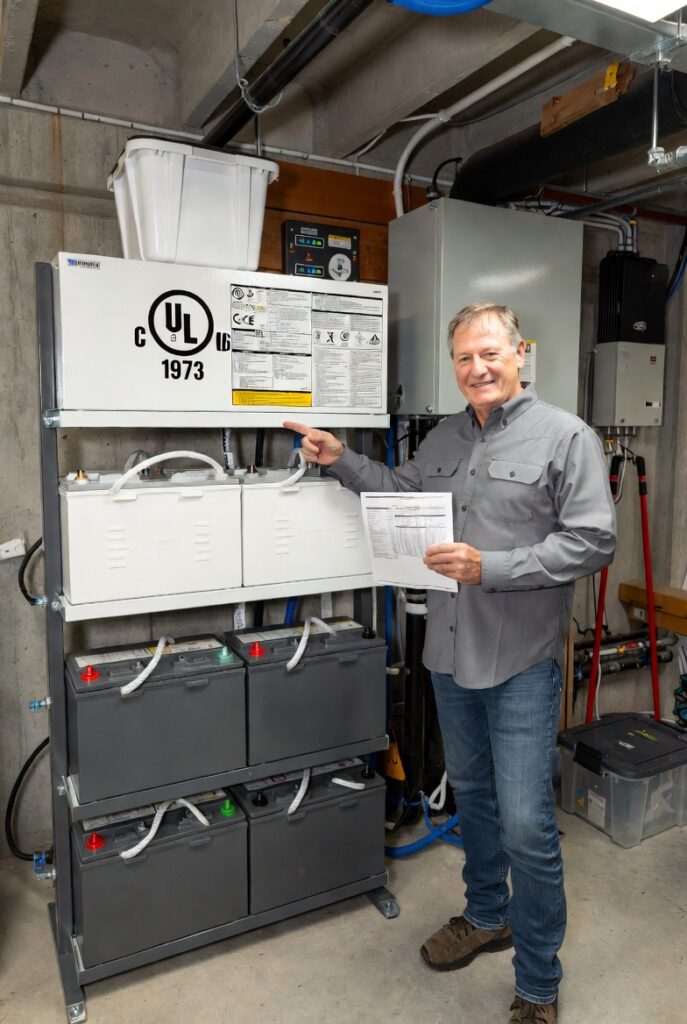
Lithium battery safety concerns are the most common reason Ontario off-grid owners delay a switch from lead acid, and most of those concerns apply to the wrong chemistry. A homeowner on Woolwich Street in Guelph, Wellington County had been planning an LFP battery installation for approximately 8 months. In February 2025 a video of a lithium e-scooter fire in a New York City apartment building circulated widely, and he called his installer to cancel the order.
The installer walked him through the critical chemistry distinction: NMC (nickel manganese cobalt oxide) has a thermal runaway onset temperature of approximately 150C and releases oxygen during a thermal event. LFP (lithium iron phosphate) has a thermal runaway onset temperature of approximately 270C and does not release oxygen.
He asked the installer whether there had been any documented LFP residential fires in Ontario from properly installed, BMS-protected systems. The installer cited zero documented cases from permitted residential LFP installations with functioning BMS protection in Ontario. Known LFP fire cases in North America involve NMC batteries incorrectly labelled as LFP, BMS failures from counterfeit cells, manufacturing defects in uncertified products, or physical damage to cells from impact or flooding. A correctly installed, UL 1973 certified LFP bank in an Ontario basement utility room does not share the risk profile of a lithium-ion e-scooter battery in a New York City apartment.
He reinstated the order and his system was installed in March 2025. The ESA inspector asked for the battery’s UL 1973 certification documentation and the system’s UL 9540 listing for the battery-inverter combination. The installer provided both from the Battle Born 100Ah LFP spec sheet and inverter documentation. The inspection passed on first review. The homeowner’s insurer requested the same certifications and added the system to the policy with no rate increase.
Lithium battery safety for LFP chemistry is an engineering question with a well-documented answer: the correct chemistry, correct BMS, correct certifications, and correct installation produce a system demonstrably safer than the lead acid bank it replaces. See our Ontario solar sizing guide before designing your system layout and enclosure.
Lithium battery safety chemistry: why LFP and NMC are not the same risk
NMC, nickel manganese cobalt oxide, is the chemistry used in EV batteries, power tools, and consumer electronics. Its thermal runaway onset temperature is approximately 150C. The NMC cathode contains nickel and manganese oxide, which releases oxygen when the cell temperature exceeds that threshold. Released oxygen accelerates combustion, makes the fire self-sustaining, and makes suppression extremely difficult, water reacts with the lithium compounds and CO2 is overwhelmed by the continuous oxygen supply. NMC heat of combustion at thermal runaway is approximately 250 to 300 Wh/kg. The viral fires in phones, e-scooters, and EV news coverage are NMC or related high-energy-density lithium chemistry, not LFP.
| Property | NMC (phones, EVs, tools) | LFP (off-grid solar) |
|---|---|---|
| Thermal runaway onset | ~150C | ~270C |
| Oxygen release during event | Yes, self-sustaining fire | No, containable fire |
| Heat of combustion | 250 to 300 Wh/kg | 100 to 150 Wh/kg |
| Fire suppression | Extremely difficult | Standard water or CO2 |
| UL 1973 residential certification | Not standard | Yes, quality brands |
| Ontario residential fire cases (permitted, BMS-protected) | N/A | Zero documented |
LFP cathode material is iron phosphate, a stable mineral compound that does not contain free oxygen. It does not release oxygen at any temperature within the cell’s physical destruction range. An LFP thermal event, if it occurs at all from a correctly installed and BMS-protected system, is a containable fire rather than a self-sustaining chemical combustion event. Heat of combustion at thermal runaway for LFP is approximately 100 to 150 Wh/kg, 40 to 50% less than NMC. The lithium battery safety distinction that matters for Ontario homeowners is not “lithium vs lead acid”, it is “LFP vs everything else in the lithium family.” See our indoor solar battery guide for how this chemistry distinction enables basement and utility room installations.
Thermal runaway: the 270C vs 150C difference that changes every decision
The 120C gap between LFP and NMC thermal runaway onset temperatures is not a marginal improvement, it is nearly double the threshold. A residential LFP battery in a well-ventilated Ontario utility room operating at normal load cycles will never approach 270C under any normal fault condition. The maximum operating temperature for a healthy LFP bank under load in Ontario conditions is approximately 35 to 45C, the BMS blocks charging above 45C as a protection measure. The gap between 45C operating ceiling and 270C thermal runaway onset is 225C of safety margin. For NMC at 150C onset, the equivalent margin from a 45C operating ceiling is only 105C.
The oxygen release difference is equally significant for lithium battery safety in a residential context. NMC releases oxygen from its cathode material when the thermal runaway threshold is crossed, creating a self-feeding fire that is extremely resistant to standard suppression. LFP does not release oxygen because iron phosphate is chemically stable, it does not decompose to produce oxygen at any temperature the cell can physically reach before structural failure. Ontario Building Code and Ontario Fire Code do not specifically mandate LFP over other lithium chemistries in residential applications, but the physics strongly favour LFP for any indoor installation. See our battery temperature performance guide for how enclosure temperature management keeps LFP well within its safety envelope.
BMS protection: the five layers between your cells and a safety event
The Battery Management System is the primary active lithium battery safety system, it operates continuously and cannot be bypassed in any quality certified LFP product. The five protection layers work simultaneously. Cell-level monitoring tracks the voltage, temperature, and current of each individual cell continuously. Low-voltage cutoff at 2.5V per cell disconnects all loads when any cell reaches depletion, preventing the over-discharge damage that weakens cell integrity. High-voltage cutoff at 3.65V per cell disconnects all charging when any cell reaches maximum voltage, this is the primary thermal runaway prevention mechanism, blocking the overcharge condition that initiates thermal events. Overcurrent protection disconnects at current limits and prevents short-circuit damage. Temperature protection blocks charging below 0C and above 45C.
A Victron SmartShunt with a temperature sensor logs the operating temperature continuously, providing forensic data if a safety event occurs and confirming normal operation within the BMS’s protection range. The BMS cannot protect against physical damage to the cell casing itself, flooding, crushing, or direct impact that breaches the cell structure bypasses the electrical protection circuit. Annual enclosure inspection for moisture intrusion and physical damage is the lithium battery safety maintenance task that backs up the BMS.
Any battery enclosure that has been submerged, struck, or exposed to sustained moisture requires professional assessment before being returned to service. The warning signs of a compromised LFP cell are heat above normal operating temperature and an abnormal odour, neither swelling nor puffing is a characteristic failure mode for quality certified LFP under normal operating conditions.
Lithium battery safety certifications: UL 1973, UL 9540, and Ontario insurance
UL 1973 is a battery system certification covering the cells, BMS, and assembly as a standalone unit for stationary energy storage applications. The certification reference number appears on the battery’s spec sheet or product documentation. ESA inspectors in Wellington and Halton County request this number to confirm the battery product is appropriate for a residential permitted installation. UL 9540 is a system-level certification covering the battery, inverter, and BMS as an integrated system tested together.
UL 9540A is the specific test method for evaluating thermal runaway fire propagation, referenced by building code authorities when assessing compliance with NFPA 855. CSA C22.2 No. 340 is the Canadian equivalent standard accepted by Ontario ESA as an alternative to UL 1973 for battery products.
A rental cottage owner on Guelph Line in Milton, Halton County installed a 200Ah LFP system in spring 2024 under an ESA permit. In fall 2024 her property insurer sent a questionnaire asking whether any lithium battery system was present indoors. Her 200Ah bank at 12V held 2.4kWh, under the 10kWh threshold, but was located in the cottage utility room. She located the UL 1973 certificate reference number on the battery spec sheet and the UL 9540 system listing from the inverter documentation.
She submitted both with a copy of the ESA inspection completion certificate. The insurer reviewed the submission within 2 weeks and confirmed the system met their documentation requirements with no policy amendment and no rate adjustment. The ESA permit was the enabling document, it gave the insurer independent verification that the installation had been inspected by a qualified authority. Without the permit, self-reported certification numbers carry no verification weight with most Ontario insurers. See our solar battery lifespan guide for how certification-quality LFP performs over the long term.
NEC and CEC: code requirements for LFP battery safety in Ontario installations
NEC 690 governs solar PV installations. NEC 690.71(A) requires that battery systems used in PV installations be listed or field-evaluated for the application, “listed” for residential applications means UL 1973 or equivalent independent certification. The AHJ may additionally require compliance with NFPA 855, the Standard for the Installation of Stationary Energy Storage Systems, which governs indoor placement distances, enclosure requirements, and fire protection for battery energy storage systems in residential buildings. NFPA 855 Table 4.1 specifies that indoor LFP installations in residential occupancies require specific clearances and may require smoke or heat detection in the battery room depending on system size. Contact the NFPA at nfpa.org for current NFPA 855 and NEC 690 requirements applicable to residential LFP installations.
CEC Section 64 governs battery installations in Ontario. Ontario ESA permits require that battery equipment meet a recognised certification standard, UL 1973, CSA C22.2 No. 340, or equivalent, and that the installation comply with the manufacturer’s specified requirements including enclosure, ventilation, and temperature range. The ESA inspection completion certificate documents that the installation was reviewed by a qualified inspector and that certified equipment was installed correctly. This certificate is the primary document Ontario insurers request to confirm a residential LFP installation meets professional standards. Contact the Electrical Safety Authority Ontario at esasafe.com before beginning any Ontario residential LFP battery installation to confirm current permit and certification requirements.
Pro Tip: The fastest way to confirm your battery qualifies for both ESA inspection and insurer documentation is to locate two numbers before purchasing: the UL 1973 certificate reference number in the battery’s technical documentation, and the UL 9540 or CSA C22.2 No. 340 system certification from the inverter or system documentation. If either number is absent from the product documentation, not just absent from the marketing page, but absent from the full technical specification package, the product has not completed the certification process that Ontario installers and insurers rely on. A legitimate certification number can be verified independently through UL’s product certification database. The Guelph Woolwich Street homeowner’s installer confirmed both numbers before ordering, which is why the ESA inspection and insurer review each took less than 2 weeks with zero follow-up questions. The certification check takes 5 minutes and eliminates the most common post-installation compliance complication.
The lithium battery safety verdict: three Ontario installation profiles
- Ontario off-grid owner who delayed LFP purchase due to lithium fire news coverage: the lithium battery safety distinction between LFP and NMC is the only fact needed to resolve the concern. LFP thermal runaway onset is 270C versus 150C for NMC. LFP does not release oxygen during a thermal event. Quality certified LFP systems with functioning BMS protection have produced zero documented residential fires in Ontario permitted installations. The fires in the news coverage, phones, e-scooters, EV incidents, are NMC chemistry. Calling them all “lithium fires” without the chemistry distinction is the source of the confusion. Purchase UL 1973 certified LFP from a quality manufacturer, obtain the ESA permit, and provide the certification references to your insurer before the first charge event. The Guelph Woolwich Street result confirms the process: ESA inspection passed first review, insurer added the system with no rate increase.
- Ontario cottage owner who received an insurance questionnaire about lithium storage: three documents answer every standard insurer question about residential LFP lithium battery safety. First: the UL 1973 certificate reference number from the battery spec sheet. Second: the UL 9540 system certification from the inverter documentation. Third: a copy of the ESA inspection completion certificate. The Milton Guelph Line result confirms the process, 2-week review, policy maintained, no rate change, no policy amendment required. The ESA permit is the most important of the three documents because it provides independent inspection verification. An insurer cannot accept self-reported certification numbers without the independent confirmation that the ESA inspection provides. If you do not have an ESA completion certificate, contact your original installer before responding to the questionnaire.
- Ontario off-grid owner planning a new LFP installation who wants to address lithium battery safety proactively: four steps at installation time prevent every known residential LFP safety complication. Specify UL 1973 or CSA C22.2 No. 340 certified LFP from a manufacturer with a documented safety and warranty record. Obtain the ESA permit before any installation work begins. Install a temperature sensor connected to the SmartShunt or monitoring system to log operating temperature continuously, this provides the forensic data an insurer or inspector may request after any fault event. Inspect the enclosure annually for moisture intrusion and physical damage as the active backup to the BMS electrical protection. These four steps address every known lithium battery safety risk category for residential LFP installations in Ontario and produce the documentation package that satisfies both the ESA inspector and the property insurer on first review.
Frequently Asked Questions
Q: Is LFP lithium the same fire risk as the lithium batteries in phone and e-scooter fires?
A: No. LFP chemistry is categorically different from the NMC and lithium cobalt oxide chemistries used in consumer electronics and most EV batteries. LFP has a thermal runaway onset temperature of approximately 270C versus approximately 150C for NMC, nearly double the threshold. More importantly, LFP does not release oxygen during a thermal event because iron phosphate is a stable mineral compound. NMC releases oxygen from its cathode material, which makes NMC fires self-sustaining and extremely difficult to suppress. An LFP thermal event from a correctly installed, BMS-protected system is a containable fire that responds to standard water or CO2 suppression. Quality certified LFP systems with functioning BMS protection have produced zero documented residential fires in Ontario permitted installations.
Q: What certifications do I need to show my insurer for a residential LFP battery installation in Ontario?
A: Three documents satisfy the documentation requirement for virtually every Ontario property insurer. First: the UL 1973 certificate reference number from your battery’s technical specification sheet or product documentation, this confirms the battery system was independently tested as a stationary storage product. Second: the UL 9540 system certification from your inverter documentation, this confirms the battery-inverter combination was tested as an integrated system. Third: a copy of your ESA inspection completion certificate, this confirms the installation was reviewed by a qualified Ontario electrical inspector.
The Milton Guelph Line cottage owner submitted all three and received insurer confirmation within 2 weeks with no rate adjustment. The ESA certificate is the most important of the three because it provides independent verification that the certified equipment was actually installed correctly.
Q: What are the warning signs that my LFP battery has a safety issue?
A: The two primary warning signs for a compromised LFP cell are heat above normal operating temperature and an abnormal odour. A healthy LFP battery in normal operation is warm to the touch during a high-current charge or discharge event but returns to ambient temperature within 30 to 60 minutes of load removal. A battery that remains noticeably warm with no load running, or that produces an unusual chemical or plastic odour that was not present during normal operation, requires immediate load disconnection and professional assessment.
Note that LFP cells do not swell or puff as a normal failure mode, swelling in LFP indicates either overcharge beyond BMS protection limits or a manufacturing defect in the cells, not normal aging. Any visible physical deformation of the battery casing requires professional assessment before the system is returned to service.
This build is engineered within the 48V DC Safety Ceiling. Diagnostic logic is based on 20+ years of technical service experience. All structural and electrical installations must be verified by a Licensed Professional and comply with your Local AHJ.
About the Author
Robert Bertrand spent 20 years as a service advisor in the automotive industry (Lexus and Nissan), where precision diagnostics, wiring integrity, and documentation standards were non-negotiable. He brings that same technical discipline to GridFree Guide, where he researches, tests, and documents off-grid solar systems for Ontario conditions. Based in Rockwood, Ontario, every article is built on verified specifications, manufacturer data, and the real-world climate constraints of Canadian off-grid living.
As an Amazon Associate I earn from qualifying purchases. This site also contains affiliate links to other products and services. GridFree Guide earns a small commission at no extra cost to you.