
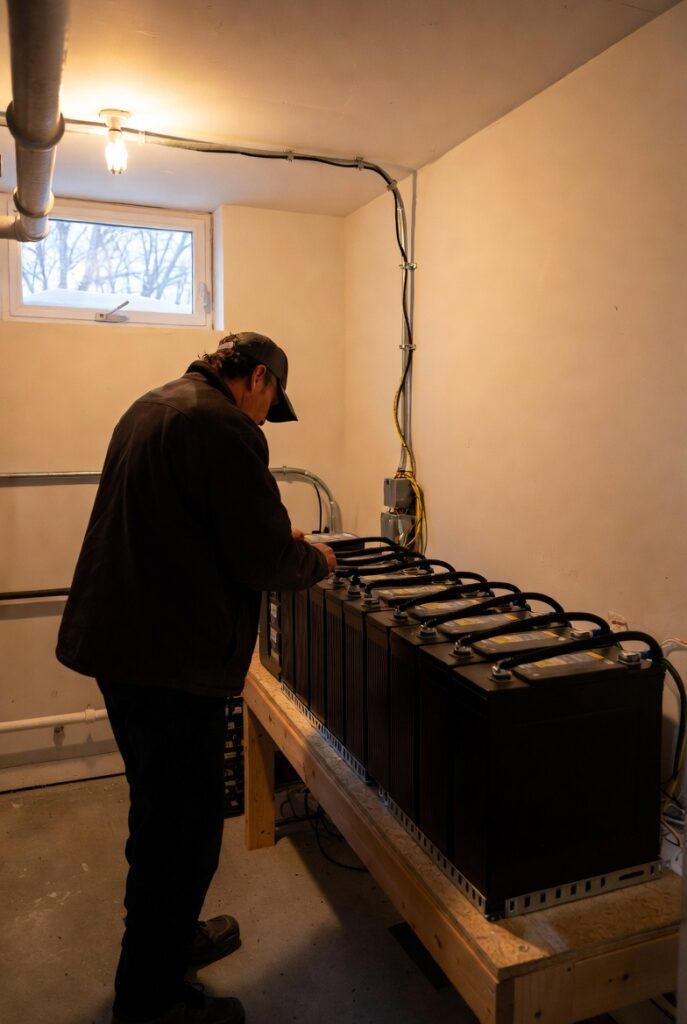
An indoor solar battery installation is not just permitted for LFP chemistry, in Ontario’s climate, it is often the single highest-impact improvement available to an existing off-grid system. A homeowner on Speedvale Avenue in Guelph had a 200Ah LFP battery bank in an uninsulated garden shed for two winters. Every November his system lost approximately 25 to 30% of effective capacity as the shed dropped to -8C overnight.
His Victron SmartShunt logs showed the battery averaging approximately 72Ah of usable capacity on January mornings instead of the rated 100Ah per unit. In March 2025 he relocated the bank to his basement utility room, running a 15-metre run of 2/0 AWG cable through conduit to the existing ground-mount array. The ESA permit cost approximately $150 and the cable and conduit materials cost approximately $280.
The temperature difference between the shed and the basement on a cold Ontario January night was approximately 22C. The shed reached -8C while the basement utility room held 14C. That 14C indoor temperature sits comfortably within the LFP optimal charging range of 0 to 45C, giving the BMS full charging permission from first light every morning. The outdoor shed at -8C was still above the 0C BMS charge cutoff, so the charging block was not the primary issue. It was the reduced charge acceptance rate and capacity in cold electrolyte that cost him the 25 to 30% seasonal loss. Moving to 14C indoors recovered that loss entirely.
The total cost of the indoor solar battery conversion was approximately $430 in materials and permit fees. Over two Ontario winters the shed battery had cost him approximately 600 kWh of lost effective capacity annually from cold performance reduction. At Ontario’s electricity rate that recovered capacity is worth approximately $78 per year. The payback on the conversion is approximately 5.5 years. The full benefit is not just energy recovery, the battery lifespan extension from operating at a consistent 14C instead of cycling between -8C and 30C seasonally adds years to the rated service life.
The indoor solar battery decision is as much a lifespan decision as an energy recovery decision. See our Ontario solar sizing guide for system design context before planning cable runs for an indoor relocation.
The indoor solar battery advantage: why Ontario basements outperform every shed
The typical year-round temperature in an Ontario basement or utility room ranges from 12 to 20C. In Guelph and Milton the average basement holds 14 to 18C year-round, exactly within the LFP charging sweet spot of 0 to 45C and the Arrhenius minimum-aging zone of 15 to 25C. An outdoor shed peaks at 45 to 65C in Ontario July, accelerating calendar aging at 4 to 16 times the rated rate, and drops to -8 to -15C in January, reducing capacity and charge acceptance. A basement holds 18 to 22C in summer and 12 to 16C in winter, full LFP capacity, full charge acceptance, and rated-pace aging throughout the year.
| Location | Summer peak | Winter low | Arrhenius aging rate | Winter capacity |
|---|---|---|---|---|
| Dark uninsulated shed | 55 to 65C | -8 to -15C | 8 to 16× rated | 65 to 80% of rated |
| Insulated shed (no vent) | 40 to 50C | -5 to -8C | 4 to 8× rated | 75 to 85% of rated |
| Insulated shed with fan | 30 to 38C | 0 to 5C | 1.5 to 2× rated | 85 to 100% of rated |
| Ontario basement/utility room | 18 to 22C | 12 to 16C | 1× rated (optimal) | 100% of rated |
The indoor solar battery delivers a dual benefit that no outdoor enclosure modification can fully replicate. At 14C the battery delivers full rated capacity and ages at the rated pace. At the summer extreme of an uninsulated dark shed at 55C the calendar aging rate is 8 times rated, consuming months of battery service life in a single Ontario heat week. Moving indoors removes both the winter capacity penalty and the summer aging acceleration simultaneously. See our battery temperature performance guide for the full Arrhenius calculation and outdoor enclosure modification options.
Lead acid off-gassing: the hydrogen risk that keeps batteries out of living spaces
Lead acid batteries produce hydrogen gas and oxygen gas as byproducts of electrolysis during charging. Hydrogen is explosive at 4% by volume in air, a concentration reachable in a poorly ventilated space during equalisation charging. AGM produces less gassing than flooded lead acid but still generates hydrogen near the end of the absorption phase. NEC 480 requires battery rooms with forced mechanical ventilation exhausting to the outdoors for any lead acid indoor installation. A utility closet without outdoor air exhaust is not code-compliant for lead acid chemistry regardless of how small the bank is.
A homeowner on Regional Road 25 in Milton, Halton County had a 400Ah flooded lead acid battery bank in an attached single-car garage. During an equalisation charge on a cold January 2024 afternoon with the garage door closed, his hydrogen sensor alarmed at 15% of the lower explosive limit, still safe, but a clear accumulation signal. The ESA confirmed that the installation required mechanical outdoor exhaust ventilation that had never been installed.
Rather than retrofit the ventilation duct, he replaced the bank with two 200Ah LFP units and relocated to an interior utility closet. The indoor solar battery installation required no ventilation ducting, passed ESA inspection on first review, and has operated for 14 months without a single alarm event. His garage space was recovered, the hydrogen risk was eliminated, and the LFP bank at 17C delivers full rated capacity year-round.
Indoor solar battery chemistry: why LFP goes inside and lead acid stays outside
LiFePO4 cells produce no hydrogen, oxygen, or flammable gas during normal charging. During abuse conditions beyond BMS protection, LFP generates minimal gas compared to NMC or cobalt lithium chemistries. LFP has the highest thermal runaway threshold of any lithium chemistry, it is the correct indoor solar battery choice for Ontario residential installations. NEC 690 and CEC Section 64 do not require outdoor-vented enclosures for LFP in normal residential fixed installations. Passive ventilation, a louvred door, an air gap at the top of the enclosure, or natural room air circulation, is sufficient for any Ontario LFP indoor installation.
The Ontario indoor location hierarchy from best to least preferred is as follows. A conditioned basement utility room at 14 to 18C year-round is the optimal choice, the thermal sweet spot requires no enclosure management. An interior utility closet at 15 to 20C with a louvred door for passive air circulation is an excellent alternative. An attached garage at 5 to 12C in Ontario winter is acceptable if the garage stays above 0C overnight, or if a heated LFP unit is specified for locations that drop below 0C. A detached uninsulated shed remains the lowest-performance location regardless of insulation modifications. See our LFP vs AGM chemistry guide for the full comparison of indoor suitability across battery types.
ESA permits and code compliance for Ontario indoor battery installations
Ontario requires an ESA permit for any new fixed electrical installation, including a battery bank relocation from outdoor to indoor. The permit is not chemistry-specific, LFP still requires a permit even though its safety profile is straightforward. The permit covers cable sizing, conduit routing, overcurrent protection, disconnect, and battery enclosure. Residential permit cost is approximately $100 to $200 in Ontario, with ESA inspection typically scheduled within 2 to 4 weeks of application. An unpermitted installation is an uninsured installation: if a fire occurs near an uninspected electrical system, the homeowner’s property insurance may deny the claim. The $150 permit is mandatory, not optional.
Cable run economics change significantly when relocating a battery indoors. A 15-metre one-way run on a 12V system at 100A peak current requires 2/0 AWG copper cable, approximately $300 in materials for the round trip. Moving the system to 24V halves the current and allows 2 AWG for the same run at approximately $120. Moving to 48V reduces current to one quarter and allows 6 AWG at approximately $50 in cable cost.
Many Ontario homeowners who relocate their battery indoors find the cable cost alone justifies upgrading from 12V to 24V or 48V at the same time. The ESA permit process covers whichever voltage the final installation uses. See our solar battery lifespan guide for how indoor temperature directly extends rated service life.
NEC and CEC: electrical code requirements for indoor battery rooms
NEC 690 governs solar PV installations. NEC 690.71 covers battery systems in PV installations including location and enclosure requirements. LFP battery systems do not require ventilated enclosures under NEC 690.71 for normal residential installation because LFP chemistry does not produce flammable gas during normal operation or under BMS-protected conditions. NEC 480 governs lead acid and vented battery systems separately, requiring mechanical ventilation and acid containment for indoor lead acid installations. Installing a lead acid battery in a location that satisfies NEC 690 but ignores NEC 480 does not produce a code-compliant installation. Contact the NFPA at nfpa.org for current NEC 480 and NEC 690 requirements applicable to indoor battery installations.
CEC Section 64 governs battery installations in Ontario. An indoor battery installation requires an ESA permit regardless of chemistry, the permit process covers the electrical installation, not the battery chemistry safety determination, which is the manufacturer’s responsibility. For lead acid chemistry, CEC Section 64 references CSA venting requirements and mandates mechanical outdoor exhaust ventilation for any enclosed space containing lead acid batteries on charge. For LFP chemistry, the CEC does not require outdoor exhaust ventilation when the battery is installed within the manufacturer’s specified temperature and ventilation conditions. Contact the Electrical Safety Authority Ontario at esasafe.com for current indoor battery installation permit requirements before beginning any Ontario indoor battery relocation.
Pro Tip: Before pulling a single cable for an indoor battery relocation, do the temperature verification first. Tape a $15 digital min-max thermometer inside your proposed indoor location and leave it for two full weeks spanning at least one cold night and one warm sunny day. Note the minimum and maximum temperatures logged. If the minimum is above 5C and the maximum is below 35C, the location is better than any outdoor enclosure in Ontario without modification. If the minimum drops below 0C, a cold attached garage in January, add the heated LFP to the specification before committing to the location. The two weeks of temperature data take all the guesswork out of the location decision and give you documentation for the ESA inspector showing the installation environment is within manufacturer specifications.
The indoor solar battery verdict: three Ontario installation profiles
- Ontario homeowner with LFP battery in an outdoor shed experiencing winter capacity loss: relocate to a basement utility room before next November. The Guelph Speedvale Avenue result is the proof case, 72Ah usable on cold January mornings became 97 to 100Ah after relocation to a 14C basement, a full 25 to 30% capacity recovery with zero new hardware. Budget $150 for the ESA permit, $280 for 2/0 AWG cable and conduit on a 15-metre run at 12V, and one weekend for the installation. The 5.5-year payback on recovered capacity understates the full return because the battery lifespan at consistent 14 to 18C extends materially beyond the outdoor cycling scenario. An indoor solar battery in an Ontario basement is the highest single-step performance improvement available to any existing system with a cold-exposed outdoor bank.
- Ontario homeowner with lead acid battery in a garage considering an indoor move: switch chemistry first, then move indoors. The Milton Regional Road 25 result confirms the sequence: the garage installation failed ESA review because the required outdoor mechanical ventilation was never installed, and retrofitting the duct was more expensive than replacing the bank. Switch to LFP, locate the new indoor solar battery in an interior utility space with passive ventilation only, and obtain the ESA permit for the new LFP installation. The chemistry switch eliminates the hydrogen ventilation requirement, reduces the permit complexity, and produces a battery that delivers full rated capacity at the interior closet’s 17C year-round temperature. Lead acid does not belong in an unventilated interior space under any circumstances.
- Ontario homeowner planning a new system with access to an interior utility space: locate the battery indoors from day one. An interior utility room at 15 to 18C eliminates the entire outdoor enclosure design problem, no insulation required, no thermostat fan, no seasonal capacity variation, and no heated LFP required for most Wellington and Halton County interior locations. Size the cable run correctly from the start, 24V or 48V system voltage makes long indoor cable runs economically practical, obtain the ESA permit before beginning installation, and operate the indoor solar battery in the thermal sweet spot for the full rated service life without any enclosure intervention required.
Frequently Asked Questions
Q: Can I install a LiFePO4 solar battery in my basement without special ventilation?
A: Yes. LFP chemistry produces no hydrogen, oxygen, or flammable gas during normal charging or under normal BMS-protected operating conditions. NEC 690 and CEC Section 64 do not require outdoor-vented enclosures for LFP in residential fixed installations. Passive ventilation, a louvred door, a vent opening, or natural air circulation in the room, is sufficient. This is the key chemical difference from lead acid, which requires mechanical outdoor exhaust ventilation under NEC 480 for any indoor installation. The indoor solar battery advantage of LFP is precisely this: the chemistry that is best for Ontario performance is also the chemistry that requires the least infrastructure to install safely indoors.
Q: Why can’t I just move my lead acid solar battery indoors to a utility closet?
A: Lead acid batteries produce hydrogen gas during charging, particularly during the equalisation and end-of-absorption phases, and hydrogen is explosive at 4% concentration in air. NEC 480 and the CEC both require mechanical ventilation exhausting to the outdoors for any indoor lead acid installation. A utility closet without outdoor air exhaust does not satisfy this requirement regardless of how small the battery bank is. The Milton Regional Road 25 result shows what happens when this requirement is overlooked: even a properly permitted garage installation failed ESA review because the required ventilation duct was never installed. The code-compliant solution for an interior utility closet installation is switching to LFP chemistry, which eliminates the hydrogen ventilation requirement entirely.
Q: Do I need an ESA permit to move my solar battery from an outdoor shed to my basement in Ontario?
A: Yes, always. A battery bank relocation from outdoor to indoor constitutes a new fixed electrical installation at the new location and requires an ESA permit in Ontario regardless of battery chemistry. The permit covers cable sizing, conduit routing, overcurrent protection, and the battery disconnect, not the battery chemistry safety determination, which is the manufacturer’s responsibility. Permit cost for a residential battery installation in Ontario is approximately $100 to $200, with inspection typically scheduled within 2 to 4 weeks.
An unpermitted installation is an uninsured installation: homeowner’s property insurance may deny a fire claim if an uninspected electrical system is found in proximity to the origin. The permit is not optional and is not a significant cost relative to the total installation.
This build is engineered within the 48V DC Safety Ceiling. Diagnostic logic is based on 20+ years of technical service experience. All structural and electrical installations must be verified by a Licensed Professional and comply with your Local AHJ.
About the Author
Robert Bertrand spent 20 years as a service advisor in the automotive industry (Lexus and Nissan), where precision diagnostics, wiring integrity, and documentation standards were non-negotiable. He brings that same technical discipline to GridFree Guide, where he researches, tests, and documents off-grid solar systems for Ontario conditions. Based in Rockwood, Ontario, every article is built on verified specifications, manufacturer data, and the real-world climate constraints of Canadian off-grid living.
As an Amazon Associate I earn from qualifying purchases. This site also contains affiliate links to other products and services. GridFree Guide earns a small commission at no extra cost to you.