
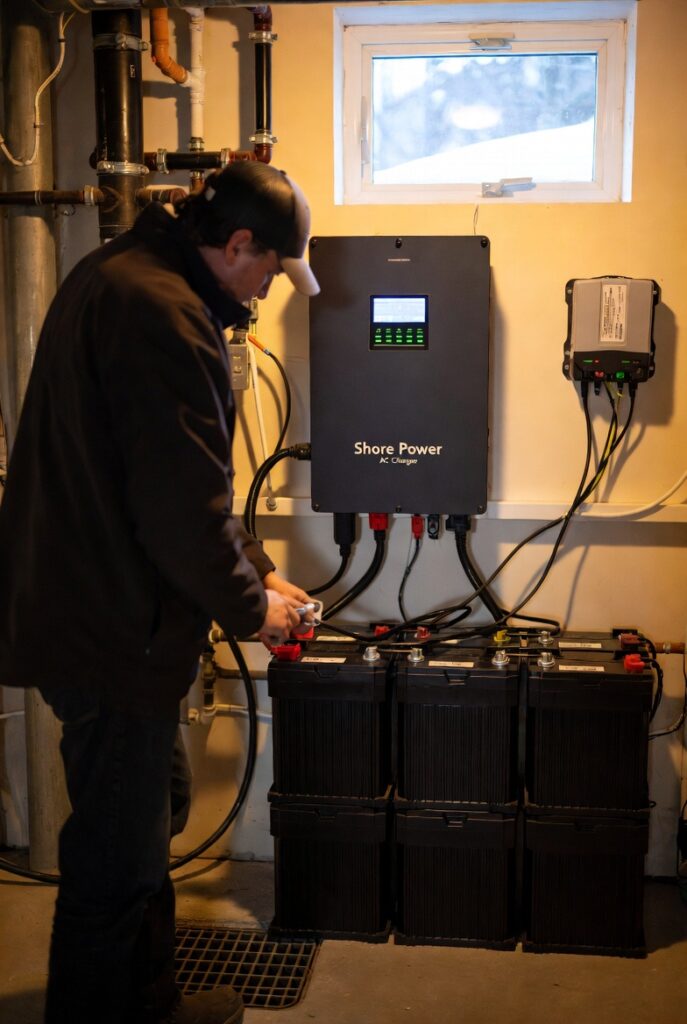
The ability to charge solar battery banks without relying on the panels is not optional for serious Ontario off-grid owners, it is the difference between a functional fortress and a fair-weather hobby. A homeowner on Edinburgh Road South in Guelph, Wellington County hit a 3-day November gray streak in 2024 with a 200Ah LFP bank. His array produced approximately 150 to 200Wh per day during the overcast period, roughly 12 to 16% of his 1,200Wh daily load. By the end of day two his Victron SmartShunt showed 23% state of charge and falling.
He had not installed any backup charging method at that point. His Battle Born heated LFP was already drawing approximately 3 to 5% of its stored charge per day to maintain the internal heater at -3C overnight, a load that added urgency to the discharge rate. He plugged a 20A AC-to-DC shore power charger into his utility room wall outlet and began a bulk charge at 14.4V. Four hours later the bank was at 87% state of charge and the system held stable through the rest of the gray streak.
He now keeps a 20A AC charger permanently connected through a manual bypass switch on his battery enclosure. The charger cost approximately $85 and the bypass switch and wiring approximately $45. He has used the shore power backup on 6 separate occasions in the 14 months since installation, preventing a BMS cutoff on each occasion that would have meant no heat, no Starlink, and no sump pump protection.
The total cost to charge solar battery banks from the grid during those 6 events was approximately $4.20 in electricity. Understanding how to charge solar battery banks without relying on panels is the planning step that separates a prepared Ontario off-grid owner from one who is simply hoping for sun. See our Ontario solar sizing guide before calculating your backup charging trigger threshold.
The charge solar battery trigger: Ontario gray streak math and the 40% threshold
Wellington County averages approximately 8 to 12 consecutive days of sub-optimal solar production per winter month from November through February. During that period average daily peak sun hours sit at 1.0 to 1.5 PSH under diffuse overcast conditions. A 1,200W array at 1.2 PSH produces approximately 1,440Wh per day. Against a typical Ontario off-grid daily load of 1,200 to 1,500Wh, the battery is neutral at best and draining at worst. A 3-day gray event producing only 200Wh per day against a 1,200Wh daily load creates a 3,000Wh deficit, more than the 1,920Wh of usable capacity in a 200Ah LFP bank. Without a charge solar battery backup plan, BMS cutoff is guaranteed during any Ontario winter gray stretch beyond 2 days.
The 40% state-of-charge threshold is the correct trigger point. At 40% SoC on a 200Ah LFP bank, approximately 768Wh of usable energy remains, roughly 15 hours of a 50W Starlink load. That margin is enough to set up a generator, wait for a shore power charger to cycle, or plan a vehicle drive to trigger alternator charging. Waiting until 20% SoC leaves approximately 8 hours of reserve and no margin for next-day setup time.
The correct practice is to check the SmartShunt SoC every morning during forecast gray periods longer than 2 days and initiate backup charging at 40% before the situation becomes urgent. See our battery voltage diagnostic guide for how to read accurate SoC from a SmartShunt rather than relying on battery voltage alone.
Shore power: the fastest and cheapest backup charging method for Ontario homes
Shore power AC-to-DC charging is the correct first choice for any Ontario off-grid property with a grid connection. A 20A charger running at 14.4V bulk charges the battery at approximately 288W. A 200Ah LFP bank from 20% to 90% state of charge requires approximately 140Ah of input at 20A, approximately 7 hours of charging time. The electricity cost for that full bulk charge event is approximately $0.13 per kWh multiplied by 0.288 kW multiplied by 7 hours, equalling approximately $0.26. The entire shore power backup installation, 20A AC charger with LFP profile, bypass switch, and wiring, costs approximately $130.
| Backup method | Equipment cost | Cost per charge event | Time to 90% SoC (200Ah) | Grid connection required |
|---|---|---|---|---|
| Shore power (20A charger) | ~$130 | ~$0.26 | ~7 hours | Yes |
| Shore power (30A charger) | ~$175 | ~$0.39 | ~4.7 hours | Yes |
| Generator (Honda EU2200i + 30A charger) | ~$1,200 | ~$3.48 in fuel | ~4.7 hours | No |
| Alternator (Victron Orion-Tr Smart) | ~$250 | Fuel + wear | ~3 hrs driving | No |
LFP profile settings are the critical setup step that most Ontario owners miss. Set bulk voltage to 14.4V, absorption voltage to 14.4V, absorption duration to 25 minutes, float voltage to 13.6V, and disable temperature compensation entirely. The factory AGM default on most chargers transitions out of absorption at approximately 80% SoC and applies an AGM float voltage of 13.8V. An LFP bank on an AGM profile will sit at 80% state of charge after a full charge event regardless of how long the charger runs.
The profile switch from AGM to lithium is the single most impactful charge solar battery setup step available at zero cost. See our solar battery lifespan guide for how incorrect charge profiles compound cycle damage over time.
How to charge solar battery banks from a generator: the LFP profile that matters
A rural resident on Britannia Road in Milton, Halton County used a standard 3,500W contractor generator during an ice storm in January 2025. His 20A charger was set to the factory AGM default. After 6 hours of generator run time the bank reached only 78% state of charge. The root cause was two compounding errors: the AGM profile terminated absorption early and transitioned to 13.8V AGM float, and the contractor generator’s unfiltered AC output, total harmonic distortion above 10%, caused the charger to reduce its output current to protect its rectifier circuits. Six hours of fuel produced a system still 22% short of full.
In spring 2025 he replaced the contractor generator with a Honda EU2200i and switched the charger to the lithium profile, 14.4V bulk, 14.4V absorption for 25 minutes, 13.6V float. His next generator charge solar battery event ran 3.5 hours and reached 97% SoC on the same 200Ah LFP bank. The EU2200i’s inverter generator output produces clean sine wave AC with total harmonic distortion below 3%, allowing the charger to operate at its rated 20A throughout the bulk phase.
At 50% load on the EU2200i, approximately 900W, fuel consumption is approximately 0.5L per hour. A full 200Ah LFP backup from 20% to 90% on a 30A charger takes approximately 4.7 hours and consumes approximately 2.4L of fuel at approximately $1.45 per litre in Ontario. Shut the generator off at 90 to 95% SoC and do not run it at float, extended float on a running generator wastes fuel with no additional state-of-charge gain. See our battery temperature performance guide for cold-weather generator charging considerations when the battery is below 5C.
Alternator charging: the Victron Orion-Tr Smart mobile method
Direct alternator-to-LFP wiring via jumper cables or fixed wire is not an appropriate method to charge solar battery banks from a vehicle. An LFP battery below 80% state of charge draws maximum current from the alternator during the bulk phase, a 200Ah bank at 20% SoC will demand every amp the alternator can produce. Vehicle alternators are rated for their current output with a duty cycle, sustained maximum-current draw at low engine RPM exceeds the duty cycle and causes premature alternator failure. The Victron Orion-Tr Smart 12/12-30A limits the current draw to exactly 30A regardless of battery SoC, protecting the vehicle alternator throughout the bulk charge phase.
At 30A output the Orion-Tr Smart delivers 432W to the battery. A 90-minute drive to town and back, approximately 3 hours of engine time, delivers approximately 90Ah to the bank, recovering approximately 45% SoC on a 200Ah LFP system. Configuration is straightforward: set the input voltage threshold to 13.2V so the device only activates when the alternator is running rather than drawing from the vehicle starter battery, set the output to 14.4V bulk with 13.6V float, and enable engine detection if the vehicle supports it. The Orion-Tr Smart is the correct and only safe method to charge solar battery banks from a vehicle alternator in Ontario off-grid applications. Any other approach risks the alternator, the LFP cells, or both.
NEC and CEC: code compliance for backup charging installations in Ontario
NEC 690 governs solar PV installations. A shore power AC-to-DC charger permanently wired into the battery system is part of the battery charging circuit and falls under NEC 690’s scope for overcurrent protection and wiring requirements. NEC 690.71 requires that the battery system include a means to disconnect charging sources, the manual bypass switch on the shore power charger circuit satisfies this requirement. The shore power charger’s AC input wiring must comply with NEC 210 for branch circuit requirements and be protected by a circuit breaker sized for the charger’s maximum current draw.
A 20A charger at 120V requires a dedicated 20A branch circuit with a 20A breaker. Contact the NFPA at nfpa.org for current NEC 690 and NEC 210 requirements for battery backup charging circuit installations.
CEC Section 64 governs battery installations in Ontario. A permanently wired shore power charger added to an existing permitted battery bank constitutes a modification to the electrical system and requires the permit holder to confirm whether a permit amendment is needed. In most cases, adding a permanently wired AC-to-DC charger changes the charging circuit configuration and requires an ESA permit amendment documenting the charger specifications, circuit breaker sizing, and disconnect provision. A portable charger plugged into an existing outlet does not require a permit amendment, only permanent wiring triggers the amendment requirement. Contact the Electrical Safety Authority Ontario at esasafe.com before permanently wiring any backup charging source into a previously permitted Ontario battery installation.
Pro Tip: The fastest way to confirm your charger is actually running the LFP profile and not the factory AGM default is to watch the SmartShunt current reading during the first 30 minutes of a charge event. On the AGM profile, the charger will start reducing current before the bank reaches 90% SoC as it transitions to the early absorption termination point. On the correct LFP profile, the charger maintains full current output through the bulk phase until the bank reaches approximately 95 to 97% SoC, then holds absorption voltage for the specified 25-minute timer before transitioning to float. If you see the current dropping before 90% SoC on the SmartShunt display, the charger is still on the AGM profile regardless of what the charger’s indicator light suggests. The Milton Britannia Road homeowner ran 6 hours of generator fuel before discovering this. A 5-minute SmartShunt check at the start of the next charge event would have caught it in the first 30 minutes.
The charge solar battery verdict: three Ontario backup methods ranked
- Ontario off-grid owner with grid access: install a shore power AC-to-DC charger as the primary backup method and configure it to the LFP profile before the first gray streak. The Guelph Edinburgh Road result is the proof case, $130 installed, $0.26 per charge event, 6 BMS cutoff events prevented over 14 months. Set bulk to 14.4V, absorption to 14.4V for 25 minutes, float to 13.6V, temperature compensation disabled. Connect through a manual bypass switch. Check the SmartShunt SoC every morning during forecast gray periods and activate at 40% SoC, not 20%. The 40% trigger leaves enough reserve to complete a full charge event before the battery reaches critical depletion. Shore power is the fastest, cheapest, and most reliable method to charge solar battery banks in Ontario when the grid is accessible.
- Ontario off-grid owner without grid access: specify an inverter generator and switch the charger to the LFP profile before the first backup event of the season. The Milton Britannia Road result confirms the profile error cost: contractor generator on AGM default, 6 hours, 78% SoC. Honda EU2200i on lithium profile, 3.5 hours, 97% SoC. Both compounding errors, generator harmonic distortion and wrong charger profile, are fixable before the next ice storm. Specify a Honda EU2200i or equivalent inverter generator for clean sine wave output, switch the charger profile to lithium, and run to 90 to 95% SoC then shut off immediately. Extended float on a running generator wastes fuel with no measurable SoC gain. Keep 10 litres of fuel stabilised in a jerry can rated for Ontario temperatures before November.
- Ontario off-grid owner who travels to remote installations with a vehicle: install a Victron Orion-Tr Smart 12/12-30A and configure it before the first winter trip. Three hours of engine time delivers approximately 90Ah to a 200Ah LFP bank, a 45% SoC recovery with no additional fuel cost beyond the trip already being made. Set the input voltage threshold to 13.2V to protect the vehicle starter battery, output to 14.4V bulk with 13.6V float, and enable engine detection. The Orion-Tr Smart is the only correct method to charge solar battery banks from a vehicle alternator. Direct wiring draws uncontrolled current that risks permanent alternator failure. For installations too remote for generator noise restrictions or shore power access, the vehicle alternator method with the Orion-Tr Smart is the practical Ontario backup solution.
Frequently Asked Questions
Q: Can I charge my LFP solar battery from a wall outlet during an Ontario gray streak?
A: Yes, using a dedicated AC-to-DC shore power charger set to the LFP profile, not the AGM default. A 20A charger brings a 200Ah LFP bank from 20% to 90% state of charge in approximately 7 hours at a cost of approximately $0.26 in electricity. The complete installation including bypass switch costs approximately $130. This is the fastest and cheapest method to charge solar battery banks in Ontario for any property with a grid connection. Set bulk to 14.4V, absorption to 14.4V for 25 minutes, float to 13.6V, and disable temperature compensation. The profile configuration is more important than the charger brand, a $85 charger on the correct LFP profile outperforms a $300 charger left on the factory AGM default.
Q: Why does my generator only charge my LFP battery to 80% no matter how long I run it?
A: The charger is set to the AGM profile. AGM absorption terminates at approximately 80% state of charge and transitions to an AGM float voltage of 13.8V, a voltage that does not fully charge LFP cells. Running the generator longer does not fix the problem because the charger has already left the bulk phase and is sitting at float. The fix is changing the charger profile to lithium: bulk 14.4V, absorption 14.4V for 25 minutes, float 13.6V.
If the generator itself is also a non-inverter contractor type with high harmonic distortion, the charger may additionally be reducing its output current to protect its rectifier circuits. A Honda EU2200i or equivalent inverter generator eliminates this second problem. The combination of the correct generator and the correct profile is what produced 97% SoC in 3.5 hours for the Milton Britannia Road homeowner versus 78% SoC in 6 hours on the wrong setup.
Q: Can I charge my solar battery from my truck or SUV while driving?
A: Yes, using a Victron Orion-Tr Smart 12/12-30A. Direct wiring from the alternator to the LFP battery without the Orion-Tr Smart is not appropriate, an LFP battery at low state of charge draws maximum current from the alternator at sustained levels that exceed its duty cycle and cause premature alternator failure. The Orion-Tr Smart limits current draw to exactly 30A, protecting the alternator throughout the bulk charge phase.
A 3-hour round trip delivers approximately 90Ah to a 200Ah bank, recovering approximately 45% SoC. Configure the input voltage threshold at 13.2V to prevent discharge of the vehicle starter battery when the engine is off. The Orion-Tr Smart is the only method to charge solar battery banks safely from a vehicle alternator in Ontario off-grid applications.
This build is engineered within the 48V DC Safety Ceiling. Diagnostic logic is based on 20+ years of technical service experience. All structural and electrical installations must be verified by a Licensed Professional and comply with your Local AHJ.
About the Author
Robert Bertrand spent 20 years as a service advisor in the automotive industry (Lexus and Nissan), where precision diagnostics, wiring integrity, and documentation standards were non-negotiable. He brings that same technical discipline to GridFree Guide, where he researches, tests, and documents off-grid solar systems for Ontario conditions. Based in Rockwood, Ontario, every article is built on verified specifications, manufacturer data, and the real-world climate constraints of Canadian off-grid living.
As an Amazon Associate I earn from qualifying purchases. This site also contains affiliate links to other products and services. GridFree Guide earns a small commission at no extra cost to you.