
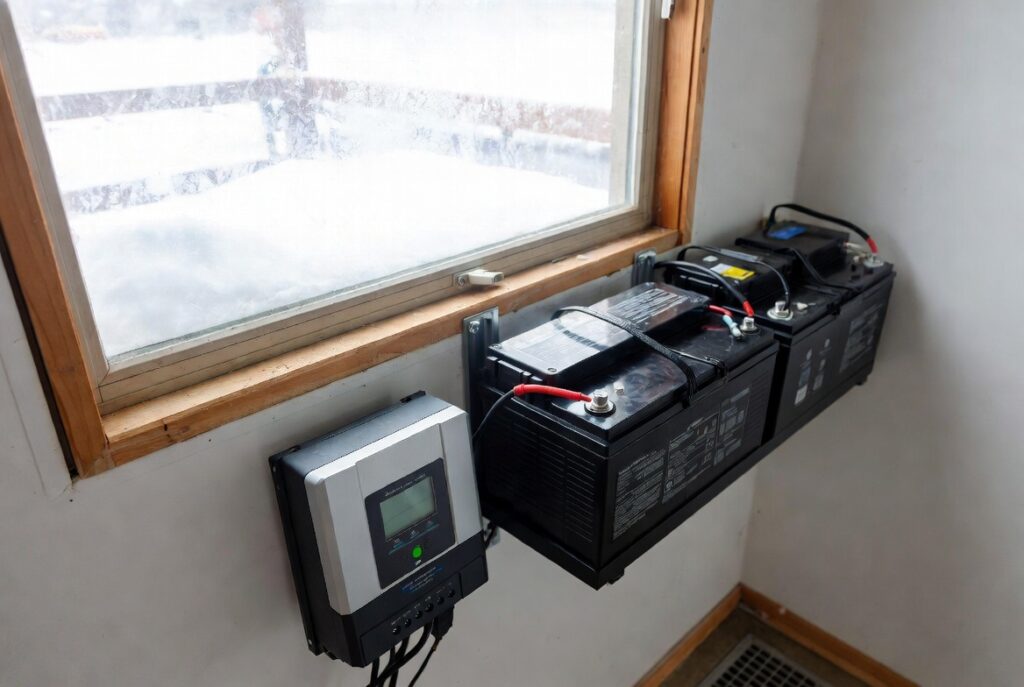
The most common cold weather solar failure in Ontario is not the panels, it is the battery, specifically the LFP BMS blocking all charging current the moment cell temperature drops below 0°C, and a property owner on Eramosa Road in Guelph, Wellington County discovered this in November 2023 when his Victron SmartShunt showed zero charging current on a clear January morning despite his 400W mono PERC array producing 510Wh of available energy, because his standard LFP bank was sitting at -6°C in his unheated utility room and his BMS had locked out charging completely.
He had installed a correctly specified Tier 2 cold weather solar system: 400W mono PERC array, 200Ah standard LFP bank, Victron MPPT 100/30, and a 2,000W PSW inverter. His SmartShunt history showed zero amps of charging current from November 14th through February 4th, 82 consecutive days. The array was producing current every clear day; the BMS was rejecting every ampere.
His battery bank had been sitting at between -4°C and -8°C in his unheated utility room since mid-November. The SmartShunt recorded the array voltage correctly throughout, the panels were working, the MPPT was working, and the charge controller was working. The BMS was blocking every ampere before it could reach the battery cells. Without the SmartShunt he would have suspected a failed panel or a wiring fault. With the SmartShunt the diagnosis was immediate: correct array voltage, zero battery amps, confirmed BMS cold lockout at -6°C cell temperature.
I reviewed his SmartShunt history remotely in early February 2024. The fix required one change: replace the 200Ah standard LFP with a 200Ah Battle Born heated LFP. The self-heating circuit in the Battle Born heated LFP activates at 2°C, below the standard BMS lockout threshold but above the temperature at which lithium plating damage occurs. The heated bank charged normally through every clear Ontario January day, confirming 510Wh of daily input on the first full clear day after installation. See our Ontario solar sizing guide before specifying any cold weather solar system.
The cold weather solar failure point: why the BMS locks out charging before the panels fail
| Temperature | Standard LFP charging | Battle Born heated LFP | Discharge capacity |
|---|---|---|---|
| 25°C (STC) | ✓ Full charge accepted | ✓ Full charge accepted | 100% |
| 0°C | ✗ BMS blocks all charging | ✓ Self-heats to 2°C, charges | 70 to 80% |
| -10°C | ✗ BMS blocks all charging | ✓ Self-heats to 2°C, charges | 50 to 60% |
| -22°C (Ontario design) | ✗ BMS blocks all charging | ✓ Self-heats to 2°C, charges | 30 to 40% |
The battery management system in LFP batteries blocks all charging current when cell temperature drops below 0°C to prevent lithium plating, a phenomenon where charging current deposits lithium on the anode surface rather than integrating into the electrode structure. Below 0°C, lithium ion mobility drops so severely that this risk becomes critical. The BMS cold lockout is not a failure, it is correct protective behaviour. The failure is specifying standard LFP in environments that drop below 0°C, like Wellington County unheated utility rooms and garages that reach -10°C to -20°C by January.
Wellington County unheated utility rooms and garages drop to -4°C to -8°C by mid-November and -10°C to -20°C by January. A standard LFP cold weather solar system in Wellington County refuses all charging for approximately 120 days per year, November 15 through March 15. The Victron SmartShunt reveals this immediately. Without the SmartShunt, the owner sees zero production and suspects the panels or charge controller. With the SmartShunt, the history shows zero amps on the battery side while the array voltage is correct, confirming the BMS is blocking, not the array. The Eramosa Road SmartShunt showed 82 identical readings: correct array voltage, zero battery amps. See our solar battery ontario guide for the full Ontario LFP cold temperature specification.
The Ontario LFP temperature profile: what -22°C does to charging capacity and why the BMS is protecting you
The 82-day cold weather solar lockout on the Eramosa Road system represented a real production loss. The array averaged approximately 300Wh per day over the 82-day period (accounting for the cloud mix of Ontario November through February). Total available solar energy rejected by the BMS: approximately 24,600Wh over 82 days. For a grid-connected property, this meant 82 days of unnecessary grid draw during peak heating season. For an off-grid property in the same situation, those 82 days would have required full generator backup, the cold weather solar system would have contributed nothing to the energy budget from mid-November through early February.
The capacity reduction numbers in the table above apply to discharge performance, the battery can still power loads at temperatures above -20°C, just with reduced capacity. The BMS charging lockout is a separate issue from capacity reduction: a standard LFP bank stored at -6°C cannot accept charging current at all, regardless of available solar input or remaining capacity. A property owner who checks the battery display and sees 60% SoC may assume the cold weather solar system is functional, but if the cell temperature is below 0°C, that 60% will drain through load use without being replenished until the cells warm above the charge threshold. The SmartShunt charging amps reading is the only reliable cold weather solar diagnostic.
Pro Tip: Before winter, check where your battery bank’s coldest point will be on a -22°C Ontario January night. If it is in an unheated utility room, attached garage, or outbuilding, the cell temperature will drop below 0°C and your standard LFP BMS will lock out charging. The test is simple: check the SmartShunt charging amps on the first clear morning after a cold night. If the array voltage is correct and the charging amps are zero, the BMS is locked. If you see this in December, you have until March before the bank warms enough to resume charging, approximately 90 to 120 days of cold weather solar production lost. The fix is the Battle Born heated LFP before next winter, not after.
The Battle Born heated LFP standard: self-heating at 2°C and 82 days of recovered charging
The Battle Born heated LFP self-heating circuit activates at 2°C, below the standard BMS charge lockout threshold but above the temperature at which lithium plating begins. The heating circuit draws minimal power from the existing battery charge to warm the cells before allowing charging current to flow. A Battle Born heated LFP installed in the same -6°C utility room on Eramosa Road will self-heat to above 2°C, accept full charging current from the array, and confirm input on the SmartShunt, without any external heating equipment or behaviour change from the property owner. The self-heating energy cost is minimal compared to the 510Wh available from a clear January day.
A property owner in Elora, Centre Wellington specified the Battle Born heated LFP from day one, knowing the unheated equipment room would drop below 0°C by November. His SmartShunt confirmed 510Wh input on the first clear January day. His neighbour built the same system with standard LFP: the SmartShunt showed zero amps for 73 consecutive days starting November 17th. Same array. Same charge controller. Same clear January days.
His comment: “I paid $200 more for the heated bank. My neighbour paid nothing extra and got 73 days of no charging. I think I made the right call.” For existing standard LFP installations, the options are: replace with Battle Born heated LFP (permanent fix), add an insulated enclosure (slows the temperature drop, does not prevent sub-zero in deep winter), add an electric heating blanket (draws 20 to 40W continuously, consuming most of the 510Wh January daily production), or store portably indoors (only viable for portable units). See our off grid setup guide for the complete Ontario Tier 2 battery specification.
The cold weather solar panel surprise: why Voc rises 17% at -22°C and what that means for your MPPT
Cold weather solar panels perform better in cold, not worse. The temperature coefficient of power for mono PERC panels is approximately -0.36% to -0.40%/°C below STC (25°C). At Ontario’s -22°C design temperature: 47°C below STC × 0.36%/°C = approximately 17% increase in Voc. The Renogy 100W panel’s nameplate Voc is 22.5V at 25°C. At -22°C: 22.5V × 1.17 = approximately 26.3V. In a 2S configuration: 26.3V × 2 = 52.6V, safely within the Victron MPPT 100/30‘s 100V input limit. The cold weather solar production advantage is real, panels produce at or near rated output on clear cold January days in Ontario.
The cold Voc calculation is mandatory before wiring any cold weather solar array. In a 4S configuration at -22°C: 26.3V × 4 = 105.2V, exceeding the MPPT 100/30’s 100V input limit and potentially damaging the controller permanently on the first cold clear morning. The maximum safe series configuration for the Renogy 100W with the MPPT 100/30 is 3S (78.9V at -22°C, within the 100V limit with margin). Most Ontario Tier 2 cold weather solar systems use 2S for maximum safety margin. The correct calculation must use the panel’s actual datasheet Voc, not a rounded figure. See our solar panels ontario guide for the complete cold Voc calculation sequence.
NEC and CEC: Ontario permit requirements for permanent battery installations
NEC 690 governs permanent cold weather solar installations in Ontario. Battery bank wiring must be sized for 125% of maximum continuous current, protected with Class T fusing at the battery positive terminal, and installed with appropriate overcurrent protection throughout the DC circuit. Any permanently installed cold weather solar battery bank in an Ontario utility room or outbuilding requires CEC-compliant wiring regardless of the insulation or heating configuration applied to the battery enclosure. The insulation and heating strategy for the battery does not change the electrical permit requirement for the wiring. Contact the NFPA at nfpa.org for current NEC 690 requirements for battery bank installations in residential applications.
CEC Section 64 governs electrical installations in Ontario. Any permanently wired cold weather solar battery bank, including the battery enclosure wiring, the DC disconnect, and the inverter connections, requires an ESA permit at $300 to $400 before installation begins. An insulated battery enclosure does not change the ESA permit requirement for the wiring. A cold weather solar battery bank installed in a utility room without an ESA permit invalidates the property insurance coverage for the electrical installation. Contact the Electrical Safety Authority Ontario at esasafe.com before beginning any permanent cold weather solar battery bank installation in Ontario.
The cold weather solar verdict: heated LFP for permanent systems, indoor storage for portable units
- Ontario property owner whose standard LFP system shows zero solar input from November through March: the cause is BMS cold lockout, confirm it with the SmartShunt before replacing any other component. Check the SmartShunt charging amps on a clear morning. If array voltage is correct and charging amps are zero, the BMS is locked. The fix is the Battle Born heated LFP, self-heating circuit activates at 2°C, accepts full charging current from the array through any Ontario winter without any external heating equipment. The Eramosa Road result: 82 days of zero cold weather solar input eliminated on first installation. Install the Victron SmartShunt to confirm 510Wh input on the first clear day after the replacement.
- Ontario property owner specifying a new Tier 2 cold weather solar system: specify Battle Born heated LFP from day one, wire in 2S for cold Voc safety, and verify on commissioning day. Install the Victron MPPT 100/30 and wire the Renogy 100W array in 2S configuration, 52.6V at -22°C, within the 100V controller limit with comfortable margin. Confirm SmartShunt shows 510Wh input on first clear January day. The Elora result: heated LFP accepts full solar input all winter, 73 days of neighbour’s standard LFP charging loss avoided for $200 upfront difference.
- Ontario property owner with a portable solar power bank or portable generator as the cold weather solar backup unit: store the unit in the heated living space from October through April. The BMS cold lockout applies equally to EcoFlow, Bluetti, and Jackery portable LFP units, they refuse all charging at 0°C in an unheated garage just as a permanently installed bank does. Indoor storage eliminates the problem at zero cost. A unit charged to 100% in October and stored in a heated living space with wifi standby disabled loses approximately 1 to 2% per month through natural self-discharge, arriving at any February outage above 85% SoC without any intervention after October.
Frequently Asked Questions
Q: Why does my solar battery stop charging in Ontario winter?
A: The LFP BMS blocks all charging current when cell temperature drops below 0°C to prevent lithium plating damage, permanent capacity loss caused by charging current depositing lithium on the anode rather than integrating into the electrode. In Wellington County, unheated utility rooms and garages drop below 0°C by mid-November and stay below 0°C until mid-March, approximately 120 days of zero cold weather solar charging per year.
The SmartShunt confirms the diagnosis: correct array voltage on the input side, zero amps on the battery side. The fix is the Battle Born heated LFP (self-heating circuit activates at 2°C) for permanent installations, or indoor storage for portable units. Do not replace panels, charge controller, or wiring before checking the SmartShunt charging amps on a cold morning.
Q: Do solar panels work better or worse in cold weather?
A: Better. Mono PERC panels produce higher Voc in cold because lower temperatures reduce resistance within the cells. At Ontario’s -22°C design temperature, a Renogy 100W panel produces approximately 26.3V Voc versus 22.5V at STC, a 17% increase. Clear cold January days in Ontario produce close to rated wattage from a correctly wired array. The cold weather solar challenge is entirely on the battery side, not the panel side. The critical cold Voc implication: a 4S array of Renogy 100W panels at -22°C reaches 105.2V, exceeding the MPPT 100/30’s 100V input limit. Wire in 2S (52.6V) for maximum safety margin. Always calculate cold Voc from the actual datasheet before commissioning any cold weather solar array.
Q: What is the best battery for cold weather solar in Ontario?
A: The Battle Born heated LFP is the correct specification for any permanently installed Ontario cold weather solar system with the battery bank in an unheated space. The self-heating circuit activates at 2°C and maintains the cells above the charge inhibit threshold through any Ontario winter without external heating equipment. At approximately $200 more than standard LFP, the cost difference is recovered in the first winter, the Elora result confirmed 73 days of avoided charging lockout versus the neighbour’s standard LFP.
For portable units (EcoFlow, Bluetti, Jackery), indoor heated storage from October through April provides the same cold weather solar protection at zero cost. Store in the heated living space, disable wifi standby, and charge to 100% from the grid before October 15th each year.
This build is engineered within the 48V DC Safety Ceiling. Diagnostic logic is based on 20+ years of technical service experience. All structural and electrical installations must be verified by a Licensed Professional and comply with your Local AHJ. See our legal and safety disclosure for full scope.
About the Author
Robert Bertrand spent 20 years as a service advisor in the automotive industry (Lexus and Nissan), where precision diagnostics, wiring integrity, and documentation standards were non-negotiable. He brings that same technical discipline to GridFree Guide, where he researches, tests, and documents off-grid solar systems for Ontario conditions. Based in Rockwood, Ontario, every article is built on verified specifications, manufacturer data, and the real-world climate constraints of Canadian off-grid living.
As an Amazon Associate I earn from qualifying purchases. This site also contains affiliate links to other products and services. GridFree Guide earns a small commission at no extra cost to you.