
You open a battery box built three years ago. The copper lugs are covered in thick green fuzz. The cable jacket feels crunchy where it enters the lug barrel. That green crust is copper oxide a corrosion product with resistance hundreds of times higher than bare copper. It is strangling the power flow at every connection. A 250A system running through corroded connections is not a 250A system it is a system generating heat at every lug while delivering less current than the battery has available. Heat shrink battery cables with adhesive-lined dual-wall tubing is the seal that prevents this from ever starting. Before sealing your connections understand how much solar power you actually need so you know what current those connections need to carry for the next 25 years.
I opened a terminal block in a Rockwood cabin equipment room last September. Three years old. Green copper oxide on every bare lug barrel even inside the heated equipment room. Three of the twelve connections had measurably increased resistance. One barrel was warm to the touch at 200A load. Another Ontario winter would have turned it into a high-resistance fault and a potential fire. The owner had used standard single-wall heat shrink. It looked correct. It was not. Two hours of adhesive-lined heat shrink installation that afternoon would have prevented three years of gradual degradation.
Heat Shrink Battery Cables: Why Standard Heat Shrink Fails
What standard single-wall heat shrink does: Standard polyolefin heat shrink tubing shrinks to approximately half its original diameter when heated creating a snug sleeve over the cable and lug barrel. It looks correct. It is not sealed. Standard heat shrink has no adhesive layer it simply conforms to the shape of the lug and cable jacket. At the ends of the tube there is no bond to either the lug barrel or the cable jacket. The tube ends are open to the atmosphere.
The capillary action problem: A 4/0 AWG Class K welding cable covered in our Wire Gauge guide contains thousands of fine copper strands. The microscopic gaps between these strands act as capillary channels moisture is drawn upward into the cable by capillary action exactly as water is drawn up a straw. Standard heat shrink does not block these capillary channels at the lug barrel end. Moisture enters from the end of the tube and wicks up inside the cable jacket. Once corrosion starts inside the jacket it cannot be cleaned the cable must be replaced entirely.
The freeze-thaw cycle – the Ontario accelerant: In a Rockwood cabin equipment room that cycles between -10°C at night and +15°C when the sun hits the roof condensation forms on cold surfaces during the warming cycle. A system experiencing 100 freeze-thaw cycles per year over 3 years has had 300 opportunities for moisture to enter every unsealed lug. Standard heat shrink battery cables installations fail silently the corrosion builds inside the jacket where it cannot be seen until resistance measurements reveal a degraded connection or something starts running warm.
Adhesive-Lined Dual-Wall Heat Shrink – The Seal That Actually Works
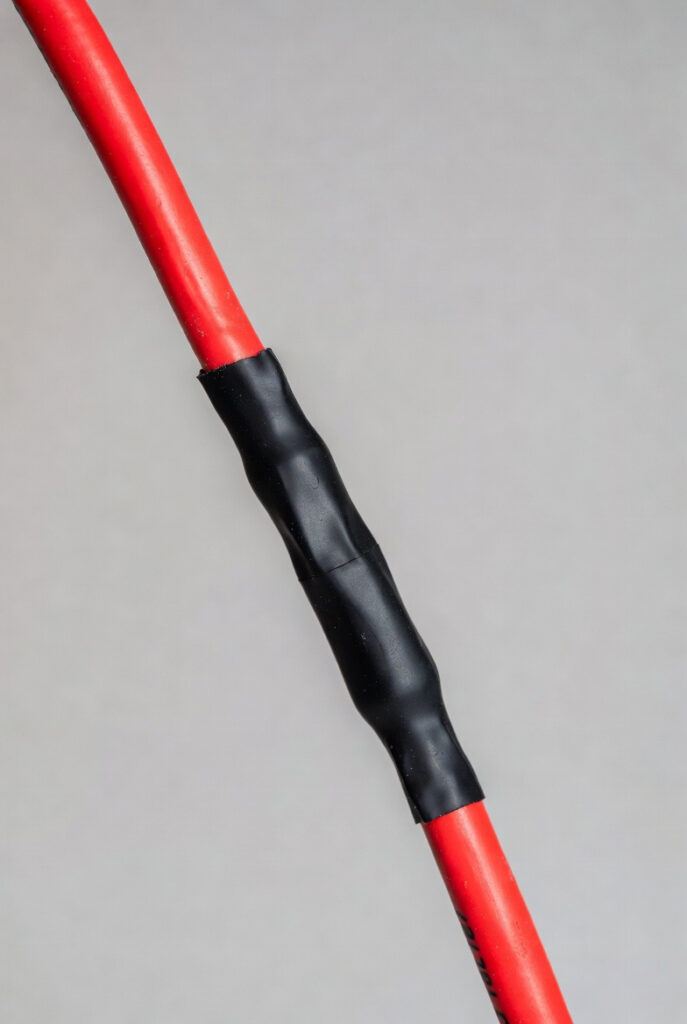
What dual-wall heat shrink contains: Adhesive-lined heat shrink sometimes called dual-wall or marine-grade heat shrink has two layers. The outer layer is standard polyolefin that shrinks on heating. The inner layer is a hot-melt adhesive a thermoplastic that is solid at room temperature and liquid when heated. When the tube is heated the outer layer shrinks and the inner adhesive layer melts flowing into every void between the tube and the cable jacket and between the tube and the lug barrel.
What the adhesive bead confirms: As the adhesive flows into voids and the outer tube continues to shrink the adhesive is squeezed outward it flows out of both ends of the heat shrink tube as a visible bead. This flowing adhesive bead is confirmation that the interior is completely filled no voids, no air pockets, no capillary channels. The adhesive bonds to the lug barrel and the cable jacket and sets hard as it cools. Airtight. Waterproof. Sealed.
The correct application technique: Start heating from the middle of the heat shrink tube not from one end. Heating from the middle forces the adhesive to flow toward both ends simultaneously pushing air out of both ends before the adhesive sets. If you heat from one end the adhesive flows to that end and sets before the other end is sealed. Middle-out heating. Always. Adhesive bead visible at both ends. Seal confirmed.
Sizing: Adhesive-lined heat shrink is typically 3:1 shrink ratio it shrinks to one third of its original diameter. For 4/0 AWG lug barrels select tubing with an expanded diameter that fits over the widest point of the lug body. Most 4/0 applications use 1-inch expanded diameter adhesive-lined tubing. Verify before cutting 10 pieces the wrong size.
The Green Crust – What Copper Oxide Actually Does to Your System
What copper oxide is: Copper oxide the green patina on bare copper surfaces forms when copper reacts with oxygen and moisture. All forms have significantly higher electrical resistance than pure copper. Green verdigris copper carbonate is the visible surface indicator of a connection that has been exposed to moisture cycling.
What copper oxide resistance does at 250A: A thin layer of copper oxide at a lug-to-busbar interface can add 0.001-0.01 ohms of resistance to the connection. At 250A: P = I² × R = 250² × 0.001 = 62.5 watts of heat generated at that single connection point. A connection generating 62.5 watts of heat will fail. Over months that heat cycles the connection expanding and contracting loosening the mechanical bond increasing resistance further generating more heat. The failure is progressive and invisible until something melts.
Why you cannot clean corroded cable internals: Surface corrosion on a lug face can be cleaned with a wire brush. Corrosion inside the cable jacket in the gaps between copper strands cannot be cleaned without replacing the cable. Once moisture has wicked into a 4/0 cable run and corrosion has started inside the jacket the cable is compromised. Complete replacement is the only fix the most expensive outcome of the cheapest failure to prevent.
Dielectric Grease – The Master Tech Contact Sealant
What dielectric grease does: Dielectric grease also called No-Ox or De-Ox compound is a non-conductive petroleum-based grease that displaces oxygen and moisture from metal contact surfaces. Applied to the flat face of a lug before bolting it to the busbar stud it fills the microscopic surface voids between the two metal faces eliminating the oxygen and moisture that would otherwise initiate corrosion at the interface.
Why non-conductive grease on a conductive connection is not contradictory: Electrical contact at a bolted lug connection is made through direct metal-to-metal contact at the high-pressure points where bolt compression forces the metal surfaces together. The grease is displaced from these high-pressure contact points it fills the surrounding low-pressure void spaces where corrosion initiates. The conductive contact points remain metal-to-metal. The surrounding surfaces are sealed.
Galvanic corrosion prevention: When two different metals are in contact in the presence of moisture they form a galvanic cell that slowly corrodes the less noble metal. As covered in our Busbar guide tin-plated copper busbars with copper lugs have minimal galvanic potential difference but in Ontario humidity even small differences drive slow corrosion over years. A thin film of dielectric grease at every lug-to-busbar interface eliminates the electrolyte. Without electrolyte there is no galvanic cell.
Application: Pea-sized amount on the lug face only not on the stud threads. Excess grease on threads changes the torque-tension relationship and causes under-tensioning. Lug face only. Thin film spread evenly. Bolt and torque to specification.
The Complete Heat Shrink Battery Cables Installation Standard
- Slide adhesive-lined heat shrink onto cable before crimping it cannot go on after lug installation
- Crimp lug using hydraulic tool as covered in our Crimping guide
- Apply dielectric grease to lug face thin film lug face only
- Bolt lug to busbar stud torque to specification with lock washer and nyloc nut
- Slide adhesive-lined heat shrink over lug barrel minimum 3cm onto cable jacket each side
- Apply heat from centre of tube outward using heat gun at 300-400°C
- Watch for adhesive bead appearing at both ends confirms complete interior fill
- Allow to cool completely 3-5 minutes minimum before energizing
- Inspect uniform shrinkage, no bubbles or voids, adhesive bead confirmed at both ends
- Color code red tubing on positive connections, black on negative the professional standard
The color coding standard: Red adhesive-lined heat shrink battery cables on positive. Black on negative. This is not aesthetic it is the professional standard that allows any qualified person to identify connection polarity at a glance during maintenance or fault diagnosis. In a dark equipment room at 3am color coding is the difference between disconnecting the correct cable and making the situation worse.
Pro Tip: Self-amalgamating tape sometimes called self-fusing silicone tape is the solution for connection points where heat shrink cannot fit. Irregular shapes where a cable enters a terminal block, at the battery terminal post itself, around a cable grommet cannot always be covered with heat shrink tubing. Self-amalgamating tape stretches and wraps around irregular shapes and fuses to itself without adhesive creating a solid rubber seal with no seam. Apply with 50% overlap each wrap covers half of the previous wrap. Three layers minimum. Stock both adhesive-lined heat shrink and self-amalgamating tape. Between the two of them every connection in the system can be sealed permanently.
The Verdict
Heat shrink battery cables with adhesive-lined dual-wall tubing is not a finishing touch. It is the seal that determines whether your system performs at 250A in March 2051 or degrades silently into a fire hazard before that.
Standard heat shrink looks correct. It is not sealed. Adhesive-lined heat shrink looks identical from the outside. The difference is the adhesive bead at both ends when correctly applied confirmation that the seal is complete.
Green crust is the result of not sealing. Sealed connections do not corrode. The choice is made at installation time — it cannot be made later without replacing the cable.
Seal every connection. Adhesive-lined. Dielectric grease. Red and black color coding.
That is the 25-year standard.
Disclosure: This article contains affiliate links. If you buy through them, GridFree Guide earns a small commission at no extra cost to you.
Questions? Drop them below.
Pingback: Solar Roof Mount Guide: Flashing, Rafters, No Leaks