
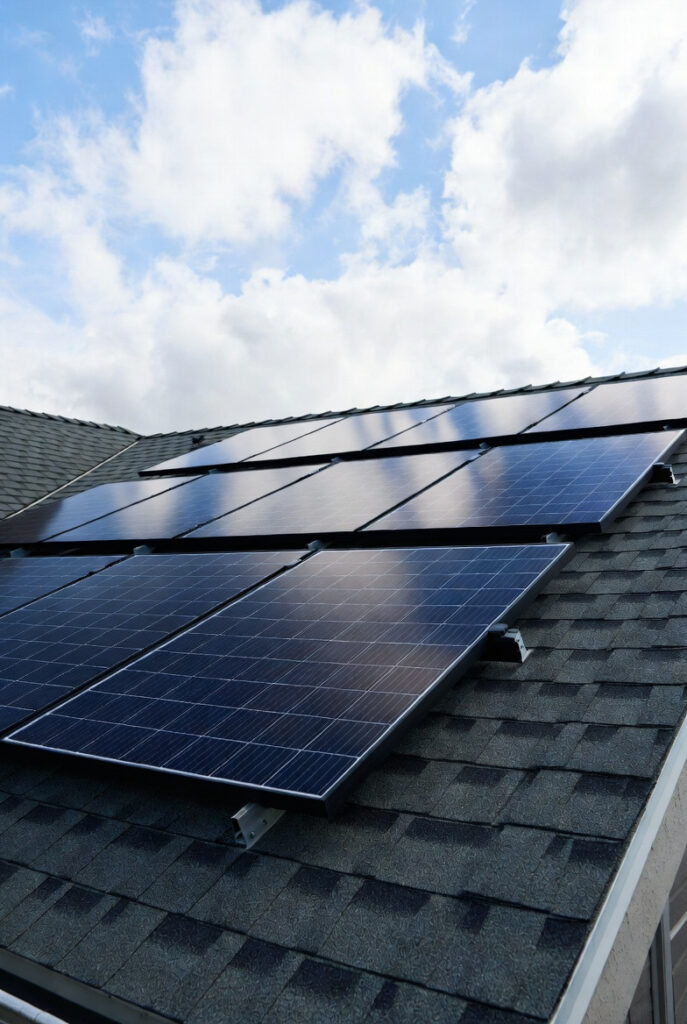
A client called me two years after his DIY solar install in Rockwood. Brown water stain on the ceiling directly under the array. He had used two full tubes of silicone around every solar roof mount. I got on the roof and found the problem immediately every mount was bolted through OSB decking between the rafters. No rafter engagement. No flashing. Two Ontario winters of freeze-thaw cycling had cracked every silicone bead. The bolts had worked loose enough to allow water migration. The OSB around three mounts was dark with moisture damage. A $200 flashing kit and two days of work the first time would have prevented a $2,400 repair. Start by understanding how much solar power you actually need so you know how many mounts your array requires.
Silicone is not a solar roof mount standard. It is a temporary patch that Ontario freeze-thaw will defeat in 18-24 months. The correct fix was removing all eight mounts, locating every rafter, installing flashed mounts centered on rafters, and replacing the damaged decking section. The $200 first time. The $2,400 after.
Solar Roof Mount: Flashing vs Silicone – Why Goop Always Fails
Why silicone fails on Ontario roofs: Silicone sealant has a service temperature range of approximately -55°C to +200°C more than adequate for Ontario conditions on paper. The failure mode is not temperature tolerance it is adhesion fatigue under thermal cycling. Every freeze-thaw cycle in a Rockwood winter creates microscopic movement between the mount base, the shingle surface, and the silicone bead. Over 50-100 cycles per winter the silicone bead fatigues tiny cracks develop at the adhesion interface. Water finds these cracks by capillary action exactly as moisture wicks into unprotected cable connections as covered in our Heat Shrink guide. Silicone applied in 2024 begins failing by 2026 in Ontario conditions.
What flashing actually does: A flashed solar roof mount does not rely on sealant to prevent water infiltration. The flashing a pre-formed metal shingle installed under the course of shingles above the mount redirects water around the penetration point entirely. Water flowing down the roof hits the top of the flashing and runs around it. No water reaches the lag bolt penetration. The physics of gravity and proper shingle course direction do the work that silicone cannot sustain.
The FlashFoot and QuickMount standard: Professional solar roof mount systems including IronRidge FlashFoot and QuickMount PV use a metal flashing plate that slides under the shingle course above the mount location. The lag bolt passes through the flashing into the rafter below. The flashing has a built-in EPDM rubber gasket under the mount foot compressing to seal the lag bolt penetration. The shingle course above covers the top edge of the flashing. Water on the roof never reaches the bolt hole.
Finding the Rafter – The Most Critical Step
Why rafter location matters: A solar roof mount bolted into OSB decking between rafters is not a mount it is a tent stake driven into cardboard. OSB decking has approximately one quarter the shear strength of a solid rafter. Under wind load and solar panels act as wings generating significant lift and lateral force a mount into OSB will eventually wiggle free. Once the mount cycles loose the seal is broken regardless of flashing quality.
How to find rafters:
- Electronic stud finder on the ceiling below the mounting area rafters align directly above ceiling joists
- Measure from the gable end rafters are typically spaced 16 inches or 24 inches on center
- Probe method, drill a 1/16 inch test hole in a low-visibility location and probe for solid wood vs void
- Rafter depth, a lag bolt must penetrate at least 2.5 inches into the rafter for code-compliant wind load resistance
The lag bolt specification: 5/16 inch diameter lag bolt minimum. Length must provide 2.5 inch minimum penetration into the rafter after passing through the roof decking and mount base. A typical installation requires a 4-5 inch lag bolt. Stainless steel not galvanized for Ontario conditions. Galvanized fasteners in contact with aluminium mounting hardware and wet conditions develop galvanic corrosion within 5-8 years.
The EPDM Gasket – The 25-Year Seal
What EPDM is: EPDM – Ethylene Propylene Diene Monomer is a synthetic rubber with exceptional UV and temperature resistance. The same EPDM compound used in engine coolant hoses and roofing membranes is used in quality solar roof mount gaskets. EPDM remains flexible and compressible at -40°C maintaining its seal through every Ontario winter without the adhesion fatigue that defeats silicone.
How the EPDM gasket works: The EPDM gasket sits between the mount base and the roofing surface compressed by the mount foot when the lag bolt is torqued to specification. The compression creates a mechanical seal around the lag bolt penetration that does not rely on chemical adhesion. As the mount thermally cycles expanding and contracting with temperature the EPDM gasket expands and contracts with it maintaining continuous contact pressure. This is the engine gasket principle applied to solar mounting the same reason a head gasket sealed with compressed fibre lasts 200,000km while silicone RTV fails at every temperature extreme.
The 25-year rating: Quality solar roof mount systems with EPDM gaskets are rated for 25+ years of service — matching the warranty period of the solar panels they support. Generic mounts with foam gaskets or no gaskets rely entirely on sealant — and sealant fails in 2-3 Ontario winters.
Ice Damming – The Ontario-Specific Failure Mode
What ice dams are: In Rockwood winter conditions snow accumulates on the roof surface. Solar panels create a warm zone directly under the array snow melts at the panel surface and flows down the roof. At the roof edge this meltwater refreezes. The refreezing meltwater builds up as an ice dam a wall of ice that backs water up under the shingles against gravity.
Why ice dams target solar mounts: A solar roof mount penetration creates a small disturbance in the shingle course a point where water flowing down the roof encounters resistance. In an ice dam scenario water is already being pushed up under the shingles by hydrostatic pressure from the ice wall below. Any imperfection in the shingle course including an improperly flashed solar mount becomes the entry point for this uphill water.
The flashing solution for ice dams: A correctly flashed solar roof mount with the flashing plate extending at least 4 inches above the mount foot under the shingle course above prevents ice dam water from reaching the lag bolt penetration even when water is being pushed uphill. This is why the flashing must slide under the shingle above not just cover the surface around the mount.
Wind Load – Why Your Array Is a Wing
What wind does to a roof-mounted array: A flat surface elevated above a roof deck like a solar panel generates aerodynamic lift and lateral drag in wind. A 1200W array of four 300W panels as covered in our Series vs Parallel guide presents approximately 7-8 square metres of sail area. At 80 km/h wind the lift and lateral forces on this array can exceed 400-600 kg. This force is transferred entirely to the roof mount lag bolts.
The mount spacing standard: Professional solar roof mount installations space mounts at maximum 1200mm 48 inches intervals along the rail. More mounts reduce the load on every individual mount and reduce the risk of any single mount failing under peak wind load.
The rafter engagement minimum: For Ontario wind load conditions each lag bolt must engage the rafter with a minimum 2.5 inches of thread penetration. A mount into 3 inches of solid rafter in an 80 km/h wind storm is secure. The same mount into 3/4 inch OSB is a projectile waiting for the right gust.
The Installation Standard Checklist
The correct solar roof mount installation – step by step:
- Locate every rafter in the array footprint mark on roof surface
- Select mount locations centered on rafters ,no mount between rafters under any circumstance
- Remove shingle tab at mount location, lift shingle course above mount location
- Slide flashing plate under lifted shingle – course flashing extends minimum 4 inches above mount foot
- Pre-drill lag bolt hole through flashing, decking, and into rafter center – 1/16 inch pilot bit
- Apply butyl tape or EPDM gasket to mount foot – secondary moisture barrier
- Install lag bolt 5/16 inch stainless steel, torque to specification
- Verify mount is level and secure – zero movement under hand pressure
- Lower shingle course over top edge of flashing – nail if necessary
- Install rail and panel clamps – torque all fasteners to specification
- Route cables with MC4 connectors as covered in our MC4 Connector guide never allow cables to pool water on roof surface use MC4 parallel branch connectors for 2S2P string joins
For a complete starter system that includes mounting hardware alongside panels consider the Renogy 100W Starter Kit — designed for straightforward residential roof installations with all mounting components included.
Pro Tip: After installation and every spring inspection and apply a thin bead of polyurethane roofing sealant (Sikaflex 221 or equivalent) around the visible top edge of the flashing where it meets the shingle above. This is not the primary seal the flashing and EPDM gasket are the primary seal. This bead is the secondary backup. Polyurethane roofing sealant remains flexible and adhesive through Ontario freeze-thaw cycles for 8-12 years significantly longer than standard silicone. Reapply every 5 years as part of annual system maintenance. This two-minute task extends the leak-free life of every mount.
The Verdict
The solar roof mount decision is made when the first lag bolt goes into the roof. Done correctly with flashing, rafter engagement, EPDM gaskets, and stainless fasteners the mounts outlast the panels they hold 25 years of Ontario winters without a ceiling stain.
Done incorrectly with silicone into OSB the first leak appears in 18-24 months. The repair cost is 10-15x the cost of doing it correctly the first time.
Flash it. Hit the rafter. Use EPDM. Use stainless. Check annually.
The Renogy 100W panels produce power for 25 years. The mounts need to last that long too.
Disclosure: This article contains affiliate links. If you buy through them, GridFree Guide earns a small commission at no extra cost to you.
Questions? Drop them below.
About the Author
Robert Bertrand spent 20 years as a service advisor in the automotive industry (Lexus and Nissan), where precision diagnostics, wiring integrity, and documentation standards were non-negotiable. He brings that same technical discipline to GridFree Guide, where he researches, tests, and documents off-grid solar systems for Ontario conditions. Based in Rockwood, Ontario, every article is built on verified specifications, manufacturer data, and the real-world climate constraints of Canadian off-grid living.
As an Amazon Associate I earn from qualifying purchases. This site also contains affiliate links to other products and services. GridFree Guide earns a small commission at no extra cost to you.