
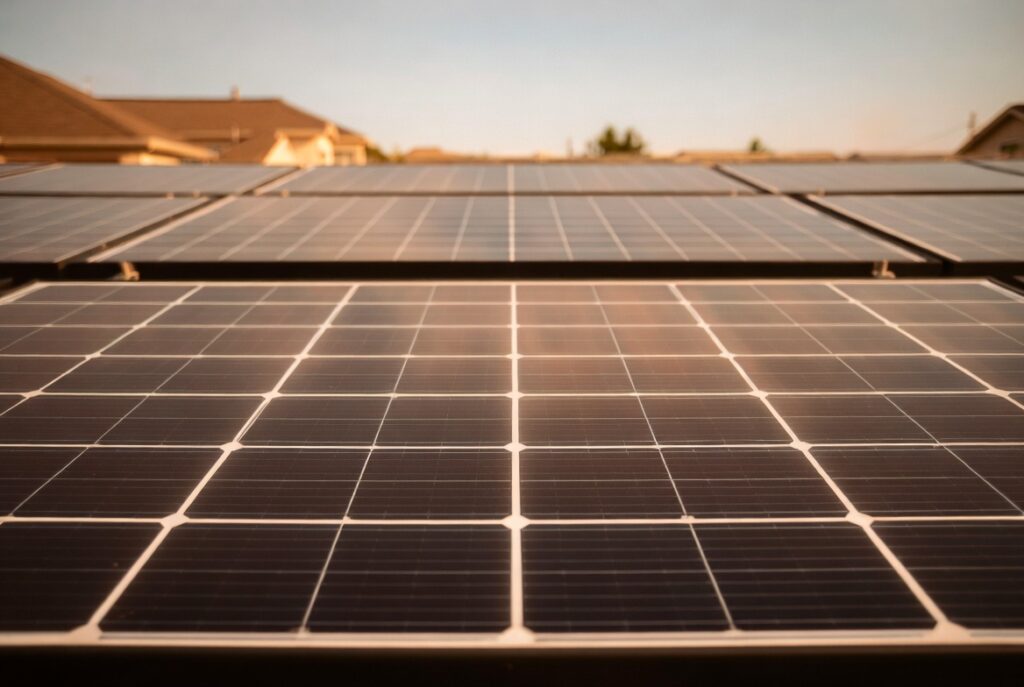
The solar cell Ontario temperature coefficient is the most commonly misunderstood specification in the Ontario off-grid community because the 400W nameplate on the front of the panel is measured at Standard Test Conditions of 25 degrees C and 1,000 W/m2, a laboratory condition that an Ontario rooftop achieves perhaps 20 days per year. The owner in Hastings County who watched their 400W array produce 355W at noon on a 42-degree July day was not experiencing a fault but the predictable physics of silicon chemistry above its rated temperature. Understanding this distinction changes how an Ontario owner interprets their SmartShunt production readings every summer.
A solar cell is not a passive component that simply absorbs sunlight. It is an active semiconductor device that converts photon energy to electron movement through the physics of the p-n junction. Understanding how the junction works explains why monocrystalline cells outperform polycrystalline on a constrained Ontario roof and why cold January panels can produce closer to their nameplate ratings than hot July panels on the same array.
The solar cell Ontario output equation has three variables: cell efficiency, irradiance, and temperature. Cell efficiency is fixed at purchase , monocrystalline at 21 to 23 percent, polycrystalline at 15 to 17 percent, thin-film at 10 to 12 percent. Irradiance is set by the Ontario season , 5.5 peak sun hours in July, 1.5 peak sun hours in January. Temperature is the variable most Ontario owners ignore until their summer production reads below expectation on the SmartShunt. See our Ontario solar sizing guide before any solar cell Ontario specification decision.
The solar cell Ontario p-n junction: how photons become DC current
| Cell type | Efficiency | Ontario application | Space per 400W |
|---|---|---|---|
| Monocrystalline (Renogy 100W) | 21 to 23% | Constrained south-facing Ontario roof | ~1.7 m2 |
| Polycrystalline | 15 to 17% | Ground mount or large barn roof with surplus space | ~2.4 m2 (+30%) |
| Thin-film flexible (Renogy 100W flex) | 10 to 12% | Curved surfaces: canoe bow, RV roof, boat deck | ~3.3 m2 |
Silicon is treated during manufacture to create two distinct layers. The N-type layer contains extra electrons from phosphorus doping. The P-type layer contains electron holes from boron doping. Where these two layers meet, a permanent electric field forms at the p-n junction boundary. When photons from sunlight strike the cell with sufficient energy to exceed silicon’s 1.12 eV bandgap, they knock electrons loose from their positions in the crystal lattice. The junction electric field forces those freed electrons through the external circuit as direct current before they recombine at the P-type side.
That direct current flows from the panel through the MC4 connectors to the MPPT 100/30, which converts the variable DC voltage from the solar cell Ontario array to the correct charging voltage for the battery bank. The MPPT tracks the maximum power point of the cell’s current-voltage curve as conditions change through the day. At 1,000 W/m2 irradiance and 25 degrees C, a 100W monocrystalline cell produces its rated voltage and current at peak efficiency. At Ontario January 1.5 peak sun hours and minus 10 degrees C, the same cell produces approximately 150Wh total daily but at higher voltage from the cold temperature. See our Ontario Victron solar guide for the full MPPT sizing specification.
Monocrystalline versus polycrystalline versus thin-film: the Ontario roof space decision
The correct Ontario solar cell specification metric is not price per watt but output per square foot of available south-facing roof. A monocrystalline cell at 22 percent efficiency produces approximately 30 to 40 percent more watts per square foot than a polycrystalline cell at 16 percent efficiency. On a constrained Ontario roof where the available south-facing surface is the binding constraint, this difference determines whether the full system fits the available space or requires a ground mount. For Ontario ground mounts and large barn roofs where space is not the constraint, polycrystalline remains a cost-effective choice , the lower efficiency does not matter when space is available.
Thin-film flexible panels occupy the specific application where rigid panels cannot go. A Renogy 100W flexible panel at 10 to 12 percent efficiency produces approximately half the watts per square foot of monocrystalline, but it is the only solar cell Ontario option for a curved canoe bow, a rounded RV roof, or a boat deck where a rigid panel cannot be mounted flat. The correct efficiency comparison for flexible panels is not against rigid mono but against no panel at all on that surface. See our Ontario solar system planning guide for the complete roof space and cell type specification.
The Northumberland County specification lesson: efficiency per square foot over price per watt
A Northumberland County homeowner received two solar quotes in spring 2024. The polycrystalline quote was approximately $0.85 per watt versus $1.10 per watt for monocrystalline , a meaningful cost difference on a 2,000W target system. The homeowner chose the polycrystalline panels to save approximately $500 on the total system cost. The decision looked correct on paper. It failed at installation when the poly array layout required approximately 30 percent more south-facing roof space than the mono array to achieve the same 2,000W target output.
The available south-facing roof could not accommodate the polycrystalline layout. The only options were to reduce the system wattage to fit the available space, add a ground mount section for the extra panels, or return the polycrystalline and re-specify monocrystalline. A ground mount would have added approximately $800 in materials and labour, eliminating the poly cost saving and adding net cost. The homeowner returned the polycrystalline panels and re-specified the monocrystalline array.
The monocrystalline array fit the available south-facing roof at the full 2,000W target. The $500 per-watt cost saving from polycrystalline was offset by avoiding the $800 ground mount addition. The net result favoured monocrystalline. The solar cell Ontario lesson from Northumberland County is direct: on any constrained Ontario roof, calculate the required square footage for both cell types before choosing on price. A 2,000W poly system that needs a ground mount costs more than a 2,000W mono system that fits the roof.
The solar cell Ontario temperature coefficient: why your 400W panel produces 355W in July
Standard Test Conditions define the 400W nameplate: 25 degrees C cell temperature and 1,000 W/m2 irradiance under a controlled spectrum. No Ontario rooftop delivers these conditions on a July afternoon. On a 30 degrees C ambient day, a south-facing panel in direct sun reaches a cell temperature of approximately 40 to 50 degrees C from absorbed infrared radiation on top of the ambient temperature. At the standard monocrystalline temperature coefficient of approximately minus 0.4 percent per degree C above 25 degrees C, a cell at 42 degrees C is operating 17 degrees above STC. The expected output reduction is 17 times 0.4 percent = 6.8 percent. On a 400W panel: 400 times 0.932 = approximately 373W expected.
The cold Ontario January reverses this physics partially. At minus 10 degrees C cell temperature, the panel is operating 35 degrees below STC. The temperature coefficient benefit is 35 times 0.4 percent = 14 percent above STC nameplate potential , a 400W panel at minus 10 degrees C cell temperature has a theoretical output of approximately 456W if irradiance conditions were STC. At Ontario January 1.5 peak sun hours, the irradiance is far below 1,000 W/m2 for most of the day, so the total daily yield remains approximately 150Wh rather than 400 times 1.5 = 600Wh. But the solar cell Ontario cold bonus confirms: panels in January cold perform closer to their nameplate efficiency than panels in July heat.
The Hastings County temperature result: 42 degrees C cell temperature, 355W output, physics confirmed
A Hastings County owner ran a 400W monocrystalline array through the summer of 2024 and logged daily production on the SmartShunt. In July, during a 4-day heatwave with daytime ambient temperatures reaching 32 degrees C, the solar noon production reading dropped to approximately 355W , 45W below the 400W nameplate. The owner opened the Victron VRM portal and reviewed the production history against previous clear days in May and June. The pattern was consistent: production dropped on the hottest days and recovered on cooler days with similar irradiance.
A physical inspection on the hottest afternoon confirmed a panel back-surface temperature of approximately 42 degrees C measured with an infrared thermometer. The SmartShunt confirmed voltage and current were within normal ranges , no fault codes, no shading, no loose connections. The temperature coefficient calculation explained the reading completely: 42 degrees C minus 25 degrees C STC = 17 degrees above STC, multiplied by 0.4 percent per degree = 6.8 percent reduction, giving an expected output of approximately 373W. The measured 355W was within the expected range after accounting for wiring losses and MPPT efficiency.
The owner’s conclusion was that the 400W nameplate is a laboratory specification, not an Ontario summer rooftop guarantee. A 400W array on a Hastings County roof in July delivers approximately 350 to 375W at solar noon on a hot day , and that is the correct real-world solar cell Ontario output for that cell type in that temperature condition. The SmartShunt confirmed no fault. The system was performing exactly as the temperature coefficient predicts. Understanding this distinction prevents unnecessary service calls and incorrect conclusions about panel degradation on normal hot summer days.
NEC and CEC: Ontario permit requirements for photovoltaic installations
Any permanently wired Ontario photovoltaic installation requires an ESA permit under CEC Section 64 before installation begins. The requirement applies regardless of cell type , monocrystalline, polycrystalline, and thin-film installations all require a permit for permanent wiring. NEC 690 governs DC circuit wiring, overcurrent protection, and grounding requirements for photovoltaic systems. The cell type does not affect the NEC 690 compliance requirements for the DC wiring that connects the solar cell Ontario array to the MPPT and battery bank. Contact the NFPA at nfpa.org for current NEC 690 requirements.
CEC Section 64 requires the ESA permit before any permanently wired solar cell Ontario installation begins, including roof-mounted arrays with fixed wiring to an interior MPPT and battery bank. The permit inspection confirms that the DC wiring, overcurrent protection, and grounding meet the Ontario Electrical Safety Code. Portable thin-film panels used without permanent wiring do not require an ESA permit, but any roof penetration, fixed conduit run, or interior hardwired connection triggers the permit requirement. Contact the Electrical Safety Authority Ontario at esasafe.com before beginning any permanently wired solar cell Ontario installation.
Pro Tip: Measure the back-surface temperature of your panels with an infrared thermometer on the hottest clear day of the summer and record it alongside your SmartShunt solar noon production reading. This gives you a personal temperature coefficient data point for your specific installation , roof colour, mounting airflow, and panel brand all affect the actual cell temperature above ambient. An Ontario roof with poor airflow under the panels can reach 55 degrees C cell temperature on a 30 degrees C day, producing approximately 12 percent below STC nameplate. A roof with adequate air gap under the panels at the same ambient temperature may reach only 40 degrees C, producing approximately 6 percent below nameplate.
The solar cell Ontario verdict: monocrystalline for Ontario roofs, efficiency before price per watt
- Ontario property owner with a constrained south-facing roof: specify monocrystalline before evaluating price per watt. The Northumberland County result: polycrystalline required 30 percent more roof space for the same wattage, triggering a ground mount cost that exceeded the per-watt savings. On any Ontario roof where available south-facing space is the binding constraint, efficiency per square foot is the correct metric. Calculate the required roof area for both cell types before choosing , the cost comparison changes when ground mount or second-roof-section costs are included.
- Ontario property owner whose summer production reads below nameplate on the SmartShunt: check cell temperature before assuming a fault. The Hastings County result: 355W from a 400W panel at 42 degrees C cell temperature is the correct real-world output , physics, not a fault. The temperature coefficient calculation confirms expected output at any cell temperature above 25 degrees C. A system showing SmartShunt production within 10 percent of the nameplate on a hot July day is performing correctly. A system showing 30 percent below nameplate on a cool May day with full sun is experiencing a real fault worth investigating.
- Ontario property owner with a curved mounting surface: specify thin-film flexible. The 10 to 12 percent efficiency of thin-film is a real limitation on output per square foot, but it is the only solar cell Ontario option for a surface where a rigid panel cannot be mounted flat. A canoe bow, RV roof curve, or boat deck that cannot use rigid monocrystalline produces more energy with thin-film than with no panel at all. For these specific applications, thin-film is the correct specification regardless of the efficiency comparison to rigid mono.
Frequently Asked Questions
Q: Why does my solar panel produce less than its rated wattage in Ontario summer?
A: The rated wattage on the nameplate is measured at Standard Test Conditions of 25 degrees C cell temperature and 1,000 W/m2 irradiance. On an Ontario summer afternoon with ambient temperatures above 28 degrees C, the panel cell temperature typically reaches 40 to 50 degrees C from absorbed infrared radiation. At the standard monocrystalline temperature coefficient of approximately minus 0.4 percent per degree C above 25 degrees C, a cell at 42 degrees C produces approximately 6.8 percent below the STC nameplate. On a 400W panel, that is approximately 373W expected before wiring and MPPT losses. The Hastings County result confirmed 355W measured against 373W expected, within the normal loss range.
Ontario summer production below nameplate is physics, not a fault, unless the shortfall exceeds approximately 15 percent on a cool clear day.
Q: Should I buy monocrystalline or polycrystalline solar panels for an Ontario rooftop?
A: For a constrained south-facing Ontario roof, monocrystalline is the correct solar cell Ontario specification because it produces approximately 30 to 40 percent more watts per square foot than polycrystalline. The Northumberland County result confirmed the consequence of choosing polycrystalline for roof space savings: the poly array required 30 percent more south-facing roof space for the same wattage target, and the available roof could not accommodate the layout. The homeowner returned the poly panels and re-specified mono. The per-watt cost difference between mono and poly is typically $0.20 to $0.30 per watt, but the space requirement difference on a constrained Ontario roof often makes mono the less expensive total system cost when ground mount additions are factored in.
For ground mounts or large barn roofs with ample space, polycrystalline remains a cost-effective solar cell Ontario option.
Q: Do solar panels work better in cold Ontario weather?
A: Solar cells are more efficient in cold temperatures than in hot temperatures relative to their STC nameplate. At minus 10 degrees C cell temperature, a monocrystalline panel has approximately 14 percent higher efficiency potential than at 25 degrees C STC.
This cold bonus means Ontario January panels are operating closer to their nameplate efficiency rating than Ontario July panels. However, the total daily yield in January is still far below July because irradiance is only approximately 1.5 peak sun hours per day versus 5.5 in July. The practical result: a 400W array on a clear Ontario January day produces approximately 150 to 170Wh total at high cell efficiency but low irradiance, versus approximately 1,800 to 2,000Wh on a clear July day at lower cell efficiency but high irradiance.
Cold improves efficiency; it does not compensate for low Ontario winter irradiance.
This build is engineered within the 48V DC Safety Ceiling. Diagnostic logic is based on 20+ years of technical service experience. All structural and electrical installations must be verified by a Licensed Professional and comply with your Local AHJ. See our legal and safety disclosure for full scope.
About the Author
Robert Bertrand spent 20 years as a service advisor in the automotive industry (Lexus and Nissan), where precision diagnostics, wiring integrity, and documentation standards were non-negotiable. He brings that same technical discipline to GridFree Guide, where he researches, tests, and documents off-grid solar systems for Ontario conditions. Based in Rockwood, Ontario, every article is built on verified specifications, manufacturer data, and the real-world climate constraints of Canadian off-grid living.
As an Amazon Associate I earn from qualifying purchases. This site also contains affiliate links to other products and services. GridFree Guide earns a small commission at no extra cost to you.