
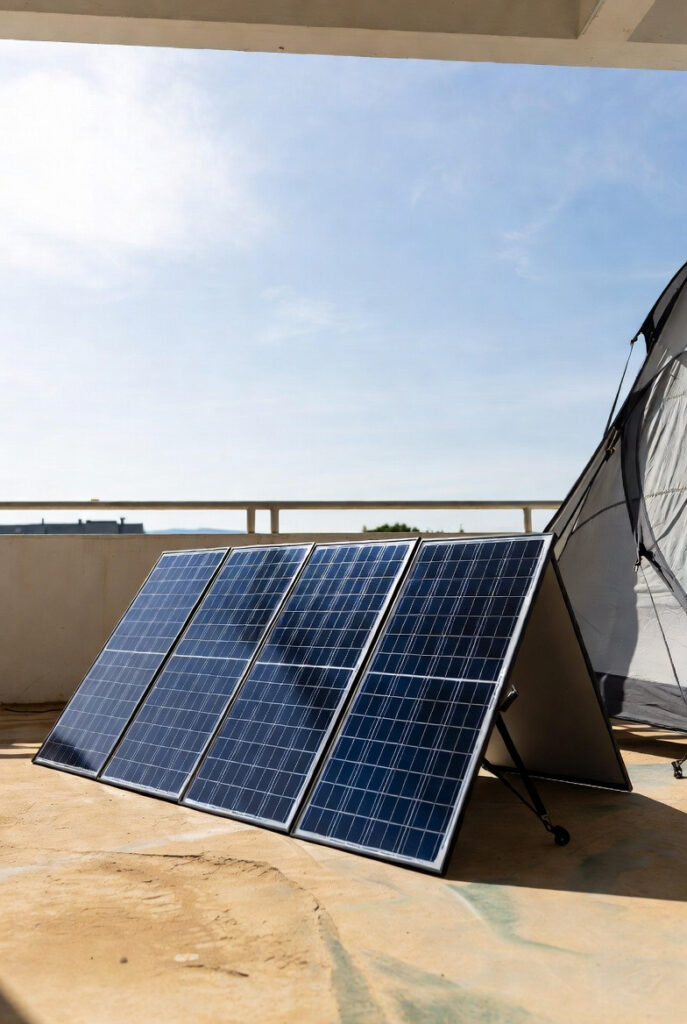
Most people assume solar requires owning a roof. That assumption stops millions of people from ever starting. The truth is there are two completely different paths into solar and one of them requires zero permits, zero contractors, and zero permanent installation. Portable solar vs rooftop solar aren’t competing options. They’re different tools for different situations. Here’s how to choose the right one for yours.
Portable Solar vs Rooftop Solar: Two Different Tools
Choosing between these two isn’t about which is better it’s about which fits your specific situation right now. Think of a portable jump-starter versus a built-in battery charger. Both serve the same basic purpose. One is for flexibility and emergencies. The other is for foundational reliability. Same logic applies here.
Portable Solar – The Plug and Play Path
What it is: Folding or rigid panels paired with a portable power station. No permanent installation. No permits. No electrician. Plug the panel into the power station and you have solar power in minutes.
Who it’s for:
- Renters who can’t modify their property
- Apartment dwellers with a balcony or outdoor space
- RV owners, campers, van lifers
- Homeowners who want to test solar before committing to rooftop
- Anyone building a grab-and-go emergency backup kit
The Ontario advantage: Portable solar completely bypasses ESA (Electrical Safety Authority) permit requirements. Permanent rooftop installations require ESA permits, licensed electricians, and utility approval. Portable systems on private property none of that. You can start today.
The stealth benefit: Portable panels come inside during storms, hail, or when you leave for extended periods. No storm damage. Significantly lower theft risk. For cottage owners and RV users this matters more than most guides acknowledge.
The MC4 reality: Most beginners don’t realize portable power stations use XT60 or DC5525 input ports not the MC4 connectors that standard solar panels use. You need an MC4 to XT60 adapter to connect standard panels to most portable stations. The Anker SOLIX C1000 Gen 2 comes with the right cables but always verify compatibility before buying panels separately.
Limitations:
- Lower total power output than rooftop systems
- Battery capacity limits how much you can store
- Doesn’t add property value
- Not a whole-home solution
Rooftop Solar The Foundational Path
What it is: Rigid panels permanently mounted on your roof, hardwired through a charge controller or grid-tied inverter, with a full balance of system components. Professional installation, permits, utility inspection.
Who it’s for:
- Homeowners in their long-term or forever home
- Anyone looking to eliminate their energy bill completely
- Properties with good south-facing roof space and minimal shading
- Homeowners who want property value increase
The advantages:
- Higher total output whole-home systems range from 5kW to 20kW+
- Permanent and weatherproof
- Adds 3 – 4% to property value on average
- Eligible for Canada Greener Homes Grant
The reality:
- Requires licensed electrician and ESA permit in Ontario
- Utility interconnection approval for grid-tied systems
- Higher upfront cost $15,000–$30,000 for whole-home systems
- Not practical for renters or frequent movers
The Comparison
| Portable Solar | Rooftop Solar | |
|---|---|---|
| Setup time | Minutes | Days to weeks |
| Permit required | No | Yes (Ontario ESA) |
| Portability | Full | None |
| Typical power output | 100W–3000W | 3kW–20kW+ |
| Upfront cost | $500–$3,000 | $15,000–$30,000 |
| Property value increase | None | 3–4% |
| Best for | Renters, RVs, emergency backup | Homeowners, whole-home offset |
| Expandable | Limited | Yes |
Solar for Renters: The Portable Advantage
In Canada approximately one-third of households rent. The solar industry largely ignores them. Portable solar is the only realistic option for renters and it’s genuinely capable, not a compromise.
A Renogy 100W Solar Panel paired with the Anker SOLIX C1000 Gen 2 can power essential loads through a blackout fridge, lighting, phone charging, CPAP without touching a single wall or signing a permit application.
For renters portable solar isn’t a consolation prize. It’s the right tool.
The Efficiency Question
Many assume rooftop solar is inherently more efficient. Fixed south-facing panels are optimized for annual production that’s technically true. But portable panels on adjustable stands can be repositioned to chase peak sun tilted for winter, angled to avoid morning or afternoon shade.
In real-world conditions a well-positioned portable panel often outperforms a fixed rooftop panel that hasn’t been cleaned in months. The efficiency gap is smaller than most people assume. For emergency backup and supplemental power portable solar is more than adequate.
Pro Tip: The best first step for any homeowner considering rooftop solar is to spend one winter running a portable system first. You’ll learn your actual energy consumption patterns, understand how solar production varies with seasons, and make a much better-informed decision when it comes time to size a permanent system. Think of portable solar as the test drive before the purchase.
The Verdict
Portable solar vs rooftop solar is the wrong frame. The right question is: what do you need solar to do right now, and what are your constraints?
If you rent or move often go portable. Start today. No permits, no contractors, no roof required.
If you’re in your forever home and want to eliminate your hydro bill permanently start planning the roof. The ROI is real and the property value increase is a bonus.
If you’re not sure go portable first. Learn your usage. Then decide.
Internal Links
- How Much Solar Power Do I Actually Need?
- Best Solar Panels for Beginners
- How to Start Going Solar With Zero Experience
- Canada Greener Homes Grant
Disclosure: This article contains affiliate links. If you buy through them, GridFree Guide earns a small commission at no extra cost to you.
About the Author
Robert Bertrand spent 20 years as a service advisor in the automotive industry (Lexus and Nissan), where precision diagnostics, wiring integrity, and documentation standards were non-negotiable. He brings that same technical discipline to GridFree Guide, where he researches, tests, and documents off-grid solar systems for Ontario conditions. Based in Rockwood, Ontario, every article is built on verified specifications, manufacturer data, and the real-world climate constraints of Canadian off-grid living.
As an Amazon Associate I earn from qualifying purchases. This site also contains affiliate links to other products and services. GridFree Guide earns a small commission at no extra cost to you.