
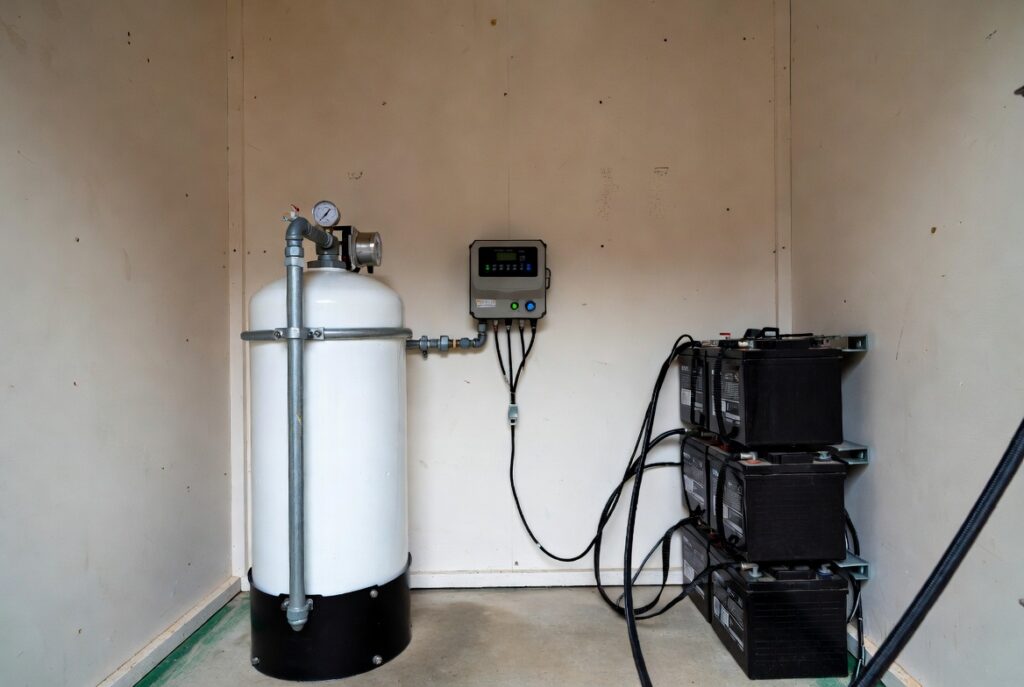
The most common Ontario off grid plumbing mistake is burying the supply line at 0.8 metres, and a property owner on Kortright Road West in Guelph, Wellington County discovered this in January 2023 when the supply line to her off-grid cabin froze solid after a four-day cold snap because the line was buried 0.4 metres above the minimum depth and the ground temperature at 0.8 metres dropped below 0°C while the line at 1.4 metres would have remained above 4°C at the same outdoor temperature.
The supply line was correctly specified in every other way: 1-inch polyethylene pipe with appropriate pressure rating, correctly sloped for drainage, with a union fitting at the pressure tank connection. The burial depth was the only specification error. A single Ontario cold snap at -28°C for four consecutive days was sufficient to freeze a 0.8m buried line solid in Wellington County’s sandy loam soil.
I diagnosed the off grid plumbing failure in late January 2023. The supply line was confirmed frozen solid from approximately 0.5m depth to the surface, with approximately 0.3m of the line frozen through. The section from 0.8m to the pressure tank in the crawlspace was also frozen because the crawlspace had no heat tape on the exposed section of pipe above the burial point. The excavation, re-burial at 1.4m, and heat tape installation in the crawlspace cost approximately $2,400 including the emergency call and the licensed plumber’s labour.
The correct off grid plumbing specification for that supply line required two changes: burial at 1.4m minimum and self-regulating heat tape on the exposed crawlspace section where the line transitions from below-grade to above-grade. Both changes together cost approximately $180 in materials when installed correctly on day one. The $2,400 emergency excavation was the cost of the incorrect specification. See our Ontario solar sizing guide before specifying any off grid plumbing system.
The off grid plumbing frost line rule: why 0.8m freezes and 1.4m does not in Wellington County
| Off grid plumbing spec | Incorrect | Correct | Ontario result |
|---|---|---|---|
| Supply line burial depth | 0.8m | 1.4m minimum | 0.8m froze in 4 days; 1.4m stays above 4°C year-round |
| Crawlspace pipe section | No heat tape | Self-regulating heat tape | Froze solid without tape; protected with tape |
| Well pump startup | No SoftStart | SoftStart Well (B0FQ4G4Q7L) | 8,000W inrush trips inverter; SoftStart reduces to 1,600W |
| Pressure tank size | 20L (seasonal only) | 60L full-time | 20L cycles every 5-10 min; 60L cycles every 45 min |
| Cost if wrong spec | $2,400 emergency repair | $180 materials on day one | $2,220 savings from correct spec |
The Southern Ontario frost line is 1.2m minimum for Wellington County and Halton Hills. The recommended off grid plumbing burial depth for main supply lines is 1.4m, 0.2m below the frost line as a safety margin. Ground temperature at 0.8m in extreme cold drops below 0°C in sandy or gravelly soils during a sustained cold snap. Ground temperature at 1.4m remains above 4°C year-round in Southern Ontario regardless of surface conditions. Ice expansion pressure in a frozen polyethylene pipe is approximately 170 MPa, sufficient to crack the pipe wall and split fittings. The four-day cold snap at -28°C that froze the Guelph line would not have reached a correctly buried line at 1.4m.
The crawlspace transition is the second off grid plumbing freeze point. The supply line transitions from below-grade (protected by ground temperature) to above-grade (exposed to crawlspace air temperature) at the building entry point. A crawlspace in an unheated off-grid cabin can reach -10°C to -15°C during an extended Ontario cold snap. Self-regulating heat tape on the crawlspace section from the building entry to the pressure tank connection prevents freezing at this transition point. Self-regulating heat tape draws approximately 10 to 30W per metre and requires a 120V outlet from the inverter output. See our off grid appliances guide for the crawlspace heat tape load calculation.
The SoftStart Well: eliminating pump inrush from the Tier 2 inverter equation
A standard well pump starts at approximately 10 times its running current. A 1/2 HP submersible pump running at 800W draws approximately 8,000W at startup, far exceeding the 3,000W PSW inverter’s capability and tripping overload protection before the pump reaches operating speed. The SoftStart Well reduces this startup surge from approximately 10x to approximately 2x running current, bringing the same 800W pump’s startup to approximately 1,600W, within the inverter’s 6,000W surge capability. Without the SoftStart Well, any off grid plumbing system using a submersible pump larger than approximately 1/4 HP will trip the Tier 2 inverter on every startup.
A property owner in Fergus, Centre Wellington specified the correct off grid plumbing from day one in fall 2022: supply line buried at 1.4m, self-regulating heat tape on the crawlspace section, SoftStart Well on the 1/2 HP submersible pump, and a 60L pressure tank. The Victron SmartShunt reading during pump cycles: 4 to 6A at 12V (approximately 48 to 72W). Pump cycle frequency: approximately once every 45 minutes at normal family usage.
Two full Ontario winters: zero inverter trips from pump startup, zero frozen supply line incidents, zero pressure tank issues. “We specified everything at depth and with the SoftStart from day one. The plumbing has never been a problem.” See our solar water heater ontario guide for the propane on-demand complement to this off grid plumbing specification.
Pro Tip: On commissioning day for any new off grid plumbing system, run the well pump through three cycles and check the SmartShunt reading for each one. The first cycle should show 4 to 6A at 12V during the pump run, with a brief momentary spike at startup that immediately settles to the running current if the SoftStart Well is working correctly. If you see a sustained spike above 60A at startup followed by an inverter trip, the SoftStart Well is not connected correctly or the pump is exceeding its rated capacity. The Fergus Centre Wellington commissioning reading: 5.2A running average across the first three cycles, no inverter trips, pump cycle duration approximately 3 minutes each. That reading on day one confirms the entire off grid plumbing specification is correct before the property is occupied.
The correct Ontario off grid plumbing specification: 1.4m burial, heat tape, SoftStart Well, 60L pressure tank
The correct Ontario off grid plumbing specification covers four elements. First: supply line burial at 1.4m minimum to ensure the line stays above 4°C year-round in Wellington County’s soil profile. Second: self-regulating heat tape on the crawlspace transition from building entry to pressure tank connection, at approximately $3 to $8 per metre installed including the 120V outlet. Third: SoftStart Well on the well pump to eliminate the inrush current that trips Tier 2 inverters. Fourth: 60L pressure tank for full-time off grid plumbing, reducing pump cycle frequency to approximately once every 45 minutes and protecting the pump motor from short-cycling.
The Victron SmartShunt provides ongoing confirmation that the off grid plumbing system is operating within specification. During each pump cycle, the SmartShunt should show 4 to 6A at 12V (approximately 48 to 72W) for a 1/2 HP pump with SoftStart installed. The cycle should last approximately 2 to 4 minutes and occur no more frequently than once every 30 minutes at normal family usage. Any deviation from this pattern, higher current draw, shorter cycles, or cycles during periods of no water use, indicates a plumbing or mechanical issue requiring investigation.
The Battle Born LFP bank handles the 48 to 72W pump draw correctly within the Tier 2 daily budget. See our off grid setup guide for the complete Tier 2 commissioning protocol.
The SmartShunt waterlogging diagnostic: how pump cycle frequency reveals pressure tank health
The SmartShunt waterlogging diagnostic is the most practical off grid plumbing monitoring tool available. A healthy 60L pressure tank stores compressed air above the water bladder and allows the pump to fill the tank to pressure, then remain off while the stored pressure delivers water to the taps. When the air bladder in the pressure tank fails, the tank fills completely with water and loses its pressure storage capacity. The pump then cycles every 2 to 5 minutes rather than every 30 to 60 minutes, running almost continuously to maintain pressure.
The SmartShunt overnight reading identifies waterlogging immediately. Check the SmartShunt history before any morning water use. A healthy off grid plumbing system shows zero pump draw overnight when no water is being consumed. A waterlogged pressure tank shows repeated 4 to 6A draws every 2 to 5 minutes through the night, even with no water being used. This pattern represents hundreds of unnecessary pump cycles per day, shortening motor life and consuming battery bank capacity that the system cannot replenish in Ontario January at 1.5 PSH.
Catching this early through SmartShunt monitoring saves both the pump motor and the Victron MPPT 100/30-fed bank from premature wear. See our off grid costs guide for the complete off grid plumbing system cost breakdown.
NEC, CEC, and Ontario plumbing code: permit requirements for permanent off-grid water systems
NEC 690 and CEC Section 64 govern the electrical components of any Ontario off grid plumbing system. The heat tape circuit requires a properly rated 120V outlet from the inverter output, protected by an appropriate breaker or fuse. The well pump control wiring, SoftStart Well connections, and pressure switch wiring all constitute permanent electrical installations requiring an ESA permit at $300 to $400 before work begins. Contact the NFPA at nfpa.org and the Electrical Safety Authority Ontario at esasafe.com before beginning any permanent off grid plumbing electrical work.
All new permanent off grid plumbing installations in Ontario, including supply line installation, pressure tank connections, and well pump plumbing, require a licensed plumber under the Ontario College of Trades. The Ontario Building Code applies to any new well installation or significant plumbing modification on a rural property. A licensed plumber ensures the off grid plumbing meets code requirements for burial depth, pipe material, and connection standards, and is required for property insurance coverage of the water system. Contact the Ontario College of Trades at collegeoftrades.ca to verify a plumber’s licence before authorizing any permanent off grid plumbing installation.
The off grid plumbing Ontario verdict: bury deep, protect the transition, use SoftStart Well from day one
- Ontario off-grid property owner who discovered a frozen supply line: confirm the burial depth before any other diagnosis. If the line is shallower than 1.2m, excavation and re-burial at 1.4m is the correct fix, not insulation wrapping or heat tape on the buried section. Add self-regulating heat tape on the crawlspace transition above grade. Licensed plumber required for the re-burial. The Guelph result: $2,400 emergency cost for a specification that cost $180 to do correctly on day one. The SmartShunt confirms correct off grid plumbing operation on the first pump cycle after re-commissioning.
- Ontario property owner specifying a new full-time off grid plumbing system: specify all four elements before purchasing any components. Burial at 1.4m. Heat tape on crawlspace transition. SoftStart Well on the well pump. 60L pressure tank. SmartShunt confirms correct operation on commissioning day: 4 to 6A during pump cycles, once every 45 minutes. The Fergus Centre Wellington result: two Ontario winters, zero inverter trips, zero freeze events, zero pressure tank issues. Licensed plumber and ESA permit required before installation begins.
- Ontario property owner whose SmartShunt shows frequent overnight pump cycles with no water in use: this is a waterlogged pressure tank with a failed air bladder. The pump cycles every 2 to 5 minutes because the tank has no compressed air storage capacity. Replace the pressure tank (60L for full-time off grid plumbing use). A licensed plumber can replace the pressure tank in approximately 2 to 3 hours. Catching this through SmartShunt monitoring before the pump motor fails saves the cost of a pump replacement on top of the tank replacement, a significant difference in repair cost.
Frequently Asked Questions
Q: How deep do water lines need to be buried off-grid in Ontario?
A: The Southern Ontario frost line is 1.2m minimum for Wellington County and Halton Hills. The correct off grid plumbing burial depth for main supply lines is 1.4m, 0.2m below the frost line as a safety margin that ensures the line stays above 4°C year-round. A line buried at 0.8m can freeze solid in 4 consecutive days at -28°C in Wellington County’s sandy loam soil, as the Kortright Road West Guelph result confirmed. The cost to correct a shallow burial after the fact: approximately $2,400 in emergency excavation and labour versus approximately $180 in additional materials to do it correctly on installation day. Always use a licensed plumber under the Ontario College of Trades for new supply line installation.
Q: What is the SoftStart Well and do I need it for my off-grid well pump?
A: The SoftStart Well reduces well pump inrush current from approximately 10 times running current to approximately 2 times running current at startup. Without it, a 1/2 HP submersible pump draws approximately 8,000W at startup, exceeding the 3,000W PSW inverter’s capability and tripping overload protection before the pump reaches operating speed. With the SoftStart Well installed, the same pump draws approximately 1,600W at startup, within the inverter’s 6,000W surge capability. The SmartShunt confirms correct SoftStart Well operation: 4 to 6A running current, brief 10 to 12A momentary at startup settling immediately. Any off grid plumbing system using a submersible well pump above approximately 1/4 HP requires the SoftStart Well.
Q: How do I know if my off-grid pressure tank is waterlogged?
A: Check the SmartShunt history overnight before any morning water use. A healthy off grid plumbing pressure tank system shows zero pump draw overnight when no water is being consumed. A waterlogged pressure tank shows repeated 4 to 6A draws every 2 to 5 minutes through the night. The air bladder inside the pressure tank has failed and the tank is filled completely with water, eliminating its pressure storage capacity. The pump runs almost continuously to maintain system pressure. A licensed plumber can replace a 60L pressure tank in approximately 2 to 3 hours. Catching waterlogging through SmartShunt monitoring before the pump motor burns out from short-cycling is the most cost-effective maintenance practice for any Ontario off grid plumbing system.
This build is engineered within the 48V DC Safety Ceiling. Diagnostic logic is based on 20+ years of technical service experience. All structural and electrical installations must be verified by a Licensed Professional and comply with your Local AHJ. See our legal and safety disclosure for full scope.
About the Author
Robert Bertrand spent 20 years as a service advisor in the automotive industry (Lexus and Nissan), where precision diagnostics, wiring integrity, and documentation standards were non-negotiable. He brings that same technical discipline to GridFree Guide, where he researches, tests, and documents off-grid solar systems for Ontario conditions. Based in Rockwood, Ontario, every article is built on verified specifications, manufacturer data, and the real-world climate constraints of Canadian off-grid living.
As an Amazon Associate I earn from qualifying purchases. This site also contains affiliate links to other products and services. GridFree Guide earns a small commission at no extra cost to you.