
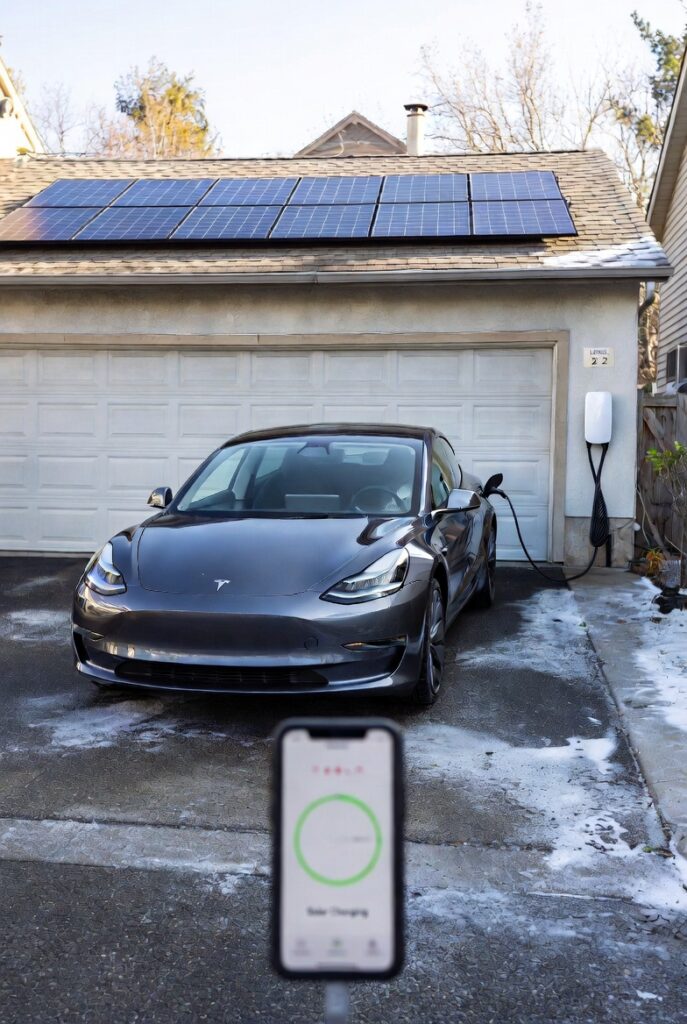
The charge tesla solar question is not about whether it works, it is about whether the math works for your commute. In January 2025 a homeowner on Kortright Road West in Guelph, Wellington County asked if his planned 2.4 kW solar array could cover his Model 3 RWD charging for his 60 km daily commute to Cambridge and back. The answer was no, and the reason had nothing to do with his panels or his car. His 60 km daily drive consumes approximately 9.6 kWh from the battery at Ontario’s real-world efficiency of 16 kWh per 100 km. With a 15% AC-DC conversion loss, his solar array needed to produce approximately 11.3 kWh per day just for the car.
The fix was adding four more 400W panels, bringing the array to 4 kW dedicated to the car and keeping the original 2.4 kW for the house. The 10 panels for the Tesla produce approximately 14 kWh on an average Ontario day, covering the 11.3 kWh the car needs with a surplus of approximately 2.7 kWh to start refilling the house battery bank. He invested approximately $2,000 in the four additional panels. The payback calculation was straightforward: his Model 3 previously cost approximately $750 per year in grid electricity for charging at Ontario’s rate of approximately $0.13/kWh. The additional panels paid for themselves in approximately 2.7 years purely on car charging savings.
I helped him do the same math for the Ontario winter scenario. In January at 2.0 to 2.5 peak sun hours, his 10-panel 4 kW array produces approximately 8 to 10 kWh per day, right at the breakeven point for the car with nothing left for the house. He added a Level 2 charger inside his attached garage so the car charges at 9.6 kW, adding approximately 48 km of range per hour.
On clear January days the solar charges the house battery bank during the day and the Level 2 charger tops up the car from the grid overnight at off-peak rates. The hybrid approach means he averages approximately $180 per year in grid charging costs during the five Ontario winter months versus $750 when he was grid-only. See our Ontario solar sizing guide to calculate your full system load before specifying panel count.
The charge tesla solar math: kWh, km, and the Ontario commute formula
The Tesla Model 3 RWD has a battery capacity of approximately 60 to 62.5 kWh with a real-world Ontario efficiency of approximately 16 kWh per 100 km in mixed driving conditions. That gives approximately 6 km per kWh as a conservative Ontario-winter-adjusted benchmark. For a 60 km daily commute, the car consumes approximately 9.6 kWh from the battery. With the 15% round-trip conversion loss from solar DC through the home inverter and back to DC in the car, the solar array must produce approximately 11.3 kWh per day just for the vehicle.
At Ontario’s annual average of 3.5 peak sun hours, that means a minimum of 3.2 kW of panels. Rounding up to 4 kW, or ten Renogy 100W panels at 400W each, provides a practical safety margin for cloudy days and system losses.
| Daily Commute | kWh from Battery | Solar Production Needed | Array at 3.5 PSH | Panels at 400W |
|---|---|---|---|---|
| 30 km | 4.8 kWh | 5.7 kWh | 1.6 kW | 4 panels |
| 60 km | 9.6 kWh | 11.3 kWh | 3.2 kW | 8 to 10 panels |
| 100 km | 16.0 kWh | 18.8 kWh | 5.4 kW | 14 panels |
| 130 km | 20.8 kWh | 24.5 kWh | 7.0 kW | 18 panels |
These figures are minimums for car charging alone, house loads are calculated separately on top. In Ontario winter at 2.0 to 2.5 peak sun hours, the same 4 kW array produces approximately 8 to 10 kWh per day. That is right at the breakeven point for the 60 km commute with nothing remaining for the house. To maintain reliable year-round solar-only charging, either a 5 to 6 kW array is required or a grid backup arrangement is needed during the five darkest months. The appliance-by-appliance sizing approach used for fridge load calculations applies identically to EV charging, measure the actual daily kWh, add losses, divide by PSH.
Level 1 vs Level 2: the flow rate that determines your morning routine
Level 1 charging uses a standard 120V/15A outlet and delivers approximately 7 to 9 km of range per hour to a Tesla Model 3. Over a 10-hour overnight charge, Level 1 adds approximately 80 km of range, which covers most Ontario 60 km commutes comfortably in summer and fall. The continuous draw is approximately 1.4 kW. Level 2 charging uses a 240V/32A wall connector and delivers approximately 40 to 48 km of range per hour, drawing approximately 9.6 kW continuously. A Model 3 with a 60 kWh battery charges from 20% to 80% in approximately 6 to 8 hours on Level 2, making it the practical standard for any Ontario driver covering more than 50 km per day.
In October 2024 a homeowner on Tremaine Road in Milton, Halton County decided to charge tesla solar using Level 1 only to avoid the cost of a Level 2 installation. He plugged his Model 3 into the 120V outlet in his detached garage at 6 PM and checked the app at 7 AM the following morning. The car had gained 96 km of range over 13 hours, approximately 7.4 km per hour.
He was satisfied through the summer and fall. However, in January 2025 he found the car had gained only 11 km of range after the same 13-hour overnight at minus 18 degrees Celsius. The battery thermal conditioning system had consumed approximately 85% of the Level 1 input throughout the night. He was commuting 55 km to Oakville and arrived with 23% state of charge on a morning that should have left him at 80%. The Level 2 installation cost $1,200 including the electrician. He has not had a low-range morning since.
Array sizing: how many 400W panels for your daily commute
The table above covers the car in isolation. For a complete Ontario charge tesla solar system, add your household daily load on top of the vehicle calculation. A typical Ontario cottage or home draws 1,200 to 1,800Wh per day for lighting, a DC fridge, and basic appliances. A 60 km commuter adding 11.3 kWh of car charging to a 1.5 kWh house load needs approximately 12.8 kWh of total daily solar production.
At 3.5 PSH that is a 3.7 kW array minimum, effectively the same 4 kW round number but now justified by the combined load rather than the car alone. The Victron SmartSolar MPPT 100/30 handles up to 400W of panels at 12V or 800W at 24V. Larger charge tesla solar arrays feeding a 48V system require a Victron MPPT 150/35 or higher to handle the combined current.
The investment math confirms the Guelph result. Four additional 400W panels at approximately $2,000 installed produces $750 per year in grid charging savings, yielding a 2.7-year payback on the car charging portion alone. Over 10 years the net saving is approximately $5,500 after recovering the panel cost. The Milton homeowner’s $1,200 Level 2 installation paid back in approximately 18 months compared to what he was spending on public Level 2 charging at $0.25 to $0.35 per kWh when his home Level 1 failed in winter.
For any Ontario Tesla owner building or expanding a solar array, the car charging math justifies oversizing the array by 30 to 40% beyond the house load calculation. See our battery chemistry guide for sizing the battery bank that stores the solar production between the panel harvest window and the overnight charging window.
Charge tesla solar in winter: why Level 1 fails at -18C and Level 2 is non-negotiable
In January, Ontario’s peak sun hours drop to 2.0 to 2.5 across southern Wellington and Halton Counties. A 4 kW array produces approximately 8 to 10 kWh per day, just enough to cover the 60 km commute’s 11.3 kWh requirement on a clear day with nothing remaining for house loads. Three strategies exist for managing the winter shortfall. The first is to oversize the array to 6 kW, which produces 12 to 15 kWh on clear January days and covers both car and house loads with comfortable margin.
The second is to use grid backup overnight in winter using a Level 2 charger at off-peak rates while the solar covers the house during the day, the Guelph hybrid approach that reduced annual charging costs to $180. The third is to reduce winter driving and charge less frequently during the three darkest months.
The Level 1 failure mechanism at Ontario winter temperatures is not a product defect. It is battery chemistry. At minus 18 degrees Celsius the Model 3 battery management system activates thermal conditioning to warm the cells before accepting a charge. The conditioning system draws approximately 1.0 to 1.2 kW. Level 1 provides a total of approximately 1.4 kW. Net charging power to the battery cells is approximately 0.2 to 0.4 kW, delivering 1 to 2 km of range per hour instead of the expected 7 to 9 km.
Level 2 provides 9.6 kW total input, enough to run the thermal conditioning at full rate and still deliver 8 to 9 kW of actual charging current to the battery. For any Ontario Tesla owner in a climate that reaches minus 15 degrees or colder between November and March, Level 2 is not an optional upgrade. It is the minimum viable charging infrastructure for a reliable daily commute. See our bidirectional EV charging guide for how the next generation of V2H systems can use your Tesla as a backup power source for the house when the solar array is offline.
NEC and CEC: code compliance for EV charging and solar in Ontario
NEC 625 governs electric vehicle supply equipment installation across North America. A Level 2 EVSE on a dedicated 240V/40A circuit must comply with NEC 625.10 branch circuit requirements and NEC 625.22 grounding requirements. A solar array connected to an EV charging system falls under both NEC 690 for the PV source circuit and NEC 625 for the EV supply equipment. The two code sections interact when a solar inverter feeds an EV charger through a shared panel: the PV disconnect requirements of NEC 690.13 and the EVSE disconnect requirements of NEC 625.23 must both be satisfied independently. Contact the NFPA at nfpa.org for current NEC 625 and NEC 690 requirements applicable to residential solar-EV installations.
In Ontario, CEC Section 26 governs electric vehicle supply equipment. An ESA permit is required for any new 240V circuit installation for a Level 2 EVSE in an Ontario home, including installations in attached and detached garages. The Tremaine Road Milton Level 2 installation required an ESA permit and was completed by a licensed electrical contractor. The permit process took two business days and the installation was completed the following weekend at a total cost of $1,200 for materials and labour.
For off-grid solar arrays that serve as the primary power source for an EV charger, both CEC Section 50 for the PV array and CEC Section 26 for the EVSE apply. Contact the Electrical Safety Authority Ontario at esasafe.com for current permit requirements before beginning any Level 2 installation or solar-EV integration in Ontario.
Pro Tip: The most common charge tesla solar sizing mistake is calculating the array for the car and forgetting to add the house load. The Kortright Road Guelph homeowner had a 2.4 kW array already covering his house. He needed to add 3.2 kW for the car, not replace the house array with a 3.2 kW array. The correct calculation is always: house daily load plus car daily load equals total solar production needed. Divide the total by your Ontario PSH for the season, add 20% buffer, and that is your minimum array size. For a 60 km commuter with a 1.5 kWh/day house load: (11.3 kWh car plus 1.5 kWh house) divided by 3.5 PSH equals 3.7 kW minimum. The 4 kW Guelph result covers both with a 2.7 kWh daily surplus for the house battery bank, exactly the kind of margin that keeps the system running through a three-day cloudy stretch in November without touching the grid.
The charge tesla solar verdict: three Ontario sizing profiles
- Ontario commuter under 50 km per day: 6 to 8 x 400W panels dedicated to car charging plus Level 1 for summer charging. A 50 km daily commute requires approximately 8 kWh of solar production per day including conversion losses. At 3.5 PSH, six to eight 400W panels producing 8.4 to 11.2 kWh covers the commute reliably from April through October. Level 1 overnight covers most summer commutes in 8 to 10 hours. However, Level 2 is strongly recommended for winter reliability. At minus 18 degrees Celsius, Level 1 delivers 1 to 2 km of range per hour instead of 8. For any commuter who drives through January and February in Ontario, the $1,200 Level 2 installation is the lowest-risk $1,200 available. The solar covers the car from spring through fall and the Level 2 grid connection covers January without interruption.
- Ontario commuter 50 to 100 km per day: 10 to 14 x 400W panels plus Level 2 mandatory for winter reliability. The 60 km Guelph case represents the middle of this range. A 4 kW dedicated car array covers the commute reliably eight months of the year and reaches breakeven in the two to three worst winter months. A 100 km daily commuter needs 14 panels at 5.6 kW to cover the car alone at 3.5 PSH. Add 2 to 4 panels for the house and the array grows to 6 kW minimum, which produces 21 kWh on a clear July day and runs both house and car with significant surplus for battery storage. Level 2 is not optional at this commute distance. The thermal conditioning draw at Ontario winter temperatures makes Level 1 unreliable for any commuter who cannot risk arriving at work on a 23% charge. The $1,200 Level 2 installation pays back against public charging costs in 18 months.
- Ontario Tesla owner building a new home or undertaking a major renovation: oversize the array to 6 kW minimum, install Level 2 from day one, and size the battery bank for two days of combined house and car autonomy. The single best time to get the charge tesla solar sizing right is before the drywall goes up. A 6 kW roof array produces 21 kWh on a clear summer day, enough for the house, the car, and meaningful surplus for battery storage. Installing Level 2 conduit and panel capacity during a renovation costs approximately $300 more than a standalone installation. Installing it after drywall and finished walls costs $800 to $1,200 more than doing it during construction. Size the battery bank for two days of autonomy: house daily load of approximately 1.5 kWh plus car daily load of approximately 11.3 kWh equals approximately 12.8 kWh per day. Two days is 25.6 kWh of usable storage, or approximately three 200Ah LFP batteries at 12V, or one 200Ah LFP bank at 48V. See our solar sizing guide for the full load calculation workflow.
Frequently Asked Questions
Q: How many solar panels do I need to charge Tesla solar for a 60 km daily commute in Ontario?
A: A 60 km daily commute consumes approximately 9.6 kWh from the Tesla battery at Ontario’s real-world efficiency of 16 kWh per 100 km. Adding the 15% conversion loss, the solar array must produce approximately 11.3 kWh per day for the car alone. At Ontario’s annual average of 3.5 peak sun hours, that requires a 3.2 kW array minimum. The practical recommendation is 10 x 400W panels at 4 kW, which produces approximately 14 kWh on a clear day and covers the commute through most of the year with a surplus for the house battery bank. Add your house daily load on top of the car calculation to determine the full array size needed.
Q: Can I charge Tesla solar using Level 1 only in Ontario winter?
A: Not reliably. At minus 18 degrees Celsius the Tesla Model 3 battery management system activates thermal conditioning, drawing approximately 1.0 to 1.2 kW to warm the cells before accepting a charge. Level 1 provides only 1.4 kW total, leaving approximately 0.2 to 0.4 kW for actual charging, enough to add 1 to 2 km of range per hour instead of the expected 7 to 9 km. The Milton Tremaine Road homeowner experienced this firsthand: 13 hours on Level 1 at minus 18 degrees added only 11 km of range instead of the 96 km he got in summer.
Level 2 provides 9.6 kW, enough to run thermal conditioning and charge simultaneously. For any Ontario commuter driving through January and February, Level 2 is the minimum viable charging infrastructure.
Q: How long does it take to charge a Tesla Model 3 from a 4 kW solar array in Ontario?
A: A 4 kW array produces approximately 14 kWh on a clear Ontario summer day at 4.5 to 5.0 peak sun hours. A 60 km commute consumes approximately 9.6 kWh from the battery, so the array covers the commute and adds approximately 4 kWh toward the house battery bank on a good day. On an average Ontario day at 3.5 PSH, the array produces approximately 14 kWh, covering the daily commute with a modest surplus.
In January at 2.0 to 2.5 PSH the same array produces 8 to 10 kWh, right at the breakeven point for the car with nothing remaining for the house. Solar does not charge the car directly on a minute-by-minute basis in most home systems, it charges the house battery bank or feeds the grid, and the Level 2 charger draws from whichever source is available.
This build is engineered within the 48V DC Safety Ceiling. Diagnostic logic is based on 20+ years of technical service experience. All structural and electrical installations must be verified by a Licensed Professional and comply with your Local AHJ.
This article contains affiliate links. If you purchase through these links, I earn a small commission at no extra cost to you.