
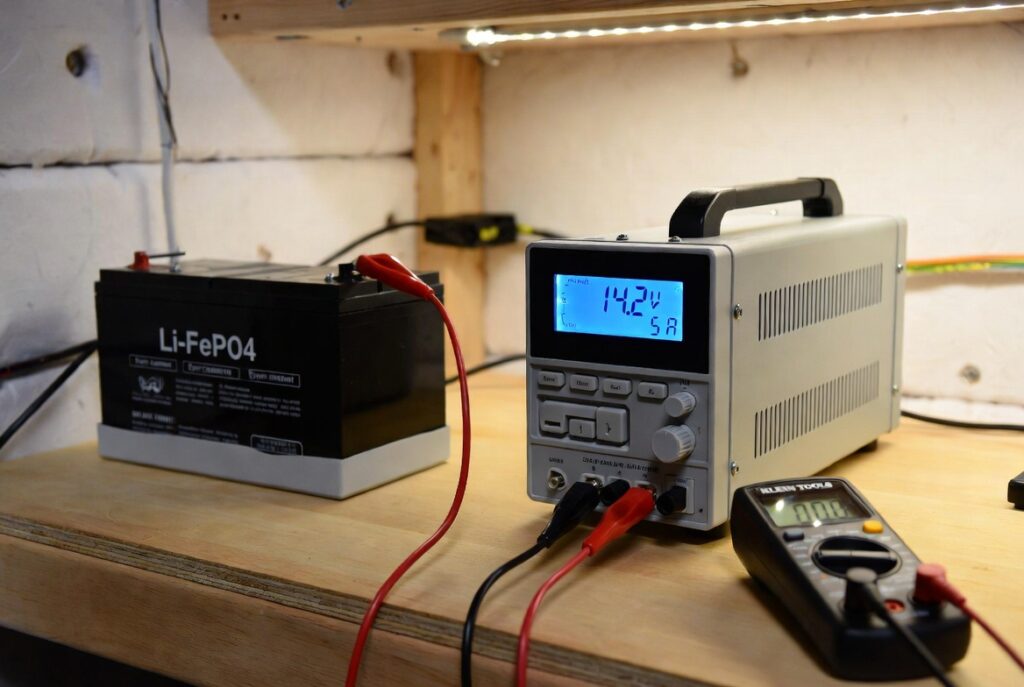
LiFePO4 BMS reset is the most misunderstood procedure in off-grid solar. In Ontario, the wrong approach turns a recoverable $50 fix into a $3,800 bank replacement. The BMS locks out when cell voltage drops below a safe threshold, and the battery appears dead at the terminals. Most owners reach for an automotive charger, which is exactly the wrong tool for this job.
The correct LiFePO4 BMS reset uses a controlled low-current approach at 0.05C. On a 100Ah bank, that means 5A maximum until the cells rise above 2.5V per cell. This slow wake-up gives the BMS time to evaluate cell health before opening the charge gate. Rushing the process with 40 to 50A from a shop charger causes lithium plating and permanent damage.
This guide covers the full LiFePO4 BMS reset diagnostic for Ontario off-grid systems. For a broader overview of battery selection, refer to the Solar Battery Guide. For system sizing fundamentals, start with the solar sizing guide.
What Triggers a LiFePO4 BMS Reset Condition
A LiFePO4 BMS locks out when cell voltage drops below 2.0 to 2.5V per cell. This is a protection feature, not a malfunction. The battery reads 0V at the terminals because the BMS has disconnected all output FETs. However, the cells themselves may still hold recoverable charge above 2.0V internally.
The most common cause in Ontario is parasitic drain during seasonal storage. An inverter left on standby draws 5 to 15W continuously, which can empty a 300Ah bank in under three weeks. Temperature-induced voltage sag during deep cold can also push cells below the BMS threshold temporarily. Recognizing whether a lockout is recoverable depends entirely on how long the cells sat below the cutoff voltage.
| Condition | Voltage (V/cell) | Cell State | Recovery Method | Success Rate | Cost |
|---|---|---|---|---|---|
| Recoverable Lockout | 2.0 to 2.5 | Retains charge | 0.05C slow wake-up | 95%+ | $50 |
| Non-Recoverable | Below 2.0 | Plating, internal damage | Full replacement | 0% | $3,800+ |
The distinction between these two conditions determines whether a LiFePO4 BMS reset will succeed. Cells held below 2.0V for more than 90 days typically suffer irreversible capacity loss from lithium plating. Cells that dropped below the threshold recently, within days or weeks, almost always recover fully with the correct protocol.
Why High-Amperage Recovery Destroys the Bank
A standard automotive charger in boost mode sends 40 to 50A into cells at critical low voltage. The BMS FETs cannot regulate this surge because they are in a disconnected protection state. The uncontrolled current causes lithium plating on the anodes and localized overheating across the cells. This damage is permanent and cannot be reversed by cycling or reconditioning.
The high-amperage approach also creates uneven cell temperatures within the bank. One cell may spike to 45C while its neighbor sits at 20C, creating a permanent capacity imbalance. After this type of damage, the bank can never hold a balanced charge again. Every subsequent cycle accelerates the weakest cell toward failure, making a LiFePO4 BMS reset impossible.
The London Diagnosis
A cabin owner near London in Middlesex County found a 400Ah 12V LFP bank reading 0V after parasitic drain. He connected a standard 12V automotive shop charger set to boost mode. The charger sent approximately 50A into cells sitting at critical low voltage. The BMS FETs could not regulate the sudden current surge.
The uncontrolled 50A surge caused lithium plating on the anodes of all four cells at once. Internal cell temperatures spiked unevenly, creating permanent capacity imbalance across the bank. What had been a simple low-voltage lockout became irreversible cell damage in under 90 seconds. The unexpected consequence was that even the BMS circuit board itself suffered thermal damage from the unregulated current.
This is the same mistake as connecting jumper cables to the wrong terminals on a modern vehicle. The starter motor survives, but the ECU and body control modules fry from the spike. The owner replaced the entire $3,800 bank because the cells could no longer hold balanced charge. A $50 benchtop charger at 5A would have recovered the bank in two hours.
The 0.05C Slow Wake-Up Protocol for LiFePO4 BMS Reset
The correct LiFePO4 BMS reset starts with a Klein Tools MM400 multimeter reading at the battery terminals. If the reading shows 0V to 3V, the BMS is locked but the cells may be recoverable. Set a benchtop charger to 14.2V with a 5A current limit on a 100Ah bank. The 0.05C rate gives the BMS time to evaluate each cell individually.
Once all cells rise above 2.5V per cell, the BMS gate opens and normal charging resumes automatically. Keep the charge rate below 10A until the bank reaches at least 13.0V at the terminals. After the bank reaches full charge, run a complete discharge and charge cycle monitored by the SmartShunt. Compare the measured Ah to the rated capacity to confirm successful recovery.
The St. Thomas Recovery
A property owner near St Thomas in Elgin County found a 100Ah 12V LFP bank locked out after winter. The inverter had been left on standby, draining the bank below the BMS threshold over four months. The terminal voltage read 0V on a Klein Tools MM400 multimeter. He set a variable DC benchtop power supply to 14.2V with a 5A current limit.
Within 90 minutes the cells rose above 2.5V per cell and the BMS gate clicked open. The Victron SmartShunt showed the bank had retained 4.2 percent SoC the entire time. The BMS had locked out at 8 percent SoC, not at true zero. The cells were never in danger because the BMS did exactly what it was designed to do.
This is like using a trickle charger on a vehicle parked for six months instead of jump-starting it. The slow approach lets the battery electronics come online before full current hits the cells. After a complete discharge and charge cycle, the SmartShunt capacity test showed 99 percent of original rated capacity. The total recovery cost was $0 in parts and two hours of patience.
Preventing Future BMS Lockouts in Ontario
The simplest prevention is disconnecting the negative terminal before seasonal storage. Store the bank at 50 to 60 percent SoC following the storage voltage standard. Install remote monitoring with the SmartShunt and Cerbo GX to catch voltage drop before it reaches lockout threshold. For more on parasitic drain during storage, see the LiFePO4 self-discharge guide.
For Ontario properties that experience extended cold snaps, a Battle Born 100Ah Heated LFP eliminates temperature-induced voltage sag. The built-in heater keeps cells above 0C automatically, preventing the LiFePO4 BMS reset scenario entirely. For more on cold weather charging, refer to the cold charging standard.
Code Compliance for LiFePO4 BMS Reset and Battery Installations
NEC Article 480 requires battery installations to include disconnect devices and overcurrent protection on all ungrounded conductors. The disconnect is directly relevant to BMS recovery because it ensures full bank isolation before applying a wake-up charge. Proper fusing prevents uncontrolled current flow during any recovery attempt. Compliance is verified through the NFPA (National Fire Protection Association) code cycle.
CEC Section 64 governs Ontario-specific installation standards for battery systems, including requirements for CSA-listed equipment and temperature monitoring. All battery disconnect devices must be accessible without removing covers, which is critical during an emergency LiFePO4 BMS reset. All Ontario installations must be inspected by the ESA (Electrical Safety Authority) before commissioning.
Pro Tip: A $50 benchtop charger with adjustable current limiting is the most important LiFePO4 BMS reset tool. It protects a $3,800 bank from the damage a $200 shop charger causes in 90 seconds.
- Never use an automotive charger on a locked LiFePO4 BMS. The 40 to 50A boost mode causes irreversible lithium plating and cell damage.
- Follow the 0.05C slow wake-up protocol at 5A on a 100Ah bank. Monitor with a multimeter until cells rise above 2.5V per cell.
- Prevent future lockouts by disconnecting the negative terminal before storage and monitoring remotely with a SmartShunt and Cerbo GX.
Frequently Asked Questions
Can I use a car battery charger to reset a locked LiFePO4 BMS?
No. A standard automotive charger sends 40 to 50A into cells at critical low voltage. The BMS FETs cannot regulate this surge. Use a benchtop charger set to 14.2V with a 5A current limit for safe LiFePO4 BMS reset recovery.
How do I know if my LiFePO4 bank is recoverable after a lockout?
Check terminal voltage with a quality multimeter. If the reading is 0V to 3V, the BMS is locked but cells may still hold charge above 2.0V internally. Banks held below 2.0V per cell for more than 90 days typically cannot be recovered.
How long does the 0.05C slow wake-up protocol take?
For a 100Ah 12V LFP bank, the slow wake-up typically takes 90 minutes to two hours. The BMS gate opens once all cells rise above 2.5V per cell. After that, normal charging resumes automatically.
This build is engineered within the 48V DC Safety Ceiling. Diagnostic logic is based on 20+ years of technical service experience. All structural and electrical installations must be verified by a Licensed Professional and comply with your Local AHJ.
About the Author
Robert Bertrand spent 20 years as a service advisor in the automotive industry (Lexus and Nissan), where precision diagnostics, wiring integrity, and documentation standards were non-negotiable. He brings that same technical discipline to GridFree Guide, where he researches, tests, and documents off-grid solar systems for Ontario conditions. Based in Rockwood, Ontario, every article is built on verified specifications, manufacturer data, and the real-world climate constraints of Canadian off-grid living.
As an Amazon Associate I earn from qualifying purchases. This site also contains affiliate links to other products and services. GridFree Guide earns a small commission at no extra cost to you.