
Most owners cycle a new lifepo4 battery wrong on day one. The mistake costs them years of service life. No spec sheet warns them about it. The first five cycles set the bank’s lifetime accuracy.
The break-in period is when the BMS does its calibration work. It maps state of charge readings, balances individual cells, and sets a true 100 percent reference. Skipping it is like skipping the break-in on a new engine. The piston rings never seat properly and the engine burns oil for life.
The cycle new lifepo4 protocol takes 2-3 days for a 100Ah bank. The protocol costs zero dollars. The payoff is years of accurate SoC readings and full design capacity. Most Ontario off-grid owners skip this step and pay for it in lost capacity over the bank’s life.
For broader sizing context, see our how much solar power do I actually need hub guide. For the full battery framework, see our solar battery guide. For the cycle count math behind why this matters, see our LiFePO4 charge cycles guide.
| Cycle Stage | SoC Target | Duration | What the BMS Does |
|---|---|---|---|
| Cycle 1 charge | 0% to 100% | 5-8 hours at 0.2C | Maps cell voltages, begins balance |
| Cycle 1 discharge | 100% to 20-30% | 4-6 hours under known load | Logs initial discharge curve |
| Cycle 2 charge | 20-30% to 100% | 4-6 hours at 0.2C | Refines cell balance |
| Cycles 3-5 | 20-30% to 100% | One per day | Calibrates SoC accuracy |
| Cycle 6+ | Normal DoD | Daily service | BMS fully calibrated |
How to cycle new lifepo4 from unboxing to first service day
Most Ontario off-grid owners receive their LFP and plug it in without a second thought. They miss the critical break-in period that sets the battery’s lifetime accuracy. The first five cycles are when the BMS does its calibration work. After cycle 5, the bank’s behavior is locked in for the next decade of service.
The cycle new lifepo4 break-in protocol takes 2-3 days for a 100Ah bank. Larger banks take 4-5 days. The schedule is one full cycle per day at conservative depth of discharge. Rest periods between cycles let the BMS finalize each step of the calibration.
The investment in this protocol pays back in years of accurate SoC reading and full design capacity. A bank rushed into service without break-in typically reads 100 percent SoC at 80-85 percent of true capacity. The owner thinks the bank is full when it is short by 30Ah or more. That mismatch causes premature low-voltage disconnects and incorrect charge timing for the rest of the bank’s working life.
The cycle new lifepo4 protocol applies to every LFP chemistry battery. Drop-in 12V replacements need it. 24V and 48V banks need it. Server-rack LFP units need it too.
Unboxing voltage check and what arrival SoC tells you
Most LFP batteries arrive at 50-60 percent state of charge for shipping. The shipping SoC keeps the cells in their safe range during transit. Lithium chemistry sits happiest at mid-range SoC during long storage periods.
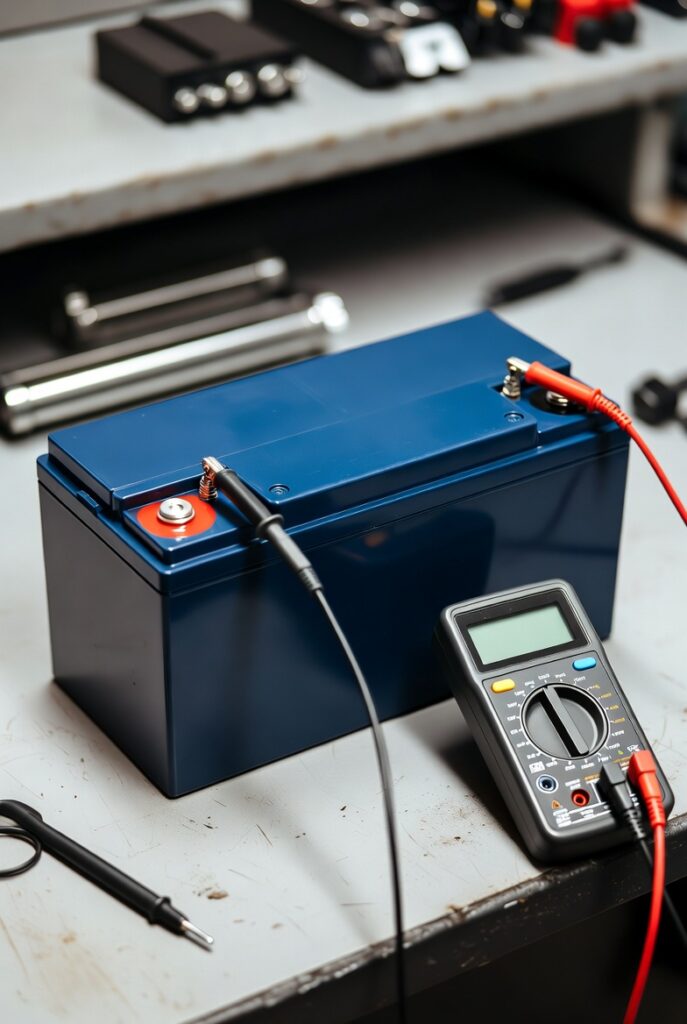
The first step at unboxing is a terminal voltage check before any wiring. For a 12V LFP system, a reading of 13.2V indicates 50 percent SoC. A 24V system at 26.4V shows the same midpoint. A 48V system at 52.8V matches.
A voltage outside 12.8V to 13.4V on arrival means contact the supplier before doing anything else. A reading at 13.5V suggests it arrived closer to 60 percent SoC, which is fine. A reading at 12.8V indicates around 40 percent SoC, also acceptable. A reading below 12.5V or above 13.6V signals a problem with shipping conditions or with the battery itself.
Photograph the terminal voltage reading on arrival before any unboxing or wiring. Most warranty claims for “dead on arrival” batteries fail because the owner cannot prove the arrival voltage. The timestamped photo protects the warranty and documents the supplier’s shipping discipline. The cycle new lifepo4 protocol begins with that single photo.
First charge at 0.2C and why slow wins
The first charge should run at 0.2C or lower. For a 100Ah bank, this means a maximum charge current of 20A. For a 200Ah bank, it means 40A maximum. For a 300Ah bank, it means 60A maximum.
A slow first charge lets the BMS map all cells and balance them properly. Fast charging skips this critical calibration step. The BMS algorithm requires time to read each cell’s response to charging current. Rushed first charge produces an imbalanced bank that never recovers full design capacity.
Most charge controllers allow setting a maximum charge current limit during commissioning. Use this setting on day one to enforce 0.2C even if the controller is rated higher. The Battle Born 100Ah Heated LFP handles up to 50A continuous charge. The first cycle should still run at 20A maximum.
The 0.2C rule is the single most ignored step in LFP commissioning across Ontario installations. Owners want the battery in service immediately and crank the controller to maximum output. The result is years of mismatched SoC readings and partial capacity loss that never recovers.
The Frontenac County unboxing
A homeowner near Kingston in Frontenac County ordered a 200Ah LFP bank for his Tier 2 off-grid build. The battery arrived in November 2024 after a 6-day shipping window through cold weather. He pulled it from the box and immediately wired it to his 600W array and 2000W inverter. The first charge ran at 35A, which is 0.175C and within spec on paper.
His Victron SmartShunt showed 100 percent SoC after only 4 hours of charging. The unexpected consequence: the battery had arrived at 70 percent rather than the standard 50 percent shipping SoC. He had pushed full system load before the BMS finished its initial cell balance routine. Two months later, the SmartShunt was reading 100 percent SoC with actual capacity around 165Ah of the rated 200Ah.
This is the diagnostic equivalent of skipping the break-in period on a new engine. The piston rings never seat properly and the engine burns oil for life. We pulled the battery offline for a 24-hour float charge to top-balance the cells. The capacity recovered to 192Ah after a proper cycle new lifepo4 reset.
Cell balance verification in the cycle new lifepo4 break-in
At full charge, all cells should read within 0.05V of each other. The 0.05V drift target is the BMS calibration goal during the first charge. Cell drift over 0.10V means the BMS needs time to top-balance the cells.
The top-balance procedure runs at full absorption voltage for 12 to 24 hours. For a 12V system, hold at 14.4V. For a 24V system, hold at 28.8V. The float charge holds cells at top voltage so the BMS can equalize charge across all cells.
If cell drift exceeds 0.05V after a 12-hour float, extend to 24 hours and remeasure. Drift remaining over 0.05V after 24 hours indicates a possible manufacturing defect. Document the drift readings before contacting the supplier. Warranty claims need the measured numbers and the timestamps.
For deeper cell-chemistry research, see Battery University on lithium battery balance management. The published lab data confirms the 0.05V target as the industry standard. See our LFP battery Ontario guide for the full cell management framework.
First discharge to 20-30 percent and the BMS calibration window
The first discharge should go to 20 to 30 percent SoC, not deeper. Use a known load like lights, a fan, or a small heater over 4 to 6 hours. The controlled discharge gives the BMS clean data to map the discharge curve.
Watch for cell voltage drift during the discharge. Drift over 0.10V during discharge indicates an imbalance the first charge did not resolve. Run another full charge plus a 12-hour float before attempting cycle 2. Skipping this step locks in inaccurate SoC readings for the bank’s working life.
The Victron SmartShunt logs the first discharge curve and uses it to calibrate the SoC algorithm. The calibration improves with each subsequent cycle as the SmartShunt accumulates real discharge data. By cycle 5, the SmartShunt should read SoC accurately within 1 percent of true capacity.
Cycles 2 through 5 in the cycle new lifepo4 protocol
A cottage owner near Barrie in Simcoe County took delivery of a 100Ah heated LFP bank in March 2025. He had read the cycle new lifepo4 protocol on a forum and committed to the full break-in before commissioning. His system was a 400W array and a 1500W PSW inverter for a seasonal cottage. He ran the entire break-in protocol over a long weekend before adding any household load.
The first charge took 7 hours at 0.2C to reach 100 percent absorption voltage. He measured cell drift at 0.08V on the first cycle, which exceeded the 0.05V target. The unexpected consequence: a 14-hour float charge brought the cells into 0.02V drift balance, far better than the 0.05V target. His SmartShunt SoC reading matched actual battery state precisely from cycle 2 onward, which most installs never achieve.
A proper engine break-in produces compression numbers within 5 percent of factory spec across all cylinders. His 5-cycle break-in produced the same result for his battery bank. Two years into service, his bank still reads full design capacity with cell drift under 0.03V. The 3 days he spent on cycle new lifepo4 calibration are paying back through year 10.
After the break-in, when you can cycle the new lifepo4 bank into normal service
After the fifth cycle, the BMS has full calibration. Move to normal daily depth of discharge pattern. Most Ontario off-grid systems run at 50 to 60 percent daily DoD with occasional deeper discharges during gray streak periods. The bank handles this load comfortably from cycle 6 onward.
In the first three years of service, watch the SmartShunt SoC reading and cell drift values monthly. A well-calibrated BMS maintains accuracy and extends the bank’s service life. Cell drift should stay under 0.03V during normal operation. SoC accuracy should remain within 2 percent of true capacity.
Long-term storage during seasonal cabin layup needs a separate protocol. Store at 50 to 60 percent SoC, not at 100 percent. The SmartShunt’s storage mode setting handles this automatically when configured. See our LFP self-discharge guide for the full seasonal layup procedure.
NEC Article 690 governs solar PV systems including all new battery installations. Wire sizing follows NEC 690.8 with continuous current calculations. Battery overcurrent protection follows NEC 690.9, with Class T fuses required for LFP banks under most authorities. Current standards are published at nfpa.org.
CEC Section 64 governs solar PV installations in Ontario including new battery commissioning. Permanent battery installations require an ESA permit before energizing the system. Wire sizing and disconnect requirements follow Section 64 tables. The Electrical Safety Authority publishes current Ontario compliance guidelines at esasafe.com.
Pro Tip: Photograph the battery’s terminal voltage on arrival before unboxing it. Most warranty claims for dead-on-arrival batteries are denied because the owner cannot prove the arrival voltage. The photo timestamps the condition and protects the warranty claim. The cycle new lifepo4 break-in starts with that single photo.
- For the off-grid owner unboxing a new LFP this week: Run the 5-cycle break-in over 3 days before adding load. The protocol costs zero dollars and adds years to service life. The Frontenac County math holds across every brand and chemistry of LFP battery.
- For the seasonal cottage owner installing in fall or winter: Allow the battery to warm to room temperature before charging. Cold-charging causes lithium plating that the BMS cannot reverse. A heated LFP unit handles this automatically through internal heating elements.
- For the year-round homeowner replacing an existing AGM bank: Disconnect the AGM bank completely before installing the new LFP. Mixed-chemistry parallel banks destroy both batteries within months. Run the cycle new lifepo4 break-in on the LFP unit before any load is connected.
Frequently asked questions
Q: How long does the cycle new lifepo4 break-in protocol take?
A: The full protocol takes 2-3 days for a 100Ah bank. Larger banks take 4-5 days. The schedule is one cycle per day at conservative DoD with rest periods between cycles. The investment pays back in years of accurate SoC reading and full design capacity.
Q: What if I skipped the break-in and the battery is already in service?
A: A 24-hour float charge at full absorption voltage can recover most of the lost balance. Pull the bank offline, charge to 100 percent, and hold at float for 24 hours. The BMS will top-balance the cells and recover most lost capacity. Future cycles will calibrate the SmartShunt SoC reading.
Q: Does the cycle new lifepo4 protocol apply to drop-in replacement banks?
A: Yes, even drop-in 12V LFP units benefit from a proper break-in cycle. The BMS in a drop-in unit still needs initial calibration through controlled charge and discharge cycles. The protocol applies to every LFP chemistry battery regardless of form factor.
This build is engineered within the 48V DC Safety Ceiling. Diagnostic logic is based on 20+ years of technical service experience. All structural and electrical installations must be verified by a Licensed Professional and comply with your Local AHJ.
This article contains affiliate links. If you purchase through these links, I earn a small commission at no extra cost to you.
About the Author
Robert Bertrand spent 20 years as a service advisor in the automotive industry (Lexus and Nissan), where precision diagnostics, wiring integrity, and documentation standards were non-negotiable. He brings that same technical discipline to GridFree Guide, where he researches, tests, and documents off-grid solar systems for Ontario conditions. Based in Rockwood, Ontario, every article is built on verified specifications, manufacturer data, and the real-world climate constraints of Canadian off-grid living.
As an Amazon Associate I earn from qualifying purchases. This site also contains affiliate links to other products and services. GridFree Guide earns a small commission at no extra cost to you.