
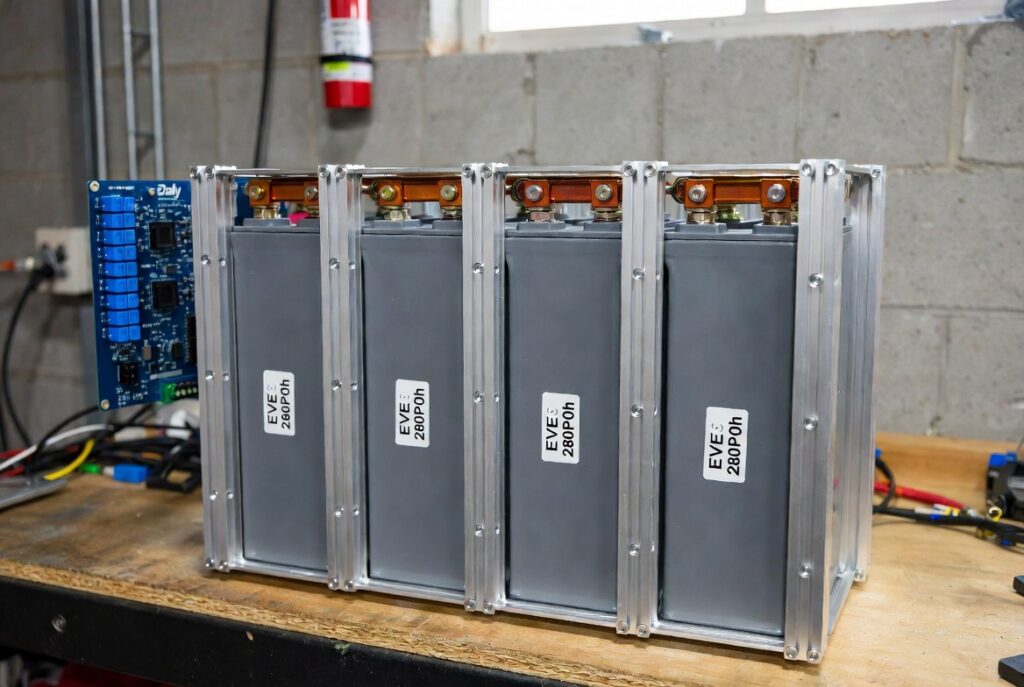
A DIY LiFePO4 battery bank costs 40 percent less than prebuilt and outlasts it when assembled correctly. Four EVE 280Ah prismatic cells cost $880. Add a 200A BMS at $85 and compression hardware at $35 and the total is $1,005. A prebuilt equivalent at the same capacity costs $2,800 or more.
The savings only justify the effort at 200Ah and above, where the gap widens from $40 to $1,800. At 100Ah the difference is $360 DIY versus $400 prebuilt. At 280Ah the savings pay for themselves immediately. The catch is that a DIY LiFePO4 battery requires precise top-balancing or the BMS shuts the system down.
This guide covers cell selection, top-balancing, BMS wiring, and compression with two Ontario I-moments that show both outcomes. For the full chemistry comparison, see our solar battery guide for Ontario.
| Component | DIY Cost | Prebuilt Equivalent |
|---|---|---|
| 4x EVE 280Ah cells | $880 | Included in prebuilt |
| 200A Daly Smart BMS | $85 | Included in prebuilt |
| Compression plates | $35 | Included in prebuilt |
| Busbars, bolts, WAGO | $30 | Included in prebuilt |
| Bench power supply | $45 | Not needed |
| Total (280Ah) | $1,075 | $2,800+ |
Why a DIY LiFePO4 battery bank saves 40 percent over prebuilt
The cost breakdown is straightforward. Four EVE 280Ah cells at $220 each total $880. The 200A Daly Smart BMS adds $85, compression plates add $35, and busbars with connectors add $30. The full 280Ah DIY LiFePO4 battery bank costs approximately $1,005 to assemble.
A prebuilt equivalent like four Battle Born 100Ah LFP units costs $1,600 for 400Ah total. A single prebuilt 280Ah class unit costs $2,800 or more. The LFP versus AGM comparison confirms that LFP chemistry wins on cost per cycle regardless of build method.
Cell selection and what to look for in prismatic LiFePO4 cells
EVE 280Ah prismatic cells are the current standard for DIY LiFePO4 battery builds. Each cell runs at 3.2V nominal with a full charge of 3.65V. Four wired in series produce 12.8V nominal for standard 12V systems. The battery spec sheet guide shows how to verify cell grading before purchase.
Always buy Grade A cells with matched internal resistance from the same production batch. Grade B or ungraded cells can have voltage drifts as high as 0.25V between units. That mismatch causes BMS shutdowns during partial SOC charging. In Ontario’s cold winters, even a small imbalance triggers repeated system halts.
The top-balancing protocol that prevents every common failure
Charge each cell individually to exactly 3.65V using a bench power supply. Each cell gets its own regulated charge until it stops accepting current. Then connect all four cells in parallel and let them rest for 24 hours. After the rest period, all cells should sit within 0.005V of each other.
That precision eliminates BMS shutdowns from voltage imbalance. Passive BMS balancing draws only 60mA and takes weeks to correct a 0.15V gap. Top-balancing takes 48 hours total but prevents every common DIY LiFePO4 battery failure. The battery voltage guide covers the full voltage range for each chemistry.
BMS wiring, compression, and the DIY LiFePO4 battery assembly sequence
The Daly Smart BMS provides overcharge protection above 3.65V per cell and cuts off below 2.5V. It also blocks charging below 0 degrees C for Ontario winter protection. I use WAGO 221-412 Lever Nuts for all BMS signal wire connections. They are tool-free, reliable, and rated for 20A per terminal.
Prismatic cells swell up to 3 percent during cycling if not compressed. That swelling causes internal delamination after a few hundred cycles. Aluminium compression plates with bolts torqued to 5 Nm prevent this. Our lithium battery safety guide covers the full thermal and mechanical protection requirements.
The Simcoe County 280Ah build success
I built a 4S 280Ah DIY LiFePO4 battery bank for a full off-grid home in Simcoe County last October. The four EVE 280Ah cells cost $880 at $220 per cell. I added a 200A Daly Smart BMS at $85 and compression plates at $35. The total build cost was $1,005 including busbars, bolts, and WAGO connectors.
The critical step was the top-balance. I spent 48 hours charging each cell individually to exactly 3.65V before connecting any busbars. After parallel resting for 24 hours, all four cells sat within 0.005V. That precision eliminated any risk of BMS shutdown from cell voltage mismatch.
After 12 months and 400 deep cycles, the Victron SmartShunt shows less than 0.02V drift between cells. The owner got 280Ah of usable capacity for $1,005. A prebuilt equivalent would have cost $2,800 or more. The DIY LiFePO4 battery delivered three times the capacity at one-third the price.
The Kawartha Lakes unbalanced cell failure
A builder in Kawartha Lakes connected four prismatic cells without top-balancing. The cells arrived with voltages ranging from 3.28V to 3.43V. He assumed the BMS would handle the 0.15V gap during normal use. He bolted the busbars and turned on the charger the same afternoon.
During the first full charge, the highest cell reached 3.75V while the lowest sat at 3.45V. The BMS triggered high-voltage protection and shut down the bank. The overall SOC was only 85 percent when the shutdown occurred. Passive balancing at 60mA would need weeks to correct that gap.
He disconnected the bank, bought a $45 bench power supply, and charged each cell to 3.65V individually. The process took 3 days of downtime. His DIY LiFePO4 battery worked perfectly after the top-balance was completed. The shortcut cost him 3 days and $45 that should have been spent before assembly.
NEC and CEC code requirements for lithium battery assembly
NEC 706.7 requires all lithium battery installations to include overcharge protection, thermal monitoring, and mechanically secured wiring. Every connection point must be rated for continuous load with proper insulation. A DIY LiFePO4 battery without a certified BMS violates NEC 706 and creates thermal runaway risk. Contact the NFPA at nfpa.org for current lithium battery requirements.
CEC Section 64 mandates that all energy storage systems in Ontario include overcharge and thermal protection. The ESA requires that DIY LiFePO4 battery enclosures meet ventilation and temperature monitoring standards. Non-compliant installations risk insurance denial and legal liability. Contact the Electrical Safety Authority at esasafe.com before connecting any DIY battery bank.
Pro Tip: Buy the bench power supply before you buy the cells. A $45 supply pays for itself by preventing the $300 BMS repair that comes from skipping the top-balance. Charge each cell to 3.65V, parallel rest for 24 hours, then assemble. That 48-hour investment protects every dollar in the build.
DIY LiFePO4 battery verdict: top-balance or do not build
- Budget builders wanting 200Ah or more: Buy EVE 280Ah cells, a Daly BMS, and compression plates. Top-balance before assembly. Pair with a Victron MPPT 100/50 for reliable charging. Total cost is $1,005 for 280Ah versus $2,800 prebuilt.
- Builders wanting reliability without assembly risk: Buy a prebuilt Battle Born 100Ah LFP. It arrives ready to connect with no balancing or compression needed. The premium buys convenience, warranty, and zero assembly risk.
- Builders who skipped the top-balance: Stop and disconnect the bank now. Buy a $45 bench power supply and charge each cell to 3.65V individually. Reassemble only after all cells match. The 48-hour delay prevents every common failure.
Frequently asked questions
Q: Is it cheaper to build your own LiFePO4 battery?
A: Yes, at 200Ah and above. A 280Ah DIY bank costs $1,005 versus $2,800 for prebuilt equivalents. At 100Ah the savings are minimal at $360 versus $400, which barely justifies the time and risk.
Q: What happens if you skip top-balancing LiFePO4 cells?
A: Cells with voltage gaps cause BMS high-voltage shutdowns at partial SOC during normal charging. Passive balancing at 60mA takes weeks to correct even a 0.15V difference. The system shuts down repeatedly until each cell is manually charged to 3.65V.
Q: Do you need a BMS for a DIY LiFePO4 battery?
A: Yes, always. The BMS prevents overcharge above 3.65V and stops discharge below 2.5V per cell. It also blocks charging below 0 degrees C, protecting against lithium plating in Ontario winter. Without a BMS, cells have no protection from thermal runaway.
This build is engineered within the 48V DC Safety Ceiling. Diagnostic logic is based on 20+ years of technical service experience. All structural and electrical installations must be verified by a Licensed Professional and comply with your Local AHJ. See our legal and safety disclosure for full scope.
About the Author
Robert Bertrand spent 20 years as a service advisor in the automotive industry (Lexus and Nissan), where precision diagnostics, wiring integrity, and documentation standards were non-negotiable. He brings that same technical discipline to GridFree Guide, where he researches, tests, and documents off-grid solar systems for Ontario conditions. Based in Rockwood, Ontario, every article is built on verified specifications, manufacturer data, and the real-world climate constraints of Canadian off-grid living.
As an Amazon Associate I earn from qualifying purchases. This site also contains affiliate links to other products and services. GridFree Guide earns a small commission at no extra cost to you.