
The best AGM batteries for Ontario solar share three traits: sealed construction, cold tolerance, and 500 or more cycles. AGM is the correct lead-acid choice because it requires zero maintenance and handles seasonal absence. Gel fails from overcharging and flooded fails from neglect. AGM survives both failure modes reliably.
The ranking criteria are cycle life at 50 percent DoD, cold performance, and cost per usable Ah cycle. CCA ratings are irrelevant for solar because cold cranking amps measure burst current, not sustained discharge. The best AGM batteries are judged by how many cycles they deliver, not by starter specs.
This guide ranks three AGM products by Ontario use case with real cost-per-cycle math. For the full chemistry comparison including LFP, see our solar battery guide for Ontario.
| Battery | Cost | Cycles (50% DoD) | Cost/Cycle | Best For |
|---|---|---|---|---|
| Renogy 100Ah AGM | $125 | 400 to 600 | $0.50 | Tier 1 shed/mobile |
| VMAXTANKS 100Ah AGM | $160 | 500 to 700 | $0.53 | Tier 2 cottage |
| UPG 100Ah AGM | $140 | 400 to 500 | $0.56 | Reliable backup |
| Discount brand 100Ah | $85 | 150 (at 80% DoD) | $1.13 | None recommended |
| Battle Born 100Ah LFP | $400 | 3,000+ | $0.13 | Long-term standard |
How we rank the best AGM batteries for Ontario solar
We measure performance by cycle life at 50 percent DoD, cold tolerance, and cost per usable Ah cycle. The battery spec sheet guide shows how to verify cycle ratings before buying. The best AGM batteries deliver at least 400 cycles when discharged no deeper than half capacity.
CCA ratings mean nothing for solar storage. What matters is how many discharge and recharge cycles the battery completes before losing capacity. The best AGM batteries for Ontario are ranked by real-world survival, not marketing numbers printed on the label.
The Renogy 100Ah AGM for Tier 1 shed and mobile builds
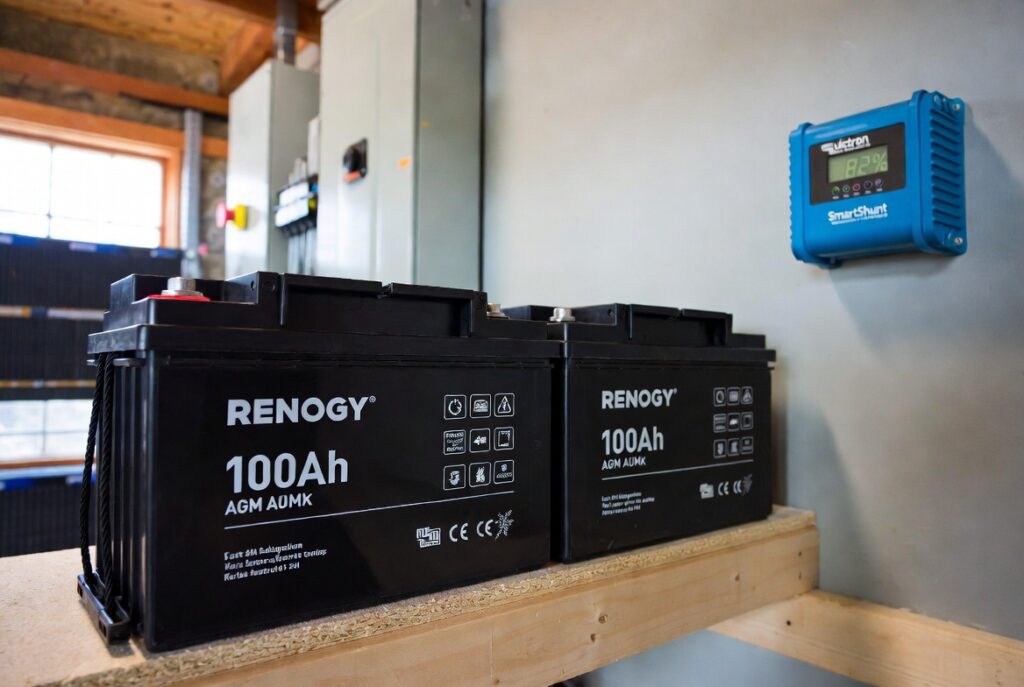
The Renogy 100Ah AGM costs $125 and delivers 400 to 600 cycles at 50 percent DoD. It is sealed, maintenance-free, and handles Ontario temperature swings without venting concerns. For sheds, trail cameras, and small mobile setups, it offers the lowest cost per watt-hour in the AGM class.
Pair it with a Victron MPPT 100/30 for stable 14.4V absorption voltage. The best AGM batteries for budget builds need consistent charging more than premium construction. The Renogy AGM proves that DoD discipline matters more than the price on the box.
The VMAXTANKS 100Ah AGM for Tier 2 cottage builds
The VMAXTANKS 100Ah AGM costs $160 and delivers 500 to 700 cycles at 50 percent DoD. It uses heavier plates that tolerate deeper cycling slightly better than standard AGM. For a weekend cottage in Ontario with moderate loads, that extra $35 over Renogy buys 100 to 200 additional cycles.
The gel vs AGM comparison confirms why AGM is the only practical sealed lead-acid for Ontario. VMAXTANKS handles the freeze-thaw cycling that gel cannot survive. The best AGM batteries for cottages balance plate thickness with cost per cycle.
The Universal Power Group 100Ah AGM for reliable backup
The UPG 100Ah AGM costs $140 and delivers 400 to 500 cycles at 50 percent DoD. It has been the industry standard for backup power for over a decade. The warranty history is longer and more consistent than most competing brands in this price range.
UPG is the choice for builders who want a proven product with no surprises. It does not lead the category in cycle life or plate construction. However, its track record in Ontario off-grid builds makes it a reliable mid-range option for emergency backup and seasonal systems.
The Peterborough County 3-year AGM success
A cottage owner in Peterborough County installed two Renogy 100Ah AGMs for a Tier 2 system with four panels. He connected a Victron SmartShunt to monitor SOC daily. He committed to the 50 percent DoD rule from day one. The total battery cost was $250 for the pair.
After 3 years and approximately 500 cycles, both batteries tested at 82 percent of original capacity. The SmartShunt confirmed the bank never dropped below 50 percent SOC. Absorption voltage held steady at 14.4V through every charge cycle. The system powered LED lights, phone charging, and a small DC fridge on weekends.
At $250 for 500 cycles, the cost works out to $0.50 per usable cycle. LFP delivers $0.13 per cycle, but AGM has the lowest upfront cost for a multi-year cottage system. Pair with Renogy 100W panels for reliable seasonal charging. The best AGM batteries last when the owner respects the 50 percent limit.
The Grey County discount AGM failure
A shed owner in Grey County bought a single 100Ah AGM from a discount brand at $85. He had no SmartShunt and no way to monitor state of charge. He routinely ran the battery until the lights dimmed at approximately 80 percent DoD. He assumed the sealed label meant durability.
At 80 percent DoD, AGM cycle life drops to approximately 150 cycles. By month 10, voltage dropped sharply before noon each day. By month 14, the battery could not hold charge past 4:00 PM. The depth of discharge guide confirms this is permanent plate sulphation.
The $85 discount AGM lasted 14 months of abuse. A Renogy at $125 with SmartShunt monitoring and DoD discipline would still be running. The $40 savings on purchase cost him $85 in replacement within the first year. The best AGM batteries are the ones paired with monitoring, not the cheapest on the shelf.
NEC and CEC code requirements for AGM installations
NEC 480.9 requires proper ventilation and overcurrent protection for all sealed lead-acid battery installations. Even AGM batteries produce small amounts of hydrogen under fault conditions. A 125A fuse on the positive terminal protects against short circuits that can melt terminals. Contact the NFPA at nfpa.org for current NEC 480 requirements.
CEC Section 64 requires all lead-acid batteries in Ontario to be installed with thermal isolation and safety clearances. The ESA enforces this in rural and cottage installations. Non-compliant setups risk insurance denial in the event of fire or freeze damage. Contact the Electrical Safety Authority at esasafe.com before installing any AGM battery bank.
Pro Tip: Set a 50 percent SOC alarm on your SmartShunt the day you install your AGM bank. When the alarm triggers, stop all non-essential loads immediately. That single habit extends AGM life from 14 months to 4 years. The $130 SmartShunt pays for itself by preventing one premature battery replacement.
Best AGM batteries verdict: DoD discipline decides lifespan
- Tier 1 shed and mobile builders: Buy the Renogy 100Ah AGM at $125 and pair with a SmartShunt. Respect the 50 percent DoD limit. Expected lifespan: 3 to 4 years at $0.50 per cycle.
- Tier 2 cottage owners with moderate loads: Buy the VMAXTANKS 100Ah at $160 for heavier plates. The extra $35 buys 100 to 200 more cycles. Best for seasonal Ontario use.
- Builders who can afford the long-term investment: Skip AGM entirely. Buy a Battle Born 100Ah LFP at $400. The LFP versus AGM comparison confirms $0.13 per cycle versus $0.50.
Frequently asked questions about the best AGM batteries
Q: How long do AGM batteries last in Ontario solar?
A: Three to five years when discharged no deeper than 50 percent and kept charged during winter. Running them below half capacity regularly cuts lifespan to under 14 months. DoD discipline is the only factor that separates long-lasting banks from early failures.
Q: Should I buy AGM or LFP for off-grid solar?
A: Buy LFP if your budget allows because the cost per cycle is four times lower. If the battery bank must stay under $300 total, AGM remains the only practical lead-acid option. The LFP versus AGM comparison shows the full cost-per-cycle math.
Q: What kills AGM batteries fastest in Ontario?
A: Deep discharge below 50 percent SOC is the primary killer. Leaving batteries at partial charge through winter causes freezing and plate damage. Using controllers without adjustable absorption voltage accelerates degradation over time.
This build is engineered within the 48V DC Safety Ceiling. Diagnostic logic is based on 20+ years of technical service experience. All structural and electrical installations must be verified by a Licensed Professional and comply with your Local AHJ. See our legal and safety disclosure for full scope.
About the Author
Robert Bertrand spent 20 years as a service advisor in the automotive industry (Lexus and Nissan), where precision diagnostics, wiring integrity, and documentation standards were non-negotiable. He brings that same technical discipline to GridFree Guide, where he researches, tests, and documents off-grid solar systems for Ontario conditions. Based in Rockwood, Ontario, every article is built on verified specifications, manufacturer data, and the real-world climate constraints of Canadian off-grid living.
As an Amazon Associate I earn from qualifying purchases. This site also contains affiliate links to other products and services. GridFree Guide earns a small commission at no extra cost to you.