
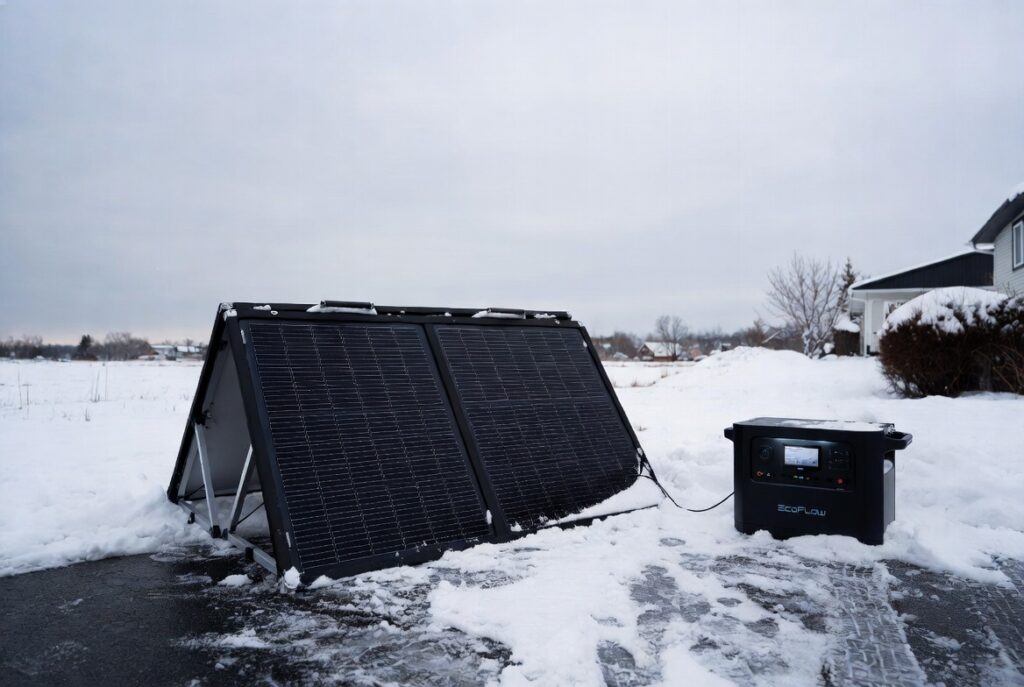
EcoFlow solar panels deliver excellent build quality and seamless ecosystem integration, but the cost per watt tells a different story. The 400W rigid and 220W portable bifacial panels use competitive monocrystalline cell technology. However, they cost $1.80 to $2.20 per watt compared to $1.05 to $1.20 for Renogy equivalents. The premium buys connector convenience, not superior energy production.
EcoFlow solar panels are designed to plug directly into Delta Pro and RIVER power stations via proprietary XT60 connectors. That tool-free connection is the core selling point. Inside the EcoFlow ecosystem, the experience is seamless. Outside it, the XT60 becomes dead weight requiring MC4 adapters.
This review covers both panels tested through real Ontario seasons and real dollar comparisons. If you are evaluating EcoFlow solar panels against the best solar panels for Ontario, the answer depends on one question.
| Spec | EcoFlow 400W Rigid | EcoFlow 220W Portable | Renogy 100W Rigid |
|---|---|---|---|
| Cell type | Mono PERC | N-type mono | P-type mono PERC |
| Efficiency | 22.6 percent | 23 percent | 21.4 percent |
| STC output | 400W | 220W front / 155W rear | 100W |
| Connector | XT60 proprietary | XT60 proprietary | MC4 standard |
| Cost per watt | $1.80 to $2.20 | $1.80 to $2.20 | $1.05 to $1.20 |
| January output (1.5 PSH) | ~508 Wh/day | ~280 to 312 Wh/day | ~127 Wh/day |
| July output (5.5 PSH) | ~1,760 Wh/day | ~880 Wh/day | ~450 to 500 Wh/day |
| Bifacial | No | Yes | No |
What EcoFlow solar panels actually cost per watt in Ontario
EcoFlow solar panels cost between $1.80 and $2.20 per watt at current Ontario retail pricing. A pair of EcoFlow 400W rigid panels runs approximately $1,400 for 800W total. Four Renogy 100W Monocrystalline Panels deliver 400W for under $440. The cost gap is not explained by cell performance.
Both brands use monocrystalline cell technology with similar efficiency ratings. The EcoFlow premium purchases XT60 connector convenience and brand integration. For builders who plan to stay inside the EcoFlow ecosystem permanently, that premium has value. For everyone else, the same money buys significantly more wattage from industry-standard panels.
The XT60 connector and ecosystem lock-in problem
The XT60 connector is the defining feature of EcoFlow solar panels. It clicks into Delta Pro and RIVER stations without tools or wiring knowledge. That makes emergency deployment fast and setup errors nearly impossible. Our full EcoFlow power station review covers the station side of this ecosystem.
The problem appears when the owner outgrows the ecosystem. If you upgrade to a Victron system or any standalone charge controller, the XT60 connector serves no purpose. MC4 adapters solve the compatibility issue but add cost and a failure point. The EcoFlow monitoring app does not integrate with VRM or any third-party platform.
The 400W rigid panel production in Ontario seasons
In July with 5.5 PSH, a single EcoFlow 400W rigid panel produces approximately 1,760 Wh per day. That covers lights, phone charging, a small DC fridge, and a fan at a seasonal cottage. Two panels at 3,420 Wh daily handle a comfortable weekend of use. Understanding solar panel efficiency explains why these numbers shift dramatically by season.
January drops production to approximately 508 Wh per day at 1.5 PSH. That keeps a small DC fridge and LED lights running on clear days. However, three consecutive grey days will drain even a Delta Pro station without supplemental charging. The 400W rigid is a solid seasonal panel but not a standalone winter solution.
The 220W portable bifacial advantage of EcoFlow solar panels
The EcoFlow 220W portable bifacial panel uses N-type cells at 23 percent efficiency. The front side produces 220W and the rear side captures up to 155W from reflected light. On snow-covered ground with albedo above 0.85, the rear side adds 15 to 20 percent output on clear days. The kickstand design allows quick deployment for emergency or camping use.
EcoFlow solar panels in the 220W bifacial format produced 280 to 312 Wh on clear January days in Ontario. That rear-side gain is real and measurable when fresh snow covers the ground. However, the bifacial advantage disappears on grass, dirt, or dark surfaces. The portable format works best for short-term deployment, not permanent mounting.
The Simcoe County ice storm deployment
Last January in Simcoe County, a homeowner lost power for 52 hours during an ice storm. He deployed two EcoFlow 220W portable bifacial panels on his cleared driveway facing south. The XT60 connectors clicked into the EcoFlow Delta Pro 3 without tools. The system was producing power within five minutes of unboxing.
On the first clear day after the storm at 1.5 PSH, the two panels produced 312 Wh combined. The snow-covered ground pushed rear-side albedo above 0.85, adding measurable bifacial gain. That 312 Wh kept the fridge compressor cycles covered through the second night. The Delta Pro 3’s 4,096 Wh capacity held enough reserve to bridge overnight gaps.
The system worked exactly as advertised for emergency deployment. However, the two panels plus Delta Pro 3 cost $4,200 total. A comparable Renogy array with a Victron MPPT 100/50 and LFP battery bank would cost approximately $2,800. The $1,400 premium bought speed and convenience, not additional energy production.
The Kawartha Lakes cottage expansion lesson
Two years ago in Kawartha Lakes, a cottage owner installed two EcoFlow 400W rigid panels on his roof. The system fed a Delta Pro 3 and produced 3,420 Wh daily at 5.5 PSH through the first summer. That covered lights, phone charging, a small DC fridge, and a fan comfortably. The owner was satisfied with the initial season of production.
The following spring, the owner expanded to a full Victron system with an MPPT 100/50 and Victron SmartShunt. The EcoFlow 400W panels worked through MC4 adapters connected to the Victron controller. However, the XT60 connectors and EcoFlow monitoring app became useless in the new system. The proprietary features the owner paid for no longer served any function.
The $1,400 spent on two EcoFlow 400W panels could have bought four Renogy 200W panels at 800W total. The Renogy panels use standard MC4 connectors that integrate with any charge controller natively. The owner gained nothing from the EcoFlow premium after leaving the ecosystem. If expansion is in your plans, start with industry-standard connectors from day one.
CEC and NEC code requirements for EcoFlow installations
The Canadian Electrical Code Section 64 governs all photovoltaic installations in Ontario, including EcoFlow panel setups. Even a portable panel deployment requires awareness of grounding and overcurrent protection standards. The Electrical Safety Authority at esasafe.com administers Ontario’s inspection and permitting process. Permanent roof-mount EcoFlow installations need the same ESA permits as any other panel brand.
NEC Article 690 covers DC wiring, fusing, and disconnect requirements on the American side. NFPA standards at nfpa.org provide the fire safety framework many Ontario builders reference. The XT60 connector does not change code compliance requirements. All EcoFlow solar panels installations must meet the same electrical standards as MC4-based systems in Ontario.
Pro Tip: Before buying EcoFlow solar panels, ask one question: will I ever expand beyond a Delta Pro station? If the answer is yes or maybe, buy MC4-standard panels from the start. The $1,400 you spend on two EcoFlow 400W panels buys 800W of Renogy with zero lock-in and full compatibility with any future charge controller.
EcoFlow solar panels verdict: convenience versus value
- Delta Pro or RIVER owners needing emergency or camping panels: EcoFlow solar panels are the fastest deployment option available. The XT60 connector eliminates wiring time entirely. Accept the cost premium as a convenience fee for speed. The Renogy solar panels review covers the lower-cost alternative.
- Seasonal cottage owners with no expansion plans: EcoFlow 400W rigid panels produce solid output with a Delta Pro 3. If the system stays at two panels and one station, the ecosystem works. Do not pay the premium if you expect to add capacity within two years.
- Builders planning expandable off-grid systems: Do not buy EcoFlow solar panels. Buy Renogy or equivalent MC4-standard panels and pair with a Victron MPPT 100/50 charge controller. You get double the wattage for the same money and zero ecosystem lock-in.
Frequently asked questions
Q: Are EcoFlow solar panels worth the money?
A: Only if you are staying inside the EcoFlow ecosystem with a Delta Pro or RIVER station. The plug-and-play speed is unmatched for emergency and camping use. Outside that ecosystem, the cost premium offers no performance benefit and creates compatibility issues when you expand.
Q: Can EcoFlow panels work with Victron or other charge controllers?
A: Yes, but only through MC4 adapters that add cost and a potential failure point. The XT60 connector serves no purpose on non-EcoFlow systems. You end up paying for proprietary convenience that no longer applies to your build.
Q: How much power does an EcoFlow 400W panel produce in Ontario winter?
A: Approximately 508 Wh per day at 1.5 PSH during January in Ontario. That keeps a small DC fridge and LED lights running on clear days. However, three or more consecutive grey days will exhaust the reserve without supplemental charging from a generator.
This build is engineered within the 48V DC Safety Ceiling. Diagnostic logic is based on 20+ years of technical service experience. All structural and electrical installations must be verified by a Licensed Professional and comply with your Local AHJ. See our legal and safety disclosure for full scope.
About the Author
Robert Bertrand spent 20 years as a service advisor in the automotive industry (Lexus and Nissan), where precision diagnostics, wiring integrity, and documentation standards were non-negotiable. He brings that same technical discipline to GridFree Guide, where he researches, tests, and documents off-grid solar systems for Ontario conditions. Based in Rockwood, Ontario, every article is built on verified specifications, manufacturer data, and the real-world climate constraints of Canadian off-grid living.
As an Amazon Associate I earn from qualifying purchases. This site also contains affiliate links to other products and services. GridFree Guide earns a small commission at no extra cost to you.