
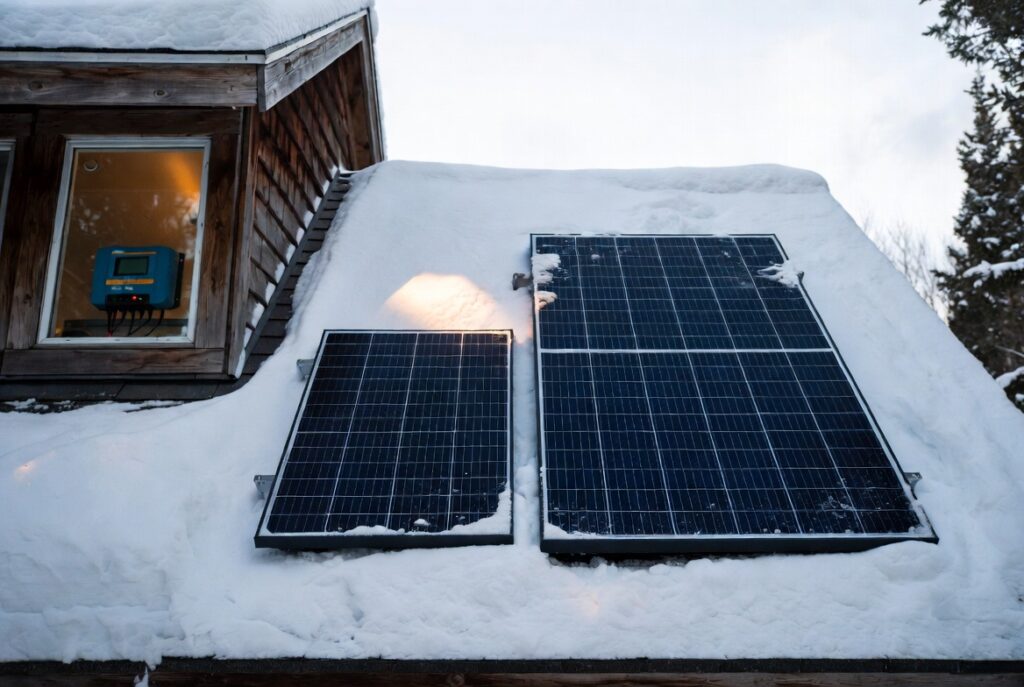
The mixing solar panels Ontario question I get asked at least once a week , can you wire a new 200W panel into an existing 100W string , has one answer for parallel wiring and a completely different answer for series wiring. In parallel, a wattage mismatch costs nothing more than some unused capacity on the larger panel. In series, a Voc mismatch between a 100W panel at 22.5V and a 200W panel at 24.3V puts four panels in series at 93.6V nominal, and then Ontario January at minus 22 degrees C adds the cold temperature coefficient to push that string to 103 to 105V on a controller with a 100V input ceiling.
Mixing solar panels Ontario safely starts with understanding which electrical property changes in parallel and which changes in series. In parallel wiring, voltage stays constant and current adds. In series wiring, voltage adds and current stays constant. That physics difference is the entire story , and it determines whether adding a mismatched panel to your system is a harmless upgrade or a fault waiting for the first cold clear January morning.
The Hastings County owner who wired two new 200W panels in series with two existing 100W panels watched the MPPT 100/50 shut down on the first clear January morning with an over-voltage fault. The rewire to parallel strings using MC4 branch connectors took 45 minutes and cost approximately $12. The alternative was a $380 MPPT replacement. The Grey County owner who replaced two panels with a different brand saw an 8 percent production reduction every cold day from a temperature coefficient mismatch , not a safety fault, but a real measurable cost. See our Ontario solar sizing guide before any mixing solar panels Ontario installation.
The mixing solar panels Ontario parallel rule: any wattage is safe when voltage stays constant
| Configuration | Voltage behaviour | Current behaviour | Safe to mix wattage? | Ontario cold Voc risk? |
|---|---|---|---|---|
| Parallel strings | Stays at highest string Voc | Adds across all strings | Yes , any wattage | Low , single-string Voc only |
| Series string, matched | Adds per panel | Limited to lowest Isc | Yes , if Voc matched | Calculable , check at minus 20C |
| Series string, mismatched Voc | Adds per panel | Limited to lowest Isc | No , Voc ceiling risk | High , cold Voc may exceed MPPT |
| Series string, mismatched Isc | Adds per panel | Limited to lowest Isc | Possible , efficiency loss | Depends on Voc match |
In parallel wiring, voltage remains constant while current adds. A Renogy 100W panel (Voc 22.5V, Isc 5.8A) wired in parallel with a 200W panel (Voc 24.3V, Isc 11A) produces approximately 16.8A combined at the MPPT input. The 200W panel contributes its full 11A and the 100W panel contributes its 5.8A. Neither limits the other. The MPPT sees approximately 24.3V at 16.8A, which is normal operating conditions for a single parallel string. This is why parallel is the safe configuration for mixing solar panels Ontario of any brand or wattage.
Parallel wiring has one constraint: total string Voc must remain within the MPPT input ceiling. For the MPPT 100/50, that ceiling is 100V. A parallel string of two 100W panels at 22.5V each in series would produce 45V combined , well within the 100V ceiling. The Ontario cold temperature coefficient adds approximately 15 to 16 percent at minus 20 degrees C, bringing that same string to approximately 52V. Still safe. The constraint applies equally to matched and mismatched parallel strings. See our Ontario solar panel wiring guide for the parallel configuration instructions.
The mixing solar panels Ontario series risk: Voc adds in series and Ontario cold amplifies it
In series wiring, Voc values add. Two 100W panels (Voc 22.5V each) and two 200W panels (Voc 24.3V each) in a single series string produce 22.5 + 22.5 + 24.3 + 24.3 = 93.6V nominal. Ontario January at minus 20 degrees C applies the cold temperature coefficient to every panel simultaneously. At minus 0.35 percent per degree C and minus 20 degrees C, Voc increases approximately 15.75 percent above nominal: 93.6V x 1.1575 = approximately 108V. That exceeds the 100V MPPT input ceiling. The fault is predictable before installation , it just requires doing the calculation first.
The over-voltage fault mechanism is straightforward. When the combined cold Voc exceeds the MPPT input ceiling, the controller shuts down to protect its input circuitry. The Hastings County system shut down at 7 AM on the first cold clear morning , exactly when maximum cold Voc occurs because the panels are cold from the overnight temperature but the sun has just started hitting them. By the time the sun warmed the panels enough to drop Voc below 100V, the peak morning production window was already lost. See our Ontario solar panels guide for the complete cold Voc calculation method.
The weakest-panel current rule in series: how Isc mismatch limits the entire string
When panels with different short-circuit current (Isc) are wired in series, the string runs at the Isc of the lowest-output panel. A 100W panel at 5.8A Isc in series with a 200W panel at 11A Isc means the entire string runs at 5.8A. The 200W panel is producing at 5.8A rather than 11A , approximately 47 percent of its rated output. The wattage difference between the two panels is irrelevant when they share a series string; the string current ceiling is set by the weakest panel regardless of how capable the stronger one is.
The wattage mismatch cost is significant and permanent as long as the panels remain in series. An owner who pays $180 for a 200W panel and wires it in series with an existing 100W panel captures only approximately 100W of value from the 200W panel. The correct configuration is to run the 200W panel as its own separate series string in parallel with the existing 100W string. Each string then contributes its full Isc to the combined MPPT input , the 100W string at 5.8A and the 200W string at 11A , for a combined 16.8A at the MPPT rather than 5.8A from the mismatched series arrangement.
The Hastings County over-voltage fault: 200W plus 100W in series, Ontario January, MPPT shutdown
A homeowner in Hastings County had an existing array of four 100W Renogy panels running as two 2-panel series strings combined in parallel. In autumn, they added two new 200W panels to expand capacity. Without checking the combined Voc, they wired the 200W panels in series with the existing 100W panels, creating one long 4-panel series string. The nominal Voc of the 100W Renogy is approximately 22.5V. The nominal Voc of the 200W panels is approximately 24.3V. Four panels in series: 22.5 + 22.5 + 24.3 + 24.3 = 93.6V nominal , close to the MPPT ceiling but not over it.
On a clear January morning at minus 22 degrees C, the cold temperature coefficient added approximately 10 to 12 percent to the combined Voc. The calculated cold Voc at minus 22 degrees C: 93.6V x (1 + 0.0035 x 47) = 93.6V x 1.1645 = approximately 109V. The MPPT 100/50 registered an over-voltage fault and shut down at 7 AM. The mixing solar panels Ontario Voc mismatch cost the owner the entire 7 AM to 10 AM production window on one of the clearest and most productive winter mornings of the month.
The fix took 45 minutes. Two MC4 branch connectors rewired the array into two separate parallel strings: string 1 with the two 100W Renogy panels in series at 45V nominal, and string 2 with the two 200W panels in series at 48.6V nominal. Both strings combined in parallel at the MPPT input at 48.6V combined , well within the 100V ceiling at any Ontario temperature. The MPPT began charging immediately after the rewire. The SmartShunt confirmed normal charging current within seconds. The owner avoided a $380 MPPT replacement for approximately $12 in connectors.
The temperature coefficient mismatch: why different brands drift apart in cold Ontario weather
Temperature coefficient expresses how much Voc changes per degree C of temperature change. Panel A at minus 0.35 percent per degree C and panel B at minus 0.29 percent per degree C produce different Voc values at the same cold temperature even if their nominal Voc values are identical. At minus 20 degrees C, the difference is approximately 0.5V per panel. In a 2-panel series string that produces approximately 1V of Voc mismatch within the string. That 1V mismatch is not an MPPT ceiling violation but it does create a measurable current imbalance as the MPPT tracks a voltage that is simultaneously optimal for neither panel.
Checking the temperature coefficient before buying replacement panels takes approximately 2 minutes. On the panel spec sheet, look for the line labelled “Temperature Coefficient of Voc” , typically expressed as percent per degree C or mV per degree C. Same brand, same model number means the same coefficient. Different brand or different model means check the spec sheet before wiring in series. For parallel wiring the temperature coefficient difference is irrelevant , mismatched coefficients only affect performance in series strings where both panels share a common current path.
The Grey County efficiency loss: 8 percent below expected from two replacement panels
A Grey County owner had run a matched 4-panel 100W array since 2019 with all four panels from the same brand and production batch. In spring 2024, two panels failed electrical inspection and required replacement. The owner sourced replacement 100W panels from a different brand with identical nominal specs: 100W rated, Voc 22V, Isc 5.8A. The difference was on the spec sheet line the owner did not check: temperature coefficient of Voc at minus 0.29 percent per degree C on the new panels versus minus 0.35 percent per degree C on the original 2019 panels.
Through summer, both strings produced approximately equally on the Cerbo GX VRM production history. As Ontario temperatures dropped below 10 degrees C in September, the SmartShunt showed the two mixed strings consistently producing approximately 8 percent below the expected output based on the VRM summer baseline. The original panels were generating approximately 0.5V more per panel at cold temperatures than the replacement panels , the opposite of the Hastings County fault direction, but still a measurable Voc mismatch within each series string creating a minor current imbalance the MPPT could not fully compensate.
The 8 percent production reduction on those two strings worked out to approximately 15 to 18Wh of daily production loss at Ontario October conditions. Over the 3-month Ontario gray streak season, that accumulated to approximately 1,350 to 1,620Wh of lost production , enough to matter on a tight January budget. No safety fault. No MPPT ceiling risk. Just a real measurable cost of mixing solar panels Ontario with different temperature coefficients in series strings. The owner calculated the replacement cost of two matched panels at approximately $160 and decided the efficiency loss was acceptable rather than replacing functional hardware.
NEC and CEC: Ontario permit requirements for solar panel wiring changes
Any rewiring of a permitted solar panel installation in Ontario requires an ESA permit update under CEC Section 64 before the work begins. Adding panels, reconfiguring strings from series to parallel, or replacing existing panels with different models all constitute modifications to the permitted installation. The Hastings County rewire from series to parallel using MC4 branch connectors is a permanent wiring change that requires an ESA permit update regardless of how simple the physical work appears. Contact the NFPA at nfpa.org for current NEC 690 requirements applicable to Ontario photovoltaic installations.
CEC Section 64 requires the ESA permit before any permanent wiring modification begins. The permit inspection confirms that the revised string configuration stays within the MPPT input voltage specifications, that overcurrent protection remains correctly sized for the new configuration, and that any new conductors meet the Ontario Electrical Safety Code gauge requirements for the revised current levels. Replacing a panel with an identical model does not require a permit update. Replacing a panel with a different model or reconfiguring the string arrangement does. Contact the Electrical Safety Authority Ontario at esasafe.com before beginning any mixing solar panels Ontario wiring modification.
Pro Tip: Before adding any panel to an existing Ontario array, calculate the worst-case cold Voc for the new series string configuration at minus 20 degrees C. The formula: cold Voc = nominal Voc x (1 + |temperature coefficient| x 45). For a 100W panel with Voc 22.5V and coefficient 0.0035: 22.5 x (1 + 0.0035 x 45) = 22.5 x 1.1575 = 26.04V per panel. Multiply by the number of panels in the series string. Keep the result below your MPPT input ceiling. If it exceeds the ceiling, reconfigure to parallel strings using MC4 branch connectors before commissioning. The Hastings County result confirmed what this calculation would have predicted: the 45-minute rewire and $12 in connectors was the right answer, not the $380 MPPT replacement.
The mixing solar panels Ontario verdict: parallel for any mismatch, series only for matched Voc panels
- Ontario owner who wants to add a panel of different wattage to an existing array: wire in parallel, not series. The Hastings County result confirms the series risk. An MC4 branch connector converts the configuration from series to parallel in under an hour. Parallel tolerates any wattage mismatch without fault risk or efficiency loss. Each string contributes its full Isc to the combined MPPT input. The mixing solar panels Ontario parallel configuration is always the safer choice when in doubt.
- Ontario owner who needs to replace a failed panel in an existing series string: match the Voc AND the temperature coefficient, not just the wattage. The Grey County result confirmed that nominal spec match is not sufficient , two panels with identical rated Voc but different temperature coefficients still produce a measurable Voc mismatch at cold temperatures. Find the temperature coefficient on the replacement panel spec sheet before ordering. Same brand, same model number eliminates the risk. Different brand requires explicit coefficient comparison.
- Ontario owner building a new system with panels from two sources: calculate the cold Voc at minus 20 degrees C before wiring any series string. Cold Voc = nominal Voc x (1 + |temperature coefficient| x 45). Multiply by the number of panels in series. The result must be below your MPPT input ceiling. If it exceeds the ceiling, reduce the number of panels per series string or reconfigure to parallel. A Renogy 100W panel at 22.5V nominal calculates to 26.04V cold Voc , meaning a maximum of 3 panels per series string on the MPPT 100/50 with its 100V ceiling.
Frequently Asked Questions
Q: Can you mix different wattage solar panels in Ontario?
A: Yes, but the safe configuration depends entirely on whether the panels are wired in parallel or series. In parallel, mixing solar panels Ontario of any wattage is safe because voltage stays constant and each panel contributes its own current independently. A 100W panel and a 200W panel in parallel both contribute their full Isc at the shared string Voc. The lower-wattage panel simply contributes less current.
In series, wattage mismatch is a secondary concern. The primary concern in series is whether the combined cold Voc of the mixed string exceeds the MPPT input ceiling at Ontario winter temperatures. The Hastings County result showed that a 93.6V nominal mixed series string reached 103 to 105V at minus 22 degrees C, triggering an over-voltage fault. Always calculate the cold Voc before wiring any mixed series string in Ontario.
Q: What happens if you mix solar panel brands in a series string in Ontario?
A: Mixing different brands in a series string in Ontario creates two potential issues. The first is Voc mismatch , if the panels have different nominal Voc values, the cold temperature coefficient amplifies those differences at Ontario winter temperatures and the combined cold Voc may exceed the MPPT input ceiling. The Hastings County fault resulted from exactly this: two 22.5V panels and two 24.3V panels in series reached 108V at minus 20 degrees C on a 100V controller. The second issue is temperature coefficient mismatch.
Panels with different coefficients produce different cold Voc values even when nominal Voc is identical. The Grey County result: two replacement panels with a slightly different temperature coefficient caused 8 percent production reduction on the mixed strings every cold day. Both issues are avoidable by checking the spec sheet before wiring.
Always verify nominal Voc and temperature coefficient match before mixing brands in any Ontario series string.
Q: How do I avoid an over-voltage fault when adding panels to an Ontario solar system?
A: Calculate the cold Voc for the worst Ontario temperature , minus 20 degrees C for most of Ontario , before wiring. The formula: cold Voc = nominal Voc x (1 + |temperature coefficient| x 45). For a 100W panel with Voc 22.5V and coefficient 0.0035: 22.5 x 1.1575 = 26.04V per panel. Multiply by the number of panels in the proposed series string. If the result exceeds your MPPT input ceiling (100V for the MPPT 100/50), reconfigure to parallel or reduce the panels per series string.
For the MPPT 100/50, the maximum safe series string at minus 20 degrees C with 22.5V nominal panels is 3 panels. Adding a fourth panel (104V cold Voc) exceeds the ceiling. The 45-minute rewire to parallel that saved the Hastings County owner a $380 MPPT replacement starts with this same calculation.
This build is engineered within the 48V DC Safety Ceiling. Diagnostic logic is based on 20+ years of technical service experience. All structural and electrical installations must be verified by a Licensed Professional and comply with your Local AHJ. See our legal and safety disclosure for full scope.
About the Author
Robert Bertrand spent 20 years as a service advisor in the automotive industry (Lexus and Nissan), where precision diagnostics, wiring integrity, and documentation standards were non-negotiable. He brings that same technical discipline to GridFree Guide, where he researches, tests, and documents off-grid solar systems for Ontario conditions. Based in Rockwood, Ontario, every article is built on verified specifications, manufacturer data, and the real-world climate constraints of Canadian off-grid living.
As an Amazon Associate I earn from qualifying purchases. This site also contains affiliate links to other products and services. GridFree Guide earns a small commission at no extra cost to you.