
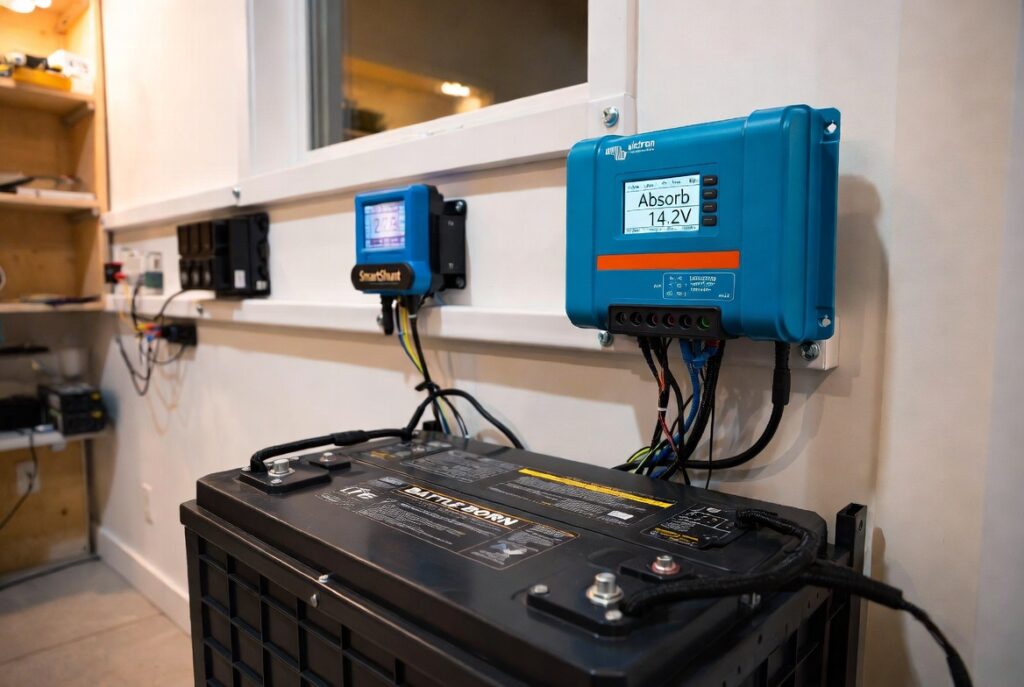
The battery charging Ontario failure that leaves Bruce County cabin owners with a partially charged bank every January morning is not a panel fault or a wiring issue but a physics constraint: at 1.5 PSH, a 400W array produces approximately 492Wh per day, and a bank starting at 30 percent SoC on a Battle Born 100Ah LFP needs approximately 576Wh to reach the bulk setpoint at 14.2V , more energy than the January production window can deliver , so the absorb stage never begins and the bank ends the day at approximately 81 percent SoC rather than 100 percent.
Battery charging Ontario operates in three distinct stages: bulk, absorb, and float. Each stage has a different voltage target, current behaviour, and duration. The SmartShunt reads differently at each stage, and understanding those readings is the difference between diagnosing a system correctly and calling for a service inspection when the system is performing exactly as designed.
The Nipissing District cabin owner who returned in April to a bank at 12 percent SoC watched all three stages complete in a single 4.5 PSH day: bulk from 9 AM to 2 PM at steady high current, absorb from 2 PM to 3 PM as current tapered from 38A to 2A, and float from 3 PM as the SmartShunt confirmed 98 percent SoC. The Bruce County owner in January with a bank at 30 percent SoC watched the entire 1.5 PSH production window consumed by bulk. The absorb stage never started because irradiance dropped below the MPPT minimum threshold before bulk was complete. Same physics. Different Ontario production windows. Different outcomes.
The battery charging Ontario three-stage sequence is not optional , a bank that skips the absorb stage ends every charge cycle at approximately 80 percent SoC regardless of what the voltage display shows. Over a week of Ontario January gray streak days, each day ending at 80 to 85 percent SoC rather than 100 percent compounds into progressive depletion. Understanding what the SmartShunt current reading means at each stage is the tool that identifies whether the system completed a full charge cycle or stopped short. See our Ontario solar sizing guide before any battery charging Ontario bank specification.
The battery charging Ontario bulk stage: maximum current, rising voltage, and the SmartShunt reading
| Stage | MPPT voltage | SmartShunt amps | SoC range filled | Typical duration |
|---|---|---|---|---|
| Bulk | Rising to 14.2V | High, steady (30 to 40A) | 0 to ~80% | 1 to 3 hours depending on depletion |
| Absorb | Held at 14.2V | Tapering (40A down to 2A) | ~80% to 100% | 30 to 60 minutes |
| Float | Drops to 13.5V | Near zero (under 2A) | Maintained at 100% | Remainder of production day |
In the bulk stage, the MPPT 100/50 delivers the maximum available current to the battery bank. Voltage rises from the resting voltage (approximately 12.8V at 20 percent SoC) toward the bulk setpoint of approximately 14.2V for a 12V LFP system. The SmartShunt shows high, steady amperage , typically 30 to 40A on a 400W array at full Ontario summer irradiance. This is the fastest charging phase: approximately 80 percent of bank capacity fills during bulk. On a clear Ontario July day, bulk from 30 percent SoC typically takes approximately 1.5 to 2 hours from a 400W array at 650 W/m2 irradiance.
The bulk stage current reading on the SmartShunt is the most useful diagnostic in the battery charging Ontario sequence. A SmartShunt reading significantly below the array’s rated output during bulk , for example, 15A from a 400W array on a clear day , indicates a resistance issue in the wiring, a shaded panel, or a loose MC4 connection rather than a charge stage problem. A SmartShunt reading close to the array’s expected output at the current irradiance confirms the system is drawing correctly. Any sustained reduction in bulk current on a clear day deserves investigation before assuming the charge stage itself is the issue.
The absorb stage: 14.2V hold, tapering current, and the final 20 percent of capacity
When the bank voltage reaches the 14.2V bulk setpoint, the MPPT transitions to the absorb stage. The MPPT holds 14.2V steady while the battery’s internal resistance rises as the cells approach full capacity. The SmartShunt shows the charging current declining progressively from the bulk peak down to the tail current threshold of approximately 2A for a 100Ah bank. This current taper is not a malfunction. It is the correct physics response as the cells become more difficult to fill during the final 20 percent of capacity. A 100Ah bank entering absorb at 80 percent SoC needs approximately 192Wh more at decreasing current rates, typically over 30 to 60 minutes on a well-sized system.
What a skipped absorb stage costs is significant and cumulative. A system that transitions from bulk directly to float without completing absorb leaves the bank at approximately 80 percent SoC even though the voltage reads 13.5V. The SmartShunt will report approximately 80 percent SoC accurately , the incomplete absorb cycle is visible in the SoC number, not hidden by it. Over time, a system regularly ending charge cycles in partial state of charge (PSOC) progressively masks true available capacity. The bank enters each Ontario winter day with less reserve than the previous day without any hardware failure. See our Ontario LiFePO4 battery guide for the full partial state of charge recovery protocol.
The float stage: 13.5V maintenance and what near-zero SmartShunt amps means
When the tail current drops to approximately 2A, the MPPT transitions to the float stage and drops voltage to approximately 13.5V. The SmartShunt shows near-zero amps , typically under 1A. The bank is at 100 percent SoC and being maintained against self-discharge without overcharging. During float, the MPPT continues to produce solar power but the bank has no room to accept it at meaningful current levels. A system in float on a sunny afternoon is confirming full charge, not wasting production.
Float on an Ontario January day can look counterintuitive.
If the bank starts the day at 95 percent SoC, the MPPT passes through bulk and absorb in under 30 minutes and spends most of the 1.5 PSH production window in float. The SmartShunt shows near-zero amps for most of the day. This is the correct outcome , the bank was already near full and the system is maintaining it correctly. The concerning Ontario January scenario is not float too early but float never reached: a bank at 30 percent SoC that ends the day at 81 percent SoC without the SmartShunt ever showing the absorb taper pattern. See our Ontario energy storage guide for how SoC management connects to winter storage sizing.
The Nipissing District full recovery: 12 percent SoC to 98 percent in a single April day
A Nipissing District cabin owner returned in early April after a 2-week absence to find the bank at 12 percent SoC. The battery had self-discharged over the absence period and the cabin had been unoccupied with no solar production since the last visit. The MPPT showed the bank was below the bulk-start threshold. An April production day with 4.5 PSH available provided the energy window for a complete battery charging Ontario recovery cycle from the deeply depleted state.
The MPPT ran in bulk from approximately 9 AM to 2 PM with high steady charging current throughout. The SmartShunt confirmed approximately 35A of charging current through the morning, consistent with the April irradiance conditions. At approximately 2 PM, the bank voltage reached the 14.2V bulk setpoint and the MPPT transitioned to absorb. The SmartShunt showed charging current beginning to taper from approximately 38A at the start of absorb toward 12A over the next 40 minutes as the cells filled toward capacity.
By approximately 3 PM, the tail current reached approximately 2A and the MPPT transitioned to float at 13.5V. The SmartShunt confirmed 98 percent SoC. The April sun provided enough production hours to complete both bulk and absorb stages from a 12 percent starting SoC. The full battery charging Ontario recovery cycle that 4.5 PSH April sun completed in one day would have been impossible in January at 1.5 PSH from the same starting SoC , the bulk stage alone would have consumed the entire January production window.
The battery charging Ontario January constraint: why 1.5 PSH may not complete the absorb stage
The Bruce County cabin owner faced a January gray streak with the bank at 30 percent SoC after three consecutive low-production days at approximately 0.8 PSH each. The Cerbo GX showed the bank needed approximately 576Wh to reach 80 percent SoC from 30 percent on the 100Ah LFP bank. January production day: 1.5 PSH available; 400W array at 82 percent efficiency produced approximately 492Wh for the day. The available production was approximately 84Wh short of what bulk alone required.
The MPPT bulk stage drew the full 492Wh, pushing the bank from 30 percent to approximately 81 percent SoC. The bank reached the 14.2V bulk setpoint at approximately 3 PM with the sun already low and irradiance declining. There was not enough remaining production to sustain 14.2V for the absorb stage. The system transitioned to float not because absorb was complete but because irradiance was insufficient to maintain 14.2V. The SmartShunt confirmed 81 percent SoC at end of day , the absorb taper pattern never appeared.
The battery charging Ontario lesson from Bruce County is that the starting SoC on each January day determines whether the available 1.5 PSH production can complete the full charge cycle. A bank starting at 30 percent SoC requires more Wh to reach absorb than a January day provides. A bank starting at 50 percent SoC requires approximately 288Wh to reach bulk completion , within the approximately 492Wh available on a 1.5 PSH day, leaving enough remaining production window for absorb. Maintaining the bank above 50 percent SoC through Ontario winter requires a generator top-up protocol for gray streaks longer than 3 days. See our Ontario solar winterize guide for the complete winter SoC management protocol.
NEC and CEC: Ontario permit requirements for battery charging installations
Any permanently wired battery charging Ontario installation requires an ESA permit under CEC Section 64 before installation begins. This applies to all fixed LFP battery bank installations connected through a permanently wired MPPT and inverter, including any new battery bank added to an existing permitted installation. The permit inspection confirms that wiring, overcurrent protection, and grounding meet the Ontario Electrical Safety Code. Contact the NFPA at nfpa.org for current NEC requirements applicable to Ontario battery storage and charging installations.
CEC Section 64 requires the ESA permit before any permanently wired battery charging Ontario work begins. Adding a new LFP bank, replacing an existing bank with a different voltage or capacity, or changing the MPPT charge controller model all constitute modifications requiring permit update. Verifying MPPT charge stage settings in VictronConnect is a maintenance activity that does not require a permit, but the underlying installation must already have ESA approval. Contact the Electrical Safety Authority Ontario at esasafe.com before beginning any new or modified battery charging Ontario installation.
Pro Tip: Before the first Ontario winter season, open VictronConnect and confirm your MPPT charge stage settings. For a 12V LFP system: bulk voltage 14.2V, absorb voltage 14.2V, float voltage 13.5V, tail current 2A for a 100Ah bank. Then check the SmartShunt SoC reading at the end of the first three clear production days. If the SmartShunt never shows the absorb taper pattern (declining from 30 to 40A down to 2A), the system is not completing absorb and the cause is either incorrect settings, a bank too depleted to reach absorb within the available PSH, or an undersized array. The Nipissing District result confirms what a completed absorb cycle looks like: 38A tapering to 2A over 60 minutes, then float at 98 percent SoC.
The battery charging Ontario verdict: maintain winter SoC above 50 percent, verify MPPT settings, track all three stages on the SmartShunt
- Ontario owner whose SmartShunt shows near-zero amps on a sunny day: check the current charge stage before assuming a fault. If the MPPT is in float, the bank is full and the system is operating correctly. Near-zero SmartShunt amps during a production window is a success state, not a fault. If the MPPT is in float but the SmartShunt SoC reads below 95 percent, check VictronConnect for an incorrect tail-current threshold causing premature float transition. The Nipissing District result confirms what correct float entry looks like: 2A tail current, 98 percent SmartShunt SoC, float voltage 13.5V.
- Ontario owner whose bank never reaches 100 percent SoC in January: calculate whether available PSH can complete the absorb stage from the starting SoC. At 1.5 PSH and 30 percent starting SoC, the bulk stage requires approximately 576Wh , more than the approximately 492Wh January production provides. The Bruce County result: bank reaches 81 percent SoC, absorb never begins, PSOC trap compounds. The fix is maintaining the starting SoC above 50 percent through generator top-up on days with forecast irradiance below 100 W/m2. A Battle Born 100Ah LFP starting at 50 percent SoC needs approximately 288Wh to reach absorb , within the January production window.
- Ontario owner building a new system: verify MPPT charge stage settings in VictronConnect before the first winter season. Bulk voltage 14.2V, absorb voltage 14.2V, float voltage 13.5V, tail current 2A for a 100Ah bank. Incorrect settings produce incorrect charge stage behaviour regardless of available PSH. The Nipissing District recovery confirmed correct settings: 98 percent SoC from 12 percent SoC in a single 4.5 PSH April day. The same settings that enabled that April recovery are the settings that determine whether a January day ends at 100 percent or 81 percent SoC.
Frequently Asked Questions
Q: What is the difference between bulk, absorb, and float charging in Ontario?
A: Battery charging Ontario operates in three stages with distinct voltage targets and SmartShunt current patterns. Bulk stage: the MPPT delivers maximum current, voltage rises from resting voltage to the 14.2V setpoint, the SmartShunt shows high steady amperage, and approximately 80 percent of bank capacity fills. Absorb stage: the MPPT holds 14.2V while the SmartShunt shows current tapering progressively from the bulk peak down to the 2A tail current threshold as the final 20 percent of capacity fills. Float stage: the MPPT drops voltage to 13.5V to maintain the bank at 100 percent SoC, the SmartShunt shows near-zero amps. On a good Ontario summer production day, all three stages complete within the available PSH window.
On an Ontario January day with a depleted bank, the bulk stage alone may consume the entire production window and the absorb stage never begins.
Q: Why does my battery never reach 100 percent SoC in Ontario winter?
A: The most common battery charging Ontario cause of incomplete winter charging is a starting SoC too low for the available January PSH to complete both bulk and absorb stages. A 100Ah LFP bank at 30 percent SoC needs approximately 576Wh to reach the 14.2V bulk setpoint. At 1.5 PSH, a 400W array produces approximately 492Wh. The bulk stage consumes the entire production window and the bank ends the day at approximately 81 percent SoC rather than 100 percent. The fix is maintaining the starting SoC above 50 percent through generator top-up on low-production days. A bank starting at 50 percent SoC needs approximately 288Wh to reach bulk completion, within the 492Wh January production.
This leaves enough remaining production window for the absorb stage to begin. The Bruce County result confirmed this: 30 percent starting SoC in January guarantees an incomplete charge cycle at 1.5 PSH.
Q: What should my SmartShunt show during each battery charging stage?
A: During the bulk stage, the SmartShunt shows high steady amperage , typically 30 to 40A on a 400W array on a clear Ontario day. This is the correct reading for maximum MPPT current delivery. During the absorb stage, the SmartShunt shows amperage declining progressively from the bulk peak down to approximately 2A over 30 to 60 minutes. The Nipissing District recovery confirmed this taper pattern: 38A declining to 2A over 60 minutes, then float entry at 98 percent SoC.
During the float stage, the SmartShunt shows near-zero amps. If the SmartShunt goes from high bulk current directly to near-zero amps without the absorb taper in between, the system transitioned to float prematurely and the bank is at approximately 80 percent SoC, not 100 percent.
This build is engineered within the 48V DC Safety Ceiling. Diagnostic logic is based on 20+ years of technical service experience. All structural and electrical installations must be verified by a Licensed Professional and comply with your Local AHJ. See our legal and safety disclosure for full scope.
About the Author
Robert Bertrand spent 20 years as a service advisor in the automotive industry (Lexus and Nissan), where precision diagnostics, wiring integrity, and documentation standards were non-negotiable. He brings that same technical discipline to GridFree Guide, where he researches, tests, and documents off-grid solar systems for Ontario conditions. Based in Rockwood, Ontario, every article is built on verified specifications, manufacturer data, and the real-world climate constraints of Canadian off-grid living.
As an Amazon Associate I earn from qualifying purchases. This site also contains affiliate links to other products and services. GridFree Guide earns a small commission at no extra cost to you.