
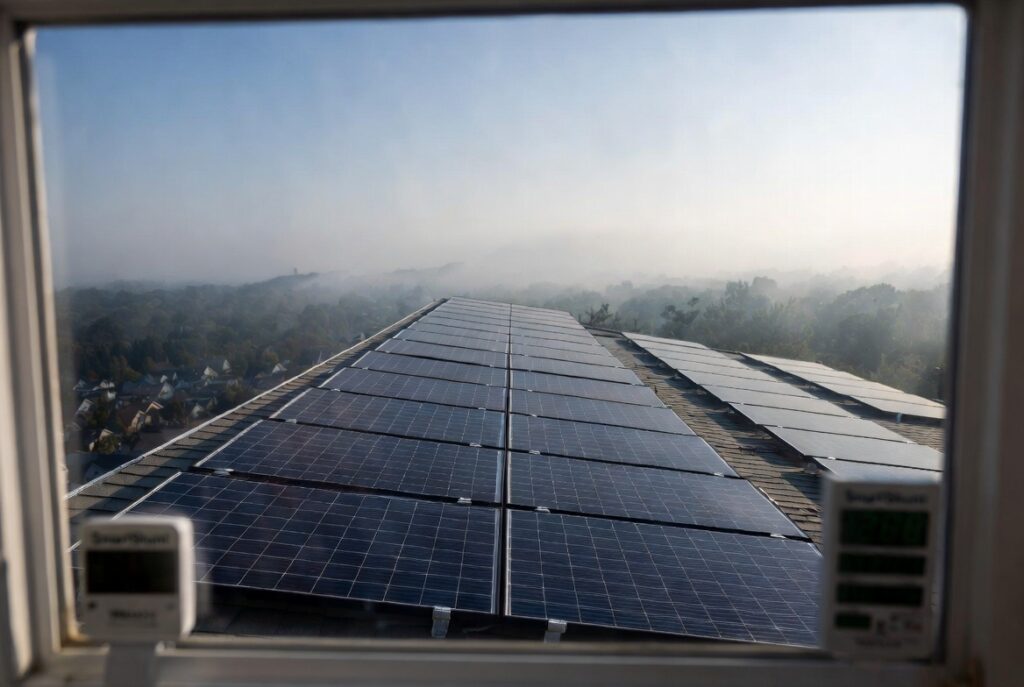
The solar irradiance Ontario gap between the 400W nameplate on a Renogy panel and the 260W the SmartShunt confirms on a hazy July afternoon in Grey County is not a panel defect or a wiring fault but the physics of irradiance. The 400W rating is measured at Standard Test Conditions of exactly 1,000 W/m2, a laboratory specification that Ontario rooftops achieve perhaps 10 days per year at peak solar noon on the clearest summer days. Irradiance is the power of sunlight striking a surface per square metre. Ontario July rooftops typically receive approximately 600 to 750 W/m2 at solar noon.
Ontario January rooftops on a clear day receive approximately 200 to 300 W/m2 because the winter sun angle forces photons through a significantly thicker layer of atmosphere before reaching the panel surface. The solar irradiance Ontario formula converts any irradiance reading into an expected production number: Panel Watts actual equals irradiance divided by 1,000 multiplied by rated watts. At 700 W/m2: 400 x 0.70 = 280W. At 250 W/m2: 400 x 0.25 = 100W. At 80 W/m2 on thick overcast: 400 x 0.08 = 32W. None of these numbers indicate a fault.
These numbers explain every SmartShunt production reading across the Ontario seasons. The Grey County owner who saw 260W at noon on a hazy July day had a healthy system producing exactly what 650 W/m2 irradiance allows. The Simcoe County owner who compared a clear January day at 100W against an overcast day at 32W had a system performing correctly under two different irradiance conditions. Understanding solar irradiance Ontario physics eliminates the majority of unnecessary service calls. See our Ontario solar sizing guide before any solar irradiance Ontario system specification.
The solar irradiance Ontario definition: STC 1,000 W/m2 versus Ontario rooftop reality
| Condition | Irradiance | 400W array output | Ontario occurrence |
|---|---|---|---|
| STC (lab spec) | 1,000 W/m2 | 400W | Rare , perhaps 10 clear summer days/year at noon |
| Clear July noon | 700 W/m2 | 280W | Common in June through August |
| Hazy July noon | 650 W/m2 | 260W | Common on humid Ontario summer days |
| Clear January noon | 250 W/m2 | 100W | Best Ontario winter production day |
| Thin overcast | 200 to 300 W/m2 | 80 to 120W | Frequent Ontario shoulder season |
| Thick overcast | 50 to 100 W/m2 | 20 to 40W | Common Ontario January and November |
Standard Test Conditions define the 400W rating: 1,000 W/m2 irradiance, 25 degrees C cell temperature, and AM1.5 spectrum. These conditions describe a laboratory in ideal conditions, not a panel on a Simcoe County rooftop in January. Ontario July rooftops in full sun typically receive approximately 650 to 750 W/m2 at solar noon, already 25 to 35 percent below STC before the temperature coefficient applies. Ontario January clear days deliver approximately 200 to 300 W/m2 because the winter sun angle forces photons through a much thicker atmospheric column before reaching the panel surface.
The gap between STC and Ontario reality has a direct consequence for system sizing. A system designed assuming 1,000 W/m2 production will consistently underperform against its targets. A system designed using Ontario-realistic irradiance inputs of 650 W/m2 for July and 250 W/m2 for January will hit its calculated production numbers. The solar irradiance Ontario planning inputs are available through the NRCan CWEEDS dataset and the pvwatts tool, which reports monthly average irradiance by postal code. See our Ontario solar cell guide for how the temperature coefficient compounds with irradiance reduction on hot summer days.
Why Ontario winter irradiance drops: air mass, sun angle, and the atmosphere filter
At the December solstice, the Ontario sun at solar noon sits approximately 22 degrees above the horizon. Photons arriving at that low angle travel through approximately 2.5 to 4 times more atmosphere than photons arriving at the near-overhead summer sun angle. This atmospheric path length is described by the air mass number: STC uses AM1.5, a standard atmospheric thickness reference. Ontario winter conditions produce AM3 to AM5, meaning photons traverse 2 to 3 times more atmosphere and lose proportionally more intensity to scattering and absorption before reaching the panel surface.
The practical effect is that even a completely clear Ontario January sky does not deliver STC irradiance. The atmosphere filters approximately 60 to 75 percent of the theoretical extraterrestrial solar irradiance by the time it reaches an Ontario rooftop in January. Cloud cover compounds this further. A clear January day at 250 W/m2 becomes 80 W/m2 on a thick overcast January day. The combination of low sun angle and cloud cover explains why Ontario January production is so much lower than the 1.5 peak sun hours average suggests on the worst days of the month.
The solar irradiance Ontario output formula: how to calculate actual watts from irradiance
The solar irradiance Ontario output formula is: Panel Watts actual = (irradiance W/m2 / 1,000) x rated watts. The formula uses 1,000 as the denominator because STC is defined at 1,000 W/m2 , any irradiance below that is a fraction of the rated output. At 700 W/m2: 400 x 0.70 = 280W. At 250 W/m2: 400 x 0.25 = 100W. At 80 W/m2: 400 x 0.08 = 32W. The MPPT 100/30 output display reflects this formula in real time. When the MPPT shows lower numbers in winter, it is reporting the correct physics response to lower irradiance, not indicating a hardware fault.
The Grey County result confirms the formula in the field. The owner’s 400W array produced 260W on a hazy July afternoon. The Cerbo GX irradiance estimate showed 650 W/m2 at solar noon due to high-altitude haze. Applying the formula: 400 x 0.65 = 260W, which is exactly what the SmartShunt was reading. The system was healthy. The 260W was the correct solar irradiance Ontario output for the available irradiance that afternoon. Running the formula before assuming a fault saves the diagnostic time every time. See our Ontario solar hours guide for how irradiance connects to the PSH daily production calculation.
The Grey County haze result: 260W on a clear July afternoon, system confirmed healthy
A Grey County owner installed a 400W monocrystalline array in spring 2024 and commissioned it with a Cerbo GX and SmartShunt monitoring setup. Through June and July, the SmartShunt typically showed 270 to 280W at solar noon on clear days, consistent with 650 to 700 W/m2 irradiance. In mid-July, during a period of high-altitude haze from wildfire smoke drifting over Ontario, the SmartShunt showed only 260W at solar noon despite the sky appearing relatively clear. The owner cleaned the panels thoroughly, checked all MC4 connections, and ran a VRM diagnostic. The Cerbo GX showed no faults on any circuit.
A review of the Cerbo GX irradiance estimate showed approximately 650 W/m2 at solar noon that afternoon rather than the typical 700 W/m2. The high-altitude haze was filtering approximately 50 W/m2 of irradiance before it reached the panels. Applying the solar irradiance Ontario formula: 400 x 0.65 = 260W, which matched the SmartShunt reading exactly. The system was performing correctly. The 260W was not a failure of the panels or the wiring , it was the accurate output for the available irradiance under haze conditions.
The owner recalibrated their production expectations after this result. On clear summer days at approximately 700 W/m2, the 400W array produces approximately 280W at noon. On hazy days at 650 W/m2, it produces approximately 260W. On thin overcast at 300 W/m2, it produces approximately 120W. On thick overcast at 80 W/m2, it produces approximately 32W. None of these readings indicate a fault. All four are the correct solar irradiance Ontario physics response to the available irradiance at that moment. The formula, not the panel nameplate, is the correct reference for expected output under Ontario conditions.
The cloud cover effect: thin overcast, thick overcast, and Ontario gray streak production
Ontario overcast is not zero production. Thin high cloud delivers approximately 200 to 300 W/m2 of diffuse irradiance across the panel surface because light reaches the panel from multiple angles rather than direct beam only. A 400W array under thin overcast produces approximately 80 to 120W, enough to offset a significant portion of critical loads and slow bank depletion. Thick overcast drops irradiance to approximately 50 to 100 W/m2, producing approximately 20 to 40W from the same array. Over 6 hours of thick overcast, that trickle contributes approximately 240Wh to the bank , not enough to sustain 700Wh daily critical loads but enough to maintain Cerbo GX communication and extend the time before generator top-up becomes necessary.
Bright overcast is a frequently misunderstood Ontario condition. Thin high cirrus cloud can deliver 300 to 400 W/m2 of diffuse irradiance because the cloud layer scatters light across a wider solid angle than direct beam illumination. Ontario cottage owners who run outside on what they consider an overcast morning and find their SmartShunt reading 150W are experiencing bright overcast irradiance, not a system anomaly. The Cerbo GX irradiance estimate distinguishes between these conditions in real time and provides the input needed to run the solar irradiance Ontario output formula for any sky condition.
The Simcoe County forecast strategy: irradiance-based generator scheduling
A Simcoe County off-grid owner ran their generator on a fixed daily schedule through January 2024, topping up the bank every evening for 2 hours regardless of the day’s solar production. In February, they began comparing SmartShunt production data against daily cloud cover forecasts. On a clear January day, the SmartShunt confirmed approximately 100W production from the 400W array at solar noon, matching the expected 250 W/m2 clear-day irradiance calculation exactly. On the following overcast day with similar daylight hours, the SmartShunt showed only approximately 32W at solar noon due to approximately 80 W/m2 irradiance under thick cloud.
The production difference between the two days was stark. Clear day daily production: approximately 100W x 1.5 PSH x 0.82 = approximately 123Wh. Overcast day daily production: approximately 32W x 1.5 PSH x 0.82 = approximately 39Wh. The difference between a clear and overcast January day was approximately 84Wh of daily bank input , enough to change whether the bank maintained a positive net balance or required generator top-up. The owner recognised that running the generator every evening was unnecessary on clear days and insufficient on multi-day overcast stretches.
The revised solar irradiance Ontario strategy used cloud cover forecast as the generator trigger. If the day’s irradiance forecast was below 100 W/m2, the generator ran for 2 hours before sunset to maintain the bank above 40 percent SoC. If the forecast showed above 200 W/m2, the panels took the lead and generator top-up was deferred to the following evening’s forecast check. Over the remainder of February and all of March, this irradiance-based scheduling reduced total generator runtime by approximately 30 percent compared to the fixed daily schedule , the same fuel consumption reduction, better bank management, and fewer generator operating hours extending service life. See our Ontario energy storage guide for the complete generator scheduling and bank management framework.
NEC and CEC: Ontario permit requirements for photovoltaic installations
Any permanently wired Ontario photovoltaic installation requires an ESA permit under CEC Section 64 before installation begins. The permit requirement applies regardless of the irradiance conditions the system will operate under , low January irradiance does not reduce the installation compliance requirement. NEC 690 governs DC circuit wiring, overcurrent protection, and grounding for photovoltaic systems in Ontario. Contact the NFPA at nfpa.org for current NEC 690 requirements applicable to Ontario solar installations.
CEC Section 64 requires an ESA permit for any permanent wiring connection in an Ontario solar irradiance Ontario installation. The permit inspection confirms that DC wiring, overcurrent protection, grounding, and disconnect provisions meet the Ontario Electrical Safety Code. Portable panels used without permanent wiring do not require a permit, but any roof penetration, fixed conduit run, or hardwired connection to an interior MPPT or battery bank triggers the requirement. Contact the Electrical Safety Authority Ontario at esasafe.com before beginning any permanently wired Ontario photovoltaic installation.
Pro Tip: Before assuming a system fault when production reads below the panel nameplate, run the solar irradiance Ontario formula using the Cerbo GX irradiance estimate. Open the VRM portal, check the irradiance reading at the time of the low production reading, and calculate: (irradiance / 1,000) x rated watts. If the SmartShunt production reading is within 10 percent of the formula result, the system is healthy and the irradiance is the variable. If the SmartShunt reading is more than 15 percent below the formula result on a clear day, there is likely a connection issue, shading, or MC4 resistance fault worth investigating.
The solar irradiance Ontario verdict: size for January irradiance, use cloud forecast for generator timing
- Ontario owner whose SmartShunt reads below rated watts: apply the irradiance formula before assuming a fault. Grey County confirmed: 260W from a 400W array at 650 W/m2 haze is the correct output. Check the Cerbo GX irradiance estimate and calculate (irradiance / 1,000) x rated watts. If the SmartShunt reading is within 10 percent of the formula result, the system is healthy. The 400W nameplate is a 1,000 W/m2 lab specification. Ontario rooftops rarely deliver 1,000 W/m2, so Ontario systems rarely deliver nameplate watts.
- Ontario owner managing January generator top-up: switch from a fixed daily schedule to an irradiance forecast schedule. The Simcoe County result: generator runtime reduced 30 percent by running only when forecast irradiance was below 100 W/m2. Cloud cover forecast is more actionable than daylight hours for Ontario winter generator scheduling. A clear January day at 250 W/m2 adds approximately 123Wh to the bank; a thick overcast day at 80 W/m2 adds approximately 39Wh. Those 84Wh determine whether the generator runs that evening.
- Ontario owner sizing a new system: use 650 W/m2 for July and 250 W/m2 for January as the solar irradiance Ontario planning inputs, not STC 1,000 W/m2. A 400W array at Ontario real-world irradiance produces approximately 280W peak in July and approximately 100W peak in January. Sizing on STC produces a system that consistently underperforms against its targets. Sizing on Ontario irradiance reality produces a system that hits its calculated numbers in every season.
Frequently Asked Questions
Q: Why does my solar panel produce less than its rated watts in Ontario?
A: The rated wattage on any solar panel is measured at Standard Test Conditions of 1,000 W/m2 irradiance and 25 degrees C cell temperature. Ontario rooftops almost never deliver 1,000 W/m2. Ontario July solar noon typically delivers approximately 650 to 750 W/m2, producing approximately 260 to 300W from a 400W panel. Ontario January solar noon on a clear day delivers approximately 250 W/m2, producing approximately 100W from the same panel. The solar irradiance Ontario formula calculates expected output for any condition: (irradiance W/m2 / 1,000) x rated watts. Run this formula against the Cerbo GX irradiance estimate before assuming a system fault.
The Grey County result confirms: 260W from a 400W array at 650 W/m2 haze is the correct and healthy output for that irradiance condition.
Q: How does cloud cover affect solar production in Ontario?
A: Cloud cover reduces irradiance but does not eliminate production. Thin high cloud delivers approximately 200 to 300 W/m2 of diffuse irradiance, producing approximately 80 to 120W from a 400W array. Thick overcast drops irradiance to approximately 50 to 100 W/m2, producing approximately 20 to 40W. Over a 6-hour overcast period, thick cloud still contributes approximately 40W x 6 x 0.82 = approximately 197Wh to the bank. Bright overcast from thin cirrus cloud can occasionally deliver 300 to 400 W/m2 diffuse irradiance, producing 120 to 160W from the same 400W array.
The Simcoe County irradiance forecast strategy reduced generator runtime by 30 percent by distinguishing between clear days above 200 W/m2 and overcast days below 100 W/m2.
Q: What is the difference between irradiance and peak sun hours in Ontario?
A: Irradiance measures the instantaneous power of sunlight at a surface at any given moment, expressed in W/m2. Peak sun hours express the total daily energy available from the sun as equivalent hours at 1,000 W/m2. Ontario July averages approximately 5.5 PSH per day , meaning the total daily solar energy received is equivalent to 5.5 hours at 1,000 W/m2, even though actual irradiance varies throughout the day from near zero at sunrise to approximately 700 W/m2 at noon and back to near zero at sunset. Ontario January averages approximately 1.5 PSH per day at 1.5 hours of 1,000 W/m2 equivalent. The solar irradiance Ontario formula uses instantaneous irradiance to calculate instantaneous panel output.
PSH multiplies that output over time to calculate daily energy production.
Both numbers are needed for a complete Ontario system specification.
This build is engineered within the 48V DC Safety Ceiling. Diagnostic logic is based on 20+ years of technical service experience. All structural and electrical installations must be verified by a Licensed Professional and comply with your Local AHJ. See our legal and safety disclosure for full scope.
About the Author
Robert Bertrand spent 20 years as a service advisor in the automotive industry (Lexus and Nissan), where precision diagnostics, wiring integrity, and documentation standards were non-negotiable. He brings that same technical discipline to GridFree Guide, where he researches, tests, and documents off-grid solar systems for Ontario conditions. Based in Rockwood, Ontario, every article is built on verified specifications, manufacturer data, and the real-world climate constraints of Canadian off-grid living.
As an Amazon Associate I earn from qualifying purchases. This site also contains affiliate links to other products and services. GridFree Guide earns a small commission at no extra cost to you.