
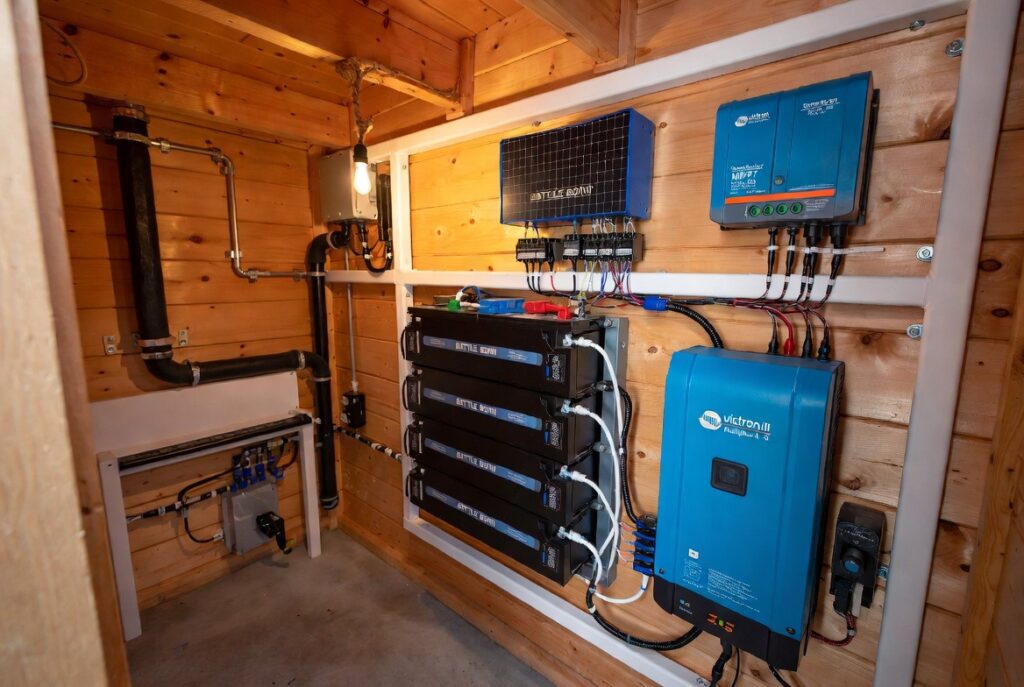
The energy storage Ontario sizing failure that strands Haliburton County cabin owners without power every January morning is not a panel problem or a wiring fault but a storage undersizing decision made at purchase: a 50Ah LFP bank that cannot bridge the gap between the end of 1.5 PSH production at approximately 2 PM and the following morning at a 700Wh daily critical load. The owner who sized correctly for the panels chose the smallest available battery to save money on the initial build.
The physics of energy storage Ontario operate identically at every scale. Ontario’s IESO faces the same problem on the provincial grid: solar and wind produce at noon; demand peaks at 5 PM and again at 9 PM.
The Sir Adam Beck pumped hydro facility on the Niagara River stores the midday surplus and releases it during the evening peaks. Your cabin LFP bank does exactly the same thing at a smaller scale. The Victron MPPT 100/50 charges during production hours; the MultiPlus-II draws during non-production hours; the SmartShunt tracks the reserve. Understanding this store-and-dispatch principle at grid scale makes the off-grid sizing decision intuitive: size for the longest overnight gap, not the average night.
The Lanark County owner who implemented a load management protocol modelled on grid operator dispatch strategy doubled their January gray streak endurance from 2.5 days to 5 days without adding a single panel or storage unit. The energy storage Ontario lesson from both counties is the same: correct storage sizing and correct load management are two separate decisions, and both are required for reliable Ontario January operation. See our Ontario solar sizing guide before any energy storage Ontario bank specification.
The energy storage Ontario grid comparison: Sir Adam Beck, BESS, and the store-and-dispatch principle
| Storage type | Scale | Charge source | Discharge trigger | Monitoring |
|---|---|---|---|---|
| Sir Adam Beck pumped hydro | ~1,740 MW | Grid surplus at noon | Evening peak demand | IESO grid control |
| Ontario utility BESS | MW-scale | Solar/wind overproduction | Grid frequency response | IESO dispatch |
| Battle Born 100Ah LFP | 1.28kWh | MPPT during PSH window | Evening and overnight loads | SmartShunt SoC |
Ontario’s IESO manages grid storage through two primary technologies. Sir Adam Beck on the Niagara River holds approximately 1,740 MW of pumped hydro capacity , during midday solar and wind overproduction, excess energy pumps water to the Queenston reservoir; during evening peak demand, the water releases through turbines. Utility-scale BESS installations deployed across Ontario from 2022 onward supplement the pumped hydro reserve with millisecond-response lithium battery capacity. Together they manage the daily production valley between Ontario’s noon solar peak and its 5 PM and 9 PM demand peaks.
The off-grid cabin scale mirrors this principle exactly. The MPPT charges the LFP bank during the Ontario solar production window , approximately 10 AM to 2 PM in January, 7 AM to 7 PM in July. The MultiPlus-II draws from the bank during non-production hours exactly as the Niagara turbines generate during peak demand. Solar production is at its annual minimum and overnight demand is at its annual maximum. Ontario’s grid survives winter because it sized its storage reserve for peak winter demand. The off-grid energy storage Ontario bank must be sized on the same principle. See our Ontario solar hours guide for the PSH data that governs the production window calculation.
The Haliburton County 50Ah failure: why storage, not panels, determines January survivability
A Haliburton County cabin owner installed a correctly sized 400W array for their 700Wh daily critical load. To reduce the initial build cost, they chose a 50Ah LFP bank. At 80 percent DoD, the usable capacity of a 50Ah bank is approximately 480Wh. The daily critical load was 700Wh. January 1.5 PSH production ended at approximately 2 PM, leaving an 18-hour overnight gap from 2 PM to 8 AM the following morning. The 480Wh usable bank could not bridge that gap against a 700Wh daily load drawing continuously through the night.
After the first week of January commissioning, the SmartShunt showed the bank hitting 15 percent SoC every night by approximately 10 PM. The BMS cold protection activated at 10 percent SoC and shut down output to protect the cells. The owner woke to no power every January morning. The panels were performing correctly. The MPPT was performing correctly. The failure point was the 50Ah bank that could not hold enough energy to bridge the Ontario January overnight gap at the installed critical load.
The fix was a Battle Born 100Ah LFP upgrade. At 80 percent DoD, the 100Ah bank holds approximately 960Wh of usable energy , enough to carry the 700Wh daily load through the 18-hour overnight gap with approximately 260Wh reserve above the 20 percent SoC floor. The SmartShunt confirmed the bank stayed above 25 percent SoC through every January night after the upgrade. The correct energy storage Ontario specification for a 700Wh daily load and a January 1.5 PSH production window is 100Ah minimum, not 50Ah. See our Ontario LiFePO4 battery guide for the full DoD and sizing specification.
The energy storage Ontario sizing rule: 100Ah minimum for the January overnight gap
The energy storage Ontario sizing formula uses three inputs: daily load, overnight gap hours, and DoD floor. Overnight gap hours x (daily load / 24) = minimum usable storage required. For an 18-hour January gap at 700Wh daily load: 18 x (700/24) = approximately 525Wh minimum usable. Add a 20 percent reserve above the DoD floor: 525 x 1.2 = approximately 630Wh minimum usable. At 80 percent DoD: 630 / 0.8 = approximately 790Wh nameplate minimum = approximately 65Ah minimum. The Battle Born 100Ah LFP at 1,280Wh nameplate provides the correct margin above this minimum.
The formula scales for any load and any overnight gap. A 1,000Wh daily load at the same 18-hour gap requires approximately 93Ah minimum , the correct specification is a 100Ah bank with a generator top-up protocol for gray streaks. A 500Wh daily load at 18 hours requires approximately 47Ah minimum , a 50Ah bank is borderline correct but provides no reserve margin; a 100Ah bank is the safer specification. Every Ontario energy storage Ontario system should run this calculation using the January overnight gap as the design constraint, not the July overnight gap where production overlaps more of the evening draw. For the complete January PSH production window by Ontario postal code, see our Ontario solar hours guide.
The 80 percent DoD rule: LFP cycle life and the 20 percent SoC floor
LFP cells cycled to 80 percent DoD achieve approximately 3,000 to 5,000 full cycles , approximately 8 to 14 years of daily cycling at the correct depth. LFP cells regularly discharged to 100 percent DoD can see cycle life drop below 1,000 cycles, meaning premature replacement in 2 to 3 years of daily cycling. The SmartShunt low SoC alert should be configured at 20 percent to warn before the BMS activates its deep discharge protection at 10 percent. Setting the alert at 20 percent gives the owner a response window before the BMS shuts down output.
Ontario BESS operators apply the same depth of discharge management to maximise asset life on utility-scale lithium cells. A utility battery regularly cycled to 100 percent DoD would require replacement years ahead of its warranted life, at significant cost to ratepayers. The 80 percent DoD rule is not a conservative safety margin , it is the correct operating specification for any LFP cell in any energy storage Ontario application, grid or off-grid. Treating the 20 percent SoC floor as a hard operating limit rather than an emergency threshold is the energy storage Ontario practice that delivers the warranted cycle life from every LFP bank.
The Lanark County load management result: doubling gray streak endurance without adding hardware
A Lanark County owner had a correctly specified system , 400W array, 100Ah LFP, MultiPlus-II , but lost 40 percent SoC through January gray streaks because heavy loads ran in the evenings. Vacuuming, device charging, and workshop tools all drew from the bank during the 6 PM to 10 PM window when the bank was already depleted from the overnight gap. The production window of 10 AM to 2 PM was being used only for battery charging, not for direct load supply. The SmartShunt showed the daily low point dropping progressively through each gray streak day.
The owner implemented a load management protocol modelled on grid operator charge-peak/discharge-valley dispatch strategy. Heavy loads were deferred to the 10 AM to 2 PM production window so the MPPT powered those loads directly rather than drawing from the bank. Essential loads , fridge, lighting, and CPAP , continued to run from the bank during non-production hours. The SmartShunt tracked the daily SoC low point as the primary performance metric. The shift required no hardware changes and no additional panels or storage.
Even through a 5-day January gray streak with actual production reduced to approximately 0.8 PSH per day, the SmartShunt never dropped below 40 percent SoC. The load management protocol effectively doubled the gray streak endurance from approximately 2.5 days to 5 days without any hardware addition. The energy storage Ontario lesson from Lanark County is direct: how you draw from the bank is as important as how large the bank is. A 100Ah bank managed with a production-window load protocol performs as well as a 200Ah bank run without discipline.
NEC and CEC: Ontario permit requirements for battery storage installations
Any permanently wired Ontario battery storage installation requires an ESA permit under CEC Section 64 before installation begins. The permit requirement applies to all hardwired battery connections , battery-to-inverter conductors, MPPT-to-battery conductors, and any permanent bus bar or distribution wiring connecting the energy storage Ontario bank to the cabin loads. The ESA inspection confirms that conductor sizing, overcurrent protection, and grounding meet the Ontario Electrical Safety Code for DC energy storage applications. Contact the NFPA at nfpa.org for current NEC 690 and NFPA 855 requirements applicable to Ontario off-grid battery storage installations.
CEC Section 64 and NFPA 855 together govern stationary energy storage system installations in Ontario. NFPA 855 specifies maximum energy storage quantities per area, separation requirements between battery modules, and ventilation requirements for indoor LFP installations. A 100Ah LFP bank in a cabin utility room is a low-risk installation that typically meets the NFPA 855 residential allowances without special separation requirements, but the ESA permit and inspection confirm compliance before the system is commissioned. Contact the Electrical Safety Authority Ontario at esasafe.com before beginning any permanently wired energy storage Ontario installation.
Pro Tip: Set the SmartShunt low SoC alert at 25 percent rather than the default 20 percent for Ontario January operation. The extra 5 percent provides a warning window before the BMS engages its deep discharge protection at 10 percent , giving approximately 30 to 45 minutes to shed non-essential loads before the system shuts down. The Haliburton County result showed the bank consistently hitting 15 percent before the owner knew there was a problem. A 25 percent alert would have triggered every night, making the undersizing problem visible before the BMS shutdown became the morning diagnostic.
The energy storage Ontario verdict: size for January, manage loads during production, track SoC daily
- Ontario cabin owner whose bank hits below 20 percent SoC in January: upgrade to Battle Born 100Ah LFP minimum. The Haliburton County result: 50Ah failed every January night; 100Ah confirmed above 25 percent SoC every night. Run the sizing formula: overnight gap hours x (daily load / 24) x 1.2 / 0.8 = minimum Ah nameplate. For a 700Wh load and an 18-hour January overnight gap, the minimum is approximately 65Ah , the 100Ah provides the correct margin. Set the SmartShunt low SoC alert at 25 percent before the next January season.
- Ontario cabin owner losing significant SoC through gray streaks: implement the load management protocol before adding hardware. The Lanark County result: heavy loads deferred to the 10 AM to 2 PM production window doubled gray streak endurance from 2.5 days to 5 days without adding panels or storage. The SmartShunt daily SoC low point is the metric that makes the improvement measurable , track it for one week before and one week after implementing the protocol to confirm the gain.
- Ontario cabin owner planning a new energy storage Ontario system: size storage for January, not July. The Sir Adam Beck principle: the IESO sizes reserve for peak winter demand, not average annual demand. Your off-grid bank must bridge the January overnight gap at 1.5 PSH production with 80 percent DoD as the operating floor. Run the sizing formula using the January overnight gap for your specific Ontario postal code PSH, not the July number that makes the bank look unnecessary.
Frequently Asked Questions
Q: How much battery storage do I need for an Ontario off-grid cabin?
A: The correct energy storage Ontario sizing calculation uses the January overnight gap as the design constraint. For a 700Wh daily critical load and an 18-hour overnight gap (2 PM to 8 AM in January at 1.5 PSH), the minimum usable storage required is approximately 525Wh. Adding a 20 percent reserve above the 80 percent DoD floor gives approximately 630Wh minimum usable, which translates to approximately 65Ah minimum nameplate capacity. The Battle Born 100Ah LFP at approximately 960Wh usable is the correct specification for this load.
It provides the required overnight coverage with reserve above the 20 percent SoC floor. The Haliburton County result confirmed: 50Ah (480Wh usable) depletes every January night at 700Wh load; 100Ah (960Wh usable) maintains above 25 percent SoC every January night at the same load.
Q: What is the 80 percent DoD rule for LFP batteries in Ontario?
A: The 80 percent DoD rule means discharging a LFP battery to no lower than 20 percent SoC during normal daily cycling. At 80 percent DoD, LFP cells achieve approximately 3,000 to 5,000 full cycles , approximately 8 to 14 years of daily cycling.
Discharging to 100 percent DoD (0 percent SoC) regularly reduces cycle life to under 1,000 cycles, meaning the bank needs replacement in 2 to 3 years rather than 10 to 14. The SmartShunt should be configured with a low SoC alert at 20 to 25 percent to warn before the BMS engages its deep discharge protection at 10 percent. The 80 percent DoD rule is the correct energy storage Ontario operating specification for any LFP bank. It is not a conservative safety margin but the operating depth that delivers the warranted cycle life.
Q: How does Ontario grid storage compare to off-grid battery storage?
A: Both Ontario grid storage and off-grid LFP storage use the same store-and-dispatch principle: capture energy during the production peak and release it during the demand valley. At grid scale, Sir Adam Beck’s approximately 1,740 MW pumped hydro facility stores the Ontario noon solar and wind surplus by pumping water to the Queenston reservoir, then releases it through turbines during the 5 PM and 9 PM demand peaks. At cabin scale, the MPPT charges the LFP bank during the 10 AM to 2 PM January production window, and the MultiPlus-II draws from the bank during the 2 PM to 8 AM overnight gap.
The IESO sizes Sir Adam Beck for peak Ontario winter demand; the correct energy storage Ontario off-grid approach sizes the LFP bank for the peak January overnight gap at 1.5 PSH. The physics are identical; only the scale differs.
This build is engineered within the 48V DC Safety Ceiling. Diagnostic logic is based on 20+ years of technical service experience. All structural and electrical installations must be verified by a Licensed Professional and comply with your Local AHJ. See our legal and safety disclosure for full scope.
About the Author
Robert Bertrand spent 20 years as a service advisor in the automotive industry (Lexus and Nissan), where precision diagnostics, wiring integrity, and documentation standards were non-negotiable. He brings that same technical discipline to GridFree Guide, where he researches, tests, and documents off-grid solar systems for Ontario conditions. Based in Rockwood, Ontario, every article is built on verified specifications, manufacturer data, and the real-world climate constraints of Canadian off-grid living.
As an Amazon Associate I earn from qualifying purchases. This site also contains affiliate links to other products and services. GridFree Guide earns a small commission at no extra cost to you.