
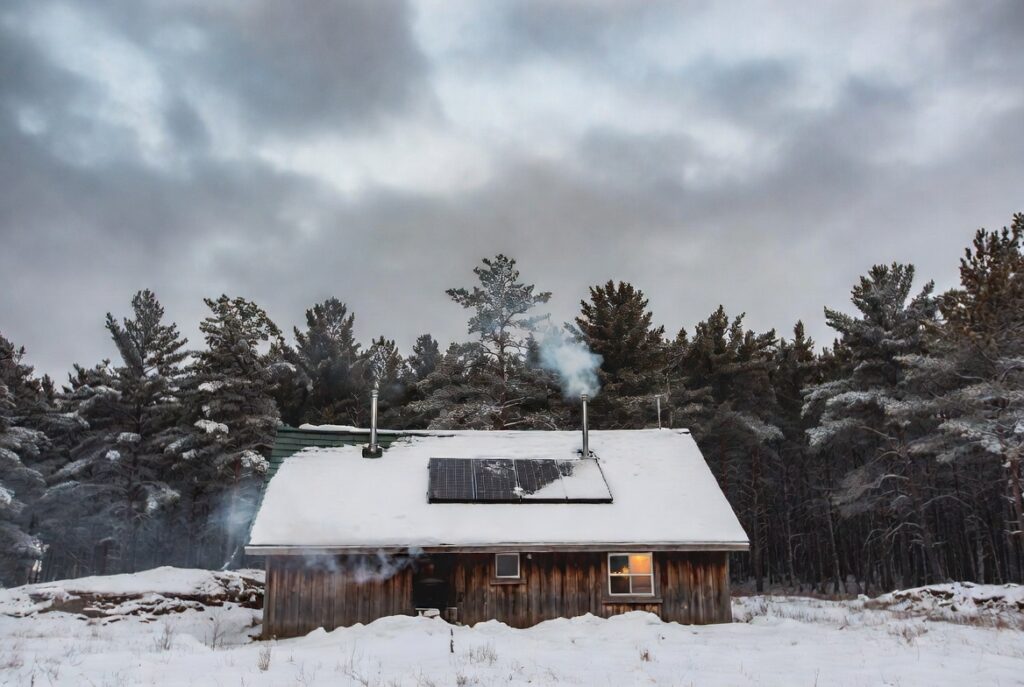
The cabin solar ontario system that fails every Friday arrival is not the one with the wrong inverter or the wrong panels but the one built around a lead-acid battery and a suitcase panel, because a seasonal cabin owner in Haliburton County ran exactly this combination and arrived every Friday evening to a dead battery bank below 10 percent SoC. The bank discharged itself during the five-day absence not from any load running in the cabin but from the lead-acid battery’s own self-discharge rate of approximately 5 to 10 percent per week at Ontario summer temperatures. A lead-acid battery rated at 100Ah typically delivers approximately 50Ah of usable capacity at 50 percent DoD before cell damage risk increases.
He switched to the Tier 1 cabin solar ontario specification: two Renogy 100W monocrystalline panels, a Victron MPPT 100/30 charge controller, a Battle Born 100Ah heated LFP bank, and a SmartShunt on the battery negative terminal. After the switch, the SmartShunt confirmed the bank retained approximately 85 percent SoC after a 5-day absence with zero solar input on overcast days. The LFP chemistry self-discharges at approximately 2 to 3 percent per month , approximately 0.5 to 0.75 percent per week , versus the lead-acid rate that had been depleting his previous system by mid-week every week.
The cabin solar ontario gray streak is the second challenge the Tier 1 spec must address. An Ontario gray streak is a 4 to 5 day stretch of heavy overcast with minimal solar harvest, common from October through March. At the lights-only daily load of approximately 190Wh, the 100Ah Battle Born bank (1,280Wh usable at 80 percent DoD) provides approximately 6.7 days of autonomy without any solar input. The SmartShunt time-to-empty display tells the owner exactly how many hours of reserve remain at any point during a gray streak. See our Ontario solar sizing guide before any cabin solar ontario specification.
The cabin solar ontario Tier 1 specification: 200W, MPPT 100/30, and heated LFP
| Component | Spec | Why |
|---|---|---|
| Array | 2 x Renogy 100W monocrystalline | 200W total, correct for lights-only Ontario cabin load |
| Charge controller | Victron MPPT 100/30 | 30A output, correct for 12V system, tracks maximum power point in low Ontario light |
| Battery bank | Battle Born 100Ah heated LFP | 1,280Wh usable at 80% DoD, self-heats at 2 degrees C, mandatory Oct through Apr |
| Monitor | Victron SmartShunt | Coulomb-counting SoC, time-to-empty for gray streak monitoring |
| All-in cost | $1,800 to $2,200 | Complete Tier 1 Ontario cabin specification |
The complete cabin solar ontario Tier 1 specification matches most 12V LED fixtures and water pumps without requiring an inverter for basic loads. Two Renogy 100W panels produce approximately 255Wh on a clear Ontario January day at 1.5 peak sun hours, covering the 190Wh lights-only daily load with 65Wh to spare for bank top-up. The MPPT 100/30 tracks the maximum power point across the full irradiance range, recovering 15 to 20 percent more energy than a PWM controller on Ontario overcast days when every watt matters during a gray streak. See our Ontario solar system planning guide for the full Tier 1 to Tier 3 sizing progression.
The load table below confirms the daily consumption basis for the Tier 1 specification:
| Load | Wattage | Daily use | Total Wh |
|---|---|---|---|
| LED lights | 20W | 5 hours | 100Wh |
| Water pump | 60W | 0.5 hours | 30Wh |
| Phone/tablet charging | 20W | 3 hours | 60Wh |
| Total lights-only | 190Wh | ||
| Small fridge (Tier 2 upgrade) | 45W | 24 hours | 1,080Wh |
| Total with fridge | 1,270Wh |
The Ontario cabin load calculation: lights-only versus fridge-included
The lights-only cabin load is the correct baseline for a seasonal Ontario cabin used on weekends and holidays: LED lights at 100Wh, water pump at 30Wh, and phone charging at 60Wh totals approximately 190Wh per day. At this load, the 1,280Wh usable Tier 1 bank provides approximately 6.7 days of autonomy without any solar input. This covers any standard Ontario gray streak , the bank can sustain a full week of cabin use through an unproductive November weather system without running dry.
The fridge calculation changes everything. A 45W efficient mini-fridge running 24 hours adds 1,080Wh to the daily load, making it the single largest load in the entire system. The total daily consumption with the fridge reaches approximately 1,270Wh , and the Tier 1 100Ah bank provides approximately 1 day of autonomy at that load rate. The Tier 1 cabin solar ontario spec cannot sustain a refrigerator through any Ontario gray streak. A Tier 2 upgrade to 400W array and 200Ah bank is required before adding a fridge. See our Ontario solar system planning guide for the Tier 2 specification.
The gray streak test: how long the Tier 1 bank lasts without sun
At 190Wh daily lights-only load, the 1,280Wh usable Tier 1 bank provides approximately 6.7 days of autonomy without any solar input. In January at 1.5 peak sun hours, the 200W array produces approximately 255Wh on a clear day, covering the lights-only load with 65Wh surplus for bank recovery. The SmartShunt time-to-empty display gives the owner a real-time reserve number during any gray streak. At 72 hours remaining on the display, it is time to either run a generator for a 90-minute bulk charge or reduce cabin loads for the remaining days.
The October through March period is when the gray streak is most dangerous for an Ontario cabin solar ontario system. November and December average approximately 1.5 to 2.0 peak sun hours per day , the 200W array produces approximately 255 to 340Wh on clear days and 25 to 50Wh on overcast days. A 5-day November gray streak produces approximately 125 to 250Wh total from the array while consuming approximately 950Wh from the bank at lights-only loads. The SmartShunt confirms whether the bank has sufficient reserve for the remaining trip days before any concern becomes urgent. See our Ontario winter solar guide for the full gray streak protocol.
The cabin solar ontario heated LFP requirement: why October ends the standard LFP season
A standard LFP BMS blocks all charging at 0 degrees C cell temperature. In an unheated Ontario cabin from October through April, the interior temperature regularly crosses the 0 degrees C line overnight. On arrival after a cold week, the panels produce power at sunrise but the standard LFP bank will not accept any charging current until the cabin heats and the cells warm above 0 degrees C by ambient conduction , a process that can take 2 to 4 hours in a cabin that has been at -15 degrees C overnight. During that wait, the panels are producing and the MPPT is clipping the output because the bank will not accept a charge.
A property owner with a year-round cabin on the Grey Bruce Peninsula near Owen Sound left the cabin unheated for 10 days in January while ambient temperatures dropped to -25 degrees C. A standard LFP bank would have cold-soaked to -25 degrees C and the BMS charge block would have activated the moment the cell temperature reached 0 degrees C on the way down. Even on the return morning with the panels producing, a standard LFP bank would have remained blocked until the cabin interior warmed the cells back above 0 degrees C by ambient conduction , a wait of several hours.
His Battle Born heated LFP self-heating element activated at approximately 2 degrees C cell temperature during the cold-soak, drawing a small amount of energy from the bank to keep the cells above freezing through the entire 10-day absence. The panels charged the bank the same morning he returned, before the cabin interior had warmed above 5 degrees C. The SmartShunt confirmed 72 percent SoC on arrival and normal charging current from the array within 10 minutes of the sun hitting the panels. His comment: “The lights were on before the cabin was warm. That is what the heated battery does.” See our Ontario solar storage guide for the full LFP vs heated LFP comparison.
NEC and CEC: Ontario permit requirements for cabin solar installations
NEC 690 governs permanent cabin solar ontario installations. Any permanently mounted array with a wired charge controller, battery bank, and loads is a permanent electrical installation subject to NEC 690 requirements. DC conductors must be sized for 125 percent of maximum continuous current, the Class T fuse must be within 18 inches of the battery positive terminal per NEC 690.9, and the MPPT 100/30 must be rated for the array cold Voc at Ontario January temperatures , STC Voc multiplied by 1.08 at -10 degrees C. Contact the NFPA at nfpa.org for current NEC 690 requirements.
CEC Section 64 governs Ontario electrical installations. A permanently wired cabin solar ontario system requires an ESA permit at approximately $300 to $400 before installation begins. A licensed electrician must complete the wiring and schedule the ESA inspection before the system is commissioned. Portable suitcase-style systems connected through existing charge ports do not require an ESA permit. Contact the Electrical Safety Authority Ontario at esasafe.com before beginning any permanently wired Ontario cabin solar installation.
Pro Tip: Before purchasing a fridge for your Ontario cabin, calculate your gray streak autonomy at the new total load. A 100Ah bank at 1,270Wh daily (with fridge) provides approximately 1 day of autonomy , a single overcast day wipes out the entire reserve. A 200Ah bank at the same load provides approximately 2 days. Neither survives a standard Ontario 4 to 5 day November gray streak without solar top-up. Size the bank before ordering the fridge, not after. The SmartShunt time-to-empty calculation at the new load tells you exactly what the gray streak exposure is before you run the wire.
The cabin solar ontario verdict: Tier 1 spec, heated LFP, SmartShunt, and when to upgrade
- Seasonal Ontario cabin used from May through October only: the Tier 1 spec with standard LFP is correct for summer-only use. When the cabin ambient does not drop below 0 degrees C overnight, a standard 100Ah LFP bank is sufficient. Two Renogy 100W panels, MPPT 100/30, and 100Ah standard LFP bank covers the lights-only load with 6.7 days of gray streak autonomy. The SmartShunt confirms the bank retains charge through weekly absences at the low LFP self-discharge rate. Budget approximately $1,600 to $1,900 all-in for the standard LFP version of this spec.
- Year-round or October through May Ontario cabin: the Battle Born heated LFP is mandatory. The Grey Bruce Peninsula result confirms the case for it: -25 degrees C January absence, self-heating element active throughout the cold-soak, panels charging the bank on return morning before the cabin interior had warmed. The SmartShunt confirmed 72 percent SoC on arrival. Budget approximately $1,800 to $2,200 all-in including the heated LFP premium. The heated battery is not optional for any Ontario cabin that sits unheated from October through April.
- Ontario cabin owner who wants to add a refrigerator: upgrade to Tier 2 before ordering the fridge. The Tier 1 100Ah bank cannot sustain the 1,270Wh daily fridge load through any Ontario gray streak , autonomy drops from 6.7 days to approximately 1 day. The Tier 2 specification is 400W array and 200Ah heated LFP bank. Even at Tier 2, a 5-day gray streak in November will deplete the bank , a generator backup plan is required for year-round fridge use in Ontario cabins. See our Ontario battery generator guide for the hybrid backup specification.
Frequently Asked Questions
Q: What size solar system does an Ontario cabin need?
A: The correct cabin solar ontario specification depends on the load. For a lights-only seasonal cabin , LED lights, water pump, and phone charging at approximately 190Wh per day , the Tier 1 spec is two 100W panels, an MPPT 100/30, and a 100Ah LFP bank at approximately $1,600 to $2,200 depending on battery type. This provides approximately 6.7 days of gray streak autonomy at the lights-only load.
Adding a refrigerator changes the daily load to approximately 1,270Wh and requires a Tier 2 upgrade to 400W array and 200Ah bank before the system can sustain that load through any Ontario gray streak. The Haliburton County result confirms the lights-only Tier 1 spec: 85 percent SoC retained after a 5-day absence with zero solar input.
Q: Do I need a heated battery for my Ontario cabin solar system?
A: Yes, for any cabin that operates year-round or from October through May. A standard LFP BMS blocks all charging at 0 degrees C cell temperature. In an unheated Ontario cabin from October through April, interior temperatures regularly cross the 0 degrees C line overnight. On a cold arrival morning, a standard LFP bank will not accept charging current from the panels until the cabin heats and the cells warm by ambient conduction , a wait of 2 to 4 hours.
The Battle Born heated LFP self-heats at 2 degrees C cell temperature, keeping the cells above freezing throughout any Ontario cold-soak. The Grey Bruce Peninsula result confirms: 10-day January absence at -25 degrees C ambient, panels charging on return morning before the cabin interior had warmed, SmartShunt confirmed 72 percent SoC on arrival.
Q: How long will a 100Ah LFP battery last in an Ontario cabin during a gray streak?
A: At the lights-only cabin solar ontario daily load of approximately 190Wh, the 100Ah Battle Born bank (1,280Wh usable at 80 percent DoD) provides approximately 6.7 days of autonomy without any solar input. This covers a standard Ontario 4 to 5 day gray streak with 1 to 2 days of reserve remaining. Adding a small fridge (45W, 24 hours = 1,080Wh) increases the daily load to approximately 1,270Wh and reduces gray streak autonomy to approximately 1 day. The SmartShunt time-to-empty display converts this calculation into a real-time hours-remaining number during any actual gray streak, so the owner knows exactly when to either reduce loads or start the generator for a top-up charge.
This build is engineered within the 48V DC Safety Ceiling. Diagnostic logic is based on 20+ years of technical service experience. All structural and electrical installations must be verified by a Licensed Professional and comply with your Local AHJ. See our legal and safety disclosure for full scope.
About the Author
Robert Bertrand spent 20 years as a service advisor in the automotive industry (Lexus and Nissan), where precision diagnostics, wiring integrity, and documentation standards were non-negotiable. He brings that same technical discipline to GridFree Guide, where he researches, tests, and documents off-grid solar systems for Ontario conditions. Based in Rockwood, Ontario, every article is built on verified specifications, manufacturer data, and the real-world climate constraints of Canadian off-grid living.
As an Amazon Associate I earn from qualifying purchases. This site also contains affiliate links to other products and services. GridFree Guide earns a small commission at no extra cost to you.