
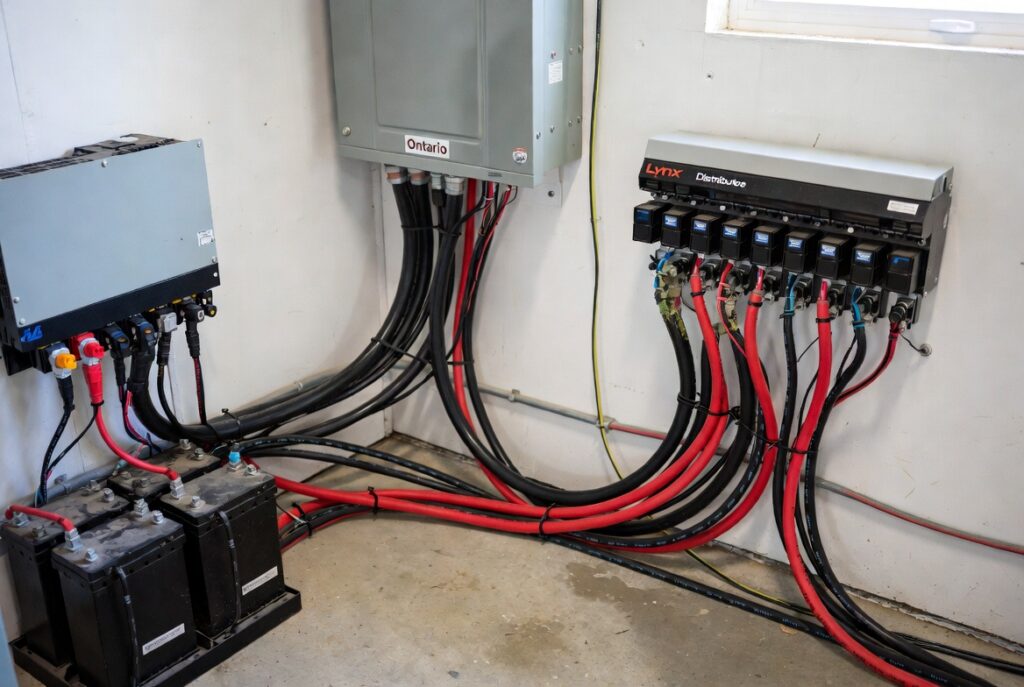
The battery inverter ontario connection that fails most often in Ontario is not caused by a faulty inverter or a defective battery, but by 6 AWG cable installed between a 48V 200Ah Battle Born heated LFP bank and a Victron MultiPlus-II, because a property owner in Orangeville used 6 AWG cable intended for AC household circuits.
His Victron SmartShunt showed the system voltage collapsing from 52V to 44V the moment a 2,000W microwave came on. The 8-volt drop was caused by the combination of undersized cable and undertorqued terminal connections. The 6 AWG cable has a free-air ampacity of approximately 65A, below the 78A minimum rating required for a 3,000W 48V inverter under the NEC 690 125 percent sizing rule.
The BMS read the voltage drop as a low-cell-voltage fault and shut down to protect the cells.
This is the BMS working correctly: it cannot distinguish between undersized cable resistance and a genuinely depleted battery at 44V, so it protects the cells from what appears to be a low-voltage event. Addressing the cable gauge first is the correct diagnostic sequence.
The fix was straightforward: replace the 6 AWG with 2/0 AWG for the same run length, and torque all terminal connections to manufacturer specification. At 62.5A through 2/0 AWG on a 3-foot run, the voltage drop is approximately 0.7V, well within the 3 percent maximum specification. Under the same 2,000W microwave load, the SmartShunt confirmed the voltage held at 47.8V without triggering the BMS.
The battery inverter ontario DC cable sizing rule is the most important specification in the entire system because no other component can compensate for undersized cable. A correctly sized array, a correctly specified MultiPlus-II, and a full Battle Born bank will all underperform if the cable connecting them cannot carry the load current without significant voltage drop. Every wiring decision in a battery inverter ontario system follows from the inverter’s maximum current draw at the system voltage. See our Ontario solar sizing guide before any battery inverter ontario wiring specification.
The battery inverter ontario DC cable rule: 2/0 AWG for any 48V 3,000W run over 2 feet
| System voltage | Inverter size | Continuous current | 125% sizing (min cable) | Minimum gauge (2-foot run) |
|---|---|---|---|---|
| 12V | 1,000W | 83A | 104A | 2 AWG |
| 24V | 2,000W | 83A | 104A | 2 AWG |
| 48V | 3,000W | 62.5A | 78A | 2/0 AWG (runs over 2 feet) |
| 48V | 5,000W | 104A | 130A | 3/0 AWG |
A 48V 3,000W MultiPlus-II draws 62.5A continuous current. The NEC 690 125 percent sizing rule requires a cable rated for at least 78A. For runs over 2 feet at 48V, 2/0 AWG is the correct minimum gauge , it carries 78A with less than 1.5 percent voltage drop across a 3-foot two-way run. The 6 AWG cable the Orangeville property owner installed has a free-air ampacity of approximately 65A, which is below the 78A requirement before any derating for conduit or bundling. Under load, the resistance of the undersized cable plus undertorqued connections produced the full 8V drop that tripped the BMS.
The 48V architecture reduces the DC current requirement by a factor of four compared to a 12V system running the same 3,000W load. A 12V 3,000W system draws 250A continuous, requiring very large cable for any practical run length. At 48V, the 62.5A draw allows 2/0 AWG to handle runs up to approximately 5 feet while staying within the 3 percent voltage drop specification. This is the primary reason Ontario Tier 2 systems specify 48V for any inverter over 1,000W. See our solar wire gauge Ontario guide for the full conductor sizing table and voltage drop calculation method.
The Class T fuse placement rule: within 18 inches of the battery positive terminal
The Class T fuse must be installed on the battery positive terminal within 18 inches of the battery under NEC 690.9. The fuse protects the cable between the battery terminal and the fuse itself from short circuit current. If the fuse is placed at the inverter end instead, the full cable run from battery to inverter is unprotected , any fault in that cable (chafing against a rack, a sharp edge, or a dropped tool bridging the cable and chassis) draws unlimited short circuit current from the battery without any protection. At 48V with a 200Ah bank, an unprotected short circuit can draw thousands of amps and start a fire before the battery’s BMS can respond.
The Victron Lynx Distributor provides an integrated DC bus with individual fuse slots for the MultiPlus-II, MPPT charge controller, and DC load connections. After the main Class T fuse on the battery positive terminal, the Lynx Distributor accepts the battery connection and distributes to all loads through individual fused ports. The only unprotected cable length in this architecture is the short run between the battery positive terminal and the Lynx input , which should be kept under 18 inches to comply with NEC 690.9. All distribution beyond the Lynx is individually protected at the bus level.
The battery inverter ontario commissioning sequence: BMS first, breaker second, inverter third
A property owner in Guelph powered up his new Tier 2 system by closing the main DC breaker and turning on the MultiPlus-II before the Battle Born LFP bank’s BMS had been initialised. The MultiPlus-II capacitors drew an inrush current spike on connection that the BMS interpreted as an uncontrolled voltage event at the battery terminals. The BMS activated the protection circuit and the system did not come online. The inverter appeared completely non-functional. He contacted the supplier to arrange a warranty return, believing the MultiPlus-II was faulty on arrival.
The correct battery inverter ontario commissioning sequence resolved the issue immediately: disconnect the inverter DC input, wait 30 seconds for the capacitors to discharge through the pre-charge resistor, press the BMS activation button on the Battle Born bank, confirm the cell voltage display shows all cells balanced and within 0.02V of each other, close the main DC breaker, then power the MultiPlus-II using the inverter on/off switch. The SmartShunt confirmed 0A at rest after the correct sequence. The MultiPlus-II operated normally from that point forward. His comment: “I thought I’d bought a dead inverter. It was one wrong step in the sequence.”
The BMS protection trip on incorrect startup is not a fault in the inverter or the battery. It is the BMS working correctly to protect the cells from an event it cannot identify as safe. The MultiPlus-II has an internal pre-charge circuit that limits capacitor inrush when the inverter is powered in the correct sequence through an initialised BMS. If the inverter is powered before the BMS is ready, the pre-charge circuit has no BMS handshake to reference and the inrush is uncontrolled. Always confirm the SmartShunt shows 0A at rest after the correct commissioning sequence before connecting any loads. See our solar battery monitor Ontario guide for the full SmartShunt commissioning protocol.
The SmartShunt placement rule: battery negative terminal only
The SmartShunt must be installed on the battery negative terminal so that all current , solar charge from the MPPT, generator charge through the MultiPlus-II charger input, inverter discharge, and DC loads , flows through the shunt before reaching the system common ground. A shunt installed on the inverter negative terminal only measures the inverter discharge current. It misses the MPPT charge current entirely, and misses the generator bulk charge current when the MultiPlus-II is running in charger mode. Within 3 to 5 days of normal operation, the SoC calculation drifts and the time-to-empty display becomes unreliable.
The correct battery inverter ontario SmartShunt installation has a single wire path from the battery negative terminal to the shunt input, and a single wire path from the shunt output to the system common negative bus. Every component that connects to the negative bus , MPPT output negative, MultiPlus-II DC negative, DC load negatives, and the Lynx Distributor negative bus , connects to the bus side of the shunt, not the battery side. This single-path architecture ensures every amp of charge and discharge flows through the shunt for complete SoC accounting. See our solar battery monitor Ontario guide for the full negative bus wiring diagram.
NEC and CEC: Ontario permit requirements for DC battery-to-inverter wiring
NEC 690 and NEC 690.9 govern all DC battery-to-inverter wiring in Ontario off-grid and battery-backed solar systems. DC conductors must be sized for 125 percent of the maximum continuous current and protected by Class T fuses rated no more than 150 percent of conductor ampacity, installed within 18 inches of the battery positive terminal. All DC wiring must use cable listed for the operating voltage , 48V DC-rated cable is required for 48V systems; standard AC household wiring such as THWN is not listed for 48V DC service. The inverter must include a DC disconnect accessible within the same enclosure or adjacent to the battery bank. Contact the NFPA at nfpa.org for current NEC 690 requirements.
CEC Section 64 governs Ontario electrical installations. Any permanent battery inverter ontario DC wiring , battery bank wiring, Class T fuse, DC disconnect, Lynx Distributor connections, and MultiPlus-II DC input , requires an ESA permit at $300 to $400 before installation begins. A licensed electrician must complete the installation to the torque specifications on all terminal connections and schedule the ESA inspection before commissioning. Contact the Electrical Safety Authority Ontario at esasafe.com before beginning any permanent battery inverter ontario installation.
Pro Tip: After commissioning the battery inverter ontario system and confirming 0A at rest on the SmartShunt, run the system through one full charge-discharge cycle before relying on the SoC display. The SmartShunt’s Coulomb counting algorithm needs a full charge-to-discharge calibration cycle to establish an accurate SoC baseline. Charge the Battle Born bank to 100 percent (confirmed by the MultiPlus-II bulk-to-absorption-to-float transition), then discharge to approximately 20 percent SoC under normal household loads while monitoring the SmartShunt time-to-empty. After that first full cycle, the SmartShunt SoC and time-to-empty readings will be accurate to within 1 to 2 percent for the operating life of the bank.
The battery inverter ontario verdict: cable gauge, fuse placement, sequence, and shunt position
- Ontario property owner installing a new 48V battery-to-inverter connection: measure the cable run, verify 2/0 AWG for any 48V 3,000W run over 2 feet, install the Lynx Distributor as the DC bus hub, and place the Class T fuse within 18 inches of the battery positive terminal. Follow the commissioning sequence: initialise the Battle Born LFP BMS first, close the main breaker second, power the MultiPlus-II third. Confirm 0A at rest on the SmartShunt before connecting any loads. Run one full charge-discharge cycle to calibrate the SoC baseline.
- Ontario property owner experiencing BMS trips under load: check the DC cable gauge first before replacing any equipment. If the SmartShunt shows voltage dropping more than 1.44V from resting voltage (3 percent of 48V) under full load, the cable is undersized. The Orangeville result: 8V drop with 6 AWG AC wiring, 0.7V drop with 2/0 AWG on the same 3-foot run. Replace the cable and torque all terminal connections to manufacturer specification before diagnosing any other component. Undertorqued terminal connections add resistance that compounds the effect of undersized cable on the same circuit.
- Ontario property owner whose BMS tripped on first startup and whose inverter appears non-functional: follow the reset and commissioning sequence before assuming a warranty fault. Disconnect the inverter DC input, wait 30 seconds for capacitor discharge, initialise the BMS, confirm cell voltage display, close the main breaker, power the inverter. The Guelph result: system operational immediately after correct sequence. The BMS protection circuit is not a fault , it activated correctly in response to an uncontrolled inrush event. One wrong step in the commissioning sequence produces a startup failure that mimics an inverter fault but is resolved in under 5 minutes.
Frequently Asked Questions
Q: What size cable do I need to connect a 48V battery to a 3,000W inverter in Ontario?
A: For a 48V 3,000W battery inverter ontario system, use 2/0 AWG cable for any run over 2 feet. The 3,000W MultiPlus-II draws 62.5A continuous at 48V, and the NEC 690 125 percent sizing rule requires a cable rated for at least 78A. 2/0 AWG has a free-air ampacity of approximately 200A and keeps voltage drop to under 1.5 percent across a 3-foot run at 62.5A. The Orangeville case confirms what happens with undersized 6 AWG cable , an 8-volt drop from 52V to 44V under 2,000W load, BMS protection trip, and system shutdown. The fix was replacing the cable with 2/0 AWG and torquing all terminal connections to specification.
Under the same 2,000W microwave load after the replacement, the SmartShunt confirmed the voltage held at 47.8V, a 0.7V drop rather than 8V, and the BMS never triggered.
Q: Where should the Class T fuse go on a battery inverter Ontario system?
A: The Class T fuse must be installed within 18 inches of the battery positive terminal under NEC 690.9. This position protects the cable between the battery and the fuse from short circuit current. If the fuse is placed at the inverter end instead, the full cable run from battery to inverter is unprotected , a fault in that cable can draw unlimited short circuit current from the bank before any protection activates. For a 78A-rated circuit on a 48V 3,000W battery inverter ontario system, size the Class T fuse at 80A or 100A.
The Lynx Distributor allows all downstream distribution to be individually fused at the bus after the main battery fuse, keeping the unprotected cable length to the minimum required by NEC 690.9.
Q: Why does my BMS trip when I turn on my inverter for the first time?
A: The BMS tripped because the inverter was powered before the BMS was fully initialised , the capacitor inrush current spike triggered the BMS protection circuit. This is the BMS working correctly, not a fault in the inverter or battery. The correct battery inverter ontario commissioning sequence is: initialise the BMS by pressing the activation button and confirming the cell voltage display, close the main DC breaker, then power the inverter. To reset after a protection trip: disconnect the inverter DC input, wait 30 seconds for the capacitors to discharge, then re-initialise the BMS from the beginning of the sequence.
The Guelph property owner resolved his apparent inverter failure immediately by following this sequence correctly , one wrong step was the entire cause.
This build is engineered within the 48V DC Safety Ceiling. Diagnostic logic is based on 20+ years of technical service experience. All structural and electrical installations must be verified by a Licensed Professional and comply with your Local AHJ. See our legal and safety disclosure for full scope.
About the Author
Robert Bertrand spent 20 years as a service advisor in the automotive industry (Lexus and Nissan), where precision diagnostics, wiring integrity, and documentation standards were non-negotiable. He brings that same technical discipline to GridFree Guide, where he researches, tests, and documents off-grid solar systems for Ontario conditions. Based in Rockwood, Ontario, every article is built on verified specifications, manufacturer data, and the real-world climate constraints of Canadian off-grid living.
As an Amazon Associate I earn from qualifying purchases. This site also contains affiliate links to other products and services. GridFree Guide earns a small commission at no extra cost to you.