
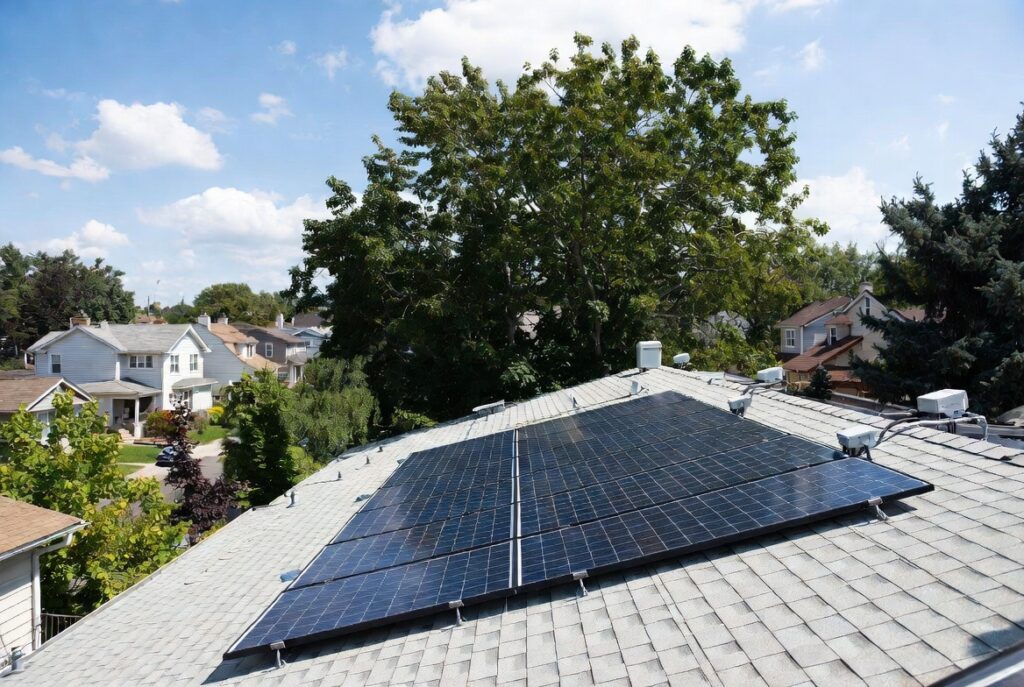
The most expensive micro inverter ontario mistake is paying the per-panel MPPT premium on an unshaded Ontario roof, because a homeowner in Guelph added approximately $800 in micro inverter hardware to a clear south-facing 8-panel array and his Victron SmartShunt showed identical daily harvest numbers to his neighbour’s identical array running a standard string inverter. The micro inverter had solved a shading problem that did not exist on his roof and produced zero additional output for the extra cost. A property owner in Orangeville had the opposite situation. A neighbour’s tree shaded three of his eight Renogy 100W panels for four hours every afternoon from September through February.
On a string inverter, those three shaded panels pulled current down for the entire eight-panel string during the shading window. The annual harvest was significantly below what the array specification predicted on that otherwise clear southern exposure.
He switched to a micro inverter system where each panel operates with its own individual MPPT. After one full year of SmartShunt data, the result was clear: the three shaded panels still lost output during the shading window, but the five unshaded panels continued producing at full rated output independently. The micro inverter ontario system recovered 19 percent of his annual harvest versus the string inverter baseline on the same roof with the same tree in the same location.
The difference between the Guelph and Orangeville cases is the only decision point in any micro inverter Ontario evaluation. The Guelph roof had no shading problem. The Orangeville roof had a consistent, recurring, multi-panel shading problem. A micro inverter is the correct solution for the Orangeville situation and an unnecessary expense for the Guelph situation. Every micro inverter Ontario decision starts with a shade audit of the specific roof before any hardware is specified. See our Ontario solar sizing guide before any micro inverter Ontario specification.
How string inverters and micro inverters differ: individual MPPT versus shared current path
| Inverter type | MPPT | Shading impact | Installed cost (8 panels) | Ontario verdict |
|---|---|---|---|---|
| String inverter (plain) | One central MPPT | One shaded panel affects whole string | ~$400-600 | Correct for unshaded Ontario roofs |
| String inverter + power optimizers | Per-panel voltage, central MPPT | Partial shading mitigation | ~$700-900 | Middle path for occasional shading |
| Micro inverter | Per-panel MPPT and inverter | Shading loss contained to one panel | ~$1,200-1,400 | Correct only when 2+ panels shade consistently |
| Off-grid MPPT 100/30 | Array-level MPPT | Same as string inverter for shading | ~$150-200 | Correct for all battery-backed Ontario systems |
On a series string, all panels share the same current path. The current through the string is limited by the panel producing the least current. When one panel is partially shaded, its current output drops, and because all panels are in series, the entire string’s current is constrained to the shaded panel’s output. Modern string inverters with power optimizers such as the SolarEdge system partially mitigate this by adding per-panel voltage management while keeping a single central inverter. Power optimizers cost more than a plain string inverter but less than full micro inverters, and they mitigate most shading loss without requiring individual inverters on every panel.
The maintenance difference matters significantly for Ontario property owners. A string inverter or Victron MPPT 100/30 sits in the utility room , diagnosis, service, and replacement happen indoors without roof access. A micro inverter is bolted to the back of each panel on the roof. When a unit fails, someone must climb onto the roof and lift the panels for replacement. On an Ontario winter day at -10 degrees C with ice on the roof, that service distinction is not a minor inconvenience. A string inverter in the utility room can be swapped in an hour. A micro inverter on an icy January roof is a licensed electrician visit with full safety equipment.
When the micro inverter ontario premium is worth it: consistent shading on two or more panels
The Orangeville property owner confirmed the correct micro inverter ontario use case with a year of SmartShunt data. A neighbour’s mature tree shaded three of his eight panels for four hours every afternoon from September through February , exactly the six-month period when Ontario solar output is already reduced by low PSH and short days. On a string inverter, the three shaded panels constrained the current for all eight panels during those four hours. The five unshaded panels were limited by the current the shaded panels could produce. After switching to a micro inverter system, the five unshaded panels continued at full rated output while only the three shaded panels lost production during the shadow window.
SmartShunt comparison data across one full year confirmed 19 percent annual harvest recovery. At typical Ontario grid electricity prices of approximately $0.14 per kWh and an 8,000Wh annual harvest recovery, the annual financial value is approximately $1,120. At $800 in additional hardware cost, the payback period is under one year in this specific shading scenario. The micro inverter ontario premium is not a luxury in this case , it is a return-generating investment with measurable data to support it.
The shading severity determines whether the micro inverter premium pays back at a reasonable rate. For shading that affects only one panel or that occurs only occasionally, the payback period extends significantly and the micro inverter premium may never fully recover. The practical Ontario threshold: if consistent shading hits two or more panels for two or more hours per day during the September through February window, the micro inverter ontario premium is worth evaluating with a SmartShunt harvest comparison on a trial inverter change. See our grid tied Ontario guide for the full HRSP context in which micro inverter systems operate.
When the micro inverter ontario premium is a waste: any unshaded Ontario south-facing roof
The Guelph property owner paid the micro inverter premium on a roof that did not need it. His south-facing 8-panel array had no trees, no chimney, no dormer, and no neighbouring structure casting shadow at any time of day from any season. He paid approximately $800 more for micro inverters versus the string inverter his neighbour used on an identical array on the same street. His SmartShunt data and his neighbour’s SmartShunt data showed identical daily Wh per clear-sky PSH on every comparable day across the full year. The micro inverter produced exactly what the string inverter produced because neither system had a shading problem to solve.
His comment after reviewing the annual harvest data: “I should have done the shade audit first.” The shade audit costs nothing. Walk the roof on a clear day in late September between 10 AM and 4 PM and watch whether any shadow crosses the panels. If the panels are clear for the entire window, a standard IESO-approved string inverter is the correct choice. The $800 micro inverter premium savings buys approximately two additional Battle Born cells that add real Ontario winter autonomy , a benefit the micro inverter cannot provide on an unshaded roof. See our solar system planning ontario guide for the full specification decision sequence.
The micro inverter per-panel monitoring capability is a genuine secondary benefit , apps such as Enphase Enlighten show per-panel production data that can identify a failing panel before it significantly reduces harvest. This monitoring benefit exists independently of the shading benefit and has some value on any array regardless of shading. However, the SmartShunt provides system-level monitoring that catches the same performance degradation at a fraction of the cost for Ontario property owners who have the SmartShunt already installed. Per-panel fault isolation is the additional benefit that the monitoring app provides over and above the SmartShunt.
The grid-tied limitation: why micro inverters need AC coupling for battery backup
Almost all micro inverter ontario systems are designed for grid-tied HRSP applications. They produce 240V AC directly on the roof and cannot connect directly to a battery bank. For a property owner who wants battery backup alongside a micro inverter system, AC coupling is required: the micro inverter AC output connects to the AC input of a battery-based inverter like the Victron MultiPlus-II, which manages the battery bank and backs up household loads during grid outages. This AC-coupled arrangement adds approximately $1,500 to $2,500 in additional hardware cost beyond the micro inverter system itself.
An off-grid-first property owner who wants per-panel MPPT is better served by a ground-mount or roof-mount array with a Victron MPPT 100/30 in the utility room than by a micro inverter system. The MPPT 100/30 provides maximum power point tracking from the entire array, sits indoors for easy service, and connects directly to the battery bank without any AC coupling requirement. The micro inverter ontario architecture is the correct choice only for HRSP grid-tied systems where partial shading is present. It is not the correct architecture for off-grid or hybrid battery-backed Ontario systems, where the MPPT 100/30 and MultiPlus-II combination delivers better performance at lower total cost. See our solar inverter ontario guide for the full inverter selection framework.
NEC and CEC: Ontario permit requirements for micro inverter and string inverter installations
NEC 690 and NEC 70 (NFPA 70, the National Electrical Code) govern both string inverter and micro inverter ontario installations. All grid-tied systems require IESO-approved inverters , string inverters and micro inverters must both appear on the IESO approved equipment list for HRSP interconnection. Array wiring for micro inverter systems uses AC wiring from the panel junction box to the building, sized for 125 percent of the maximum inverter AC output current. String inverter systems use DC wiring from the panels to the inverter, sized for 125 percent of Isc at the cold Voc design voltage. Contact the NFPA at nfpa.org for current NEC 690 requirements for Ontario grid-tied solar installations.
CEC Section 64 governs Ontario electrical installations. Both string inverter and micro inverter HRSP systems require an ESA permit at $300 to $400, IESO interconnection approval, and installation by a licensed electrician. Micro inverter systems additionally require AC wiring run from the roof panel junction boxes to the building , this roof-to-building AC run must be included in the permit scope and inspected before the roof is closed. Contact the Electrical Safety Authority Ontario at esasafe.com before beginning any micro inverter ontario or string inverter HRSP installation.
Pro Tip: Before specifying any micro inverter ontario system, do the September shade audit. On a clear day in late September, stand where you can observe the entire array from 10 AM to 4 PM. September is the critical month because the sun angle is low enough to reveal tree and chimney shadows that do not appear in summer but will persist through the entire October through February low-PSH period. If the panels are completely clear for the full 10 AM to 4 PM window on a clear September day, choose a string inverter and save the $800 micro inverter premium. If you see any shadow cross two or more panels during that window, the micro inverter ontario system will pay back within one to two years through recovered harvest, as the Orangeville data confirms.
The micro inverter ontario verdict: audit the shade before paying the per-panel premium
- Ontario property owner with consistent partial shading on two or more panels from a tree, chimney, or dormer: the micro inverter premium is justified by the data. Run the SmartShunt before and after on a trial panel to confirm the shading impact, then specify micro inverters for the affected panels or the entire array if shading affects multiple sections. Request a full year of per-panel monitoring data from the installer to confirm the recovery matches the expected return. The Orangeville result: 19 percent annual harvest recovery, hardware cost payback under one year at Ontario grid electricity prices.
- Ontario property owner with a clear south-facing roof and no shading: specify a standard IESO-approved string inverter for the HRSP grid-tied system and put the $800 micro inverter premium savings toward additional battery capacity or a larger array. The SmartShunt will confirm the string inverter performance matches the micro inverter specification on any unshaded day. Do the September shade audit first , it costs nothing and takes one afternoon. The Guelph result: identical annual harvest between micro inverter and string inverter systems, $800 saved, no output benefit from the premium hardware.
- Ontario property owner who wants battery backup alongside a grid-tied array: do not combine micro inverters with a battery bank unless the full AC coupling cost is in the budget and the design has been reviewed by a licensed electrician. An AC-coupled micro inverter system with MultiPlus-II battery backup adds approximately $1,500 to $2,500 in extra hardware versus a standard MPPT 100/30 off-grid system. For most Ontario off-grid or hybrid property owners, the MPPT 100/30 and MultiPlus-II combination in the utility room is the correct specification , lower total cost, simpler maintenance, full battery integration, and no roof electronics requiring cold-weather service.
Frequently Asked Questions
Q: Do micro inverters work better than string inverters on Ontario roofs?
A: Micro inverters outperform string inverters only when consistent partial shading affects two or more panels for several hours per day. In the Orangeville case, tree shading on 3 of 8 panels for 4 hours per afternoon from September through February caused a measurable harvest deficit on a string inverter. Switching to a micro inverter system recovered 19 percent of annual harvest. On an unshaded Ontario roof, micro inverters produce identical output to string inverters as the Guelph comparison confirmed over a full year of SmartShunt data. The September shade audit is the first step before any micro inverter ontario decision.
Q: Are micro inverters worth the extra cost for a grid-tied Ontario solar system?
A: The approximately $800 hardware premium is justified only if your roof has consistent partial shading affecting two or more panels during the September through February window. In that scenario, the Orangeville data shows a payback period under one year at Ontario grid electricity prices. On an unshaded south-facing Ontario roof, the micro inverter produces identical annual harvest to a string inverter at $800 less , the premium buys per-panel monitoring but no additional energy. Do the September shade audit before committing to either system. If the panels are clear for the full 10 AM to 4 PM window on a late September clear day, a string inverter is the correct and less expensive choice.
Q: Can I use micro inverters for an off-grid solar system in Ontario?
A: Micro inverters produce AC power and cannot connect directly to a battery bank without AC coupling through a battery-based inverter such as the MultiPlus-II. The AC-coupled arrangement adds approximately $1,500 to $2,500 in hardware cost beyond the micro inverter system itself, making it significantly more expensive than a standard off-grid system using the Victron MPPT 100/30. For most Ontario off-grid property owners, the MPPT 100/30 in the utility room connected directly to the battery bank is the correct choice , lower cost, easier service, and no roof electronics requiring cold-weather access for any service or replacement event.
This build is engineered within the 48V DC Safety Ceiling. Diagnostic logic is based on 20+ years of technical service experience. All structural and electrical installations must be verified by a Licensed Professional and comply with your Local AHJ. See our legal and safety disclosure for full scope.
About the Author
Robert Bertrand spent 20 years as a service advisor in the automotive industry (Lexus and Nissan), where precision diagnostics, wiring integrity, and documentation standards were non-negotiable. He brings that same technical discipline to GridFree Guide, where he researches, tests, and documents off-grid solar systems for Ontario conditions. Based in Rockwood, Ontario, every article is built on verified specifications, manufacturer data, and the real-world climate constraints of Canadian off-grid living.
As an Amazon Associate I earn from qualifying purchases. This site also contains affiliate links to other products and services. GridFree Guide earns a small commission at no extra cost to you.