
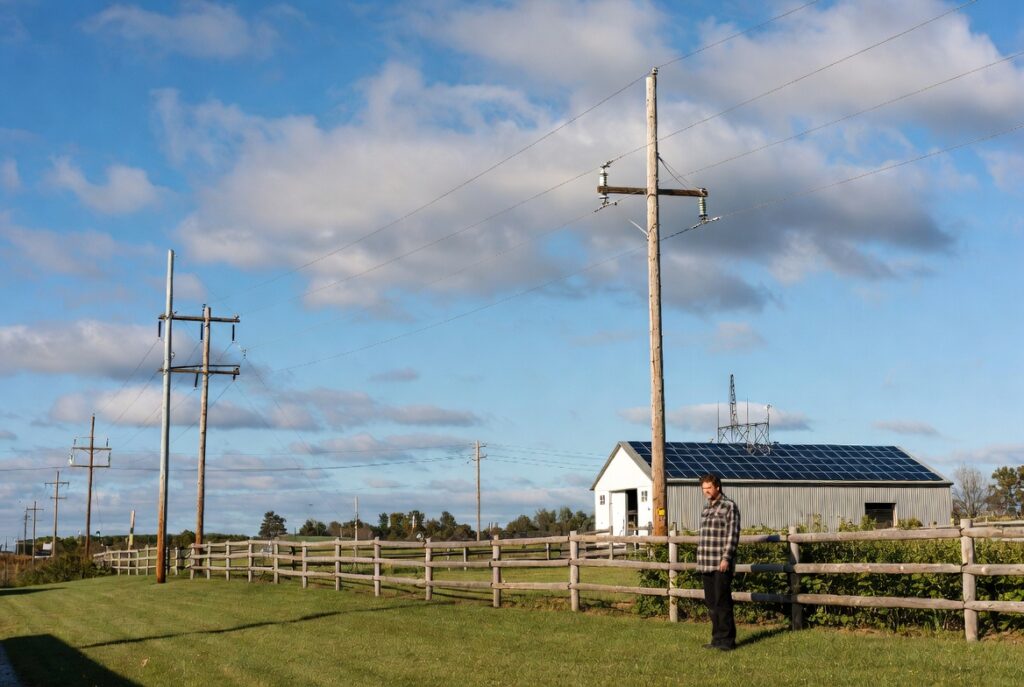
The grid tied ontario decision comes down to one number from Hydro One, because a property owner in Guelph installed an 8.5kW HRSP array on an existing grid connection for approximately $22,000 and will earn back the cost through net metering credits at approximately 8 cents per kWh over approximately 9 years, while a property owner in Erin Township, Centre Wellington received a $47,000 connection quote from Hydro One for a new rural service and installed a complete Tier 2 off-grid system for $12,400 instead, saving $34,600 and owning permanent energy independence from day one of commissioning.
The Guelph homeowner’s decision was straightforward. Her house was already connected to the Guelph Hydro grid at zero marginal connection cost. The 8.5kW array fed power into the grid during the day and her meter ran backwards through the net metering program. At approximately 14 cents per kWh for consumed power and 8 cents per kWh for exported credits, her system generates positive cash flow from the first month of operation.
Over a typical Ontario year, an 8.5kW array in Guelph produces approximately 8,500 kWh, based on Ontario’s approximately 4.0 peak sun hours annual average. At the net metering rate, that production offsets approximately $1,190 in annual Hydro bills at 14 cents per kWh consumed equivalent value. The $22,000 system cost divided by $1,190 annual saving produces the 9-year payback calculation that makes the grid tied ontario decision financially correct for her property. No battery bank is required for the basic HRSP configuration, and there are no winter heating concerns for LFP cells in a grid-only system.
I walked through the calculation with her before she committed to the grid-tied path. The existing Hydro One connection was the deciding factor. A grid tied Ontario system is only financially correct when the connection infrastructure already exists or costs under approximately $15,000 to establish. Without that connection at near-zero marginal cost, the net metering math no longer wins against the off-grid alternative. See our Ontario solar sizing guide before making any grid tied Ontario decision for an Ontario property.
The grid tied ontario case: when HRSP net metering beats off-grid on the numbers
| Path | Upfront cost | Ongoing cost | Battery needed | Ontario verdict |
|---|---|---|---|---|
| HRSP grid-tied (urban, existing connection) | $22,000 system | Net consumption only | No | Correct when connection exists. 9-year payback. |
| Off-grid Tier 2 (rural, no connection) | $12,400 system | Generator fuel for gray streaks | Yes (Battle Born heated LFP) | Correct when connection quote exceeds $25,000. |
| Hybrid (existing connection + battery backup) | $22,000 + $8,000-$12,000 | Net consumption + maintenance | Yes (Battle Born heated LFP) | Correct when both credits and outage backup are priorities. |
| Grid connection only (no solar) | $15,000-$80,000+ rural extension | Full Hydro One rate exposure | No | No solar benefit. Never correct for rural new builds. |
The HRSP program in Ontario allows homeowners to install grid-tied solar arrays and earn net metering credits at approximately 8 cents per kWh exported. During the day, the array feeds power into the grid and the meter runs backwards. At night or during high consumption periods, the homeowner draws power from the grid and pays only for the net consumption. The typical Ontario residential rate ranges from 12 to 17 cents per kWh depending on time-of-use periods and utility. An 8.5kW array in Guelph produces approximately 8,500 kWh annually based on Ontario’s average of 4.0 peak sun hours, generating enough credits to offset most of a typical household’s annual consumption.
The grid tied Ontario financial case is strongest where hydro rates are above 12 cents per kWh and the connection already exists at near-zero marginal cost. Ontario TOU rates range from approximately 8.7 cents per kWh (off-peak) to 17.5 cents per kWh (on-peak) as of 2026. The net metering settlement at 8 cents per kWh exported offsets the blended rate effectively for most residential consumers. A battery-free grid-tied system requires no winter LFP maintenance and produces no autonomy concerns during gray streaks, but also provides no backup power during grid outages from ice storms. For the IESO approval process and current net metering rates, see our solar payback guide.
The HRSP program: how Ontario net metering credits work and what they actually pay
HRSP (Home Renewable and Storage Program) is Ontario’s framework for grid-tied solar installations. Net metering credits accumulate at approximately 8 cents per kWh exported to the grid, and the homeowner pays only for net consumption after credits are applied. An ESA permit and IESO interconnection approval are required before commissioning any grid-tied system. The system must use a certified grid-tie inverter from the IESO approved equipment list. The Victron MultiPlus-II is not currently on the IESO approved list for HRSP grid export , it is the correct inverter for the off-grid and hybrid battery backup path, not for the grid-tied HRSP export function.
The HRSP process takes 4 to 12 weeks and requires an ESA permit at $300 to $400. Annual production estimates run approximately 1,000 kWh per kW of installed capacity based on Ontario’s 4.0 annual average peak sun hours. At an 8.5kW array size, that is approximately 8,500 kWh per year, offsetting approximately $1,190 in annual hydro bills at 14 cents per kWh. The net metering rate of 8 cents per kWh is subject to change by the IESO. Verify the current rate at ontario.ca before calculating any payback period for a specific grid tied ontario installation. See our solar inverter ontario guide for the certified grid-tie inverter selection process.
The off-grid alternative: when $12,400 beats $47,000 at commissioning
The property owner in Erin Township, Centre Wellington faced a $47,000 Hydro One connection quote for a 1.2km rural line extension to his new acreage build. He installed a complete Tier 2 off-grid system for $12,400 instead: two Battle Born heated LFP 100Ah units wired in series (24V, 200Ah bank), a Victron MultiPlus-II 2,000VA, a Victron MPPT 100/30, a 400W array with four Renogy 100W panels, and a Victron SmartShunt for bank monitoring. The system was commissioned in fall 2021. The financial saving at commissioning was $34,600 , the difference between the connection quote he avoided and the system he owns.
After three years of Ontario winters, the SmartShunt confirms the bank cycles correctly at every temperature the uninsulated utility room delivers. The heated LFP bank self-heats at 2 degrees C and accepts charging current through every January cold snap without a blocked charging event. Zero grid bills. Zero Hydro One rate increases. Zero connection fee ever. His comment: “Hydro One quoted me $47,000 for a wire I wouldn’t own. I own my power system instead.”
The financial logic is straightforward for any rural Ontario property receiving a new connection quote above $25,000. The complete Tier 2 off-grid system at $8,000 to $15,000 is not just cheaper at commissioning , it eliminates 25 years of Hydro One rate exposure, delivers outage immunity during Ontario ice storms, and is owned outright from day one. The grid tied ontario path requires the connection infrastructure to already exist at near-zero cost to generate a better financial result than a well-specified Tier 2 system. See our off-grid costs guide for the complete Ontario Tier 2 system cost breakdown.
The grid tied ontario break-even: what the Hydro One connection quote actually costs you
The grid tied ontario connection cost is the decision number. Calculate the full cost of both paths before committing. Path A: the Hydro One connection quote plus the HRSP system cost plus 25 years of net consumption billing at current Ontario rates. Path B: the complete Tier 2 off-grid system cost plus battery replacement at year 10 (approximately $2,000 to $4,000 for two Battle Born cells) plus generator fuel for gray streak backup over 25 years. For most rural Ontario properties where the connection quote exceeds $25,000, Path B is less expensive over 25 years even after accounting for battery replacement and generator fuel.
The hybrid path is the third option for rural Ontario properties that already have a grid connection for the main house. HRSP on the main house earns net metering credits through the existing connection. A separate off-grid battery backup system with a MultiPlus-II and Battle Born heated LFP bank powers the detached workshop, well pump, and critical loads during grid outages without affecting the HRSP net metering account. This adds approximately $8,000 to $12,000 to the total system cost but provides both grid income through net metering and outage protection through the battery bank. See our off-grid setup guide for the complete hybrid commissioning sequence.
NEC and CEC: Ontario permit requirements for both grid-tied and off-grid installations
NEC 690 governs photovoltaic systems in Ontario for both grid-tied and off-grid installations. Grid-tied HRSP systems require IESO interconnection approval, an ESA permit, and installation by a licensed electrician using an IESO-approved grid-tie inverter certified to UL 1741. Off-grid systems require an ESA permit for all permanent wiring, including the inverter, battery bank, DC disconnect, and array connections. Both paths must comply with NEC 690 conductor sizing, fusing, and disconnect requirements. Contact the NFPA at nfpa.org for current NEC 690 requirements applicable to Ontario solar installations.
CEC Section 64 governs electrical installations in Ontario. Any permanently wired solar installation , grid-tied or off-grid , requires an ESA permit at $300 to $400 before installation begins. Grid-tied systems additionally require an IESO interconnection agreement signed with the local distribution company before commissioning the grid export function. A licensed electrician must complete the installation and schedule the ESA inspection for both paths. Contact the Electrical Safety Authority Ontario at esasafe.com before beginning any permanent solar installation in Ontario.
Pro Tip: Before accepting a Hydro One connection quote for a rural Ontario property, request a complete Tier 2 off-grid system quote from a licensed installer on the same day. Compare the two numbers directly. If the connection quote exceeds the off-grid system cost by $5,000 or more, the off-grid path is financially superior at commissioning and you will never pay Hydro One rates again. The Erin Township property owner did this comparison in 2021: $47,000 for a wire he would never own versus $12,400 for a system he owns outright. The grid tied ontario path had no chance at those numbers.
The grid tied ontario verdict: HRSP for urban, off-grid for rural, hybrid for the property that needs both
- Urban or suburban Ontario property owner already connected to the grid with Hydro One at zero marginal connection cost: the grid tied ontario HRSP path is the correct financial decision. Install a grid-tie array sized to your annual consumption using an IESO-approved inverter. Complete the ESA permit and IESO interconnection. Earn net metering credits at approximately 8 cents per kWh against your hydro bill. The Guelph result: $22,000 array, 9-year payback, no battery maintenance required, no winter LFP heating concerns. Verify the current HRSP net metering rate at ontario.ca before calculating your specific payback period.
- Rural Ontario property owner with a Hydro One new connection quote over $25,000: off-grid is the financially correct decision at commissioning. A complete Tier 2 system with Battle Born heated LFP bank, MultiPlus-II, MPPT, and Renogy 100W panels at $12,400 costs less than almost any rural Hydro One connection quote over $25,000. Own your power system rather than paying for a wire you will never own. Use the Victron SmartShunt to confirm bank health through Ontario winters. The Erin Township result: $34,600 saved at commissioning, zero grid bills, three winters confirmed.
- Rural Ontario property owner who already has a grid connection for the main house but wants battery backup during ice storm outages: the hybrid path combines HRSP on the main house with a dedicated off-grid battery backup for critical loads. The grid tied ontario HRSP system earns net metering credits on the main house during normal operation. A separate MultiPlus-II with a Battle Born heated LFP bank powers the workshop, well pump, and critical circuits during grid failures. The Renogy 100W panel benchmark applies to both the grid-tied expansion array and the off-grid backup array. This path adds $8,000 to $12,000 to the total cost but provides both grid income and outage protection.
Frequently Asked Questions
Q: Is grid tied solar or off-grid solar better for Ontario rural properties?
A: For most rural Ontario properties, off-grid is financially correct when Hydro One new connection quotes exceed $25,000. A complete Tier 2 off-grid system at $8,000 to $15,000 costs less than most rural connection quotes in that range and delivers permanent energy independence. The grid tied ontario HRSP path is correct when the connection already exists at near-zero marginal cost, where an 8.5kW array can pay back in approximately 9 years through net metering credits. Between $15,000 and $25,000 for a connection, the decision depends on property use, load profile, and grid reliability history in your specific area.
Q: How does the HRSP net metering program work in Ontario?
A: HRSP (Home Renewable and Storage Program) allows Ontario homeowners to install grid-tied solar arrays and earn net metering credits at approximately 8 cents per kWh for every kWh exported to the grid. The homeowner pays only for net consumption after credits are applied against the hydro bill. An ESA permit at $300 to $400 and IESO interconnection approval are required before commissioning. The system must use a certified grid-tie inverter from the IESO approved equipment list. Annual production runs approximately 1,000 kWh per installed kW at Ontario’s 4.0 average peak sun hours. Verify the current rate at ontario.ca before calculating your specific payback period.
Q: What is the break-even point where off-grid beats grid tied in Ontario?
A: The practical break-even threshold in Ontario is approximately $25,000 for a Hydro One connection quote. When the connection quote exceeds $25,000, a complete Tier 2 off-grid system at $8,000 to $15,000 is cheaper at commissioning and provides permanent protection against rising Hydro One rates. When the connection quote is under $15,000 and the property is already partially served, the grid tied ontario HRSP path usually produces a better 25-year financial outcome through net metering credits. Between $15,000 and $25,000, calculate both paths in full before committing, including 25-year rate escalation assumptions for Hydro One versus battery replacement costs at year 10.
This build is engineered within the 48V DC Safety Ceiling. Diagnostic logic is based on 20+ years of technical service experience. All structural and electrical installations must be verified by a Licensed Professional and comply with your Local AHJ. See our legal and safety disclosure for full scope.
About the Author
Robert Bertrand spent 20 years as a service advisor in the automotive industry (Lexus and Nissan), where precision diagnostics, wiring integrity, and documentation standards were non-negotiable. He brings that same technical discipline to GridFree Guide, where he researches, tests, and documents off-grid solar systems for Ontario conditions. Based in Rockwood, Ontario, every article is built on verified specifications, manufacturer data, and the real-world climate constraints of Canadian off-grid living.
As an Amazon Associate I earn from qualifying purchases. This site also contains affiliate links to other products and services. GridFree Guide earns a small commission at no extra cost to you.