
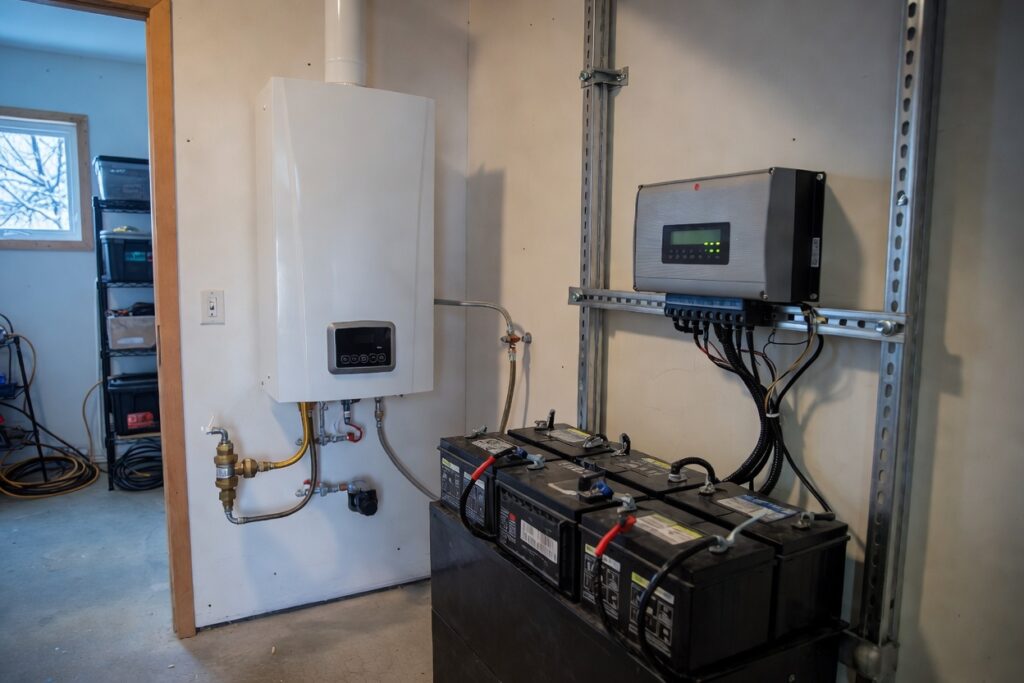
The most common Ontario solar water heater mistake is installing a 6,000W electric tankless water heater on a Tier 2 off-grid system, because a 6,000W draw on a 200Ah LFP bank depletes the entire 1,920Wh usable capacity in approximately 19 minutes and trips the 3,000W PSW inverter on the startup surge before the first shower is even finished, and a property owner on Speedside Road in Guelph, Wellington County discovered this when his Victron SmartShunt captured the 6,000W draw the moment his family turned on the tap for the first time, and the battery bank dropped from 100% SoC to the BMS protection threshold while he was still in the shower.
He had installed a correctly specified Tier 2 system: 400W mono PERC array, 200Ah Battle Born LFP bank, Victron MPPT 100/30, and 3,000W PSW inverter. The inverter’s peak rating was 3,000W continuous and 6,000W surge for fractions of a second. The tankless water heater’s minimum draw was 6,000W continuous, requiring 6,000W sustained for the full duration of every hot water use.
The inverter’s overload protection activated within seconds, cutting power to the heating element before any hot water reached the tap. I reviewed his SmartShunt history that afternoon. The 6,000W draw was confirmed on the first and only use, the bank dropped from 100% to 22% SoC (approximately 422Wh remaining from 1,920Wh usable) in approximately 18 minutes before the BMS protection threshold cut the load. The inverter had tripped on overload simultaneously, no hot water reached the tap at all on the first attempt.
The correct solar water heater specification for any Ontario Tier 2 off-grid system is propane on-demand, not electric. A 40,000 BTU propane on-demand unit installed that afternoon for approximately $400 drew zero amps from the battery bank, provided unlimited hot water, and required no changes to the solar system. The SmartShunt confirmed the difference immediately: 6,000W during the electric tankless attempt, 1 to 3W from the electronic igniter during the first propane shower. See our Ontario solar sizing guide before specifying any solar water heater system.
The solar water heater Ontario failure mode: why 6,000W electric tankless empties 200Ah LFP in 19 minutes
| Solar water heater option | Battery draw | Ontario off-grid verdict | Installed cost |
|---|---|---|---|
| 6,000W electric tankless | 6,000W, drains 200Ah in 19 min, trips inverter | ✗ Incompatible with Tier 1 and Tier 2 | $800 to $1,200 |
| Propane on-demand 40,000 BTU | 1 to 3W (igniter only) | ✓ Correct Ontario off-grid specification | $350 to $500 |
| Solar thermal evacuated tube | 50 to 100W (circulation pump) | Grid-connected pre-heating only, not off-grid | $3,000 to $8,000 |
| 1,200W point-of-use electric | 1,200W continuous | Marginal on Tier 2 for sink only, not recommended | $200 to $400 |
A 6,000W electric tankless solar water heater on a 200Ah LFP bank drains the entire 1,920Wh usable capacity in approximately 19 minutes. Current draw at 12V: 6,000W ÷ 12V = 500A, exceeding any Tier 2 battery bank’s safe continuous discharge rating. A Tier 2 3,000W PSW inverter is rated for 3,000W continuous and 6,000W surge for fractions of a second. A 6,000W continuous water heating load trips it immediately. The solar water heater electric tankless failure mode is not a configuration problem, it is a fundamental incompatibility between resistive heating loads and any battery-based off-grid solar system below Tier 3.
The only electric resistive solar water heater that is marginally viable on a Tier 2 system is a point-of-use 1,200W unit for a single sink, not a shower, not a bathtub, not a whole-home system. Even a 1,200W unit draws 100A at 12V continuously, consuming approximately 1,200Wh per hour from a 1,920Wh usable bank. Ontario families typically use 40 to 60 litres of hot water per person per day, far more than a 1,200W unit can deliver. The correct Ontario solar water heater specification for off-grid use is propane, not electric at any power level. See our off grid setup guide for the complete Ontario Tier 2 load specification.
The Ontario hot water load profile: why resistive heating is incompatible with Tier 1 and Tier 2 systems
A family of 4 in Ontario uses approximately 160 to 240 litres of hot water per day for showers, dishwashing, and laundry. Heating this volume from a groundwater temperature of approximately 8°C to 55°C requires approximately 12,000 to 18,000Wh of thermal energy per day. The Battle Born LFP 200Ah bank stores 1,920Wh usable, approximately 10% of the daily hot water requirement. No Tier 1 or Tier 2 solar water heater system based on electric resistance can provide enough energy for this load.
The solar system’s role in a correctly specified Ontario off-grid property is to power intelligence loads: LED lighting (approximately 30W), refrigeration (approximately 60W), communications (approximately 15W), pumps and controls (approximately 50W), and electronics (approximately 40 to 100W). Total intelligent load: approximately 200 to 260W continuous. Ontario January: 400W array × 1.5 PSH × 0.85 = 510Wh per clear day, sufficient for intelligent loads with reserve. Adding any resistive heating load to this system eliminates that reserve and runs the bank to the BMS protection threshold within hours. See our off grid costs guide for the complete Ontario off-grid load profile.
Pro Tip: Before specifying any solar water heater for an Ontario off-grid build, check the SmartShunt reading during a hot water use event on the first commissioning day. With a propane on-demand unit, the SmartShunt should show 1 to 3W during the full duration of a shower, the electronic igniter only. If the reading spikes above 10W during hot water use, there is likely an electric element in the system drawing from the bank. The Speedside Road Guelph SmartShunt reading during the failed electric tankless attempt was 500A at 12V, the SmartShunt confirmed the failure mode in real time before the first shower reached body temperature. The Elora Centre Wellington SmartShunt reading during the first propane shower: 2W. Same family size, same hot water demand, zero battery impact.
The correct Ontario solar water heater: propane on-demand, zero battery draw, TSSA G2 installation
The correct solar water heater for any off-grid Tier 1 or Tier 2 Ontario build is propane on-demand. A 40,000 BTU propane on-demand unit provides unlimited hot water for a family of 4, draws zero watts from the battery bank (only 1 to 3W from the electronic igniter), and requires no changes to the solar system. The Victron SmartShunt confirms the result on commissioning day: during hot water use, the SmartShunt shows 1 to 3W igniter draw, indistinguishable from background load. Installed cost: approximately $350 to $500 by a TSSA G2 licensed technician. All propane appliance installations in Ontario require a TSSA G2 licensed technician, this is a legal requirement under the Ontario Technical Standards and Safety Act.
A property owner in Elora, Centre Wellington specified propane on-demand as the solar water heater from day one. His SmartShunt confirmed 1 to 3W during every hot water use. Family of 4, unlimited hot water, no battery bank impact through two full Ontario winters. His comment: “We’ve never once thought about the hot water since we moved in. The propane handles it. The solar handles everything else.” Propane on-demand operating cost in Ontario: approximately 1.5 to 2.5L per hour of continuous hot water use.
For a family of 4 at approximately 45 minutes daily cumulative use: approximately 1.1 to 1.9L per day. Annual propane cost for hot water alone: approximately $250 to $400 at current Ontario propane rates. See our solar backup power guide for the complete Ontario off-grid energy budget.
Solar thermal vs propane vs electric: the grid-connected Ontario comparison
Solar thermal evacuated tube collectors are a legitimate solar water heater technology for grid-connected Ontario properties. They absorb solar radiation through vacuum tubes, transfer heat to a glycol loop, and pre-heat incoming cold water before gas or electric backup heating. For a grid-connected Ontario home, solar thermal can reduce gas or electric hot water consumption by approximately 40 to 60% in the April through October season. Installed cost: approximately $3,000 to $8,000 for a full residential system. The correct solar thermal Ontario solar water heater application is grid-connected pre-heating, not off-grid primary heating.
Solar thermal is not the correct solar water heater specification for an off-grid Ontario system. The glycol circulation pump draws approximately 50 to 100W continuously during solar collection hours, competing directly with the intelligent loads the solar system is designed to power. Ontario January freeze risk requires continuous glycol circulation to prevent damage, increasing pump load during the period when solar production is lowest at 1.5 PSH. The solar thermal system also requires backup heat for cloudy periods, which returns the decision to propane versus electric. For off-grid Ontario properties, propane on-demand is the correct solar water heater specification regardless of roof orientation or system size.
NEC, CEC, and TSSA: Ontario permit requirements for off-grid hot water systems
NEC 690 and CEC Section 64 govern the electrical components of any Ontario solar water heater system, including the solar array, charge controller, battery bank, and inverter. Any permanently wired solar water heater system requires an ESA permit at $300 to $400 before installation begins. If the solar water heater system includes a hardwired 240V connection for an electric tankless unit, that circuit requires an additional ESA permit for the sub-panel connection. Contact the NFPA at nfpa.org and the Electrical Safety Authority Ontario at esasafe.com before beginning any permanently wired solar water heater installation.
Propane appliance installations in Ontario are governed by the Technical Standards and Safety Act and require a TSSA G2 licensed technician for all work. A TSSA G2 license covers natural gas and propane appliance installation, including propane on-demand water heaters, propane furnaces, and propane range hookups. Installing a propane appliance without a TSSA G2 licensed technician is illegal in Ontario and invalidates property insurance coverage for the appliance circuit. Contact the TSSA at tssa.org to verify a technician’s G2 license before authorizing any propane solar water heater installation in Ontario.
The solar water heater Ontario verdict: propane for heat, solar for power, SmartShunt to confirm
- Ontario property owner who installed an electric tankless water heater on an off-grid solar system and is experiencing battery drain and inverter trips: check the SmartShunt during hot water use before replacing any other component. The SmartShunt will show 6,000W or more, confirming the load is the water heater, not a system fault. The fix is propane on-demand: approximately $350 to $500 installed by a TSSA G2 technician, zero battery draw, unlimited hot water. The Guelph result: SmartShunt confirmed 6,000W draw, bank to 22% SoC in 18 minutes, propane on-demand installed same afternoon, 1 to 3W igniter confirmed on first propane use.
- Ontario property owner specifying a new off-grid solar water heater system: specify propane on-demand before finalizing the solar system size, it changes the entire sizing calculation. A 40,000 BTU propane on-demand unit draws zero battery watts for heating, so the solar system is sized only for intelligent loads (approximately 200 to 260W combined). This sizing produces a correct Tier 2 system: 400W array, 200Ah Battle Born LFP, Victron MPPT 100/30. The Elora result: SmartShunt confirmed 1 to 3W during all hot water use, zero battery impact, family of 4 served through two Ontario winters. TSSA G2 installation required.
- Ontario property owner on a grid-connected property who wants a solar water heater to reduce hydro costs: solar thermal evacuated tube collectors are the correct specification for grid-connected properties. Approximately $3,000 to $8,000 installed, 40 to 60% hot water cost reduction April through October, backup gas or electric heating required for winter. This is a legitimate solar water heater investment for grid-connected Ontario properties. It is not appropriate for off-grid use due to circulation pump power requirements (50 to 100W continuous) and glycol freeze risk in Ontario January conditions.
Frequently Asked Questions
Q: Can I use an electric tankless water heater with my off-grid solar system in Ontario?
A: Not on any Tier 1 or Tier 2 system. A standard 6,000W electric tankless solar water heater draws 500A at 12V, it drains a 200Ah LFP bank (1,920Wh usable) in approximately 19 minutes and trips a 3,000W PSW inverter immediately on startup. The Speedside Road Guelph result confirmed both failure modes on the first use: bank to 22% SoC in 18 minutes, inverter on overload simultaneously, zero hot water delivered. The correct solar water heater for any Ontario off-grid system is propane on-demand: zero battery draw, unlimited hot water, approximately $350 to $500 installed by a TSSA G2 licensed technician.
Q: What is the best solar water heater for off-grid Ontario?
A: Propane on-demand is the only correct solar water heater specification for Ontario off-grid Tier 1 and Tier 2 systems. It draws zero watts from the battery bank for heating, only 1 to 3W from the electronic igniter, provides unlimited hot water for a family of 4, and requires no changes to the solar system sizing. The Elora Centre Wellington result confirms it: two Ontario winters, SmartShunt showing 1 to 3W during every hot water use, zero battery impact.
Operating cost: approximately $250 to $400 per year for hot water propane. For grid-connected Ontario properties, solar thermal evacuated tube collectors are a legitimate solar water heater investment, approximately $3,000 to $8,000 installed, 40 to 60% hot water cost reduction April through October.
Q: Do I need a permit to install a propane water heater in Ontario?
A: Yes, all propane appliance installations in Ontario require a TSSA G2 licensed technician. This is a legal requirement under the Ontario Technical Standards and Safety Act. Installing a propane solar water heater without a TSSA G2 licensed technician is illegal in Ontario and invalidates property insurance coverage for the appliance circuit. Verify a technician’s G2 license at tssa.org before authorizing any propane installation. The ESA permit at $300 to $400 is separately required for the permanently wired electrical components of the solar water heater system (array, charge controller, battery bank, inverter), contact esasafe.com before beginning any permanently wired installation.
This build is engineered within the 48V DC Safety Ceiling. Diagnostic logic is based on 20+ years of technical service experience. All structural and electrical installations must be verified by a Licensed Professional and comply with your Local AHJ. See our legal and safety disclosure for full scope.
This article contains affiliate links. If you purchase through these links, I earn a small commission at no extra cost to you.