
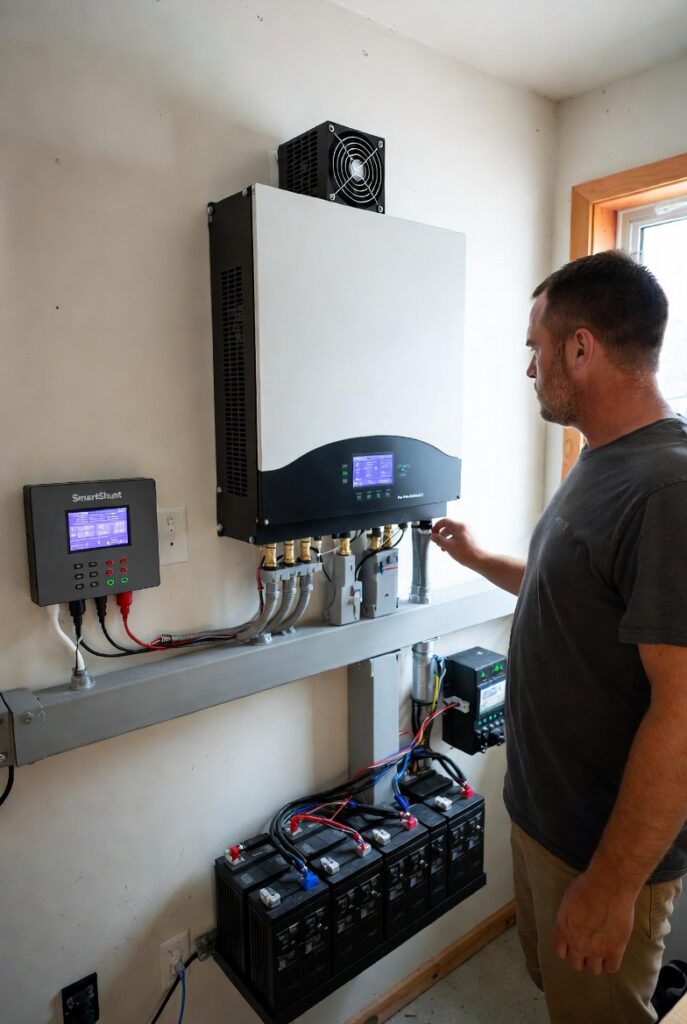
The most common solar inverter size mistake in Ontario is purchasing a 1,500W continuous inverter based on the total running load and discovering that the AC compressor fridge, which draws only 150W while running, surges to approximately 2,400W for 300 to 500 milliseconds on every compressor startup, tripping any inverter whose surge rating falls below that threshold. A property owner on Hanlon Creek Drive in Guelph, Wellington County commissioned a year-round off-grid cabin in fall 2023.
He purchased a 1,500W continuous PSW inverter after calculating his total running load at approximately 450W: AC compressor refrigerator 150W, LED lighting 60W, laptop 65W, phone charging 20W, and propane furnace blower 80W. He reasoned that 1,500W provided more than 3× headroom above his 450W running load.
On commissioning day, the inverter tripped consistently every time the refrigerator compressor started. The root cause was the inverter’s surge specification: the unit was rated for 1,500W continuous but only 1,800W surge, a budget inverter with a 1.2:1 surge-to-continuous ratio instead of the industry-standard 2:1 ratio. An AC compressor refrigerator surges to approximately 2,400W on every startup cycle. The 2,400W startup surge exceeded the 1,800W surge rating by 33%, every compressor cycle was an overload event.
I replaced the inverter with a 2,000W continuous/4,000W surge PSW unit. The 4,000W surge rating provided a 67% margin above the 2,400W fridge startup surge, eliminating every trip. His Victron SmartShunt confirmed the compressor startup current spike, approximately 20A at 12V for approximately 400 milliseconds, within the new inverter’s rated surge window without any protection response. The correct solar inverter size for his 450W running load required a 4,000W surge-rated unit, not a 1,500W unit with an 1,800W surge ceiling. See our Ontario solar sizing guide before selecting any solar inverter size.
The solar inverter size surge problem: why running watts are the wrong number to size from
| Load type | Running watts | Startup surge | Minimum inverter surge |
|---|---|---|---|
| LED lights / laptop / phone | 100W total | ~100W (resistive) | Any PSW |
| AC compressor refrigerator | 150W | ~2,400W | 3,000W surge minimum ✓ |
| 12V DC compressor fridge | 60 to 80W | ~600W | Direct to battery, no inverter needed ✓ |
| 1/2 HP well pump (no SoftStart) | 600W | ~2,800W | 3,500W surge minimum ✓ |
| 1/2 HP well pump (with SoftStart) | 600W | ~900W | 1,125W surge minimum ✓ |
The three numbers in any solar inverter size selection: continuous watts, surge watts, and input voltage. Continuous watts is the sum of all simultaneous running loads plus 25% margin, for the Hanlon Creek cabin: 435W × 1.25 = 544W minimum, selecting a 1,000W or 1,500W rated unit. Surge watts is the peak startup current of the largest inductive load in the system, an AC fridge at 2,400W startup requires the inverter to sustain that current for 300 to 500ms without tripping.
The standard 2:1 surge-to-continuous ratio means a 1,500W continuous inverter should have 3,000W surge capacity. Many budget units specify only 1.2 to 1.5× surge multiplier, confirming the surge rating from the datasheet is the single most important step in any solar inverter size decision.
The Ontario inductive load hierarchy from highest to lowest startup surge: 1/2 HP AC well pump without SoftStart at approximately 2,800W, AC compressor refrigerator at approximately 2,400W, 1/2 HP well pump with SoftStart Well at approximately 900W, AC compressor fridge on a 12V DC unit at approximately 600W (direct battery connection, no inverter required), and furnace blower motor at approximately 240 to 400W depending on motor size. For most Ontario off-grid systems with both an AC fridge and a SoftStart-equipped well pump, the AC fridge startup dominates the surge requirement at 2,400W. This means the solar inverter size for a typical Tier 2 or Tier 3 Ontario system is determined by the refrigerator, not the pump.
Pure sine wave vs modified sine wave: why PSW is mandatory for Ontario off-grid
A pure sine wave inverter produces an AC output waveform identical to grid power, a smooth 60Hz sinusoidal wave at 120V RMS. A modified sine wave inverter produces a stepped approximation with harmonic distortion at approximately 3% to 5% total harmonic distortion (THD) versus the grid’s 1% to 3%. For purely resistive loads (incandescent bulbs, simple resistive heating elements), MSW produces no measurable damage. For inductive motor loads, refrigerator compressors, well pumps, furnace blowers, the harmonic distortion increases core losses in the motor windings, causing higher operating temperatures and accelerating winding insulation failure over time.
For sensitive electronics, Starlink transceivers, laptop power supplies, battery chargers, CPAP machines, MSW harmonic distortion can cause power supply overheating, reduced efficiency, and failure of power factor correction circuits. The cost difference between a 2,000W PSW and a 2,000W MSW inverter is typically $50 to $150, a negligible premium against the cost of a damaged compressor winding or failed Starlink power supply. Specify PSW for every Ontario solar inverter size decision regardless of the current load list, the load list will always include inductive motors and sensitive electronics in a year-round off-grid system.
Pro Tip: Before purchasing any inverter, look up the surge rating on the manufacturer’s specification sheet, not the box label, the datasheet. The box typically shows only the continuous watts. The datasheet shows: continuous watts, surge watts, surge duration (seconds), and the surge-to-continuous ratio. A legitimate 2:1 surge inverter shows the surge rating as exactly 2× the continuous rating. A 1,500W/3,000W surge unit is correct. A 1,500W/1,800W surge unit is a budget grade that will trip on any AC compressor startup. The Hanlon Creek Drive Guelph result: the datasheet would have shown 1,800W surge, the buyer never checked. One datasheet lookup at the point of purchase prevents the commissioning-day discovery that the inverter trips on every fridge cycle.
The solar inverter size voltage decision: 12V, 24V, and the 48V current advantage
The solar inverter size input voltage must match the battery bank voltage exactly. At 2,000W continuous output: a 12V bank delivers 2,000 ÷ 12 = 167A; a 24V bank delivers 2,000 ÷ 24 = 83A; a 48V bank delivers 2,000 ÷ 48 = 42A. The wire gauge required for 167A at 12V is approximately 4/0 AWG (107mm²); the gauge for 83A at 24V is approximately 2 AWG, a substantial reduction in cable cost, weight, and handling complexity.
Resistive losses in wiring are proportional to I², so the 12V cable losses are (167/83)² = approximately 4× higher than 24V cable losses for the same power output. For continuous output above approximately 2,000W, 24V or 48V reduces cable cost and wiring losses significantly. Embed Battle Born 100Ah LFP as the battery bank that feeds the inverter.
A first-time builder near Bronte Road in Milton, Halton County designed his complete year-round off-grid system in spring 2023. His loads: AC fridge 150W (2,400W surge), well pump with SoftStart 600W (900W surge), LED 60W, laptop 65W, Starlink 65W, furnace blower 80W, total 1,020W running. Dominant surge: AC fridge at 2,400W. Solar inverter size formula: 1,020W × 1.25 = 1,275W minimum continuous (select 2,000W); 2,400W × 1.25 = 3,000W minimum surge (select 4,000W surge); system voltage: 24V for 83A cable versus 12V’s 167A.
He specified a 2,000W/4,000W surge PSW inverter at 24V. His SmartShunt confirmed 100A at 24V for 400ms on fridge startup, within the rated 167A surge capacity. Zero trips in two Ontario winters. See our solar energy storage guide for the battery bank sizing that pairs with any solar inverter size.
The SoftStart connection: how a $300 device changes the inverter size equation
The SoftStart Well reduces the well pump’s startup surge from approximately 2,800W to approximately 900W by ramping motor voltage from 30% to 100% over 2 to 3 seconds instead of instantaneous full-voltage start. Without SoftStart, a 1/2 HP well pump requires a solar inverter with at least 3,000W continuous and 6,000W surge capacity to handle the 2,800W startup surge with 25% margin. With SoftStart, the same pump requires an inverter with at least 1,500W continuous and 1,125W surge capacity for the pump alone. The SoftStart Well at approximately $300 eliminates the need for a 5,000W inverter at approximately $800 to $1,200, a net savings of approximately $500 to $900 in inverter cost from a single accessory.
The SoftStart Well does not reduce the running load calculation, the pump still draws approximately 600W while operating. In most Ontario systems with both an AC fridge and a SoftStart-equipped well pump, the AC fridge compressor startup at 2,400W remains the dominant surge source, not the pump at 900W. The solar inverter size is still determined by the fridge, but the well pump no longer requires the inverter to be upsized beyond what the fridge already demands. The result: a 2,000W/4,000W surge PSW inverter handles both loads simultaneously, the Bronte Road Milton system confirmed this across two Ontario winters. See our off grid water guide for SoftStart Well installation that reduces well pump startup surge.
NEC and CEC: Ontario requirements for permanently installed solar inverters
NEC 690 governs solar PV installations including the inverter. The inverter’s AC output circuit must comply with NEC 240 branch circuit requirements, the circuit from the inverter output to the load panel must be sized for the inverter’s continuous output rating and protected by appropriately sized overcurrent protection. The inverter’s DC input circuit from the battery bank must comply with NEC 690 battery circuit requirements, including overcurrent protection at the positive terminal rated for the battery bank’s maximum discharge current.
A 2,000W inverter at 24V draws up to 83A from the battery bank at full continuous output, the DC fuse or breaker at the battery positive terminal must be rated above this current. Contact the NFPA at nfpa.org for current NEC 690 and NEC 240 requirements for inverter installations in off-grid residential systems.
CEC Section 64 governs solar PV installations in Ontario. A permanently installed solar inverter requires an ESA permit before permanent wiring begins. The permit application must identify the inverter model, continuous output rating, surge output rating, AC output voltage and frequency, DC input voltage range, and the overcurrent protection on both the AC output and DC input circuits. A portable inverter not permanently wired does not require an ESA permit. Any inverter permanently wired to a load panel requires the ESA permit before wiring begins. Contact the Electrical Safety Authority Ontario at esasafe.com before beginning any permanent inverter installation in Ontario.
The solar inverter size verdict: three numbers for every Ontario off-grid system
- Ontario off-grid cabin owner whose inverter trips on every fridge or pump startup: the surge rating is the problem, not the continuous rating. Confirm the inverter’s actual surge specification from the datasheet, not the box label. A budget 1,500W/1,800W surge inverter (1.2:1 ratio) trips on any AC fridge startup at 2,400W. The correct solar inverter size for a system with an AC fridge is a minimum 2,000W continuous / 4,000W surge PSW unit. Install the Victron SmartShunt on the battery negative line to confirm the actual startup current spike on the next compressor cycle and verify it falls within the replacement inverter’s rated surge window.
- Ontario off-grid property owner selecting the battery bank voltage for a new system: match the inverter input voltage to the continuous output level. Under 1,000W continuous: 12V is practical. Between 1,000W and 3,000W continuous: 24V reduces cable gauge from 4/0 AWG to 2 AWG for the same output and reduces wiring losses by approximately 75%. Above 3,000W continuous: 48V reduces cable requirements further. A Battle Born 100Ah LFP battery bank at 24V (two 12V batteries in series) runs a 2,000W PSW inverter at 83A, manageable with 2 AWG cable versus the 4/0 AWG required at 12V for the same power. The Bronte Road Milton result: 2,000W/4,000W surge 24V PSW, zero trips in two Ontario winters on a complete system with AC fridge and SoftStart-equipped well pump.
- Ontario off-grid property owner planning a new system: apply the four-step solar inverter size calculation before purchasing. Step 1: sum all simultaneous running loads. Step 2: multiply by 1.25 for the minimum continuous rating. Step 3: identify the largest inductive startup surge (AC fridge approximately 2,400W or well pump approximately 900W with SoftStart) and multiply by 1.25 for the minimum surge rating. Step 4: select bank voltage based on continuous output level. Pair the correctly sized PSW inverter with an MPPT 100/30 charge controller at the matching bank voltage. See our solar panel size guide for the panel array that feeds the complete system.
Frequently Asked Questions
Q: What size solar inverter do I need for an Ontario off-grid cabin?
A: Apply the four-step solar inverter size formula. Step 1: total simultaneous running load (example: 435W for the Hanlon Creek cabin). Step 2: multiply by 1.25 for minimum continuous rating (544W minimum, select 1,000W or 1,500W). Step 3: identify the largest inductive startup surge, an AC fridge surges to approximately 2,400W, a well pump to approximately 2,800W without SoftStart or 900W with SoftStart. Multiply the larger surge by 1.25 for the minimum surge rating (2,400W × 1.25 = 3,000W minimum surge).
Step 4: select a PSW inverter whose continuous AND surge ratings both meet or exceed these minimums. The Hanlon Creek result: 450W running load required a 2,000W/4,000W surge PSW unit because the AC fridge surge, not the running load, was the binding constraint.
Q: Why does my solar inverter trip when the fridge compressor starts?
A: The inverter’s surge rating is insufficient for the AC fridge compressor’s startup current. An AC compressor refrigerator surges to approximately 2,400W for 300 to 500 milliseconds on every startup cycle, even though it only draws approximately 150W while running. A budget inverter rated at 1,500W continuous but only 1,800W surge (1.2:1 ratio) is exceeded by this startup surge on every compressor cycle. The fix is a 2,000W continuous / 4,000W surge PSW inverter, which provides a 67% margin above the 2,400W fridge surge. Confirm the actual surge rating from the inverter’s specification datasheet before purchasing a replacement, the box label typically shows only continuous watts.
Q: Should I use a 12V, 24V, or 48V solar inverter for my off-grid system?
A: Match the inverter input voltage to the continuous output level. For under 1,000W continuous output: 12V is practical and the battery bank is simple (one or two 100Ah LFP batteries). For 1,000W to 3,000W continuous: 24V is correct, at 2,000W output, a 24V bank delivers 83A versus the 167A a 12V bank would require for the same power, allowing 2 AWG cable instead of 4/0 AWG and reducing resistive wiring losses by approximately 75%. For above 3,000W continuous: 48V reduces cable requirements further. The Bronte Road Milton result confirms the 24V choice: 2,000W/4,000W surge 24V PSW, 83A cable, zero inverter trips across two Ontario winters on a complete system with AC fridge and SoftStart-equipped well pump.
This build is engineered within the 48V DC Safety Ceiling. Diagnostic logic is based on 20+ years of technical service experience. All structural and electrical installations must be verified by a Licensed Professional and comply with your Local AHJ.
About the Author
Robert Bertrand spent 20 years as a service advisor in the automotive industry (Lexus and Nissan), where precision diagnostics, wiring integrity, and documentation standards were non-negotiable. He brings that same technical discipline to GridFree Guide, where he researches, tests, and documents off-grid solar systems for Ontario conditions. Based in Rockwood, Ontario, every article is built on verified specifications, manufacturer data, and the real-world climate constraints of Canadian off-grid living.
As an Amazon Associate I earn from qualifying purchases. This site also contains affiliate links to other products and services. GridFree Guide earns a small commission at no extra cost to you.