
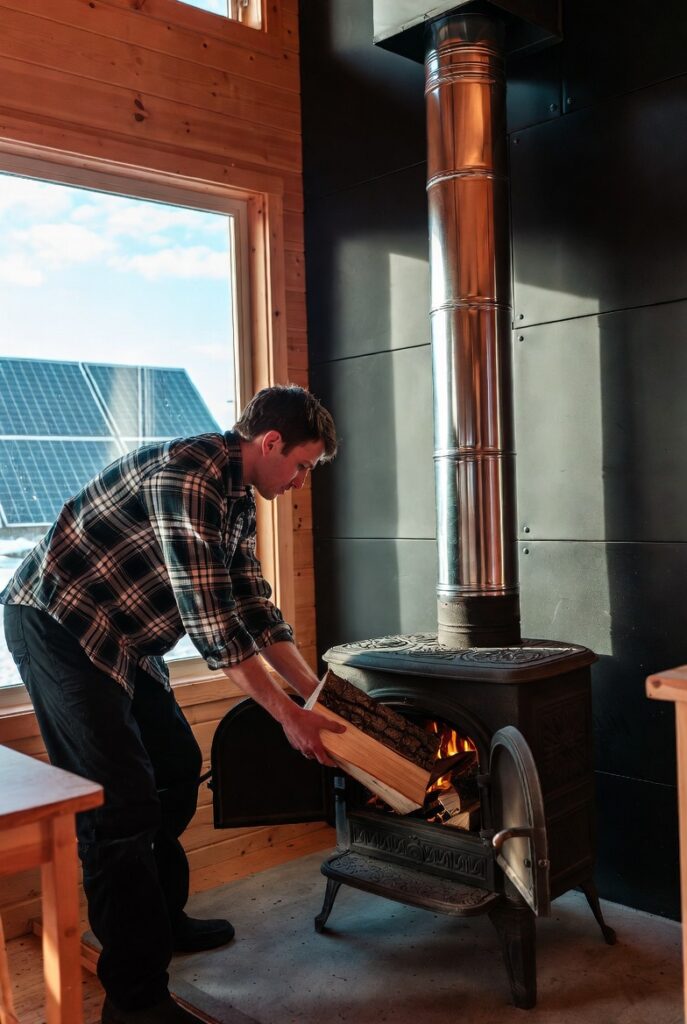
The most important wood stove Ontario off-grid owners overlook is not the primary heater, it is the backup that runs at 0.0W of electrical load when a 5-day January gray streak drops the solar battery bank to 20% SoC and the propane delivery truck cannot reach the property. A homeowner on Woodlawn Road West in Guelph, Wellington County built a 600 square foot year-round off-grid cabin in fall 2022.
His primary heat source was propane radiant, correct for Ontario winter. He decided against a wood stove to reduce installation complexity. In January 2023, a 5-day gray streak dropped his solar battery bank from 92% to 24% SoC, the propane tank reached 10% on day 4, and the delivery truck could not access the property due to a snow-blocked driveway.
He ran a 1,500W electric space heater from the battery bank as emergency backup and dropped the bank to 8% SoC before the propane truck arrived on day 6. His Victron SmartShunt confirmed 11 hours of electric heater runtime: 1,500W × 11h = 16,500Wh drawn from a bank with approximately 4,800Wh of usable capacity. The bank had cycled through more than 3 full equivalent cycles in 11 hours of emergency heating, a damaging pattern for any LFP bank. His Battle Born heated LFP batteries in the unheated utility room had survived the depth, but the cycle damage was confirmed in the SmartShunt’s capacity tracking over the following months.
I specified a wood stove Ontario installation for the following fall: a 35,000 BTU cast-iron stove, WETT-certified installation, double-wall stainless chimney, and minimum 18-inch clearance-to-combustibles on all sides. Total installation cost: approximately $2,400 for the stove, $1,800 for the chimney system, and $600 for the hearth pad and WETT inspection, approximately $4,800. His January 2024 gray streak identical in duration was managed entirely by the wood stove, allowing the battery bank to focus on LED lighting, DC fridge, Starlink, and laptop charging, approximately 280Wh per day total. The SmartShunt showed the bank recovering to 68% SoC on the first clear day after the gray streak ended. See our Ontario solar sizing guide before designing any off-grid heating system.
The wood stove Ontario sizing formula: BTU output for every Ontario cabin floor plan
| Cabin size (sq ft) | Required BTU output | Cords per season | Ontario verdict |
|---|---|---|---|
| Under 500 sq ft | 20,000 to 30,000 BTU | 1 to 2 cords | Don’t oversize, cabin will overheat ✓ |
| 500 to 1,000 sq ft | 35,000 to 50,000 BTU | 2 to 4 cords | Correct range for most Ontario off-grid builds ✓ |
| 1,000 to 2,000 sq ft | 60,000 to 90,000 BTU | 4 to 6 cords | Central placement essential for even heat ✓ |
| Above 2,000 sq ft | 90,000+ BTU or 2 stoves | 6+ cords | Multiple stoves or wood furnace required ✓ |
The Ontario wood stove sizing formula: 30 to 40 BTU per square foot at -25°C design temperature for a well-insulated cabin (R-20 walls, R-40 ceiling). For a 600 sq ft cabin: 600 × 35 = 21,000 BTU minimum, a 35,000 BTU stove provides margin for -30°C cold snaps. For 1,000 sq ft: 35,000 BTU minimum, a 45,000 to 50,000 BTU stove. Oversizing is as problematic as undersizing: a 60,000 BTU wood stove Ontario installation in a 600 sq ft cabin overheats the space in under one hour and forces low-burn smoldering that accelerates chimney creosote buildup at a far faster rate than a correctly sized stove operating at 60 to 80% of rated output.
Wood consumption for the Woodlawn Road Guelph 600 sq ft cabin: 35,000 BTU × 8h/day × 120 heating days = approximately 336 million BTU per heating season. At 17 million usable BTU per cord of maple: approximately 2 to 3 cords per season. Ontario hardwood (maple, oak, ash) provides approximately 20 to 25 million BTU per cord, the correct specification for any wood stove Ontario system. Birch at approximately 20 million BTU per cord is widely available in Wellington/Halton County. Softwood (pine, spruce) at 14 to 18 million BTU per cord is suitable for fire starting but inefficient as a primary fuel. See our off grid heating guide for the propane primary heat comparison and Ontario thermal load calculation.
Clearance-to-combustibles: the installation error that fails every WETT inspection
Standard clearance-to-combustibles for a wood stove Ontario installation: 36 inches (915mm) to unprotected combustible walls from the side and back of the stove. An approved heat shield, non-combustible material (Durock, Hardibacker, or equivalent) with a minimum 1-inch air space, reduces the required clearance from 36 inches to approximately 12 inches for the protected face. The hearth pad must extend a minimum 18 inches in front of the stove door and 8 inches beyond each side, made of non-combustible material (stone, tile, or equivalent). These three clearance requirements are the most common wood stove Ontario WETT inspection failure points, all correctable, none acceptable to skip.
The chimney system is the highest-risk component of any wood stove Ontario installation. Ontario Building Code requires the chimney to extend a minimum of 3 feet above the roof penetration point and at least 2 feet above any part of the roof within 10 feet horizontally. A double-wall or triple-wall insulated stainless steel Class A chimney is the correct specification for any installation passing through a cold unheated space, attic or exterior wall, where condensation and creosote buildup risk is highest. Clean the chimney annually before the heating season, typically September in Ontario to ensure clear passage before the first continuous cold weather requires the stove daily.
Pro Tip: Schedule the WETT inspection before the first heating use of the season, not after. The Concession Road 10 Milton result demonstrates why: a non-compliant clearance discovered after the first winter means the stove has operated without insurance coverage for one full heating season. The WETT inspector identifies clearance issues during a pre-use inspection when they can still be corrected before any fire risk materialises. A heat shield correction takes one day. Retroactively correcting a clearance issue after a fire claim denial is significantly more expensive. WETT inspection cost: approximately $150 to $300. Insurance claim denial on a non-certified wood stove Ontario installation: no defined ceiling.
The wood stove Ontario WETT requirement: why the certificate matters for insurance coverage
WETT (Wood Energy Technology Transfer) certification is the national standard for wood energy installation inspections in Ontario. A WETT-certified inspector verifies the stove model and BTU rating, chimney system construction and height, clearances-to-combustibles, hearth pad dimensions, and combustion air supply. Most Ontario home insurers require a WETT certificate as a condition of coverage for any structure with a wood-burning appliance, a wood stove Ontario installation without a WETT certificate typically voids fire insurance coverage for claims originating from the wood stove. The WETT inspection costs approximately $150 to $300 and is separate from the building permit inspection required under Ontario Building Code.
A property owner near Concession Road 10 in Milton, Halton County installed a 45,000 BTU wood stove in their 850 square foot year-round off-grid residence in fall 2023. Their contractor positioned the stove 22 inches from the back wall without a heat shield. The WETT inspector identified the 22-inch clearance as non-compliant for the stove model’s 36-inch requirement to unprotected combustibles. The contractor installed a Type 2 heat shield (non-combustible board, 1-inch air space), reducing the required clearance from 36 to 12 inches and bringing the 22-inch actual clearance into compliance.
The WETT certificate was issued after the correction. Their January 2024 insurance renewal required the WETT certificate number as a condition of coverage. Their comment: “We would have failed the insurance inspection if we hadn’t done the WETT before winter.” See our off grid cabin guide for the full Ontario regulatory checklist for year-round builds.
Wood supply planning: cords per season and hardwood vs softwood for Ontario winters
A wood stove Ontario system requires a confirmed wood supply before the first heating season. A cord of maple stacked green requires approximately 1 full year of seasoning before it burns efficiently, unseasoned wood contains approximately 50% moisture versus 20% for seasoned wood, reducing usable heat output per cord by 25 to 35% and dramatically accelerating chimney creosote buildup. For a first-year installation, purchase pre-seasoned hardwood from a local supplier. For subsequent seasons, purchase green wood the spring before the heating season and season it through summer and fall before the first heating need in October.
Ontario hardwood in Wellington/Halton County: maple, oak, and ash from local woodlot operators at approximately $250 to $350 per cord delivered and dumped (unseasoned) or $350 to $450 per cord split and seasoned. A 3-cord purchase is approximately $1,050 to $1,350 for unseasoned split hardwood delivered. The wood supply cost of $1,050 to $1,350 per heating season as primary heat is higher than the propane primary cost of approximately $380 per season, which confirms the wood stove Ontario system’s correct role as backup and gray streak emergency heat, not the lowest-cost primary source. For the complete cost comparison see our off grid bathroom guide for propane budgeting across all off-grid thermal loads.
NEC and CEC: Ontario building requirements for wood stove installations
NEC 690 governs the solar PV system components on any off-grid property with a wood stove Ontario installation. The wood stove itself has zero electrical connections and is not subject to NEC 690 requirements. However, the off-grid solar system that powers the remaining electrical loads must be correctly sized for the winter load profile, with a wood stove handling all heating, the electrical load reduces to lighting, refrigeration, communications, and small appliances, typically 200 to 400Wh per day.
A wood stove Ontario installation that successfully shifts heating off the solar system reduces the minimum required battery bank capacity and array size significantly, the Woodlawn Road Guelph result confirmed the reduction from an estimated 1,620Wh/day total to 280Wh/day electronics-only. Contact the NFPA at nfpa.org for current NEC 690 requirements for off-grid solar systems in residential applications.
CEC Section 64 governs solar PV installations in Ontario. The wood stove Ontario installation requires a building permit under Ontario Building Code, contact the local CBO before any permanent wood stove installation in a structure. The solar array and battery bank on the property require a separate ESA permit. The two permits are independent: the building permit covers the stove, chimney, and hearth pad; the ESA permit covers the solar electrical system.
The Victron SmartShunt on the battery negative line confirms the reduced daily load when the wood stove is actively managing the heating requirement, the Woodlawn Road Guelph SmartShunt logs showed 280Wh/day electronics-only during the gray streak versus the estimated 1,620Wh/day before the wood stove was added. Contact the Electrical Safety Authority Ontario at esasafe.com before beginning any permanent electrical installation on the property.
The wood stove Ontario verdict: backup heater, primary heater, and the gray streak safety net
- Ontario off-grid cabin owner who has propane primary heat and no wood stove: install a wood stove as emergency backup before the first Ontario winter. The Woodlawn Road West Guelph result is the case: without a wood stove, a 5-day gray streak plus delayed propane delivery forced 11 hours of emergency electric heating, 16,500Wh drawn from 4,800Wh usable, three equivalent LFP cycles in one event. A correctly sized wood stove at approximately $4,800 installed handles every Ontario gray streak at 0.0W electrical load. The Battle Born heated LFP batteries protect the bank from sub-zero temperatures; the wood stove protects the bank from the emergency load spike that threatens LFP longevity when the propane supply runs low.
- Ontario property owner planning a new off-grid build who wants to size the wood stove Ontario installation correctly: apply the BTU formula before purchasing. For 600 sq ft: 35,000 BTU stove, 2 to 3 cords maple per season, $4,800 installed. For 1,000 sq ft: 45,000 to 50,000 BTU stove, 3 to 4 cords per season. Specify Ontario hardwood pre-seasoned for the first season. Commission the WETT inspection before first heating use and clear the certificate before the insurance renewal. A Renogy 100W panel and correctly sized MPPT controller power the electronics-only load while the wood stove handles all thermal load, the cleanest possible off-grid winter energy split with zero heating load on the battery bank.
- Ontario property owner whose wood stove Ontario installation is already in place but has never had a WETT inspection: commission the inspection before the next insurance renewal. The Concession Road 10 Milton result shows the clearance failure was discovered and corrected in one day for the cost of a heat shield. The WETT inspection at $150 to $300 is the lowest-cost insurance protection available for any wood stove Ontario property, the alternative is a fire claim denial on a non-certified installation that typically surfaces only after the claim has been filed. Do not carry a wood stove Ontario system through another heating season without a WETT certificate on file.
Frequently Asked Questions
Q: Do I need a WETT inspection for a wood stove in Ontario?
A: Yes. Most Ontario home insurers require a WETT certificate as a condition of coverage for any structure with a wood-burning appliance. A wood stove Ontario installation without a WETT certificate typically voids fire insurance coverage for claims originating from the wood stove. The WETT inspection costs approximately $150 to $300 and covers the stove installation, chimney system, clearances-to-combustibles, hearth pad dimensions, and combustion air supply. The Concession Road 10 Milton result: a 22-inch clearance failure was identified and corrected with a heat shield before the first heating use, the WETT certificate was issued the same day. Insurance renewal in January 2024 required the certificate number as a condition of coverage.
Q: What size wood stove do I need for an Ontario off-grid cabin?
A: Apply the 30 to 40 BTU per square foot formula at -25°C design temperature for a well-insulated cabin (R-20 walls, R-40 ceiling). For a 600 sq ft cabin: 600 × 35 = 21,000 BTU minimum, specify a 35,000 BTU stove for margin at -30°C events. For a 1,000 sq ft cabin: 35,000 BTU minimum, specify a 45,000 to 50,000 BTU stove. Do not oversize: a 60,000 BTU wood stove Ontario installation in a 600 sq ft cabin overheats the space in under one hour and forces low-burn smoldering that accelerates chimney creosote buildup.
The correct wood stove Ontario size is the one that runs at 60 to 80% of rated output during the coldest Ontario nights, not at 20% smoldering to keep temperatures manageable.
Q: How many cords of wood does an Ontario off-grid cabin need per season?
A: For a 600 sq ft cabin with a 35,000 BTU wood stove Ontario installation: approximately 2 to 3 cords of Ontario hardwood (maple, oak, or ash) per heating season. The calculation: 35,000 BTU/h × 8h/day × 120 heating days = approximately 336 million BTU per season, divided by 17 million usable BTU per cord of seasoned maple = approximately 2 to 3 cords. Purchase pre-seasoned hardwood for the first season, unseasoned (green) maple reduces usable heat output by 25 to 35% and significantly increases creosote buildup. Ontario hardwood from Wellington/Halton County woodlot operators costs approximately $350 to $450 per cord split and seasoned delivered, or $1,050 to $1,350 for a 3-cord purchase.
This build is engineered within the 48V DC Safety Ceiling. Diagnostic logic is based on 20+ years of technical service experience. All structural and electrical installations must be verified by a Licensed Professional and comply with your Local AHJ.
About the Author
Robert Bertrand spent 20 years as a service advisor in the automotive industry (Lexus and Nissan), where precision diagnostics, wiring integrity, and documentation standards were non-negotiable. He brings that same technical discipline to GridFree Guide, where he researches, tests, and documents off-grid solar systems for Ontario conditions. Based in Rockwood, Ontario, every article is built on verified specifications, manufacturer data, and the real-world climate constraints of Canadian off-grid living.
As an Amazon Associate I earn from qualifying purchases. This site also contains affiliate links to other products and services. GridFree Guide earns a small commission at no extra cost to you.