
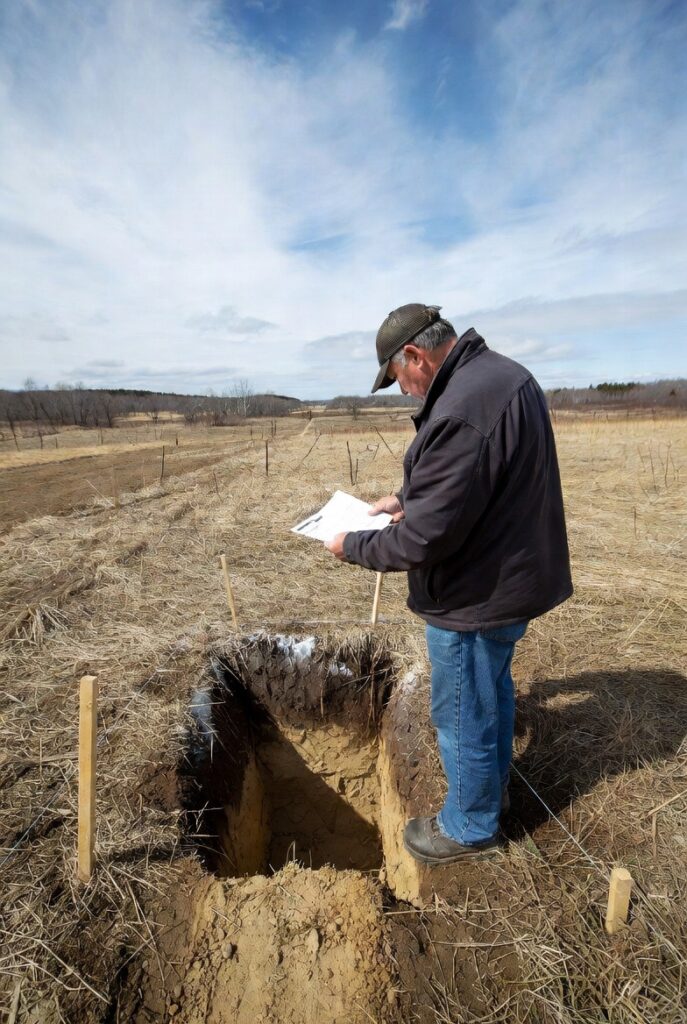
The most expensive surprise in an Ontario off grid septic project is a failing soil percolation test, when a property’s clay-heavy soil fails the percolation test, a $14,500 conventional field bed budget becomes a $18,000 to $30,000 alternative treatment system quote before the first shovel breaks ground. A property owner on Kortright Road in Guelph, Wellington County purchased 5 acres of rural land in spring 2022 planning a year-round off-grid primary residence. His preliminary budget included approximately $10,000 to $15,000 for off grid septic based on a neighbour’s 2018 conventional system. He commissioned a soil percolation test in June 2022 before finalizing the system design.
The percolation test results came back as heavy clay throughout the upper 1.8 metres of the test pit. The soil absorbed water at approximately 35 minutes per centimetre, well above the 15 minutes per centimetre threshold required for a conventional absorption field. His designer, a Qualified Designer under Ontario Building Code Part 8, informed him that a conventional septic field bed was not approvable on this property without soil replacement or an alternative treatment system. The lowest-cost alternative treatment system quote for his anticipated 3-bedroom occupancy load: approximately $26,000.
Together we evaluated the composting toilet plus grey water alternative. A composting toilet eliminated all toilet waste (black water) from the sewage system requirement. Grey water from the two sinks and shower required an approved handling system, the local municipality approved a grey water pit with a gravel field for the anticipated grey water volume from 2 occupants. Total off grid septic cost: $1,400 for the composting toilet, $1,800 for the grey water pit and field, and $600 for the Qualified Designer’s approval documentation, approximately $3,800 total versus the $26,000 alternative system quote. See our Ontario solar sizing guide before designing any off grid system on a property with unknown soil conditions.
The off grid septic perc test: the one diagnostic that determines your entire budget
| Soil type | Perc result | Off grid septic options | Est. install cost |
|---|---|---|---|
| Sandy or loam (good perc) | ≤15 min/cm | Conventional field bed | $12,000 to $18,000 |
| Clay or rocky (poor perc) | >15 min/cm | Alternative treatment system | $18,000 to $30,000 |
| Any soil (transitional) | Any | Holding tank | $4,000 to $6,000 + pump-outs |
| Any soil (eco/low-water) | Any | Composting toilet + grey water | $2,700 to $6,000 |
The percolation test measures how quickly soil absorbs water: a test pit is dug in the proposed absorption field area, water is added, and the absorption rate is measured in minutes per centimetre. At 15 minutes per centimetre or less the soil passes for a conventional absorption field; above 15 minutes per centimetre a conventional field bed is not approvable and an alternative treatment system is required. Wellington/Halton County clay soils frequently absorb at 25 to 60 or more minutes per centimetre, the Kortright Road Guelph result at 35 min/cm is not unusual for this region. The percolation test costs approximately $500 to $1,500 and is typically conducted by a Qualified Designer as part of the system design engagement.
The percolation test result determines not just which off grid septic system is approvable but whether the land purchase price reflects the correct system cost. A rural property priced assuming a $15,000 conventional system that actually requires a $26,000 alternative treatment system has an $11,000 hidden cost embedded in the purchase. Commissioning a percolation test before finalizing a rural purchase is the single highest-return investment in any off grid septic project. A failing result does not kill the project, the Kortright Road Guelph result shows that a composting toilet path can reduce the off grid septic cost from $26,000 to $3,800. But the result must be known before the budget is set.
What happens when clay soil fails the percolation threshold
When a percolation test returns above 15 minutes per centimetre, the property owner faces three paths. Path 1: alternative treatment system at $18,000 to $30,000, a mound system, advanced treatment unit (ATU), or drip irrigation system that treats effluent to a higher standard before applying it to the soil. Path 2: holding tank at $4,000 to $6,000 install plus $1,300 to $5,200 per year in pump-out costs, all waste is contained and removed by truck with no soil contact required.
Path 3: composting toilet plus approved grey water handling at $2,700 to $6,000, eliminates toilet waste entirely and reduces the grey water volume requiring approved handling by approximately 40 to 50% of typical daily water use. The correct path depends on occupancy, water use volume, and the local municipality’s approved grey water handling options.
The Kortright Road Guelph result demonstrates Path 3 economics: $3,800 total versus $26,000 for Path 1. The condition is municipal approval of the grey water handling component, a grey water pit with gravel field approved by the local CBO for 2-occupant primary residence use. A property owner considering this path must confirm the local CBO’s position on grey water pits before committing to the composting toilet approach, approval is not guaranteed and varies significantly between organized municipalities and unorganized territory in Ontario. See our off grid bathroom guide for the composting toilet specification and grey water system options.
Pro Tip: Before finalizing any rural Ontario property purchase that requires a new sewage system, commission the soil percolation test as a condition of the offer. A standard offer to purchase can include a percolation test condition with a 30 to 45-day window for results. This protects the buyer from discovering after closing that the property requires a $26,000 alternative treatment system instead of the $14,500 conventional system assumed in the budget. The Kortright Road Guelph homeowner purchased his land before commissioning the percolation test, the test result did not kill the project, but it eliminated the conventional septic option entirely and required a complete system redesign. A pre-purchase percolation test at $500 to $1,500 is the lowest-cost off grid septic insurance available.
The off grid septic four options: cost, soil requirement, and Ontario approval path
The four off grid septic options in Ontario ranked by upfront cost. Option 1: composting toilet plus approved grey water handling at $2,700 to $6,000, correct for poor-perc properties where municipal approval is obtainable, seasonal cottages, and properties in unorganized territory. Option 2: holding tank at $4,000 to $6,000 install, correct as a transitional solution or for properties with extreme soil challenges; annual pump-out costs of $1,300 to $5,200 make it unsuitable for year-round primary residences over the long term.
Option 3: conventional septic field bed at $12,000 to $18,000, correct for properties passing the percolation test at 15 min/cm or less; lifespan 25 to 35 years with tank pumping every 3 to 5 years at approximately $400 to $500. Option 4: alternative treatment system at $18,000 to $30,000, correct for poor-perc soils where year-round primary residence is planned and composting toilet is not acceptable; requires ongoing service contracts typically $500 to $1,500 per year.
A property owner near Regional Road 25 in Milton, Halton County broke ground on a year-round off-grid primary residence in spring 2023. His 2-acre lot on loam-over-sand produced a percolation test result of 8 minutes per centimetre, well within the 15 min/cm threshold. His Qualified Designer specified a 3,600-litre two-compartment tank, distribution box, and 300-square-metre absorption field at the required 15-metre setback from the drilled well.
Building permit approved April 2023, installation completed May 2023. His total off grid septic installation cost: $14,500. Septic tank pumped at the 3-year mark in May 2026 for $420. His comment: “The perc test passed on the first try and the whole thing was completely straightforward.” See our off grid water guide for well pump surge and the SoftStart Well that connects the water supply to the completed property system.
Ontario Building Code Part 8: the permit and Qualified Designer requirement
Ontario Building Code Part 8 (Ontario Regulation 332/12) governs private sewage system design and installation. Any building with plumbing, including off-grid cabins and rural residences, requires an approved sewage system under Part 8 before occupancy. A Qualified Designer under Ontario Building Code qualification requirements must prepare the sewage system design for Class 4 (conventional and alternative treatment) and Class 5 (holding tank) systems. The building permit application is submitted to the local municipality’s Chief Building Official (CBO), who reviews the design for Part 8 compliance and issues the permit before construction begins. Ontario EPA Part VIII also applies, particularly for setback requirements from wells and watercourses.
A sewage system installed without a building permit or by a party who is not a Qualified Designer under Ontario Building Code Part 8 can result in a work stop order from the local CBO, mandatory removal of the non-compliant system, and potential Ontario EPA enforcement action. The setback requirement from a drilled well is approximately 15 metres for a conventional system; watercourse setbacks vary by system type. The off grid septic permit application must be filed and approved before any excavation begins. See our off grid cabin guide for the complete Ontario regulatory checklist for year-round off-grid primary residence construction.
NEC, CEC, and the solar system connection to off-grid water and septic
NEC 690 governs the solar PV system components that power the off grid property, including the water pump that supplies water to the plumbing connected to the sewage system. The well pump circuit must comply with NEC 240 branch circuit requirements for the motor load and circuit protection. For properties using a SoftStart Well to reduce well pump startup surge from 2,800W to 900W, the SoftStart Well installation is covered by the existing pump branch circuit permit, confirm with the local ESA inspector whether a permit update is required for the added device. Contact the NFPA at nfpa.org for current NEC 690 and NEC 240 requirements for motor branch circuits in off-grid residential applications.
CEC Section 64 governs solar PV installations in Ontario. A permanently installed solar array and battery bank on a property with an approved off grid septic system requires an ESA permit for the electrical installation. The solar system’s DC array, MPPT charge controller, battery bank, and inverter output circuit must all be identified in the permit application. The Victron SmartShunt on the battery negative line monitors the well pump’s actual daily Wh contribution to the total load, the pump’s running time and current draw appear as repeating current spikes in the SmartShunt daily log, confirming the pump load is within the solar system’s daily production budget.
Contact the Electrical Safety Authority Ontario at esasafe.com before beginning any permanent electrical installation on an off grid septic property.
The off grid septic verdict: which system matches your soil, budget, and occupancy
- Ontario rural property owner whose percolation test has come back above 15 min/cm on a property intended for year-round primary residence: evaluate the composting toilet plus grey water path before committing to the $18,000 to $30,000 alternative treatment system. The Kortright Road Guelph result: $3,800 total versus $26,000 for the alternative system, with municipal approval obtained for the grey water pit. Confirm the local CBO’s position on grey water handling before purchasing the composting toilet, approval is not guaranteed and varies by municipality. If the CBO requires full sewage treatment for all waste streams, the alternative treatment system is the correct off grid septic path regardless of cost. A Renogy 100W panel plus MPPT controller can power the grey water pump and composting fan from the same solar system handling all other off-grid electrical loads.
- Ontario rural property owner whose percolation test has passed at 15 min/cm or less and who plans a conventional septic field bed: engage a Qualified Designer and file the building permit before breaking ground. The Regional Road 25 Milton result: $14,500 for a complete conventional off grid septic system on good-perc loam-over-sand, operational for 3 years, first pump-out at $420 as scheduled. Budget for tank pumping every 3 to 5 years at approximately $400 to $500 per pump-out, the system will provide reliable sewage treatment for 25 to 35 years. The Victron SmartShunt on the well pump circuit will confirm the actual daily pump electrical load, typically 400 to 450Wh per day for the water supply pump serving a conventional septic property.
- Ontario rural property owner in the planning phase who has not yet commissioned a percolation test: commission the test before purchasing the property or finalizing the off grid septic budget. A rural Ontario property requiring an alternative treatment system instead of a conventional field bed carries an additional $8,000 to $15,000 in sewage system cost that may not be reflected in the purchase price. The percolation test at $500 to $1,500 is the most cost-effective diagnostic available, it determines whether the off grid septic budget is $3,800, $14,500, or $26,000 before any other commitment is made. Include the percolation test as a condition of the purchase offer with a 30 to 45-day window for results before any off grid septic budget is finalized.
Frequently Asked Questions
Q: Do I need a septic system for an off-grid property in Ontario?
A: Yes. Any building with running water (plumbing) requires an approved sewage system under Ontario Building Code Part 8 before occupancy. A composting toilet eliminates the toilet waste (black water) component, but grey water from sinks and showers still requires an approved handling system. In organized Ontario municipalities, a Qualified Designer and building permit are required for any permanent sewage system. In some unorganized territories, a composting toilet plus an approved grey water pit may be accepted for low-volume seasonal use, confirm the specific requirements with the local CBO before designing any off grid septic system that relies on composting toilet plus simple grey water disposal.
Q: What happens if my soil fails the percolation test in Ontario?
A: A failing percolation test (above 15 min/cm absorption rate) means a conventional absorption field bed is not approvable on the property. The three paths are: (1) alternative treatment system at $18,000 to $30,000, a mound system, ATU, or drip irrigation system designed for poor-perc soils; (2) holding tank at $4,000 to $6,000 install with ongoing pump-out costs of $1,300 to $5,200 per year; or (3) composting toilet plus approved grey water handling at $2,700 to $6,000, which eliminates toilet waste from the sewage requirement entirely. The Kortright Road Guelph result: clay soil at 35 min/cm, $26,000 alternative treatment quote, redesigned to composting toilet plus grey water pit for $3,800 with municipal approval.
Q: How much does an off-grid septic system cost in Ontario?
A: Off grid septic costs in Ontario range from approximately $2,700 to $6,000 for a composting toilet plus approved grey water system (correct for poor-perc properties with municipal approval), to $12,000 to $18,000 for a conventional field bed on good-perc soil (requires passing the percolation test at 15 min/cm or less), to $18,000 to $30,000 for an alternative treatment system on clay or rocky poor-perc land. A holding tank installation costs $4,000 to $6,000 but adds $1,300 to $5,200 in annual pump-out costs. The Regional Road 25 Milton conventional off grid septic result: $14,500 total for a 3-bedroom-equivalent system on loam-over-sand, first 3-year pump-out at $420.
This build is engineered within the 48V DC Safety Ceiling. Diagnostic logic is based on 20+ years of technical service experience. All structural and electrical installations must be verified by a Licensed Professional and comply with your Local AHJ.
About the Author
Robert Bertrand spent 20 years as a service advisor in the automotive industry (Lexus and Nissan), where precision diagnostics, wiring integrity, and documentation standards were non-negotiable. He brings that same technical discipline to GridFree Guide, where he researches, tests, and documents off-grid solar systems for Ontario conditions. Based in Rockwood, Ontario, every article is built on verified specifications, manufacturer data, and the real-world climate constraints of Canadian off-grid living.
As an Amazon Associate I earn from qualifying purchases. This site also contains affiliate links to other products and services. GridFree Guide earns a small commission at no extra cost to you.