
The most common solar battery charger failure in Ontario is a 5W dashboard panel connected to a vehicle battery through a PWM controller, in January, that setup delivers approximately 6Wh on a clear day, which is less than the parasitic draw of a modern vehicle’s security system and engine management module, meaning the battery continues to discharge while the charger sits in the sun. A property owner on Elmira Road in Guelph, Wellington County purchased a $45 solar battery charger in fall 2022 to maintain his work truck battery over winter while the truck sat unused for 6 to 8 weeks.
The unit was a 5W panel with an integrated PWM controller and a dashboard suction cup, placed on the windshield facing south. He assumed 5 watts of solar input would offset the approximately 30mA parasitic draw from the truck’s alarm system and engine computer.
By February 2023 the truck battery was dead at approximately 10.4V, below the recovery threshold for a standard flooded lead-acid battery. The 5W panel on a windshield in January in Guelph receives approximately 1.0 to 1.5 PSH per day, the windshield glass reduces transmission to approximately 70% of outdoor panel output, the PWM controller clips excess voltage, and the 5W nameplate delivers approximately 3 to 4W effective output. At 1.2 PSH × 3.5W effective = approximately 4.2Wh per day. The truck’s parasitic draw was confirmed at 35mA at 12V = 10.1Wh per day. The panel delivered approximately 4Wh against a 10Wh daily drain, a net daily discharge of approximately 6Wh.
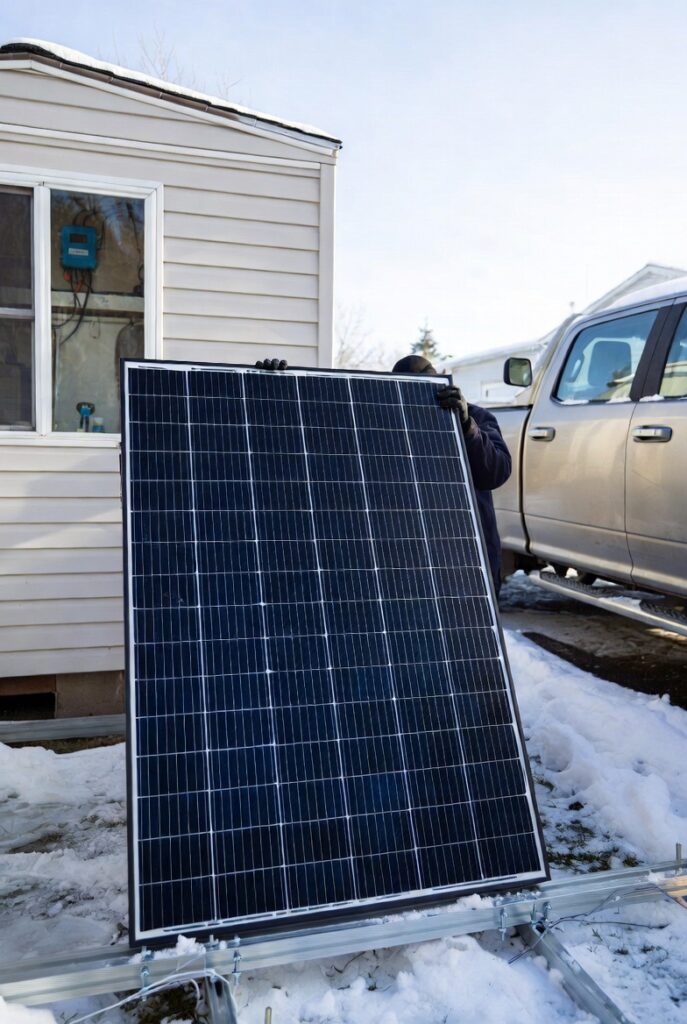
I replaced the setup with a Renogy 100W monocrystalline panel mounted outdoors at 45-degree south-facing tilt, connected through a Victron MPPT 100/30 to the truck battery. The MPPT 100/30 harvested the full cold Voc from the panel, approximately 25.5V at -15°C converted to increased charging current versus the battery’s 12.8V absorption voltage. Clear January day production: approximately 100W × 1.5 PSH × 0.80 = 120Wh per day. His truck battery remained above 12.6V resting voltage through the following winter without generator intervention. See our Ontario solar sizing guide before specifying any solar battery charger for an Ontario application.
Why the 5W dashboard panel cannot maintain an Ontario vehicle battery in January
| Solar battery charger type | January daily output | vs 35mA parasitic draw | Ontario verdict |
|---|---|---|---|
| 5W PWM dashboard (windshield) | ~1.6Wh/day | -8.5Wh/day net loss | Battery dies by February ✗ |
| 5W PWM panel (outdoor 45°) | ~4Wh/day | -6Wh/day net loss | Still loses to parasitic draw ✗ |
| 100W MPPT outdoor 45° | ~120Wh/day | +109.9Wh/day net gain | Battery maintained all winter ✓ |
| 3×100W MPPT outdoor 45° | ~240-260Wh/day | Meets 20Ah/day cottage load | Weekend cottage correct ✓ |
The dashboard location is the core problem. A windshield panel at 30 to 50 degrees from horizontal in Ontario January receives approximately 40 to 60% of the solar energy a south-facing 45-degree outdoor panel receives at the same location. Combining glass transmission loss (approximately 70%), angle loss (approximately 50%), and PWM efficiency loss (approximately 75%), a 5W nameplate dashboard panel delivers approximately 1.3W effective in an Ontario January, approximately 1.6Wh per clear day. The parasitic draw wins by a factor of 6 to 7. Moving the panel outdoors to correct south-facing tilt is the single largest solar battery charger improvement available before any component upgrade.
Even outdoors, a 5W panel cannot win against a modern vehicle’s parasitic draw. At ideal outdoor conditions (45-degree south, no glass, MPPT controller): 5W × 1.5 PSH × 0.80 = 6Wh per day against a 10.1Wh daily drain, still a 4Wh/day deficit. A minimum 100W panel is required to overcome any meaningful Ontario parasitic load. The 100W threshold is not a conservative safety margin, it is the minimum where the solar battery charger production begins to exceed the parasitic drain and actually charges the battery on clear January days.
The solar battery charger PWM failure: why cheap controllers waste the Ontario cold advantage
In January at -20°C, a 100W panel’s Vmpp increases to approximately 20.5V, 13.5% above its STC Vmpp of approximately 18.5V. A PWM controller connects the panel directly to the battery at battery voltage (approximately 12.8 to 14.4V) and discards the 6V difference between panel Vmpp and battery voltage as heat in the controller. That lost power represents approximately 29% of the panel’s cold-weather power advantage. An MPPT controller harvests this elevated Vmpp and converts the voltage difference to increased charging current, delivering approximately 25 to 30% more energy to the battery on the same cold morning. Ontario January is the MPPT’s strongest argument.
A $45 PWM unit connected to a 100W panel on a cold clear January morning in Guelph wastes approximately 25Wh compared to a Victron MPPT 100/30 connected to the same panel. Over a 30-day January with approximately 12 clear days, the MPPT solar battery charger delivers approximately 300Wh more than the PWM, approximately 25Ah extra from the same panel, the equivalent of 25% of a 100Ah LFP bank’s usable capacity. The Elmira Road Guelph result confirmed this directly: same location, same panel, different controller, MPPT held the battery above 12.6V all winter, PWM let it drop to 10.4V. See our solar panel size guide for the cold Voc calculation that explains why Ontario cold amplifies the MPPT advantage.
Pro Tip: When evaluating any solar battery charger for Ontario winter use, run three quick checks before purchasing. First: multiply panel watts × 1.5 PSH × 0.80 to get clear January daily output, this is the maximum you will get. Second: measure or estimate the target battery’s parasitic drain in mA and multiply by 24 × 12V to get the daily drain in Wh. Third: confirm that the panel output exceeds the parasitic drain by at least 2 to 3 times as a buffer for gray days. For the Elmira Road truck: 100W × 1.5 × 0.80 = 120Wh daily output versus 10.1Wh daily drain, a 12:1 buffer ratio. A 5W panel produces only a 0.6:1 ratio, which explains exactly why it fails.
The solar battery charger sizing formula: panel watts for any daily Ah requirement
The solar battery charger sizing formula: Step 1: daily Ah to replace × battery voltage = daily Wh. Step 2: daily Wh ÷ 1.2 × 1.25 = minimum panel watts. Step 3: round up to the nearest standard panel. For a vehicle battery maintainer at 35mA parasitic draw: 35mA × 24h × 12V = 10.1Wh ÷ 1.2 × 1.25 = 10.5W minimum, use a 100W panel standard. For a weekend cottage at 20Ah/day from a 12V bank: 20 × 12 = 240Wh ÷ 1.2 × 1.25 = 250W minimum, use 3 × 100W (300W). For a daily cabin at 50Ah/day from a 24V bank: 50 × 24 = 1,200Wh ÷ 1.2 × 1.25 = 1,250W minimum, use 4 × 400W.
A weekend cottage owner near Brampton Road in Guelph, Wellington County sized his solar battery charger system in spring 2023 for his 100Ah LFP bank.
His 20Ah/day cottage load: LED lighting 5Ah, DC fridge 10Ah, phone charging 2Ah, Starlink mini 3Ah. Formula result: 240Wh ÷ 1.2 × 1.25 = 250W minimum. Two 100W panels = 200W, insufficient. He chose 3 × 100W at $240 total connected through a Victron MPPT 100/30 to the LFP bank. His Victron SmartShunt on commissioning day in April 2023 showed 12.4A peak at 11:00 AM on a clear spring day, approximately 223Wh in the peak production window alone. His January logs confirmed 240 to 260Wh per clear day, bank above 60% SoC through every gray streak. See our solar energy storage guide for battery sizing to pair with any solar battery charger.
The MPPT advantage: harvesting cold Voc instead of clipping it
The Victron MPPT 100/30 operates at up to 100V input and delivers up to 30A of charge current to a 12V or 24V battery bank. At 12V with a single 100W panel at -20°C (Voc approximately 25.5V, Vmpp approximately 20.5V), the MPPT 100/30 harvests the full 100W from the panel and converts it to approximately 7.5A charging current at 13.5V, approximately 98% conversion efficiency. A PWM controller with the same panel delivers approximately 5.4A at 13.5V, approximately 72% of the MPPT output in the same cold conditions. On a clear -20°C January morning, the MPPT 100/30 delivers approximately 28% more charge to the battery from the same 100W panel.
For panel arrays above approximately 360W at 12V, the correct solar battery charger controller is the Victron MPPT 100/50, it handles up to 50A charging current and approximately 650W of panel input at 12V. The MPPT 100/50 is the correct controller for the weekend cottage tier at 300W and above and for any daily cabin system up to approximately 650W at 12V. Verify the panel array’s maximum short-circuit current (Isc) and cold Voc against the controller’s maximum input specifications before connecting any solar battery charger assembly. See our solar power system integration guide for the full controller selection sequence.
NEC and CEC: Ontario requirements for permanently installed solar charging systems
NEC 690 governs permanently installed solar PV systems. A solar battery charger system permanently mounted to a structure must comply with NEC 690 requirements for the DC wiring from the panel to the charge controller, the charge controller to the battery, and the battery overcurrent protection. A portable solar battery charger (panel on a suction cup, controller not permanently wired) is not subject to NEC 690 permit requirements, it functions as a portable appliance.
However, any solar battery charger system where the panel is permanently mounted to a building and the wiring runs through the building structure requires an NEC 690 permit application for the DC wiring. Contact the NFPA at nfpa.org for current NEC 690 requirements for solar battery charger installations in residential and commercial applications.
CEC Section 64 governs solar PV installations in Ontario. A permanently installed solar battery charger system with a panel mounted to a structure requires an ESA permit before permanent wiring begins. A portable solar battery charger, a panel connected by a cable to a controller and battery without permanent structural mounting or wiring through walls or conduit, does not require an ESA permit for portable use. A property owner who begins with a portable solar battery charger setup and later permanently mounts the panel to the building must file the ESA permit before making any permanent wiring connections. Contact the Electrical Safety Authority Ontario at esasafe.com before permanently installing any solar battery charger system in Ontario.
The solar battery charger verdict: vehicle maintainer, weekend cottage, and daily cabin tiers
- Vehicle battery maintainer or seasonal trickle charge (10 to 50Wh/day replacement): one Renogy 100W monocrystalline panel mounted outdoors at 45-degree south-facing tilt, connected through a Victron MPPT 100/30 to the battery. Clear January production: approximately 120Wh per day, 12 to 20 times more energy than a 5W dashboard trickle unit. The Elmira Road Guelph result: truck battery above 12.6V all winter on this configuration versus dead at 10.4V on the $45 PWM setup. A 100W outdoor MPPT solar battery charger overcomes any Ontario vehicle parasitic draw and provides meaningful charge on every clear winter day.
- Weekend cottage or cabin (100 to 300Wh/day replacement for a 12V LFP bank): 3 × 100W panels at 300W total through a Victron MPPT 100/30, verified by Victron SmartShunt on commissioning day. The Brampton Road Guelph result: 12.4A peak charging current on the first clear spring day, 240 to 260Wh per clear January day, bank above 60% SoC through every winter gray streak on a 100Ah LFP bank. This solar battery charger tier is sufficient for LED lighting, DC fridge, laptop, and Starlink mini at approximately 20Ah/day total.
- Daily cabin or year-round off-grid system (600Wh/day or more): panels above 650W total through a Victron MPPT 100/50 for 12V systems. Apply the solar battery charger sizing formula: daily Wh ÷ 1.2 × 1.25 = minimum panel watts, then verify the panel cold Voc at -25°C stays below the controller’s 100V maximum input. Install a SmartShunt on the battery negative line from commissioning day one to confirm the actual daily Wh delivered versus the formula estimate. A correctly sized solar battery charger at this tier should confirm the formula within 10% on the first clear January week.
Frequently Asked Questions
Q: What is the best solar battery charger for maintaining a vehicle battery in Ontario?
A: One 100W panel mounted outdoors at 45-degree south-facing tilt connected through a Victron MPPT 100/30 is the minimum effective solar battery charger for Ontario vehicle battery maintenance. The MPPT 100/30 harvests the cold panel voltage instead of clipping it, delivering approximately 120Wh per clear January day, enough to overcome the 10 to 30Wh daily parasitic drain of any modern vehicle’s electronics. The Elmira Road Guelph result: truck battery above 12.6V resting voltage all winter on this configuration versus dead at 10.4V with a $45 5W PWM dashboard setup. A 100W panel plus MPPT 100/30 costs approximately $280 to $350 total, significantly less than a battery replacement and the cost of a failed winter start.
Q: Why is my solar battery charger not keeping up with my battery’s discharge in January?
A: Two likely causes. First: if the panel is smaller than 100W or positioned on a dashboard or flat roof, the Ontario January production (1.5 PSH maximum) is insufficient to overcome the battery’s daily parasitic drain, a 5W dashboard panel produces approximately 1.6Wh per clear January day against a 10Wh parasitic drain. Second: if the controller is a PWM type, it is clipping approximately 25 to 30% of the panel’s cold-weather voltage advantage. The correct solar battery charger fix for Ontario is a minimum 100W panel mounted outdoors at 45-degree south tilt connected through an MPPT controller. Confirm the actual daily charge input with a SmartShunt to verify the solar battery charger is delivering the expected Wh.
Q: What is the difference between a PWM and MPPT solar charge controller?
A: A PWM (Pulse Width Modulation) controller connects the panel directly to the battery at battery charging voltage (approximately 13.5V), discarding any panel voltage above battery voltage as heat. In cold Ontario conditions, a 100W panel produces Vmpp of approximately 20.5V, the PWM wastes the 7V differential and delivers approximately 72% of what an MPPT delivers. An MPPT (Maximum Power Point Tracking) controller continuously adjusts to harvest the panel’s full power at its Vmpp and converts it to increased charging current at the battery voltage, delivering approximately 25 to 30% more energy to the battery on cold Ontario mornings.
For a solar battery charger application in Ontario, MPPT is always the correct controller type. The Victron MPPT 100/30 at approximately $100 to $120 is the standard entry-level MPPT for 12V and 24V Ontario solar battery charger systems.
This build is engineered within the 48V DC Safety Ceiling. Diagnostic logic is based on 20+ years of technical service experience. All structural and electrical installations must be verified by a Licensed Professional and comply with your Local AHJ.
About the Author
Robert Bertrand spent 20 years as a service advisor in the automotive industry (Lexus and Nissan), where precision diagnostics, wiring integrity, and documentation standards were non-negotiable. He brings that same technical discipline to GridFree Guide, where he researches, tests, and documents off-grid solar systems for Ontario conditions. Based in Rockwood, Ontario, every article is built on verified specifications, manufacturer data, and the real-world climate constraints of Canadian off-grid living.
As an Amazon Associate I earn from qualifying purchases. This site also contains affiliate links to other products and services. GridFree Guide earns a small commission at no extra cost to you.