
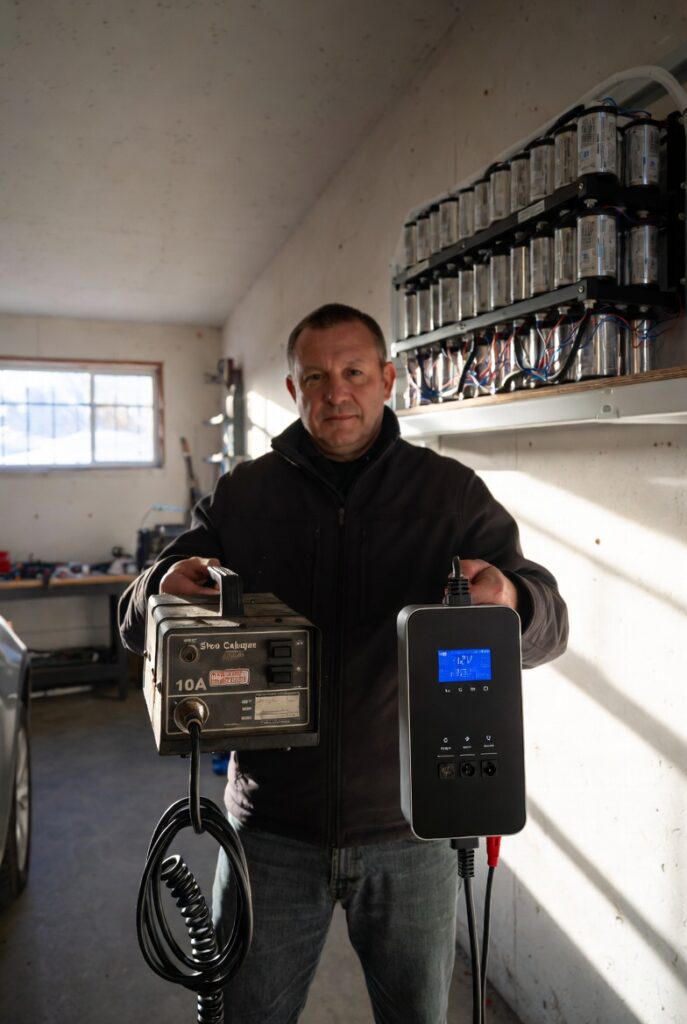
A smart battery charger is not a luxury upgrade, it is the minimum safe specification for any Ontario off-grid system running LFP chemistry. A homeowner on Scottsdale Drive in Guelph, Wellington County had been using an old 10A shop charger from his garage to top up his Battle Born 100Ah LFP during November gray streaks. The charger had served his lead acid truck battery faithfully for a decade. He connected it to the LFP bank and left it running overnight. The next morning his Victron SmartShunt showed 78% state of charge despite the charger having run for 8 hours. He repeated the process the following night with the same result, 78% in the morning.
The charger was applying its lead acid float voltage of 13.8V continuously. On LFP chemistry, 13.8V corresponds to approximately 70 to 80% state of charge on the flat discharge curve. The charger was not failing. It was doing exactly what it was designed to do: float a lead acid battery at 13.8V. Applied to LFP, that voltage produced a permanent 78% SoC ceiling with no path to a full charge regardless of how long it ran.
He replaced the shop charger with a 20A smart battery charger set to the lithium profile. The first overnight cycle reached 97% SoC by morning, a 19-percentage-point improvement on the same bank, the same array, and the same Ontario November sun. His SmartShunt comparison confirmed it: week one with the dumb charger showed a peak SoC of 78% on 5 of 7 days; week two with the smart battery charger showed 96 to 97% on 5 of 7 days. The only thing that changed was the charger’s profile. See our Ontario solar sizing guide before sizing your backup charging system for gray streak capacity requirements.
What a smart battery charger actually does: profile selection vs dumb float
A smart battery charger allows the user to select the battery chemistry profile and then applies the correct voltage sequence for that chemistry accurately. The user selects the profile, the charger does not auto-detect chemistry. That distinction matters: a smart battery charger set to the wrong profile is no safer than a dumb charger, and potentially more dangerous if equalization is included in the selected profile. The lithium profile on a quality smart battery charger applies 14.4V bulk, holds absorption at 14.4V until the current drops below the tail current threshold, transitions to 13.6V float, and skips equalization entirely. That sequence consistently delivers approximately 97% state of charge.
| Charger type | Float voltage | LFP SoC achieved | Equalization | Safe for LFP? |
|---|---|---|---|---|
| Dumb shop charger | 13.8V (fixed) | ~78% | Not applicable | No, leaves 22% unfilled |
| Smart charger, AGM profile | 13.8V | ~78-80% | 15.0-16.0V every 30 days | No, equalization trips BMS |
| Smart charger, LFP profile | 13.6V | ~97% | Disabled | Yes ✓ |
The profile selection is the entire value proposition of a smart battery charger for LFP systems. Confirm the charger is on the lithium profile before every backup charging event. Confirm equalization is disabled. Confirm temperature compensation is disabled, that feature reduces bulk voltage in warm conditions and is designed for lead acid, not LFP. Three settings to check, zero cost to check them, and the consequence of missing any one of them ranges from a permanently undercharged bank to a BMS emergency disconnect. See our Ontario backup charging guide for the full three-method backup strategy including generator and alternator options.
The four charging stages: bulk, absorption, float, and the one LFP skips
The four charging stages serve distinct purposes. Bulk delivers full available current to the battery until it reaches the target voltage, the fastest phase, carrying the battery from low SoC to approximately 80% in most conditions. Absorption holds constant voltage at the target with tapering current, completing the fill from approximately 80% to 97 to 100%. Float applies a maintenance voltage to hold the charge without overcharging, LFP uses 13.6V for this stage. Equalization applies a high voltage of 15.0 to 16.0V for flooded lead acid desulphation, LFP skips this stage entirely and permanently.
LFP absorption completes faster than lead acid because LFP cells have very low internal resistance and fill quickly at absorption voltage. The tail current threshold, typically 2% of rated Ah, is reached in approximately 20 to 40 minutes on a partially depleted bank with a 20A smart battery charger. Lead acid absorption on the same charger takes 1 to 4 hours because the plates absorb charge more slowly through their chemical reaction. A smart battery charger on the lithium profile uses the shorter absorption duration correctly. A lead acid profile would hold absorption longer than LFP requires, consuming time without delivering additional capacity. See our solar battery lifespan guide for how correct absorption termination protects long-term LFP cycle life.
Why 13.8V float leaves your LFP bank permanently at 78%
LFP has a flat discharge curve from approximately 13.6V at 100% SoC down to approximately 13.0V at 20% SoC, a span of approximately 0.6V across 80% of usable capacity. The lead acid float voltage of 13.8V sits in the middle of LFP’s flat region, corresponding to approximately 70 to 80% state of charge. A dumb charger applying 13.8V float cannot push the LFP bank higher because the battery voltage equals the charger voltage and no current flows. The battery is not full. The charger has run out of voltage headroom against the battery’s electrochemical resistance at that state of charge.
The practical Ontario consequence accumulates quickly over a gray streak. A backup charging event with a dumb 13.8V charger on an LFP bank starting at 20% SoC climbs to approximately 78% and stops there, leaving 22% of usable capacity unfilled. For a 100Ah LFP bank at 80% DoD, that 22% represents approximately 17.6Ah of unused capacity per charging event. Over a 3-day Ontario November gray streak requiring backup charging every evening, the shortfall accumulates to approximately 52Ah of capacity that a smart battery charger on the correct lithium profile would have delivered.
That 52Ah is roughly the equivalent of half a day’s worth of Starlink, lighting, and DC refrigerator load, the difference between a system that holds through the gray streak and one that shuts down on day three.
The smart battery charger equalization hazard: why LFP and high voltage don’t mix
Equalization is a high-voltage desulphation cycle for flooded lead acid batteries, typically 15.0 to 16.0V, that boils the electrolyte to break up sulfate crystals on the plates. LFP cells have no sulfate crystals, no plate-based electrolyte, and no physical process that requires or benefits from high-voltage treatment. The LFP BMS high-voltage cutoff is typically 3.65V per cell, 14.6V for a standard 12V four-cell bank. An equalization voltage of 15.0 to 15.5V exceeds that cutoff by 0.4 to 0.9V. The BMS triggers an emergency disconnect the moment the voltage crosses 14.6V.
A cottage owner on James Street in Milton, Halton County replaced his AGM bank with LFP in spring 2025 but kept the same smart battery charger without checking the settings. The charger was on the AGM profile with automatic equalization scheduled every 30 days. Four weeks after installation the equalization cycle activated during a clear afternoon. The charger pushed the bank above 15.0V. The BMS triggered an emergency high-voltage disconnect at 14.6V, cutting all loads simultaneously, Starlink offline, DC fridge stopped, charge controller faulted.
The installer diagnosed the AGM profile setting immediately. The charger was switched to the lithium profile, equalization disabled, BMS manually reset. No measurable capacity loss resulted because the BMS cutoff was fast enough. Not all equalization events end that cleanly, sustained overvoltage before the BMS responds can cause permanent capacity reduction in LFP cells. See our LFP battery maintenance guide for the three profile settings to confirm after any chemistry swap.
NEC and CEC: code requirements for backup battery charger installations in Ontario
NEC 690 governs solar PV installations. A permanently wired AC-to-DC smart battery charger is part of the battery charging circuit and falls under NEC 690’s scope for overcurrent protection and disconnecting means. NEC 690.71 requires that the battery system include a means to disconnect all charging sources, the charger’s integrated power switch or a bypass switch on the charger circuit satisfies this requirement. The charger’s AC input wiring must comply with NEC 210 for branch circuit requirements. A 20A smart battery charger at 120V input requires a dedicated 20A branch circuit with a 20A breaker. Contact the NFPA at nfpa.org for current NEC 690 and NEC 210 requirements for permanently wired backup battery charger installations.
CEC Section 64 governs battery installations in Ontario. A permanently wired smart battery charger added to an existing permitted battery bank constitutes a modification to the electrical system. The permit holder must confirm whether the modification requires an ESA permit amendment, in most cases, adding a permanently wired AC-to-DC charger that changes the charging circuit configuration requires an amendment documenting the charger specifications, circuit breaker sizing, and disconnect provision. A smart battery charger connected via a portable plug into an existing outlet does not require a permit amendment. Contact the Electrical Safety Authority Ontario at esasafe.com before permanently wiring any smart battery charger into a previously permitted Ontario battery installation.
Pro Tip: The fastest way to confirm a smart battery charger is on the correct LFP profile is to watch the SmartShunt voltage display during the first 10 minutes of a charge event. A charger on the lithium profile will drive the battery voltage up toward 14.4V immediately in bulk phase. A charger on the AGM profile will do the same, the difference is not visible during bulk. The moment to check is when the charger transitions to absorption: on the lithium profile, absorption terminates in 20 to 40 minutes once the current drops below 4A on a 200Ah bank. On the AGM profile, absorption holds for 1 to 4 hours regardless of current. If your charger is still in absorption after 90 minutes on a partially depleted LFP bank, the profile is wrong. Check the charger’s display for an active equalization indicator as well, if equalization is scheduled and the AGM profile is active, it will appear as a countdown or a stage indicator. That is the warning to stop the charge event, change the profile, disable equalization, and restart.
The smart battery charger verdict: three Ontario backup charging profiles
- Ontario off-grid owner currently using a dumb shop charger or any charger without a dedicated lithium profile for LFP backup charging: replace with a smart battery charger before the next gray streak. The Guelph Scottsdale Drive result is the evidence, 78% SoC ceiling from the dumb charger versus 97% SoC on the first smart charger cycle, a 19-percentage-point gain with no change to the battery, array, or controller. A 20A smart battery charger with a lithium profile costs approximately $80 to $120 and brings a 100Ah LFP bank from 20% to 90% in approximately 3.5 hours. That 19% recovered capacity is worth more than the charger cost when it represents the difference between system shutdown and full load operation on day three of a November gray streak in Wellington County.
- Ontario off-grid owner who switched from AGM to LFP and kept the old smart battery charger: check the profile setting before the next use. A smart battery charger on an AGM profile applies the wrong float voltage, wrong absorption duration, and most critically, equalization, which triggers a BMS emergency disconnect the moment the voltage exceeds 14.6V. The Milton James Street result confirms that even a quality smart battery charger becomes a safety hazard when the profile was set for the previous chemistry and never updated. Change the profile to lithium or LiFePO4, disable equalization, and disable temperature compensation before reconnecting. This check takes 60 seconds and prevents the Starlink-offline, fridge-stopped, battery-fault scenario that James Street experienced.
- Ontario off-grid owner selecting a new smart battery charger for backup use during Ontario gray streaks: confirm three features before purchasing. First: a dedicated lithium or LiFePO4 profile with 14.4V bulk, 14.4V absorption, and 13.6V float as configurable settings. Second: an equalization disable option that works on the lithium profile, some chargers force equalization on a non-overridable schedule tied to the lead acid profile; the lithium profile must bypass this entirely. Third: a continuous current rating matched to your backup window, a 20A charger brings a 100Ah LFP bank from 20% to 90% in approximately 3.5 hours; a 30A charger reduces that to approximately 2.3 hours for installations where generator or shore power run time is limited by fuel cost or utility rate concerns.
Frequently Asked Questions
Q: Will an old shop charger damage my LFP solar battery?
A: An old dumb shop charger set to its default 13.8V lead acid float will not damage LFP cells, but it will permanently cap your state of charge at approximately 78% regardless of how long it runs. The 13.8V float voltage equals the battery voltage at approximately 70 to 80% SoC on the LFP flat discharge curve, and no current flows once those voltages equalise. The result is not cell damage but a system that operates permanently at 78% capacity during backup charging events. Over a multi-day Ontario gray streak that capacity gap accumulates to approximately 52Ah of lost access on a 100Ah bank. A smart battery charger on the lithium profile corrects this entirely on the first cycle.
Q: What happens if I accidentally use the equalization setting on my LFP battery?
A: The LFP BMS triggers an emergency high-voltage disconnect when the charger pushes the bank above the BMS cutoff of approximately 14.6V, 3.65V per cell for a 12V four-cell bank. Equalization at 15.0 to 16.0V exceeds this threshold by 0.4 to 1.4V. The BMS cuts all loads simultaneously, the result is a sudden system shutdown identical to the Milton James Street event. After the disconnect, the BMS typically requires a manual reset before accepting charge current again.
If the BMS cutoff was fast enough, the cells experience no permanent damage. If the overvoltage persisted for more than a few seconds before the cutoff, permanent capacity reduction is possible. The correct prevention is confirming equalization is disabled on the smart battery charger before any LFP charging event.
Q: What is the correct charging profile for a smart battery charger on LFP batteries?
A: Select the lithium or LiFePO4 profile on the charger. Set bulk voltage to 14.4V. Set absorption voltage to 14.4V. Set absorption termination to tail current, 2% of rated Ah, which is 2A for a 100Ah bank and 4A for a 200Ah bank. Set float voltage to 13.6V. Disable equalization. Disable temperature compensation. These six settings apply correctly to any quality LFP battery including Battle Born chemistry. If the charger does not allow equalization to be disabled on the selected profile, do not use that charger on an LFP bank, a forced equalization cycle will eventually trigger a BMS emergency disconnect regardless of how carefully the daily charging is managed.
This build is engineered within the 48V DC Safety Ceiling. Diagnostic logic is based on 20+ years of technical service experience. All structural and electrical installations must be verified by a Licensed Professional and comply with your Local AHJ.
About the Author
Robert Bertrand spent 20 years as a service advisor in the automotive industry (Lexus and Nissan), where precision diagnostics, wiring integrity, and documentation standards were non-negotiable. He brings that same technical discipline to GridFree Guide, where he researches, tests, and documents off-grid solar systems for Ontario conditions. Based in Rockwood, Ontario, every article is built on verified specifications, manufacturer data, and the real-world climate constraints of Canadian off-grid living.
As an Amazon Associate I earn from qualifying purchases. This site also contains affiliate links to other products and services. GridFree Guide earns a small commission at no extra cost to you.