
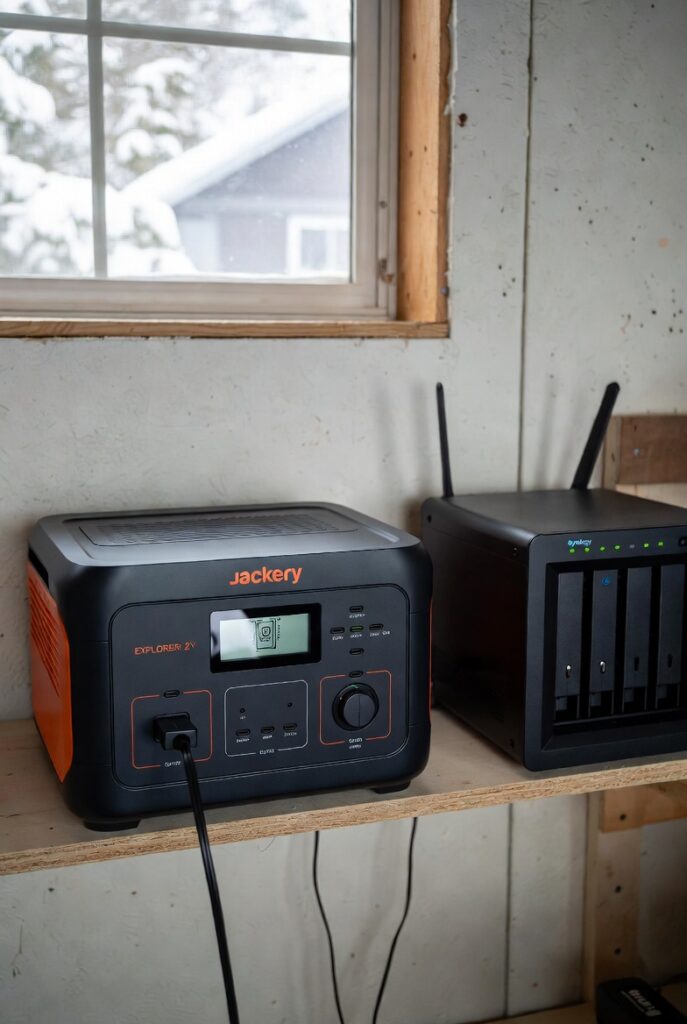
Every jackery review has to start with the same honest admission: Jackery invented the portable power station category, then spent three years watching competitors pass them in battery chemistry. The Classic and early Pro series used NMC lithium-ion cells rated for 500 to 800 cycles. That is not an acceptable service life for Ontario outage protection. In 2024 the v2 series corrected that entirely, bringing LFP cells rated for 3,000 cycles and second-generation ChargeShield thermal management to the full lineup.
I was called in by a family on Kortright Road West in Guelph, Wellington County, Ontario, in February 2026 to review their load profile. The question was whether a Jackery Explorer 1000 v2 would cover their three critical outage loads: a NAS home server at 60W, a router at 18W, and a refrigerator at 150W average. Their longest outage had been 11 hours during a February ice storm.
Combined with a laptop at 65W and phone charging at 47W, their total continuous draw was 340W. The Explorer 1000 v2 at 1,070Wh and 1,500W continuous covered that load with 1,160W of headroom. At 340W average draw with a 30 percent winter fridge duty cycle, effective draw drops to 178W, extending runtime to 5.1 hours from a full charge.
The Kortright Road owner paid around $430 on sale. When the ice storm hit at 3:15 AM the unit switched to battery in 20ms. The fridge kept running, the NAS kept recording, and the children did not wake up. For exact runtime math, see our solar generator refrigerator guide. That 20ms switchover and zero-configuration operation is the specific Jackery brand promise that drives this jackery review.
From NMC to LFP: The Battery Chemistry Shift That Changed the Jackery Lineup
The Classic series used NMC lithium-ion cells with a 500 to 800 cycle service life to 80 percent capacity. At one cycle per day that is 1.4 to 2.2 years before meaningful capacity loss. For Ontario outage protection where the unit sits at 100 percent charge most of the year, calendar degradation under high SoC storage is the real concern. The rule for this jackery review is direct: do not buy any Jackery unit older than the Plus series.
The v2 series launched in 2024 is the current standard. LFP cells rated for 3,000 cycles deliver approximately 8.2 years at one cycle per day. Second-generation ChargeShield manages thermal stress during fast charging. CTB construction integrates cells into the chassis, reducing weight by 41 percent compared to older designs at similar capacity.
| Unit | Capacity | Output | Weight | Solar Max | 0-80% Charge | Cycles | Sale Price |
|---|---|---|---|---|---|---|---|
| Explorer 300 Plus | 288Wh LFP | 300W / 600W surge | 8.3 lb | 100W | 50 min | 3,000+ | $199 |
| Explorer 1000 v2 | 1,070Wh LFP | 1,500W / 3,000W surge | 23.8 lb | 400W | 60 min | 3,000+ | $430 |
| Explorer 2000 v2 | 2,042Wh LFP | 2,200W / 4,400W surge | 39.5 lb | 400W | 66 min | 3,000+ | $749 |
ChargeShield Explained: How Jackery Protects Battery Life During Fast Charging
ChargeShield is Jackery’s variable-speed charging algorithm. It runs at full rate during the first 20 percent of charge, reduces between 20 and 80 percent to minimize heat, then tapers from 80 to 100 percent to protect cells from high-voltage stress. Jackery states ChargeShield extends battery life by 50 percent compared to constant-rate charging.
The ChargeShield algorithm also manages cold-temperature charging. Below 0C the BMS inhibits charging entirely. Between 0C and 10C, ChargeShield reduces charge rate automatically to prevent lithium plating. For an Ontario basement at 8C in January, this means the 1000 v2 charges more slowly but protects the cells from the failure mode that shortens battery life.
The Jackery Review Entry Tier: Explorer 300 Plus for Camping and Cottage Loads
The Jackery Explorer 300 Plus holds 288Wh, delivers 300W continuous with 600W surge, weighs 8.3 lb, and charges to full in approximately 2 hours from AC. The 100W solar input ceiling is the main constraint. At $199 to $249 on sale it is the correct jackery review recommendation for any buyer whose entire load fits under 300W.
A family from Milton, Halton County camped at Pinery Provincial Park every August long weekend for four years, spending $85 per weekend on a gas generator rental. Their teenager bought a 300 Plus for $199 in August 2025. At 117W average draw the 288Wh battery runs for 2.1 hours. With a 100W SolarSaga panel producing 480Wh per day at 4.8 peak sun hours in August, the battery recharges fully in 2.9 hours. The $340 annual rental was eliminated in under 8 months.
The Jackery Review Mid-Tier: Explorer 1000 v2 for Ontario Home Backup
The Explorer 1000 v2 is the correct jackery review answer for the Kortright Road use case. At 1,070Wh and 1,500W continuous it handles 340W of critical loads for 5.1 hours at 30 percent winter fridge duty cycle. The 20ms UPS switchover keeps the NAS clean and the fridge running. For a deeper single-unit test, see our Jackery Explorer 1000 review. At $430 on sale it sits in the same tier as our top picks in the best solar generators under $1,000 guide.
For buyers whose load exceeds the 1000 v2 ceiling or whose outages regularly exceed 10 hours, the Jackery Explorer 2000 v2 at $749 on sale is the next step. At 2,042Wh and 2,200W continuous it covers the same 340W load for 9.7 hours at winter duty cycle from a single charge. The 39.5 lb weight with a foldable handle makes it manageable for a basement shelf.
The 400W Solar Ceiling: The One Limitation Every Jackery Buyer Must Understand
Both the Explorer 1000 v2 and 2000 v2 are capped at 400W solar input. For the 1000 v2 at 1,070Wh, 400W of panel in Ontario summer at 4.8 peak sun hours delivers 1,920Wh per day. That recharges the battery twice over. In winter at 2.5 peak sun hours, 400W delivers only 1,000Wh per day.
The Explorer 2000 v2 at 400W solar input requires 5.1 hours of peak sun for a full charge. The EcoFlow Delta 2 Max accepts 1,000W solar and achieves the same result in 2 hours. For any Ontario buyer whose primary charging method is a panel array above 400W, EcoFlow or Bluetti 2kWh units are the correct direction. For the far more common buyer who charges overnight from a wall outlet and uses solar as supplemental top-up, the 400W ceiling is a non-issue. For a full explanation of daily solar requirements, see our solar sizing guide.
NEC and CEC: Code Compliance for Portable Power Station Installations
NEC 706 governs the Explorer 300 Plus, 1000 v2, and 2000 v2 as portable energy storage systems. NEC 706.15 requires a listed BMS with temperature protection including charge inhibit at the manufacturer minimum safe charging temperature. All three units carry UL certification and include ChargeShield BMS with 0C charge inhibit. Contact the NFPA (National Fire Protection Association) for current NEC 706 requirements.
In Ontario all three units are subject to CEC Section 26 for storage battery systems. The 0C charge inhibit applies at the BMS level regardless of charger input. Placement near combustibles or in unventilated enclosures is prohibited under the Ontario Fire Code. For permanent installation, ESA approval is required before energizing. Contact the ESA (Electrical Safety Authority) for current permit requirements in Ontario.
Pro Tip: Before the first Ontario winter outage, test your Jackery unit by unplugging it from the wall and confirming the 20ms UPS switchover. Plug in a desk lamp and pull the wall plug. The load should continue without interruption. The Kortright Road family confirmed the NAS showed no power event in its log. That 5-minute test is the difference between knowing the unit works and hoping it does.
- For Ontario campers or cottage owners with loads under 300W, the Explorer 300 Plus at $199 eliminates gas generator rentals and pays back in under 8 months. At 8.3 lb it fits in a day pack.
- For Ontario families protecting a NAS, router, fridge, and laptops during ice storms, the Explorer 1000 v2 at $430 delivers 5.1 hours per charge at winter duty cycle with zero configuration required.
- For Ontario homeowners needing 10+ hours of single-charge coverage, the Explorer 2000 v2 at $749 covers 340W of critical loads for 9.7 hours. The only tradeoff is the 400W solar ceiling.
Frequently Asked Questions
Is the jackery review verdict different for camping versus home backup?
Yes. For camping with a 117W load and a 100W solar panel, the Explorer 300 Plus at $199 is the correct answer. For home backup of a 340W critical load through an 11-hour Ontario ice storm, the Explorer 1000 v2 at $430 is correct. Both use ChargeShield LFP cells rated for 3,000 cycles.
What does the jackery review say about the 400W solar limitation?
The 400W solar ceiling is a real limitation for buyers who want fast solar charging of a 2kWh battery. The 2000 v2 requires 5.1 hours of peak sun versus 2 hours for EcoFlow at 1,000W solar. For buyers who charge from the wall overnight and use solar as a top-up, the ceiling is not a practical constraint.
Does the jackery review recommend older Pro or Classic series units?
No. The Classic series used NMC cells rated for 500 to 800 cycles. That is under 2.2 years of daily service life. Buy only the Plus series or v2 series. The v2 with LFP cells, ChargeShield, and CTB construction is the only generation this jackery review recommends in 2026.
How does the Jackery Explorer 1000 v2 handle Ontario winter basement temperatures?
ChargeShield reduces charge rate automatically between 0C and 10C to prevent lithium plating. Below 0C the BMS inhibits charging entirely. An Ontario basement at 8C in January charges more slowly but the cells are fully protected from cold-temperature damage.
This build is engineered within the 48V DC Safety Ceiling. Diagnostic logic is based on 20+ years of technical service experience. All structural and electrical installations must be verified by a Licensed Professional and comply with your Local AHJ.
About the Author
Robert Bertrand spent 20 years as a service advisor in the automotive industry (Lexus and Nissan), where precision diagnostics, wiring integrity, and documentation standards were non-negotiable. He brings that same technical discipline to GridFree Guide, where he researches, tests, and documents off-grid solar systems for Ontario conditions. Based in Rockwood, Ontario, every article is built on verified specifications, manufacturer data, and the real-world climate constraints of Canadian off-grid living.
As an Amazon Associate I earn from qualifying purchases. This site also contains affiliate links to other products and services. GridFree Guide earns a small commission at no extra cost to you.