
A 4-string 1200W array four 300W panels each as its own string all combined using three sets of Y-branch MC4 connectors daisy-chained together. String 3 develops a ground fault a cable chafed against a metal rail edge under snow load. Instead of losing 25% of production the other three strings dump their combined current into the fault. The branch connector junction softens. A solar combiner box with individual 15A string fuses would have blown the String 3 fuse in milliseconds isolated the fault kept the other three strings producing at 75%. Instead there is a smoking connector on the roof. Before sizing your array understand how much solar power you actually need so you know how many strings you are combining.
I got that call last August from a Rockwood client. Four strings. Three daisy-chained Y-branch connectors. String 3 ground fault from a chafed rail cable. The remaining three strings were using String 3 as a load resistor. The branch connector housing was softening in the August sun. A Midnite Solar MNPV6 with individual string fuses would have isolated it in milliseconds.
Solar Combiner Box: Why Branch Connectors Fail at Three or More Strings
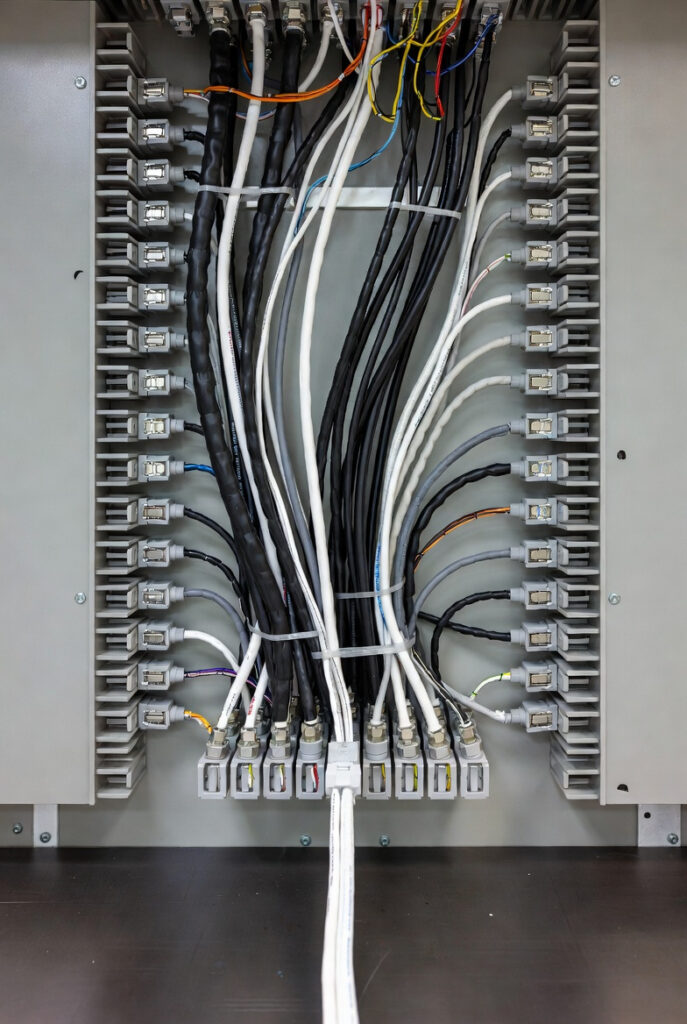
What a solar combiner box does: A solar combiner box is a weatherproof enclosure that accepts multiple solar string inputs — each on its own fused terminal and combines them into a single output cable pair to the MPPT charge controller. Each string has its own fuse. The combined output runs one cable pair to the equipment room instead of multiple cable pairs — one per string.
Why two strings on a Y-branch is acceptable: Two strings on a Y-branch MC4 connector as covered in our MC4 Connector guide is standard practice for a 2S2P configuration as covered in our Series vs Parallel guide. Two strings at roughly equal voltage combine cleanly. No fusing required at the branch point because both strings are at similar voltage and current no reverse current flows.
Why three or more strings on a Y-branch is a fault waiting to happen: When a third string is added by daisy-chaining a second Y-branch connector the fusing calculation changes fundamentally. If one of the three strings develops a fault a ground fault, a short, a partially shaded string producing significantly less voltage the other two strings see a low-resistance path through the faulted string. Current flows from the healthy strings into the fault. The branch connector junction carries the combined fault current of multiple strings simultaneously. Without individual string fuses there is nothing to interrupt this reverse current. The branch connector becomes a heating element.
The fault current math: A single 300W string at 10A. Three healthy strings see a faulted fourth string. Combined fault current at the junction: 3 × 10A = 30A flowing into a connector rated for 20A maximum. P = I²R at the junction. The connector fails before any system-level protection responds.
The String Fusing Solution
What string fusing does: Each string input in a solar combiner box has its own DC fuse typically 15A or 20A for standard 10 AWG string wiring. The fuse rating is sized above the string’s normal operating current (typically 8-10A) but below the maximum current the string wiring can safely carry. If a string develops a fault the string fuse opens in milliseconds. That string is isolated. The remaining strings continue producing through their own unfaulted terminals.
The Midnite Solar MNPV6: The Midnite Solar MNPV6 is a 6-input solar combiner box 6 string inputs each with its own fuse position, a positive and negative bus bar, a single output terminal, and a NEMA 4X weatherproof enclosure. Each string input accepts a standard DIN rail fuse. The combined output connects to the MPPT via a single cable pair sized for combined array current. The MNPV6 also has knockout positions for mounting a surge protective device as covered in our Lightning Protection guide integrating the SPD directly at the array input point.
The ECO-WORTHY 4-string option: For smaller arrays the ECO-WORTHY 4 String Solar Combiner Box provides 4 fused string inputs in a compact NEMA 4X enclosure appropriate for most residential 4-panel or 8-panel arrays. Pre-wired with bus bars and output terminals install the string fuses, connect the input cables, connect the output cable, mount to wall or pole.
The One Cable Run – The Wiring Efficiency Argument
What the combiner box saves on cable: A 4-string array without a solar combiner box requires 4 positive and 4 negative 10 AWG cables running from the roof to the equipment room 8 cables total. The solar combiner box consolidates these 8 cables into 2 cables one positive and one negative carrying the combined array current of 32-40A. These output cables are sized appropriately per our Wire Gauge guide for the combined current.
The cost saving: The 10 AWG solar extension cable costs approximately $1.75 per foot. A 20-foot run from roof to equipment room requires 40 feet of cable per string pair. Four string pairs: 160 feet of 10 AWG at $1.75/foot = $280 in cable. With a combiner box: one output cable pair × 40 feet = 40 feet at $2.50/foot for 8 AWG = $100 in cable. The $180 cable savings offsets a significant portion of the combiner box cost.
The penetration savings: Fewer cables means fewer roof and wall penetrations. Every additional cable penetration through a roof or wall is a potential leak point as covered in our Solar Roof Mount guide. A combiner box mounted on the roof edge or exterior wall consolidates all string connections into one weatherproof enclosure one cable penetration into the equipment room rather than four.
The Lightning Integration -SPD at the Array Input
Why the combiner box is the ideal SPD location: The solar combiner box is the first point where all array strings converge before the cable run to the MPPT. Mounting the SPD inside or adjacent to the combiner box puts surge protection at the array entry point where induction surges arrive first. As covered in our Lightning Protection guide the SPD belongs between the array and the MPPT controller the combiner box is exactly this location.
The MNPV6 SPD integration: The Midnite Solar MNPV6 has dedicated knockout positions for surge protective device installation. The Midnite Solar MNSPD mounts directly into the MNPV6 enclosure putting the string fusing, the combining, and the surge protection in one enclosure mounted at the array with a single protected cable run to the MPPT and inverter.
The Rockwood Serviceability Advantage
Why serviceability matters in February: In Rockwood in February diagnosing a string fault means working on the roof in cold conditions. A solar combiner box mounted on the exterior wall or roof edge puts all string terminations in one accessible location. Open the NEMA 4X door. Test each string fuse with a multimeter. Identify the faulted string in 60 seconds without touching a single MC4 connector on the roof.
Without a combiner box: Diagnosing a string fault in a daisy-chained branch connector system requires disconnecting MC4 connectors on the roof in winter one at a time. This is a 30-45 minute cold roof job. With a combiner box it is a 2-minute equipment room job.
NEMA 4X vs NEMA 3R:
- NEMA 3R: rated for rain not dust-tight, not for hose-directed water. Adequate for roof-mounted under-eave locations
- NEMA 4X: rated for hose-directed water, ice, and dust the correct specification for any exposed exterior location in Ontario conditions horizontal sleet, ice accumulation, freeze-thaw cycling at the enclosure seals
Quick Reference – Combiner Box Selection
| Feature | Branch Connector Only | 4-String Combiner | 6-String Combiner |
|---|---|---|---|
| String fusing | No | Yes — individual fuses | Yes — individual fuses |
| Fault isolation | No — all strings fault | Yes — one string only | Yes — one string only |
| Cable runs to MPPT | 1 per string | 1 combined | 1 combined |
| SPD integration | No | Optional | Yes — MNPV6 has positions |
| Weatherproof enclosure | No | NEMA 4X | NEMA 4X |
| Serviceability | Poor — roof access | Excellent — enclosure door | Excellent — enclosure door |
| Best for | 2-string arrays | 3-4 string arrays | 5-6 string arrays |
Pro Tip: Label every string fuse position inside the combiner box before closing it up String 1 NE panel, String 2 NW panel, String 3 SE panel, String 4 SW panel. Use a label maker on the enclosure interior door. When a fuse blows in February you need to know which roof location to inspect without guessing. Document string open circuit voltages at commissioning write them on the label so a technician testing in winter knows what normal looks like for each string at current temperature and conditions. This 5-minute documentation step saves hours of winter diagnostic time.
The Verdict
A solar combiner box is not optional for arrays with three or more strings. Branch connectors daisy-chained beyond two strings are a fault scenario waiting for the right conditions a chafed cable, a ground fault, a partially shaded string producing reversed current.
Individual string fuses. One cable run. SPD integration. NEMA 4X enclosure. Labelled string positions. 60-second winter fault diagnosis from inside the equipment room.
That is the professional standard.
Disclosure: This article contains affiliate links. If you buy through them, GridFree Guide earns a small commission at no extra cost to you.
Questions? Drop them below.
About the Author
Robert Bertrand spent 20 years as a service advisor in the automotive industry (Lexus and Nissan), where precision diagnostics, wiring integrity, and documentation standards were non-negotiable. He brings that same technical discipline to GridFree Guide, where he researches, tests, and documents off-grid solar systems for Ontario conditions. Based in Rockwood, Ontario, every article is built on verified specifications, manufacturer data, and the real-world climate constraints of Canadian off-grid living.
As an Amazon Associate I earn from qualifying purchases. This site also contains affiliate links to other products and services. GridFree Guide earns a small commission at no extra cost to you.