
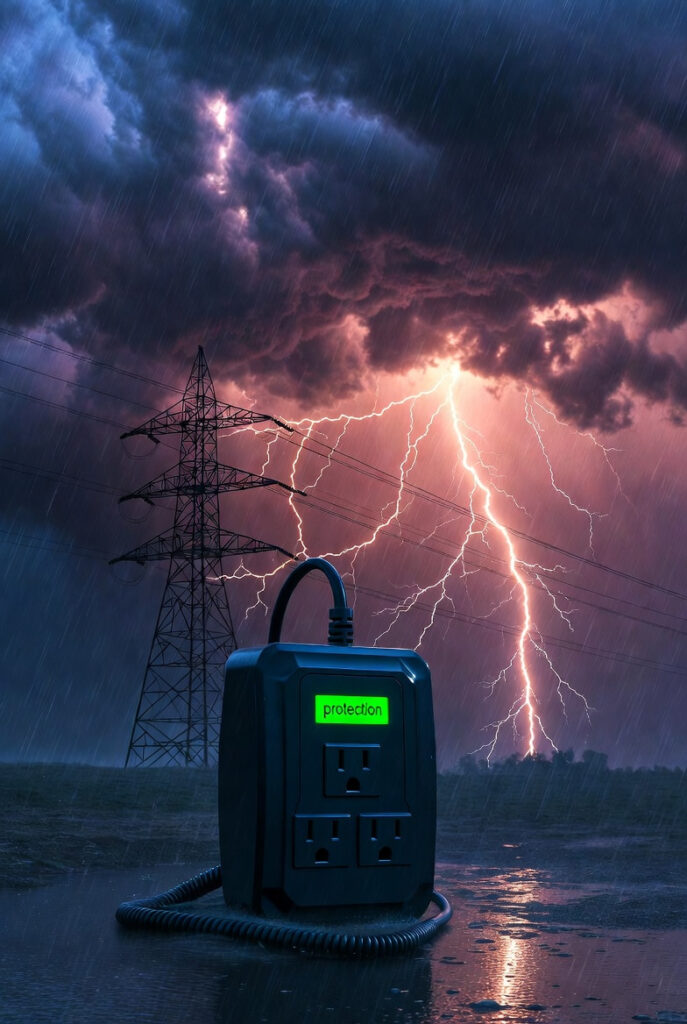
A client called me the morning after a July thunderstorm in Rockwood. The strike had not hit his cabin it hit a tree 80 metres away. His Cerbo GX was dead. His SmartSolar MPPT 100/50 had a Fatal Error light and would not reset. His MultiPlus-II was clicking on startup. Total damage: $1,330 from a strike that did not hit his property. No surge arrestor. No ground rod. Solar lightning protection does not protect against a direct strike nothing does. It protects against induction surges from nearby strikes the electromagnetic pulse that travels down your solar array cables and vaporizes your electronics without touching the sky. Before sizing your protection system understand how much solar power you actually need so you know what equipment you are protecting.
I installed a Midnite Solar MNSPD-300 and an 8-foot copper ground rod that afternoon. Total cost: $140. He has been through three more summer storms since then. Zero issues.
Solar Lightning Protection: Why Direct Strikes Are Not the Only Threat
What an induction surge is: When lightning strikes near your property a tree, a hill, the ground 50-100 metres away the massive current flowing through the earth and air creates a rapidly changing electromagnetic field. This changing magnetic field induces a voltage into any nearby conductor including your solar array cables, your DC wiring, and the communication cables connecting your Victron components. Your solar cables become the secondary winding of a transformer with a lightning bolt as the primary.
The amplitude of the induced surge: The induced voltage in a 10-metre solar cable run from a nearby lightning strike can reach 1,000-10,000 volts depending on strike distance and cable geometry. Your Victron MultiPlus-II is designed for 12-48V operation. Its internal electronics MOSFETs, microcontrollers, communication interfaces have maximum voltage ratings of typically 60-100V. A 5,000V induction surge arrives at the inverter terminals in microseconds. The internal protection diodes attempt to clamp the voltage. They fail. The control board is destroyed.
Why no surge arrestor means no protection: Without a solar lightning protection device the induction surge follows the path of least resistance from your array cables into your equipment. Victron equipment has some internal transient voltage suppression designed for normal grid surges but not designed for the amplitude of a nearby lightning induction event. The damage propagates through the entire connected system in microseconds.
How a DC Surge Protective Device Works
What an SPD does: A Surge Protective Device SPD is a voltage-clamping device installed on the DC lines between your solar array and your MPPT charge controller. The SPD contains Metal Oxide Varistors MOVs components that have very high resistance at normal operating voltage and very low resistance above a clamping threshold voltage. When a surge arrives the MOV resistance drops instantly diverting the surge current through the SPD to the ground connection rather than allowing it to continue into the MPPT and inverter.
The Midnite Solar MNSPD-300 standard: The Midnite Solar MNSPD-300 is specifically designed for solar DC applications rated for the higher open circuit voltages common in series-configured solar arrays. Normal operating voltage 40-60V for a typical array is well below the clamping threshold. The SPD is invisible to normal operation. When a surge arrives above 300V the MOVs conduct and shunt the surge to ground. The SPD takes the hit. The MPPT and inverter are protected.
The ground rod – why the SPD is useless without it: An SPD with no path to ground cannot shunt the surge. The MOVs conduct but the current has nowhere to go. The surge attempts to find ground through whatever path is available your battery negative terminal, your inverter chassis, your building wiring. This is how a solar lightning protection device without a proper ground makes damage worse not better. The SPD must be bonded to a dedicated ground rod via a low-resistance path. 6 AWG copper minimum. As short and direct as possible. No coils or loops in the ground wire.
The Ground Rod Standard
What a ground rod does: A ground rod typically an 8-foot copper-clad steel rod driven vertically into the soil provides a low-resistance path from your solar lightning protection system directly to earth ground. A surge that reaches earth ground dissipates harmlessly into the surrounding soil. A surge that cannot reach earth ground looks for another path and that path is your equipment.
Ground rod installation:
- Drive the 8-foot rod vertically into moist soil not into gravel or dry sand which has high resistivity
- Connect 6 AWG bare copper wire from SPD ground terminal to ground rod as short and straight as possible no coils
- Bond the ground rod to the main electrical system ground generator, building ground, solar mounting rails all bonded to the same ground rod system
- In Ontario frost conditions drive the rod to at least 1 metre depth below the frost line frozen soil has significantly higher resistivity than moist soil
The solar rail ground bond: The metal mounting rails covered in our Solar Roof Mount guide must be bonded to the same ground system as the SPD. An ungrounded metal rail on the roof is an antenna for induction surges collecting electromagnetic energy from a nearby strike and feeding it directly into your wiring. A properly grounded rail provides a direct path to earth for induction currents before they reach the cable connectors.
The Cerbo GX – The Most Vulnerable Component
Why the GX device is most at risk: The Victron Cerbo GX is the most surge-vulnerable component in a Victron system for one specific reason it connects to everything. VE.Direct cables to the MPPT. VE.Bus cable to the MultiPlus-II. VE.Can to managed batteries. Ethernet to the router. Temperature sensors. Every one of these connections is a potential surge path into the Cerbo GX logic board which operates at 3.3-5V logic levels. A 100V transient on a VE.Direct cable destroys the communication interface. A 500V transient on the ethernet connection destroys the entire logic board. See our full Cerbo GX guide for what the Cerbo GX does and why it is worth protecting.
The replacement cost reality: A Cerbo GX costs approximately $350-450 but it is just the first component the surge destroys. The same surge that kills the Cerbo GX has already traveled through the MPPT, the MultiPlus-II VE.Bus interface, and any other connected device. Total damage from a single nearby strike on an unprotected system commonly runs $1,000-2,500.
The $100 vs $3,500 math: A Midnite Solar MNSPD-300 costs approximately $100. A complete Victron system replacement MultiPlus-II 5000, SmartSolar MPPT 100/50, Cerbo GX costs $3,500+. Solar lightning protection investment is 3% of the replacement cost of what it protects.
The Rockwood Isolated Cabin Risk
Why isolated cabins are higher risk: Lightning seeks the path of least resistance to ground the highest point in the local terrain or the object with the best ground connection. A Rockwood cabin on a hill with a metal-railed solar array on the roof presents both elevation and a metal structure connected to the ground system. The cabin does not need to be the tallest structure in the region. It needs only to be the most conductive path in the immediate vicinity during a strike event.
The summer storm pattern: Ontario summer thunderstorms July and August particularly produce multiple cloud-to-ground strikes per storm. A cabin that experiences 20-30 storms per summer has 20-30 opportunities for a nearby ground strike. Over 10 years that is 200-300 storm events. Solar lightning protection that costs $100 one time provides protection for every one of those events.
Quick Reference – Solar Surge Protection Specifications
| Component | Specification | Purpose |
|---|---|---|
| DC Surge Arrestor | Midnite MNSPD-300 or equivalent | Clamps DC array surge to ground |
| Ground wire | 6 AWG bare copper shortest path | Carries surge current to ground rod |
| Ground rod | 8-foot copper-clad steel | Dissipates surge current into earth |
| Rail ground bond | 6 AWG to same ground system | Prevents rail becoming surge antenna |
| Installation location | Between array and MPPT input | Protects MPPT and all downstream equipment |
Pro Tip: Install a DC circuit breaker between the SPD and the MPPT input as part of your solar lightning protection system. A Blue Sea Systems 40A DC breaker for strings up to 30A or a Blue Sea Systems 100A DC breaker for larger arrays. The breaker serves two functions — it allows safe disconnection of the array for maintenance without live connections, and it provides overcurrent protection for the wiring between the SPD and the MPPT. The SPD protects against voltage surges. The breaker protects against sustained overcurrent. Together they are the complete protective package between your array and your Victron equipment.
The Verdict
Solar lightning protection is the $100 insurance policy on a $10,000 system. The Midnite Solar MNSPD-300 on the DC lines. A properly installed 8-foot ground rod bonded to the solar rails and the SPD ground terminal. A 6 AWG ground wire with no coils or loops.
A tree strike 80 metres from your cabin costs $1,330 without protection. It costs $0 with it.
The storm does not ask permission. Install the protection before July.
Disclosure: This article contains affiliate links. If you buy through them, GridFree Guide earns a small commission at no extra cost to you.
Questions? Drop them below.
About the Author
Robert Bertrand spent 20 years as a service advisor in the automotive industry (Lexus and Nissan), where precision diagnostics, wiring integrity, and documentation standards were non-negotiable. He brings that same technical discipline to GridFree Guide, where he researches, tests, and documents off-grid solar systems for Ontario conditions. Based in Rockwood, Ontario, every article is built on verified specifications, manufacturer data, and the real-world climate constraints of Canadian off-grid living.
As an Amazon Associate I earn from qualifying purchases. This site also contains affiliate links to other products and services. GridFree Guide earns a small commission at no extra cost to you.