
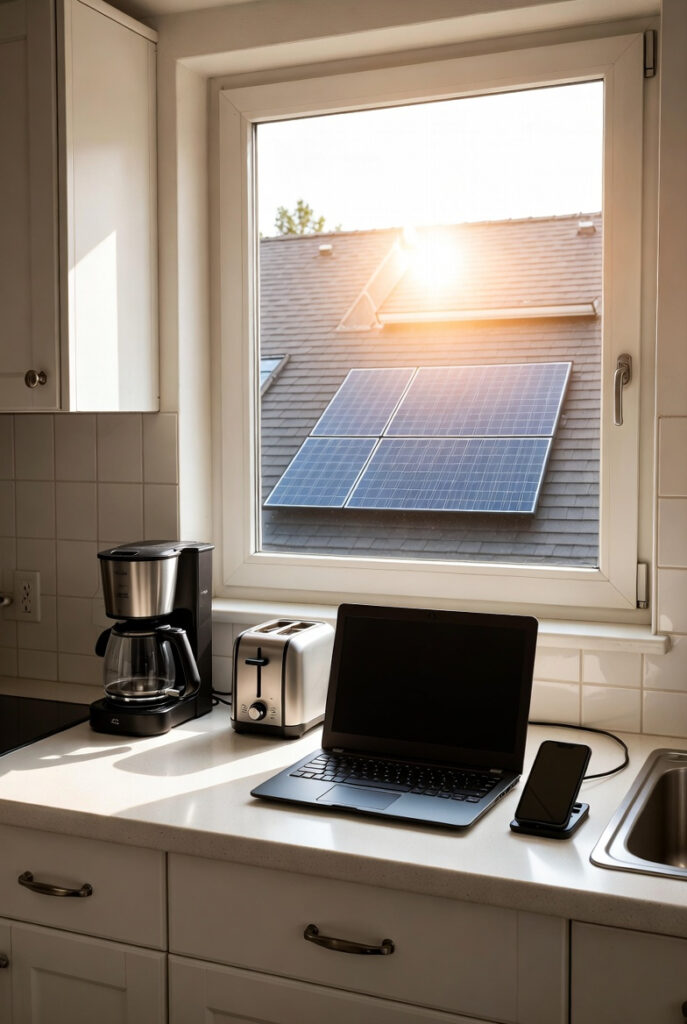
Can you run a toaster on solar? Yes. Should you? That depends entirely on your battery bank and inverter capacity. What appliances can run on solar power is actually the wrong question. The right question is: which appliances make sense for your specific system size?
Think of it like vehicle accessories. Running the AC, heated seats, and high beams all at once will eventually overwhelm your alternator if you are not careful. Solar works the same way every load draws from the same bank and that bank has limits.
What Appliances Can Run on Solar Power?
The Easy Wins Low Draw Appliances
These appliances are solar-friendly. Low wattage, predictable draw, no startup surge.
| Appliance | Running Watts | Daily Hours | Daily Wh |
|---|---|---|---|
| LED lights (4 bulbs) | 40W | 6 hours | 240Wh |
| Laptop | 45–65W | 6 hours | 270–390Wh |
| Phone charging | 10–18W | 3 hours | 30–54Wh |
| Starlink (normal) | 50–75W | 8 hours | 400–600Wh |
| 12V fridge (efficient) | 30–45W avg | 24 hours | 720–1,080Wh |
| CPAP (no humidifier) | 30–60W | 8 hours | 240–480Wh |
| Small fan | 15–35W | 8 hours | 120–280Wh |
These are the foundation of any off-grid system. A 1,000Wh battery station like the Anker SOLIX C1000 Gen 2 handles the entire list comfortably for a full day with a single 100W panel recharging throughout.
The Heavy Hitters Inverter Testers
These appliances work on solar but require careful management. High wattage, often with significant startup surge.
| Appliance | Running Watts | Startup Surge | Notes |
|---|---|---|---|
| Coffee maker | 800–1,200W | Minimal | Run during solar noon |
| Microwave | 900–1,200W | Minimal | Short bursts only |
| Washing machine | 500W | 1,500W+ surge | Run during solar noon |
| Vacuum cleaner | 400–800W | 1,200W+ surge | Short use, solar noon |
| Power tools | 300–1,200W | 2–4x running | Brief use only |
| Window AC | 500–1,500W | 2–3x running | Only large systems |
These are manageable with the right inverter and strategic timing. Not everyday loads for small systems occasional loads planned around solar production.
The No-Go Zone Resistance Heating
If an appliance generates heat using electricity it is the enemy of a small off-grid system. Full stop.
| Appliance | Running Watts | Daily Use | Daily Wh |
|---|---|---|---|
| Electric space heater | 1,500W | 4 hours | 6,000Wh |
| Electric water heater | 3,000–5,500W | 2 hours | 6,000–11,000Wh |
| Electric oven | 2,000–5,500W | 1 hour | 2,000–5,500Wh |
| Toaster | 800–1,500W | 0.1 hours | 80–150Wh |
| Hair dryer | 1,800W | 0.25 hours | 450Wh |
| Electric kettle | 1,200–1,500W | 0.1 hours | 120–150Wh |
The math is brutal. A single space heater running 4 hours uses more power than everything in the Easy Wins category combined. Off-grid homes replace these loads with propane, wood, or gas alternatives.
Ontario reality: Diesel truck block heaters run 400–1,500W and many homesteaders forget to include them in their load calculations. A block heater running 4 hours overnight is 1,600–6,000Wh potentially your entire battery bank.
Understanding Startup Surge: Why Your Inverter Might Trip
Motors do not start gently. When a motor-driven appliance starts it draws 2–5x its running wattage for a fraction of a second. This is called startup surge or inductive load.
Why this matters: A washing machine rated at 500W running watts needs 1,500W+ at startup. If your inverter is rated for 1,000W continuous it will trip the moment the washing machine tries to start even though 500W is theoretically within its capacity.
The rule: Size your inverter for your highest startup surge not your highest running wattage.
Even when nothing is running: A 3,000W inverter sitting idle draws 20–50W of overhead just staying on. Leave a large inverter running 24 hours and that is 480–1,200Wh per day wasted on overhead. Turn off your inverter when you do not need it.
Measure your actual appliance draw before sizing your system. A Kill-A-Watt meter tells you real running watts and reveals startup surge patterns over a 24-hour test cycle.
DC vs AC: Why a 12V Fridge Changes Everything
A standard 120V dorm fridge running through an inverter draws 150–200W at the wall. A quality 12V DC fridge running directly off your battery bank draws 30–45W average.
Same function. One-fifth the power consumption.
The efficiency difference comes from two sources. A 12V fridge motor is designed for low-draw continuous operation. A standard AC fridge was never designed with battery efficiency in mind. And running any AC appliance through an inverter adds 5–10% conversion loss on top of the appliance’s own consumption.
For off-grid refrigeration the 12V fridge is not a luxury upgrade. It is the only rational choice for systems under 3kWh of daily production.
The same logic applies to any 12V alternative 12V fans, 12V lighting, 12V water pumps. Every appliance you can run directly on DC is an appliance you do not need to waste inverter overhead on.
For more on refrigerator sizing see our How Many Solar Panels to Run a Refrigerator guide.
The Solar Noon Strategy
Your battery bank exists to carry you through the night. It should not be carrying heavy loads during peak solar production hours.
Run your highest-draw appliances between 10am and 2pm when your panels are producing at or near peak output. Washing machine, vacuum, power tools, coffee maker run these during solar noon and the panels absorb the load directly without touching the battery bank.
After 3pm start shifting to low-draw appliances. By sunset your battery bank should be at or near full charge ready to carry you through the night on lights, devices, and fridge only.
This single habit change extends your effective battery capacity by 20–30% without adding a single panel or battery cell.
The Appliance Tier List
| Appliance | 1,000Wh Station | Full Home System |
|---|---|---|
| LED lights | ✅ All evening | ✅ All evening |
| Phone/laptop | ✅ Multiple charges | ✅ Multiple charges |
| CPAP | ✅ Full night | ✅ Full night |
| 12V fridge | ✅ 18–24 hours | ✅ Continuous |
| Starlink | ✅ 12–14 hours | ✅ Continuous |
| Coffee maker | ⚠️ One cup, solar noon | ✅ As needed |
| Washing machine | ❌ Too large | ✅ Solar noon only |
| Space heater | ❌ Never | ❌ Never — use propane |
| Electric water heater | ❌ Never | ❌ Propane or solar thermal |
| Block heater | ❌ Never | ⚠️ Large system only |
Pro Tip: Before you buy anything measure everything. Plug your most-used appliances into a Kill-A-Watt meter one at a time and run each for 24 hours. You will discover your old fridge draws 3x what the nameplate says, your gaming console draws 180W in use and 15W on standby, and your cable box draws 17W around the clock. Real numbers from real hardware beat spec sheets every time and they will change which appliances you decide to keep off-grid.
The Verdict
What appliances can run on solar power? Almost anything with the right system size and smart load management. The hard limit is resistance heating. Electric heat of any kind is the fastest way to drain a battery bank and the easiest load to replace with propane or wood.
Everything else is a matter of system sizing, inverter capacity, and timing. Run heavy loads at solar noon. Keep the battery bank for overnight essentials. Measure before you buy.
Disclosure: This article contains affiliate links. If you buy through them, GridFree Guide earns a small commission at no extra cost to you.
About the Author
Robert Bertrand spent 20 years as a service advisor in the automotive industry (Lexus and Nissan), where precision diagnostics, wiring integrity, and documentation standards were non-negotiable. He brings that same technical discipline to GridFree Guide, where he researches, tests, and documents off-grid solar systems for Ontario conditions. Based in Rockwood, Ontario, every article is built on verified specifications, manufacturer data, and the real-world climate constraints of Canadian off-grid living.
As an Amazon Associate I earn from qualifying purchases. This site also contains affiliate links to other products and services. GridFree Guide earns a small commission at no extra cost to you.