
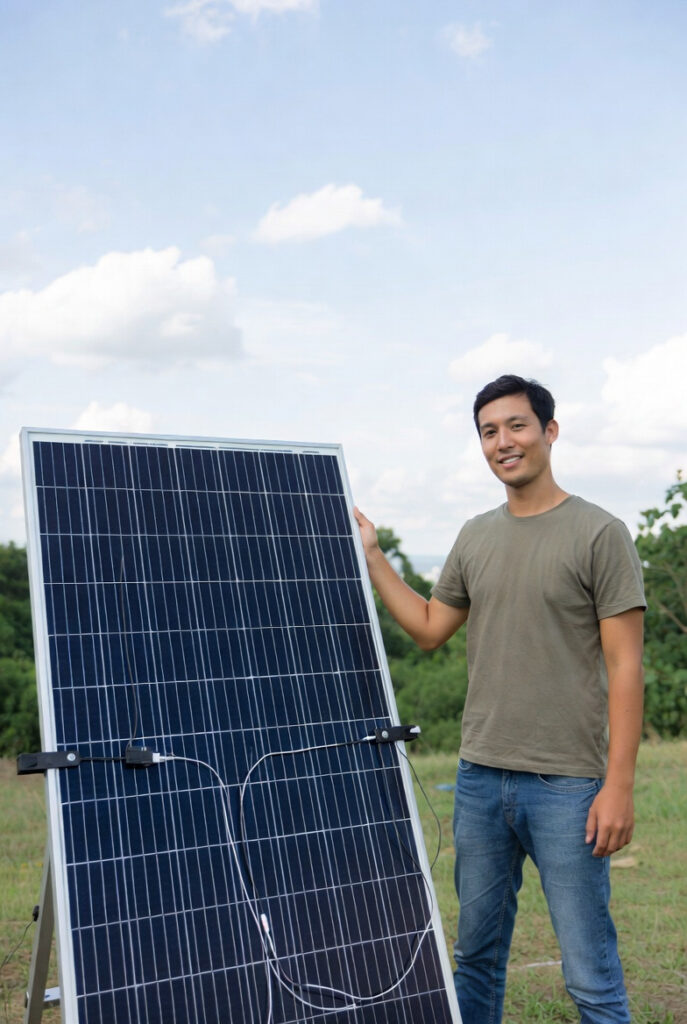
Analysis paralysis is real when it comes to starting your solar journey. The internet is overflowing with options, tutorials, and YouTube rabbit holes that leave beginners feeling lost. You might feel like you’re restoring an old car buying a turbo kit, headers, and an exhaust before realizing none of it fits the engine. A garage full of parts that don’t work together.
That’s what happens when people skip the sequence.
This guide is your project manager. We’re going to break the process into five steps where each one builds on the last. By the end, you’ll know exactly how to start going solar without wasting money on equipment you don’t need yet.
Your 5-Step Solar Roadmap
Step 1: Do the Math Before You Spend the Money
The first step in any solar project is understanding your energy needs. Before you look at a single product listing, you need to know one number: your daily watt-hour (Wh) consumption. Everything downstream panel size, battery capacity, charge controller rating is calculated from that number.
Two methods to find it:
| Method | Cost | Accuracy |
|---|---|---|
| Kill-A-Watt Meter | ~$30 | High |
| Utility Bill Analysis | Free | Medium |
| Appliance Label Math | Free | Low |
The Kill-A-Watt meter plugs in between your device and the wall and measures actual real-world consumption. It’s the most accurate option and worth the $30.
Utility bill analysis gives you monthly totals divide by 30 to get daily kWh, multiply by 1,000 for watt-hours. Free and useful for a whole-home estimate.
Appliance label math is the least reliable option.
Pro Tip: Appliance labels overstate real-world consumption by 30–50%. A fridge rated at 150W on the label might actually draw 80–90W once the compressor cycles are averaged out. Measure it don’t trust the sticker.
Once you have your daily Wh number, How Much Solar Power Do I Actually Need? walks you through exactly how to size a system around it.
How to Start Going Solar Without Buying the Wrong Thing First
Step 2: Start Small The Gateway Project
This is the most important step for beginners. Don’t buy a 5kW all-in-one system as your first project. That’s like handing a new driver a 600 horsepower car it might work, but when something goes wrong you won’t know why, and the mistakes are expensive.
Start with a portable power station or a 100W starter kit instead.
For Ontario residents specifically, portable power stations are the ideal first project:
- 100% legal for renters no landlord permission needed
- No ESA permit required
- No roof work, no permanent wiring, no inspections
- You learn how solar input, battery storage, and AC output actually interact
- If you make a mistake, it’s a lesson not a liability
The Anker SOLIX C1000 Gen 2 is a solid first unit 1,056Wh capacity, 1,800W output, connects directly to a solar panel with no additional hardware. Pair it with a Renogy 100W Solar Panel and you have a complete, functional system you can learn on.
For a realistic look at what a 1,000W system can actually power during an outage, read What Can I Run on a 1000W Solar Generator During a Blackout?
For a comparison of beginner panel options once you’re ready to expand, Best Solar Panels for Beginners in 2026 covers what to look for without the marketing noise.
Step 3: Understand Component Matching
Solar is not plug-and-play. Voltage, amperage, and battery chemistry have to be compatible across every piece of the system. Get this wrong and you’ll either get poor performance or damage expensive equipment.
Voltage must match across your panels, charge controller, and battery bank. A 12V system needs 12V-rated components throughout. Mixing voltage ratings creates heat, inefficiency, and potential failure.
Amperage determines whether your charge controller can handle your panels’ output. If your panels push 30A at peak sun and your controller is rated for 20A, you have a problem that gets worse on a hot summer day.
Battery chemistry matters because LiFePO4 and AGM batteries charge differently. Your charge controller needs the correct profile for your battery type using the wrong one degrades the battery faster and can create safety issues.
The 5 Components Every Solar System Needs explains how all of these pieces interact before you spend a dollar on hardware.
Step 4: Permits and Safety The Boring Stuff That Isn’t Optional
Safety regulations exist because solar systems involve real electrical current, and in some cases grid connection. Skip this step and you risk fines, voided insurance, or worse.
In Ontario, here’s how the rules break down:
| System Type | ESA Permit Required | Building Permit | Notes |
|---|---|---|---|
| Portable power station | No | No | Safe and legal for renters |
| Off-grid cabin | Usually No | Sometimes | Check municipal bylaw |
| Grid-tied rooftop | Yes | Yes | Licensed electrician required |
| Hybrid battery backup | Yes | Yes | Hydro One notification required |
The Electrical Safety Authority governs all permanent electrical installations in Ontario. Any fixed wiring even off-grid falls under their jurisdiction. DIYing a grid-tied system without an ESA permit voids your homeowner’s insurance.
If you start with a portable system, none of this applies yet. One more reason the gateway project approach makes sense for beginners.
Step 5: Match the System to Your Actual Goal
Before scaling up from your starter kit, get clear on what you actually want to accomplish:
- Blackout backup – enough power to run essentials for 24–48 hours
- Cottage or cabin – weekend power without shore power or a generator
- Van or RV – mobile power with limited roof space
- Partial home offset – reduce your hydro bill while staying grid-connected
- Full off-grid – whole-home independence, the most complex and expensive path
Each goal has a different system size, component list, and regulatory path. Knowing your goal before you buy anything is what separates a clean build from an expensive collection of parts that almost works.
How to Start Going Solar This Weekend
You don’t need to spend a dollar to officially begin. You just need 90 minutes.
The Weekend Warrior Energy Audit:
- Walk through your home
- List every device you’d want running during a 3-day power outage
- Write down the wattage from the label of each one
- Estimate how many hours per day you’d run each device
- Multiply watts × hours = watt-hours per device
- Add everything up
Take a photo of the list. That’s your first solar document and it’s the number that determines everything else about your system.
The One Mistake That Kills Every Solar Project
Buying panels before knowing your daily watt-hour usage.
Panels appear first in every YouTube video because they’re the most visual part of the system. But panels should be sized last after you know your load, your battery capacity, your charge controller rating, and your inverter requirements. Buy panels first and you’ll either overbuy or underbuy, and either way the system won’t perform the way you expected.
The correct sequence: energy audit first, gateway project second, component matching third, permits fourth, panels sized last.
That sequence isn’t arbitrary. It’s the order that costs you the least money when you make a beginner mistake and every beginner makes at least one.
Start with the audit this weekend. The rest follows from there.
How Much Solar Power Do I Actually Need?
What Can I Run on a 1000W Solar Generator During a Blackout?
Best Solar Panels for Beginners in 2026
The 5 Components Every Solar System Needs
Affiliate Disclosure: GridFree Guide participates in the Amazon Associates program. If you purchase through links on this page, we may earn a small commission at no extra cost to you. We only recommend products we’ve researched and would use ourselves.
About the Author
Robert Bertrand spent 20 years as a service advisor in the automotive industry (Lexus and Nissan), where precision diagnostics, wiring integrity, and documentation standards were non-negotiable. He brings that same technical discipline to GridFree Guide, where he researches, tests, and documents off-grid solar systems for Ontario conditions. Based in Rockwood, Ontario, every article is built on verified specifications, manufacturer data, and the real-world climate constraints of Canadian off-grid living.
As an Amazon Associate I earn from qualifying purchases. This site also contains affiliate links to other products and services. GridFree Guide earns a small commission at no extra cost to you.