
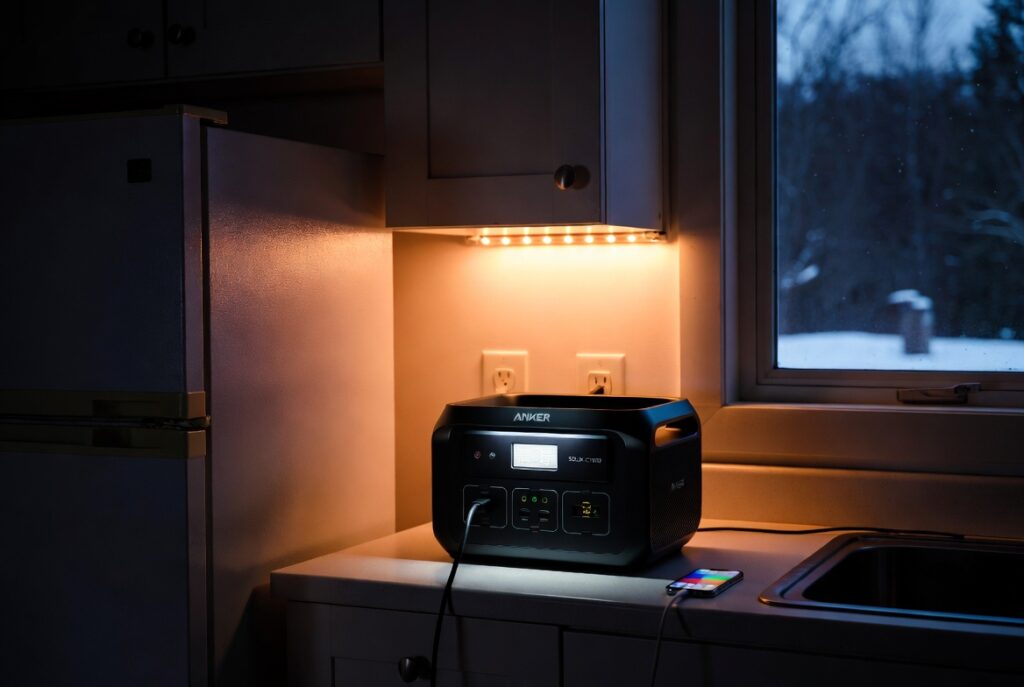
A 1000W solar generator keeps your fridge, CPAP, and phones running during a blackout. It will not run a space heater. The combined essential load of a fridge, CPAP, router, and LED lights sits at roughly 252W. A 1,024Wh battery at that draw lasts approximately 4 hours per charge cycle.
The critical distinction is running watts versus surge watts. A fridge draws only 150W continuously but surges to 800W for 2 seconds when the compressor kicks on. A 1000W solar generator with 2,000W surge handles that startup cleanly. A unit with only 1,000W surge will shut down on the first compressor cycle.
This guide covers what a 1000W solar generator powers, what it cannot, and the runtime formula. For a full unit comparison, see our 1000W solar generator comparison.
| Appliance | Running Watts | Surge Watts | Runtime (1,024Wh) |
|---|---|---|---|
| Fridge | 150W | 800W | 6.8 hours |
| CPAP machine | 60W | None | 17+ hours |
| WiFi router | 12W | None | 85 hours |
| 3 LED bulbs | 30W | None | 34 hours |
| Phone charging | 15W each | None | 68 hours |
| Space heater | 1,500W | None | 41 minutes |
| Coffee maker | 1,000W | None | 61 minutes |
| All essentials combined | 252W | 800W (fridge) | 4.1 hours |
What a 1000W solar generator actually runs during a blackout
A 1000W solar generator powers your fridge at 150W, CPAP at 60W, router at 12W, and LED lights at 30W. Phone charging adds 15W per device. The combined essential load sits at approximately 252W running. The Anker SOLIX C1000 Gen 2 covers that load for 4.1 hours per charge.
With a Renogy 100W Monocrystalline Panel adding 127 Wh on a clear January day, runtime extends through a second night. Two panels double that recharge to 254 Wh daily. Our solar generator refrigerator runtime guide covers fridge-specific calculations. A 1000W solar generator paired with solar covers a 24 to 48 hour Ontario outage.
Running watts versus surge watts and why the compressor matters
Running watts measure the steady continuous draw of an appliance during normal operation. Surge watts measure the brief spike when a motor starts. A fridge runs at 150W but surges to 800W for 1 to 3 seconds each time the compressor engages. The generator’s surge rating must exceed the highest single-appliance surge.
The Anker SOLIX C1000 Gen 2 carries a 2,000W surge rating. That handles the 800W fridge compressor startup with 1,200W of margin. A cheaper unit with only 1,000W surge will trip its protection circuit on the first compressor cycle. Always check the surge rating, not just the continuous output, before buying any 1000W solar generator.
What a 1000W solar generator cannot run and why heat is the limit
Heat-generating appliances are banned from any 1000W solar generator during a blackout. A space heater at 1,500W drains a 1,024Wh battery in 41 minutes. A coffee maker at 1,000W drains it in 61 minutes. A hair dryer at 1,200 to 1,800W exceeds the continuous output limit entirely.
These appliances convert electricity to heat at nearly 100 percent draw with no cycling or rest periods. The fridge cycles its compressor on and off, averaging 150W over time. A space heater runs at full power continuously until you unplug it. For heating during an Ontario blackout, use propane and see our home backup solar guide for alternatives.
The runtime formula and how to calculate hours of backup
Divide the battery capacity in watt-hours by the total running load in watts. The result is your runtime in hours. A 1,024Wh battery divided by 150W fridge-only load equals 6.8 hours. The same battery divided by 252W full essential load equals 4.1 hours.
Solar recharge extends the math. One Renogy 100W panel at 1.5 PSH in January adds 127 Wh per clear day. That buys roughly one additional hour of full-load runtime per recharge cycle. Two panels at 254 Wh daily extend a 1000W solar generator from overnight backup to a 48-hour system.
The Simcoe County 36-hour ice storm
During a 36-hour ice storm in Simcoe County, I deployed an Anker SOLIX C1000 Gen 2 with one panel. The fridge drew 150W with 800W compressor surges. I also ran a CPAP at 60W, a router at 12W, and three LED bulbs at 30W. The combined running load sat at 252W.
The battery lasted 4.1 hours before the first recharge cycle began. On the first clear morning at 1.5 PSH, the panel returned 127 Wh. That stretched fridge and CPAP runtime through the second night. By hour 36 when grid power returned, the battery still held 18 percent SOC.
The 1000W solar generator covered every essential load for the full 36-hour outage. The food stayed cold, the CPAP ran all night, and phones charged fully. Total system cost was $649 for the Anker plus $109 for the panel. A propane generator covering the same loads would have burned $45 in fuel.
The Wellington County space heater mistake
A neighbour in Wellington County plugged a 1,500W space heater into his 1000W solar generator during a February outage. The generator’s 1,500W continuous rating matched the heater on paper. The heater drew full power nonstop with no cycling. There were no surges, just constant maximum draw.
The battery drained from 100 percent to zero in 41 minutes. The fridge stopped, the CPAP shut down, and the router went dark. The space heater provided 41 minutes of warmth and 23 hours of cold. One bad load choice turned a 36-hour backup system into a 41-minute system.
He recharged the next morning and ran only the fridge, CPAP, and lights for the remaining 18 hours. Heat loads belong on propane, not battery power. The 1000W solar generator handles electronics and food preservation only. Load discipline is the difference between surviving the outage and losing everything.
NEC and CEC code requirements for portable generator use
NEC 705 governs the connection of portable power sources to household circuits and load centres. A 1000W solar generator plugged into a wall outlet must not back-feed the main panel without a listed transfer device. Overloading a shared circuit with generator output and grid return creates fire and electrocution risk. Contact the NFPA at nfpa.org for current Article 705 requirements.
CEC Section 64 requires all battery-based backup systems connected to residential wiring to comply with ESA standards in Ontario. A portable 1000W solar generator powering individual appliances via its own outlets does not require an ESA permit. However, any connection to the home’s electrical panel requires licensed installation and inspection. Contact the Electrical Safety Authority at esasafe.com for Ontario-specific requirements.
Pro Tip: Before your next outage, write your load priority list on a piece of tape and stick it to the generator. Tier 1 is router and phones. Tier 2 is fridge. Tier 3 is CPAP. Everything else stays unplugged. If you never plug in the space heater, the 1000W solar generator covers a 36-hour Ontario ice storm every time.
1000W solar generator verdict: load discipline wins the outage
- Ontario homeowners facing 12 to 36 hour outages: The Anker SOLIX C1000 Gen 2 plus one panel covers fridge, CPAP, and phones. Total cost sits under $760. Our Anker SOLIX C1000 review covers the full test.
- CPAP users needing guaranteed overnight power: The 1,024Wh battery runs a 60W CPAP for over 17 hours on one charge. Add a panel for daytime recharge and the generator covers a multi-day outage. A Victron SmartShunt tracks remaining capacity in real time.
- Homeowners needing heat or well pump backup: Skip the 1000W class entirely. Upgrade to an EcoFlow DELTA Pro 3 or a full Victron battery bank. Our budget solar generator guide covers the upgrade path.
Frequently asked questions
Q: How long will a 1000W solar generator run a fridge?
A: Approximately 6.8 hours on a full 1,024Wh battery at 150W continuous fridge draw. With one Renogy 100W panel adding 127 Wh per clear January day, runtime extends through a second night. Careful load management stretches a 1000W solar generator to cover a full 48-hour outage.
Q: Can a 1000W solar generator run a space heater?
A: No. A standard 1,500W space heater drains a 1,024Wh battery in 41 minutes flat. Even with a 2,000W surge rating, the continuous draw is unsustainable. Heating needs belong on propane or natural gas, not on battery power.
Q: What is the best 1000W solar generator for Ontario blackouts?
A: The Anker SOLIX C1000 Gen 2 at 1,024Wh with 2,000W surge handles fridge compressor startup cleanly. It weighs 12.9 kg and recharges fully in 58 minutes via AC. Pair it with one Renogy 100W panel for extended runtime through multi-day Ontario outages.
This build is engineered within the 48V DC Safety Ceiling. Diagnostic logic is based on 20+ years of technical service experience. All structural and electrical installations must be verified by a Licensed Professional and comply with your Local AHJ. See our legal and safety disclosure for full scope.
About the Author
Robert Bertrand spent 20 years as a service advisor in the automotive industry (Lexus and Nissan), where precision diagnostics, wiring integrity, and documentation standards were non-negotiable. He brings that same technical discipline to GridFree Guide, where he researches, tests, and documents off-grid solar systems for Ontario conditions. Based in Rockwood, Ontario, every article is built on verified specifications, manufacturer data, and the real-world climate constraints of Canadian off-grid living.
As an Amazon Associate I earn from qualifying purchases. This site also contains affiliate links to other products and services. GridFree Guide earns a small commission at no extra cost to you.