
A customer complains their 3,000W inverter beeps Low Voltage the moment the microwave starts batteries fully charged at 100% SoC. You look at the install and see 2 AWG jumper cable running 1.5 metres from battery to inverter. At 250A that 2 AWG cable is not a conductor it is a 1.5-metre toaster element inside a wooden cabin. The wire gauge off grid solar decision is not about what looks like enough copper. It is about what the math says at 250 continuous amps. Before sizing your cables understand how much solar power you actually need so you know what current your wiring needs to carry.
I measured 0.8V of voltage drop on a 3,000W inverter installation in Rockwood last year. The owner had used 2 AWG cable for the battery-to-inverter run 1.2 metres long. At 250A that cable was dropping nearly 1V. His battery was at 12.8V. His inverter was seeing 11.9V. It thought it was dying. We replaced the run with WindyNation 4/0 AWG battery cable that afternoon. Voltage drop dropped to 0.08V. The inverter never complained again.
Wire Gauge Off Grid Solar: Why Undersized Cable Kills Inverters
The 250A reality: A 3,000W inverter on a 12V system draws 250A continuous at full load. This is not a peak draw this is what the cable carries every time the microwave runs, the well pump starts, the space heater cycles on. The cable between the battery and the inverter carries this current continuously.
What 2 AWG actually handles: 2 AWG copper cable is rated for approximately 130-180A depending on installation conditions. At 250A continuous a 2 AWG cable is running 40-90% over its rated capacity. Over-driven cables do two things they drop voltage and they generate heat. Inside a wooden cabin equipment room that heat builds.
The voltage drop formula: Voltage drop = Current × Resistance per foot × Length × 2 (round trip)
- 2 AWG resistance: approximately 0.000162 ohms per foot
- At 250A over 4 feet round trip: 250 × 0.000162 × 4 = 0.162V minimum
- At 12V that is 1.35% drop from the cable alone before connections, terminals, or any other resistance in the circuit
Why 1V of drop matters at 12V: A 12V LiFePO4 battery at 80% SoC sits at approximately 13.0V. Subtract 0.8-1.0V of cable voltage drop and the inverter terminal sees 12.0-12.2V. Most 12V inverters have a low voltage cutoff at 11.5-12.0V. The inverter is not seeing a dying battery it is seeing a thin cable. It shuts down anyway.
The 3% Rule – The Master Tech Wire Sizing Standard
What 3% means: The wire gauge off grid solar professional standard is maximum 3% voltage drop between battery and inverter under full load. On a 12V system that is 0.36V maximum drop across the cable run. On a 24V system it is 0.72V. On a 48V system it is 1.44V.
Why 3% and not less: Below 3% drop the additional copper cost and cable weight provides diminishing returns on system performance. Above 3% drop the inverter begins to see voltage that does not accurately represent battery state and efficiency losses become meaningful. The 3% rule is the engineering balance point.
The 4/0 AWG advantage: 4/0 AWG copper cable has a resistance of approximately 0.000051 ohms per foot roughly one third the resistance of 2 AWG. At 250A over 4 feet round trip: 250 × 0.000051 × 4 = 0.051V drop. That is 0.4% voltage drop on a 12V system well under the 3% standard. The inverter sees what the battery actually has.
Wire Gauge Reference – 12V System at 3000W
| Cable Run Length | Minimum Gauge | Recommended Gauge | Voltage Drop at 250A |
|---|---|---|---|
| 1 foot (0.3m) | 2/0 AWG | 2/0 AWG | 0.025V |
| 2 feet (0.6m) | 3/0 AWG | 4/0 AWG | 0.026V |
| 3 feet (0.9m) | 4/0 AWG | 4/0 AWG | 0.038V |
| 4 feet (1.2m) | 4/0 AWG | 4/0 AWG | 0.051V |
| 6 feet (1.8m) | 4/0 AWG | 4/0 AWG | 0.077V |
| 8 feet (2.4m) | 250 MCM | 4/0 AWG | 0.102V |
For any 12V 3,000W system with a battery-to-inverter run longer than 18 inches the WindyNation 4/0 AWG battery cable is the correct specification. Not 2/0. Not 1/0. Not 2 AWG. 4/0 AWG.
For 24V and 48V systems: Same 3,000W at 24V draws 125A half the current allowing 2/0 AWG for the same run lengths. Same 3,000W at 48V draws 62.5A one quarter the current allowing 1/0 AWG or 2 AWG. Upgrading from 12V to 24V or 48V cuts cable cost in half. This is one of the primary financial arguments for higher voltage systems on large installations.
Welding Cable vs THHN House Wire – The Flexibility Argument
Why THHN fails in battery boxes: THHN is standard house wiring solid or coarse-stranded copper with a thermoplastic nylon jacket. It is designed for straight runs inside conduit not for the tight bends required inside a battery enclosure. A 4/0 THHN cable bent to a 6-inch radius will crack the insulation and work-harden the copper strands over time. In a vibrating environment van, cabin near a gravel road, generator-backed system THHN eventually fractures at the bend point.
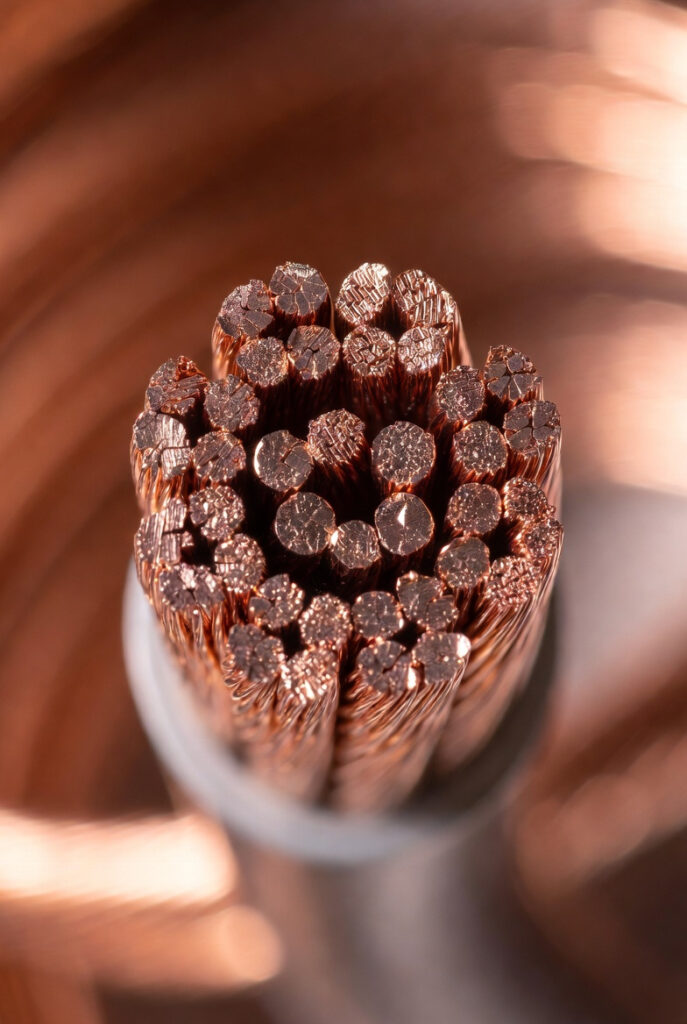
Why Class K welding cable is the professional choice: Class K welding cable uses thousands of fine copper strands typically 30 AWG individual strands in 4/0 gauge. This construction allows the cable to bend repeatedly without work-hardening. A 4/0 welding cable can be bent to a 2-inch radius and routed through tight battery compartments without insulation damage or strand fatigue.
The jacket specification: EPDM rubber jacket not PVC is the correct specification for battery cables. EPDM remains flexible to -40°C. PVC jacketed cable becomes stiff and brittle below -10°C a real failure mode in Ontario cabin equipment rooms during January. Any wire gauge off grid solar installation in Ontario, Minnesota, or Montana should specify EPDM jacketed welding cable or USE-2 rated cable not standard PVC THHN.
The Ontario Cold Start Reality
What cold does to voltage drop: On a -20°C Rockwood morning your LiFePO4 battery bank starts at reduced capacity approximately 85% of rated capacity at room temperature. The battery resting voltage is also slightly lower due to cold. If you add 0.8-1.0V of cable voltage drop on top of cold-reduced battery voltage your inverter sees a voltage that may be below its low-voltage cutoff before the coffee maker even heats up.
The cold start math:
- 12V LiFePO4 at -10°C: approximately 12.6V resting
- Subtract 0.8V cable drop from undersized wire: inverter sees 11.8V
- 12V inverter low voltage cutoff: typically 11.5-12.0V
- Result: inverter refuses to start under load on a cold morning not because the battery is dead because the cable is thin
4/0 AWG eliminates this failure mode: With 4/0 AWG and a 0.05V drop at 250A the inverter sees 12.55V on a cold morning well above cutoff. The coffee maker starts. The cabin warms up. The battery does its job. The cable does not get in the way.
The Cost Reality – Buy Once Cry Once
What 4/0 AWG costs: 4/0 AWG welding cable costs approximately $8-15 per foot in 2026. A typical battery-to-inverter run requires 4-6 feet of positive and 4-6 feet of negative 8-12 feet total. Total cable cost: $80-180 for a complete run.
What undersized wire costs: A fried Victron MultiPlus inverter: $1,500-3,000 replacement cost. Rewiring a completed installation: 4-6 hours of labour at $80-120/hour. Potential fire damage from overheated cable in a wooden cabin: uninsured loss.
The protection pair: As covered in our Class T Fuse guide the Class T fuse and 4/0 AWG cable are a matched pair neither works correctly without the other. A correctly rated Class T fuse on an undersized cable does not prevent the cable from overheating. Correctly sized 4/0 AWG without a Class T fuse does not prevent catastrophic arc damage. Wire and fuse. Together. Correct specification both.
The busbar connection: The 4/0 AWG run terminates at the busbar system covered in our Busbar guide. The cable is only as good as the termination point. 4/0 AWG into a stacked ring terminal post is still a bad installation. 4/0 AWG terminated correctly at a tin-plated busbar stud with a nyloc nut and torqued to specification is the complete professional standard.
Pro Tip: Always run the ground (negative) cable in the same gauge as the positive cable 4/0 for positive means 4/0 for negative. The ground return carries the identical current as the positive feed. Undersized ground cables cause identical voltage drop as undersized positive cables. The inverter does not distinguish between positive voltage drop and negative voltage drop both reduce the voltage it sees. Run matched gauge positive and negative. Always.
The Verdict
The wire gauge off grid solar decision is made once. The cable is inside the walls, inside the conduit, inside the battery enclosure. Replacing it later costs ten times what getting it right costs today.
4/0 AWG for 12V 3,000W systems. EPDM jacket. Fine strand Class K construction. Matched gauge positive and negative. Terminated correctly at a busbar. Protected by a Class T fuse.
That is the complete standard. Build it right the first time.
Disclosure: This article contains affiliate links. If you buy through them, GridFree Guide earns a small commission at no extra cost to you.
Questions? Drop them below.
Pingback: Crimping Battery Lugs: Why Solder Always Fails
Pingback: Heat Shrink Battery Cables: The Adhesive-Lined Standard
Pingback: Solar Panels Series vs Parallel: Master Tech Guide
Pingback: 12V vs 24V vs 48V Solar: The Master Tech Choice
Pingback: Conduit Fill Solar: Derating and the 40% Rule Explained