
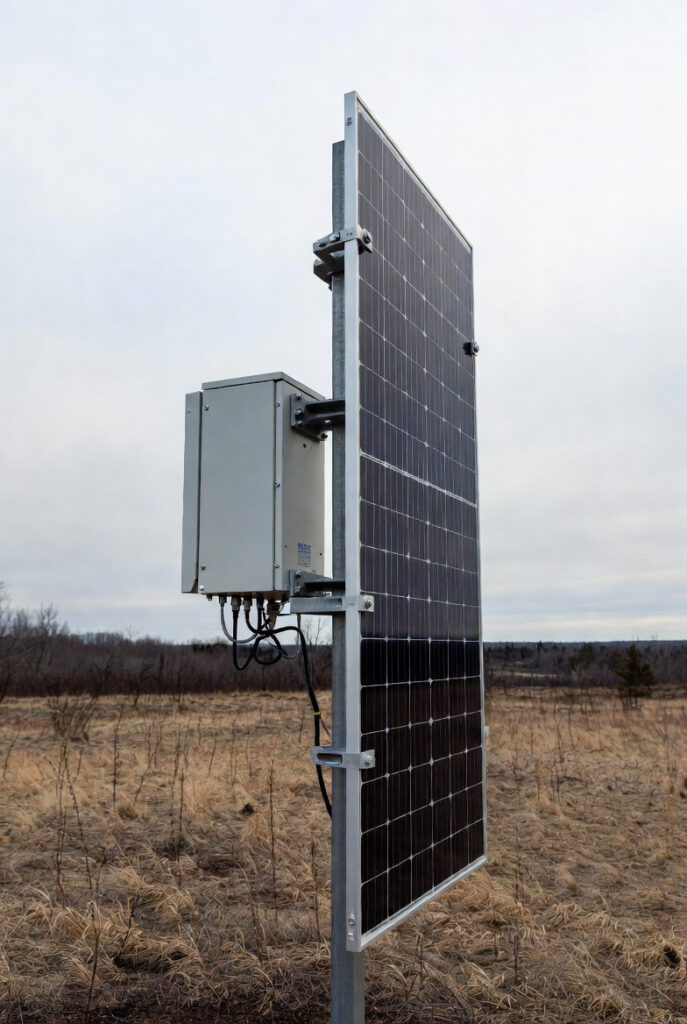
Wildfire lookout solar systems fail when designers size the array for clear-sky production and never model the smoke-shading scenario. I was asked to review the power specifications for a lookout tower installation in the Temagami District north of North Bay that the Ministry of Natural Resources and Forestry wanted to upgrade with AI-assisted smoke detection cameras. The existing wildfire lookout solar system was a standard 400W array at 30-degree tilt with a 100Ah LFP battery bank. The system performed adequately during the spring and fall monitoring seasons when fire risk was low. I modelled the system performance during a simulated smoke event using irradiance data from the 2023 Temagami fire complex, when the sky was rated AQI 400 plus for 11 consecutive days. Under those atmospheric conditions a standard 400W south-facing array at 30-degree tilt produced an average of 112Wh per day, a 73% reduction from its clear-sky baseline of 416Wh per day. The AI camera system and Starlink telemetry together drew 312Wh per day. The system had a daily deficit of 200Wh under smoke conditions. The 100Ah LFP bank at 80% DoD provided 1,200Wh of usable storage. At 200Wh daily deficit the battery depleted to cutoff in 6 days. The tower went dark on day 7 of an 11-day smoke event. The fix was a 400W bifacial array at 65-degree tilt replacing the original 30-degree monofacial array and a battery bank upgrade to 300Ah LFP. Under the same 2023 smoke irradiance data the bifacial vertical-tilt array produced 198Wh per day, 77% more than the flat monofacial array in the same atmospheric conditions, because diffuse sky radiation is more uniformly distributed across the hemisphere and a steep bifacial panel captures it from both faces. For the winter diffuse irradiance calculations that use the same bifacial advantage for snow-covered Ontario conditions, Article 160 covers the derate factors. For the full system sizing hub that covers the load calculation foundation, the hub covers the numbers.
Why Wildfire Lookout Solar Fails on Day 7 of a Smoke Event
At AQI 400 the direct beam is attenuated 80 to 95%. The remaining energy is diffuse, distributed across the full sky hemisphere. A bifacial panel at 65 degrees captures diffuse from the front face across the broadest sky arc and albedo from the rear face. Combined bifacial gain under smoke: 60 to 90% more than monofacial at 30 degrees for the same rated capacity. The 10:1 sizing rule from Article 193 applied to a 24/7 tower load: AI camera 25W plus Starlink 15W average in sleep mode plus charge controller and telemetry 5W equals 45W total continuous. Ten times 45W equals 450W panel minimum. One hundred times 45W equals 4,500Wh battery minimum for 5-day blackout survival, approximately 375Ah at 12V. The Victron SmartShunt provides real-time SoC during the smoke event so the tower operator knows how many days of reserve remain and can request resupply before the bank depletes.
| Array Configuration | Clear-Sky Production | Smoke-Event Production |
|---|---|---|
| 400W monofacial at 30 degrees | 416Wh per day | 112Wh per day |
| 400W bifacial at 65 degrees | 362Wh per day | 198Wh per day |
The Bifacial Vertical Array: Diffuse Light Capture During Active Fire
For a wildfire lookout solar array The 65-degree mounting geometry puts the front face nearly vertical facing south-southwest, capturing the broadest arc of the diffuse sky dome, with the rear face capturing albedo from the tower platform, rock, and surrounding terrain. Clear-sky performance penalty: a 65-degree tilt versus 30-degree tilt loses approximately 12 to 18% of clear-sky direct beam production at Ontario latitudes. Smoke event performance gain: 60 to 90% more diffuse capture. The bifacial vertical array performs 12 to 18% worse than a standard flat array on clear days and 60 to 90% better during a smoke event. On a wildfire lookout tower the smoke event is the design condition and the clear-sky performance penalty is the acceptable trade-off. The 65-degree mounting also provides nearly complete self-cleaning: ash and particulate depositing on a near-vertical surface falls away under gravity within 12 to 24 hours. A 30-degree panel accumulates ash across its entire surface and requires manual cleaning.
The Positive-Pressure NEMA 4X Cabinet: Ash Protection for Tower Electronics
I inspected a lookout tower power system on the French River District in August following a complaint that the inverter had failed during active fire monitoring operations. The inverter was a standard 2,000W residential unit mounted in a ventilated enclosure on the tower platform. When I opened the enclosure I found the inverter’s cooling fan intake packed with fine white-grey ash. The ash layer was 8 to 10mm thick across the fan guard. The fan had been running against a blocked intake for approximately 4 days before the inverter’s thermal protection triggered a permanent shutdown. The ash was calcium-rich wood ash from a mixed boreal forest fire, slightly alkaline and hygroscopic it absorbs atmospheric moisture and becomes electrically conductive when wet. Overnight condensation on the ash layer had created a partially conductive path across the inverter’s internal PCB traces. The inverter was not recoverable. The replacement cost including labour and helicopter access was $4,200. I replaced it with a positive-pressure NEMA 4X steel cabinet with a filtered intake fan. Clean air pushes in. Ash-laden air never touches the electronics. The problem has not come back.
The filter specification: a MERV 13 filter captures 85% of particles above 0.3 micrometres, correct for active fire environments where wood ash particles range from 0.5 to 100 micrometres. Filter replacement frequency during an active fire event: every 72 hours. Between fire events: monthly inspection, annual replacement. For the construction site NEMA 4X enclosure standard that uses the same positive-pressure principle for concrete dust protection, Article 194 covers the full enclosure specification.
The Lightning DAS: Protecting Tower Electronics from Ground Potential Rise
A conventional lightning rod provides a preferred strike termination point but allows full strike current to flow. Ground potential rise on a steel tower at strike: 5,000 to 50,000V at the tower base. This GPR travels through bonding conductors into solar electronics regardless of surge protectors because the GPR exceeds the 6,000V clamp voltage for 10 to 50 microseconds during the strike event. A dissipation array system places a network of small-radius ionising points 1 to 2 metres above the protected structure. These bleed off the static charge differential by corona discharge, reducing the local electric field gradient below the threshold for leader formation. On a Shield ridge tower at 400 metres elevation taking 3 to 8 direct strikes per season without protection, the DAS eliminates the ground potential rise event rather than surviving it. The DAS installation requires a registered electrical engineer’s certification in Ontario. Contact the Sudbury ESA district office for DAS installation permit requirements for communications and monitoring towers in the Temagami and French River districts.
The AI-Triggered Starlink Sleep Mode: Power Management for Telemetry
A continuous Starlink connection draws 20 to 40W average, 480 to 960Wh per day. Sleep mode draws 2 to 5W standby, 48 to 120Wh per day. When the AI camera detects a positive smoke signature it triggers the GPIO pin that wakes the Starlink router. The Starlink boots in 30 to 45 seconds, transmits the alert and video clip, and returns to sleep. Total daily Starlink energy for 5 alert events: approximately 60 to 80Wh. The saving over continuous connection: 400 to 880Wh per day. On a tower battery bank running a 200Wh daily deficit during a smoke event this saving extends battery life by 2 to 4 additional days. The AI decision happens at the camera with no cloud connection required for the detection step, only for the alert transmission. For the full DC-native Starlink POE bypass standard that reduces standby draw from 20W to 5W, Article 175 covers the configuration. The Victron Smart Battery Sense wireless temperature sensor monitors battery cell temperature during extreme heat events when tower platform temperatures can exceed 45°C in direct sun, triggering charge current reduction to protect LFP cells from thermal stress.
The Wildfire Lookout Solar System: Minimum Viable vs Full Sentry Standard
The decision follows whether the tower is a manned observation post or an unmanned autonomous AI detection platform.
The minimum viable wildfire lookout solar system is the correct choice for a manned observation post with a single AI camera and Starlink telemetry in a moderate fire district. It includes a 400W bifacial array at 65-degree tilt, 200Ah LFP battery bank, positive-pressure NEMA 4X enclosure with MERV 13 filtered intake, and a standard lightning rod. Capital cost runs $3,500 to $5,500. It provides 12 to 14 days of autonomous operation during a heavy smoke event and requires operator presence for manual camera monitoring.
The full sentry standard is the correct choice for an unmanned autonomous AI detection platform in a high-risk fire district such as the Temagami or French River corridors. It includes an 800W bifacial array at 65-degree tilt, 300Ah LFP bank with Victron SmartShunt for real-time SoC telemetry, positive-pressure NEMA 4X steel cabinet with MERV 13 filtered intake and thermostat-controlled exhaust fan, lightning DAS with registered engineer certification, AI-triggered Starlink sleep mode, and satellite-linked battery monitoring via the solar remote monitoring standard VRM alert integration. Capital cost runs $9,000 to $16,000. It provides commercial-grade uptime through 14-day smoke blackouts and active lightning seasons without any operator presence required.
NEC and CEC: What the Codes Say About Wildfire Lookout Solar
NEC 690 governs the PV source circuits of any wildfire lookout solar installation. NEC 780 covers closed-loop and multipoint communication systems and applies to the AI camera and telemetry wiring between the camera, processor, and Starlink router. NEC 250 governs grounding and bonding. A lightning DAS installation requires coordination with the NEC 250 bonding requirements for the tower structure. All metallic components including the solar array frames, enclosure, and antenna mounts must be bonded to a single ground reference that connects to the DAS grounding network. NEC 285 covers surge protective devices and requires that SPDs be installed at the service entrance and at the equipment level for any installation exposed to direct lightning risk.
In Ontario, wildfire lookout towers operated by the Ministry of Natural Resources and Forestry are subject to CEC Section 64 for any solar installation. The DAS installation requires a Professional Engineer stamp and a separate ESA permit from the solar installation permit. The MNRF’s forest fire management infrastructure is classified as a critical public safety installation. ESA permit applications for wildfire monitoring tower solar installations are processed under the priority infrastructure permit pathway with a target review time of 15 business days. The positive-pressure enclosure installation is subject to CEC Section 18 for Class II Division 2 locations if the tower is within 3 metres of fuel storage used for the tower’s generator backup. Contact the Sudbury ESA district office for permit requirements for solar installations on MNRF fire monitoring infrastructure in the Temagami and French River fire management zones.
Pro Tip: Before specifying the battery bank for a wildfire lookout tower, pull the worst fire season irradiance data from the nearest Environment Canada weather station for your specific district. The Temagami 2023 fire season produced AQI above 300 for 14 consecutive days. A battery bank sized for a 5-day blackout fails on day 6 of a 14-day event. Size the bank against the longest historically recorded smoke event in your fire management zone, not the average event. The average is what happens most of the time. The worst case is what destroys the system.
The Verdict
A wildfire lookout solar system built to the sentry standard keeps the AI cameras scanning and the telemetry transmitting through day 14 of a smoke event, a direct lightning season, and an ash infiltration event simultaneously.
- Mount the bifacial array at 65 degrees, not 30. The Temagami tower went dark on day 7 because a flat array in smoke produces 112Wh per day. The bifacial vertical array produces 198Wh per day under identical smoke conditions. The 12% clear-sky penalty is the smallest trade-off in this article.
- Put the electronics in a positive-pressure NEMA 4X cabinet with a MERV 13 filter. The French River inverter failure cost $4,200 in helicopter-access replacement because a ventilated enclosure drew ash directly onto the PCB traces. A positive-pressure filtered cabinet costs $400 and lasts the life of the tower.
- Install the lightning DAS before the first fire season. A Shield ridge tower takes 3 to 8 direct strikes per season without DAS protection. Each strike generates a 5,000 to 50,000V ground potential rise that travels through the bonding conductors into the solar electronics. The DAS prevents the strike. The conventional rod survives it. On a tower with no helicopter access and no backup system, the difference is between a functioning sentry and a $16,000 heap of melted electronics on a ridge.
In the shop, we do not run the engine without an air filter in a sandstorm. On the tower, the electronics run behind a MERV 13 filter or they do not run at all.
Questions? Drop them below.
This post contains affiliate links. If you purchase through our links, we may earn a small commission at no extra cost to you.