
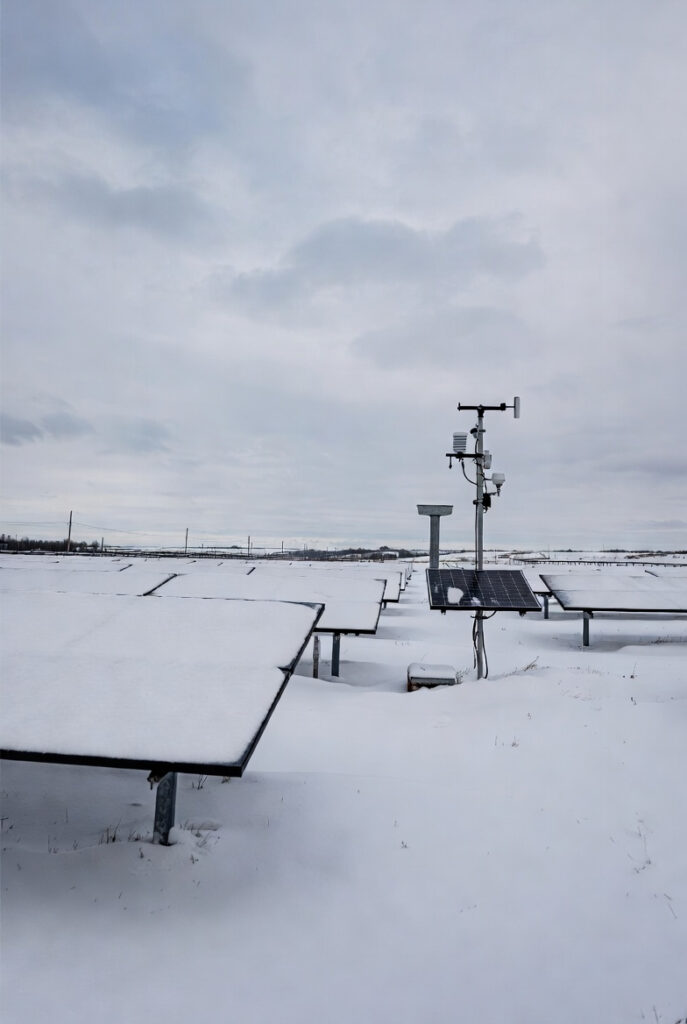
Weather station solar failures in Ontario happen quietly. The station keeps transmitting data but the numbers are wrong. You do not find out until it matters most, during the worst storm of the winter. I was asked to review the power system for an agricultural weather station on a grain farm near Listowel in Perth County that had gone offline on day 3 of a February ice storm. The farmer had installed a Davis Vantage Pro 2 with a heated tipping bucket rain gauge the previous fall to track spray application windows and growing degree days for his corn and soybean operation.
The station ran on a 100W panel and a 100Ah SLA battery. The rain gauge heater drew 45W continuously from the moment ambient temperature dropped below 4°C. In February near Listowel the temperature drops below 4°C for approximately 18 to 20 hours per day on average. At 45W continuous draw the heater alone consumed 810 to 900Wh per day. The 100W panel in February produced approximately 250 to 350Wh per day under normal overcast conditions. During the ice storm with cloud cover at 100% the panel produced approximately 40Wh per day. The daily energy deficit during the ice storm was 860Wh.
The 100Ah SLA bank at 50% usable capacity provided 600Wh of usable reserve. The station went dark on day 3 of the 5-day storm. The farmer missed 48 hours of ice accumulation data during the worst event of the winter. I replaced the always-on heater controller with a smart duty-cycle controller that activated the heater only when the precipitation sensor detected active precipitation. The heater ran an average of 3.2 hours per day in February versus the previous 18 to 20 hours. As a result the daily heating energy dropped from 900Wh to 144Wh. The station survived the same storm pattern the following February with 180Wh of daily panel production and 14Wh to spare each day. The smart controller cost $185. The 48 hours of missing ice storm data it replaced was worth considerably more to the farm’s spray program. For the solar weather station heated sensor budget standard that covers the same heated sensor energy calculation for agricultural monitoring stations, Article 199 covers the full winter power budget. For the full system sizing hub that covers the load calculation foundation, the hub covers the numbers.
Why a Weather Station Solar System Goes Dark on Day 3 of a February Storm
The always-on heater draws 45W continuous at 18 hours below 4°C per day, equalling 810Wh per day from the heater alone. February panel production in Perth County under ice storm overcast runs only 40 to 80Wh per day. The daily deficit is 730 to 770Wh. However, a smart duty-cycle controller activates the heater only during active precipitation, averaging 3.2 hours per day versus 18 to 20 hours. As a result the daily heating energy drops from 810Wh to 144Wh, an 82% reduction.
The Victron Smart Battery Sense wireless temperature sensor monitors the LFP bank temperature during February cold snaps, alerting the farmer when battery temperature approaches 0°C and charging should be suspended to prevent lithium plating. For the battery bank winterization standard that covers the same LFP cold temperature charging protocol for Ontario off-grid installations, Article 190 covers the full deep freeze protocol.
| Heater Mode | Daily Heating Energy | February Survival on 100Ah LFP |
|---|---|---|
| Always-on at 4°C threshold | 810 to 900Wh | Less than 1 day under ice storm |
| Smart duty-cycle controller | 144Wh | 5 to 7 days under ice storm |
The Ultrasonic Anemometer: Wind Data When It Matters Most
Weather station solar anemometer failures happen exactly when wind data matters most. I reviewed a recurring wind data gap problem at a municipal weather monitoring station on an exposed ridge near Owen Sound in Grey County that served as an input to the local emergency management system for wind advisory issuance. The station had been using a standard 3-cup anemometer since installation. In four years of operation the station had experienced 6 complete anemometer failures, all between November and March.
The most recent failure occurred during a January wind advisory event when measured winds at a nearby Environment Canada station reached 87km/h. The Owen Sound station reported 0.0km/h for 14 consecutive hours because the cups had frozen in a block of rime ice. The emergency management coordinator had issued a wind advisory without local ground-truth data for the highest-wind period of the event.
I replaced the 3-cup anemometer with a Gill MaxiMet ultrasonic wind sensor. The ultrasonic sensor has no moving parts, no cups to freeze, no bearings to seize, and no reed switch to corrode. It draws 0.8W continuously compared to 0.05W for the cup anemometer, a 0.75W increase. However, in 22 months of operation since the replacement the station has not recorded a single zero-wind event that was not confirmed by nearby stations. The station delivered accurate wind data through 3 winter seasons including 2 events above 90km/h. Total cost of the ultrasonic sensor: $340. The emergency management value of accurate wind data during a 90km/h event is not a number anyone wants to calculate after the fact. For the solar weather station ultrasonic sensor standard that covers the full comparison between ultrasonic and cup anemometers in Ontario field conditions, Article 199 covers the complete analysis.
The PWM Fan Aspirated Shield: Temperature Without Battery Drain
An always-on fan draws 1.5 to 2W continuous, consuming 36 to 48Wh per day. However, forced aspiration is most needed at midday on sunny days when the solar disc heats the shield exterior. A PWM fan powered directly from the panel output runs at full speed when the panel produces 50W and at near-zero speed when the panel produces 5W or less. As a result the fan runs hardest exactly when it is needed most and draws near-zero power at night.
Daily average power consumption drops from 2W continuous to approximately 0.4W average, saving 38Wh per day. On a 100W weather station solar system producing 250Wh per day in February those 38Wh represent 15% of the total daily production. That saving is the difference between surviving day 5 of a whiteout and going dark on day 4. For the remote sensor solar aspirated radiation shield standard that confirmed a 3.8°C warm bias from passive shields on a Wellington County research plot, Article 209 covers the full shield comparison.
The Hail-Rated Panel and Bird Deterrent Standard
Ontario’s agricultural belt between Lake Erie and Georgian Bay experiences 4 to 8 damaging hail events per year. Hailstone diameters reach 25 to 40mm in severe convective events. A standard 2mm glass panel that takes a direct hit from a 30mm hailstone typically fractures at the glass, introduces water vapour into the laminate, and causes cell corrosion within one to two seasons. However, a 3.2mm tempered glass panel certified to IEC 61215 Class 1 hail testing survives the same impact without glass failure.
Bird deterrent spikes mounted at 150mm intervals along the top panel edge prevent landing entirely. As a result the panel surface stays clean between maintenance visits. A single herring gull deposit on a 100W panel reduces output by 15 to 25% depending on deposit location relative to cell strings. The Renogy 100W solar panel provides the base production for a sheltered farm weather station location where hail risk is low and the primary concern is winter overcast performance. For the weather buoy solar bird deterrent spike standard that covers the same panel protection protocol for exposed outdoor installations, Article 206 covers the full spike and cleaning specification.
The Weather Station Solar System: Minimum Viable vs Full Meteorology Standard
The decision follows the criticality of the data and the station’s exposure to hail and winter storm conditions.
The minimum viable weather station solar system for a farm operator running a basic temperature, wind, and precipitation station in southern Ontario includes a 100W hail-rated panel, a 100Ah LFP battery, a smart duty-cycle heater controller for the rain gauge, a PWM fan aspirated radiation shield, and bird deterrent spikes. Capital cost runs $900 to $1,400. It provides continuous data through a normal Ontario winter including 5-day overcast periods.
The full meteorology standard for a municipal emergency management or agricultural mesonet node includes a 200W hail-rated panel, 200Ah LFP bank with Victron Smart Battery Sense winter temperature monitoring and low-voltage alert, smart duty-cycle heater with precipitation-triggered activation, ultrasonic anemometer, PWM fan aspirated shield, and bird deterrent spikes. Capital cost runs $2,800 to $4,500. It provides climate-grade uptime through the worst Ontario winter storm season including February ice events and June hailstorms.
NEC and CEC: What the Codes Say About Weather Station Solar
NEC 690 governs the PV source circuits of any weather station solar installation regardless of array size. A 100W or 200W weather station array is subject to the same NEC 690 overcurrent protection and disconnecting means requirements as a residential installation. The low-voltage sensor circuits including the anemometer, temperature sensor, and rain gauge heater are subject to NEC 725 Class 2 circuit requirements. The rain gauge heater at 40 to 50W is a significant resistive load on the 12V DC system and requires overcurrent protection rated for its full operating current at the battery connection.
In Ontario, a weather station solar installation on agricultural land does not require an ESA permit provided the system is a self-contained low-voltage DC unit with no connection to building fixed wiring. A 12V or 24V DC solar panel charging an LFP battery that powers a weather station is outside ESA permit requirements as a portable low-voltage DC installation. For agricultural weather stations receiving funding through the Ontario Ministry of Agriculture, Food and Rural Affairs precision agriculture programs, OMAFRA requires that the station meet Environment Canada Meteorological Service of Canada observer network standards. Contact Environment and Climate Change Canada for station siting and instrument calibration requirements if the station is intended to contribute data to the national surface weather observation network.
Pro Tip: Before sizing the battery bank for a heated weather station, run the heated tipping bucket gauge on bench power for one full week in November with the heater connected and the precipitation sensor disconnected so it runs continuously, and log the total Wh consumed each day. That week’s worst-day number is your always-on heater baseline. Then get a smart duty-cycle controller and run the same test with the precipitation sensor connected and a sprinkler dripping on the gauge for 3 hours per day to simulate active precipitation. The difference between those two numbers is the energy saving the controller provides. I have seen always-on baselines of 950Wh per day drop to 130Wh per day with a smart controller on the same gauge. Size your battery for the controlled number plus a 5-day reserve. The always-on number is what kills stations in February.
The Verdict
A weather station solar system built to the meteorology standard keeps measuring the storm without being killed by it — through the ice, the whiteout, and the hailstones that break every cheap panel in the county.
- Replace the always-on heater controller with a smart duty-cycle controller before the first November freeze. The Listowel grain farm went dark on day 3 of a 5-day ice storm because a 45W heater running 18 hours a day consumed 810Wh while the panel produced 40Wh. A $185 smart controller cut the heating draw to 144Wh per day. The same storm the following year the station had 14Wh to spare at the end of each day.
- Replace the cup anemometer with an ultrasonic sensor before the first rime ice season. The Owen Sound municipal station reported 0.0km/h for 14 hours during an 87km/h wind event because the cups were frozen solid. The emergency coordinator issued a wind advisory without local ground truth. A $340 ultrasonic sensor has not reported a false zero in 22 months through 3 winter seasons.
- Specify hail-rated 3.2mm tempered glass panels before the first June convective season. Ontario’s agricultural belt takes 4 to 8 damaging hail events per year with stones up to 40mm. A 2mm panel that fractures in a hailstone cannot measure the storm that broke it. A 3.2mm panel certified to IEC 61215 Class 1 survives it.
In the shop, we do not put a thin windshield in a gravel truck. On the weather mast, we do not put a 2mm panel in a field that gets golf-ball hail every June.
Frequently Asked Questions
Q: How long will a weather station solar system survive a 5-day Ontario whiteout? A: A 200Ah LFP bank with a smart duty-cycle heater controller averages 80Wh per day in heating energy during storm conditions. Combined with 150Wh per day of panel production under heavy overcast a 200Ah LFP bank provides 12 to 14 days of autonomous operation in the worst Ontario winter conditions.
Q: Why does a heated rain gauge drain the battery so fast in winter? A: An always-on heated orifice draws 40 to 50W for 18 to 20 hours per day when ambient temperature is below 4°C, consuming 720 to 1,000Wh per day. A smart duty-cycle controller reduces this to 40 to 80Wh per day by activating the heater only during active precipitation. The saving is 88 to 92% of the total heating energy budget.
Q: Do solar panels on weather stations need to be hail-rated? A: In Ontario’s agricultural belt between Lake Erie and Georgian Bay, 4 to 8 damaging hail events occur annually with hailstone diameters reaching 25 to 40mm. A standard 2mm glass panel fails IEC 61215 Class 1 hail testing. A 3.2mm tempered glass panel survives it. For a station monitoring the storm that produces the hail, having the panel survive is not optional.
Questions? Drop them below.
This post contains affiliate links. If you purchase through our links, we may earn a small commission at no extra cost to you.