
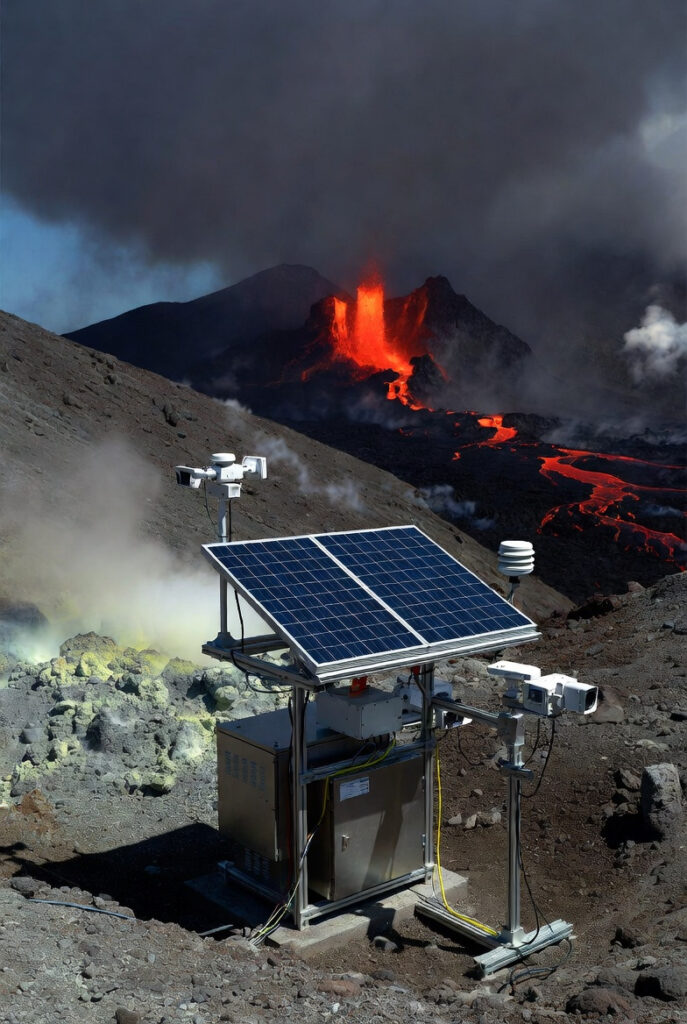
Volcanic monitoring solar failures are not gradual. They happen fast, in one season, and they take expensive instruments with them. I was asked to review a power system failure at a SO2 spectrometer station on the south flank of a stratovolcano in the Cascades that a USGS volcano hazards team had been operating for 14 months. The station ran a standard 200W monocrystalline panel array with anodised aluminium frames on a steel unistrut rack, a 150Ah LFP battery in a NEMA 3R enclosure with a cooling fan, and a Campbell Scientific CR1000 datalogger. The site was located 2.1 kilometres from an active fumarolic field emitting SO2 at 340 tonnes per day.
Within 6 weeks of deployment the anodised coating on the aluminium frames began pitting at every joint and mounting hole. By 14 months the pits had penetrated the coating at 23 locations around the frame perimeter. At 4 of those locations the frame metal had corroded through completely, causing a conductive short between the aluminium frame and the panel’s positive output terminal. The short drew 4.8A continuously, depleting the battery bank in 18 hours. The voltage collapsed below operating thresholds, killing both the CR1000 and the SO2 spectrometer. Total instrument loss was $43,000.
I redesigned the mounting system using 316L stainless steel angle brackets and HDPE composite frame supports with no aluminium in the corrosion zone. The 316L stainless has a chromium oxide passive layer that is chemically inert to sulfuric acid concentrations below 10% by weight, well above the 0.1 to 0.3% concentration typical of SO2 fumarolic rain at 2 kilometres. In 28 months of operation since the redesign across three SO2 emission cycles including one period at 890 tonnes per day the mounting system showed no visible corrosion at any bracket or support point. For the weather buoy solar marine-grade ETFE corrosion standard that uses the same 316L and composite frame approach for saltwater environments, Article 206 covers the full corrosion-resistant specification. For the full system sizing hub that covers the load calculation foundation, the hub covers the numbers.
Why a Volcanic Monitoring Solar System Fails Before the Eruption Ends
SO2 dissolves in atmospheric moisture to form sulfurous acid, then oxidises to sulfuric acid, producing pH 2 to 4 rainfall at 1 to 5 kilometres from active vents. Anodised aluminium oxide coating dissolves at 2 to 10 microns per year at pH 2, penetrating to the aluminium substrate within 8 to 14 months at a typical fumarolic site. Once the substrate is exposed aluminium corrodes at 0.5 to 2mm per year. However, 316L stainless steel has a passive chromium oxide layer that is chemically inert to sulfuric acid below 10% concentration.
As a result 316L brackets show no measurable corrosion at fumarolic sites over multi-year campaigns while standard aluminium frames corrode through in under two seasons. The Victron SmartShunt monitors the battery bank and transmits a low-battery alert via Iridium SBD before the station goes dark during an eruptive episode. For the seismic monitoring solar galvanic isolation standard that uses the same 316L corrosion-resistant hardware for high-humidity shield rock installations, Article 212 covers the full materials specification.
| Frame Material | SO2 Acid Rain Resistance | Expected Service Life at pH 3 |
|---|---|---|
| Anodised aluminium | Oxide coating dissolves within 8 to 14 months | 1 to 2 seasons before substrate exposure |
| 316L stainless steel | Chemically inert below 10% sulfuric acid | Multi-year with no measurable corrosion |
| HDPE composite | No metallic component- fully inert | Indefinite in SO2 environments |
The 316L Frame and TiO2 Panel Coating: Chemistry Against Chemistry
The acid corrosion protection hierarchy uses 316L stainless steel at all structural connections, HDPE composite frame supports where metal contact with the panel laminate is unavoidable, and TiO2 photocatalytic nano-coating on all panel glass surfaces. The TiO2 coating uses UV radiation to break down organic surface contaminants including the organic binders in fresh ash deposits before they polymerise into a pozzolanic crust. As a result fresh ash deposited on a TiO2 panel surface in daylight has its bonding chemistry disrupted before the pozzolanic reaction can initiate.
In addition the TiO2 coating creates a superhydrophilic surface during UV exposure that causes water to sheet across the panel rather than bead, carrying loose ash particles to the panel edge. However, at night or during extended overcast the TiO2 photocatalytic effect is suspended and the 75-degree tilt geometry becomes the primary ash defence. For the remote sensor solar LDO regulator standard that covers the same chemical resistance principle for instrument power supplies in corrosive field environments, Article 209 covers the full isolation architecture.
The Ash Cement Burial: Pozzolanic Reaction on Your Solar Array
Volcanic monitoring solar ash failure is the slowest of the volcanic failure modes but the most total when it completes. I reviewed a power system shutdown at a thermal camera station on the eastern rim of a caldera in Iceland that a university geophysics group had been operating to monitor ground deformation during a rifting episode. The station ran a 150W panel on a standard aluminium frame at 30-degree tilt, a 100Ah LFP battery, and a Mobotix thermal imaging camera drawing 18W continuous.
During a 6-day subplinian eruption the station received 28mm of ash fall over 4 days. When rain began on day 5 it triggered the pozzolanic reaction, producing a calcium-aluminium silicate hydrate matrix that bonded the ash particles into a rigid crust. By day 7 the 28mm deposit had hardened into a 22mm thick crust with a compressive strength of approximately 0.8 MPa. The crust was physically bonded to the panel glass surface. The panel produced zero watts. Total mass of the hardened crust on the 150W panel was 4.2 kilograms.
I upgraded the replacement station to a 75-degree rack tilt with TiO2 nano-coated glass panels. The TiO2 coating breaks down organic binders in fresh ash deposits under UV radiation before they can polymerise. The 75-degree tilt sheds any ash not broken down by the TiO2 coating within 2 to 4 hours of deposition, before the 4-hour pozzolanic initiation threshold. During two subsequent ashfall events of 8mm and 14mm depth the replacement station lost production for less than 3 hours per event and resumed full output within 90 minutes of the ash ceasing. The TiO2 nano-coating treatment cost $340 for the full panel set. The hardened ash removal from the original panels required a commercial pressure washer and 6 hours of fieldwork. For the fish hatchery solar sealed cabinet standard that uses the same gasket-sealed enclosure principle to prevent contamination of sensitive electronics, Article 207 covers the full enclosure specification.
The Sealed NEMA 4X Enclosure: Keeping Ash Out of the Electronics
A cooling fan at a volcanic site during an ash fall draws 0.2 to 0.8 litres of air per second through the enclosure. At 10 grams of ash per cubic metre of air a fan running for 6 hours deposits 43 to 172 grams of abrasive glass particles inside the enclosure. However, a NEMA 4X IP66 gasket-sealed enclosure requires no air exchange. The battery and controller operate within a sealed thermal envelope.
Maximum internal temperature rise in a sealed 0.1 cubic metre enclosure with a 30W heat load and a 200 square centimetre passive aluminium heat sink is approximately 18°C above ambient, within the operating range of all standard LFP batteries and MPPT controllers. As a result the electronics stay within operating range without any air movement at all. For the air quality solar NEMA 4X sealed enclosure standard that covers the same fan-free passive cooling principle for industrial monitoring enclosures, Article 211 covers the full thermal specification.
The Bicarbonate Wash System and Topographic Siting
Acidic ash deposits on panel glass etch the anti-reflection coating and TiO2 layer if left in contact for more than 24 hours after the pozzolanic reaction has partially hardened them. A 2-litre reservoir of 2% sodium bicarbonate solution connected to a drip manifold across the panel top edge provides a neutralising wash when activated. The bicarbonate reacts with the sulfuric acid in the ash deposit to form sodium sulfate and water, neutralising the acidity before the glass etching can progress. As a result the panel surface chemistry is restored to neutral after each wash cycle.
The topographic siting rule is non-negotiable. Consult the lahar and pyroclastic flow hazard maps for the specific volcano before selecting the station location. A station on a ridge above lahar channels survives an ash event. The same station in a drainage channel does not survive the subsequent lahar. The Renogy 100W flexible panel bonds directly to a corrosion-resistant backing surface without an aluminium frame for temporary volcanic monitoring deployments where the ETFE surface provides inherent chemical resistance to SO2 acid rain.
The Volcanic Monitoring Solar System: Minimum Viable vs Full Magma Standard
The decision follows eruption frequency, SO2 flux level, and whether the station is a temporary deployment or a permanent network node.
The minimum viable volcanic monitoring solar system for a short-duration hazard monitoring deployment at a moderate SO2 site includes a 200W panel with 316L stainless frame hardware, 30-degree tilt with TiO2 coated glass, a 150Ah LFP battery in a NEMA 4X sealed enclosure with passive heat sink, and a bicarbonate wash reservoir. Capital cost runs $3,200 to $4,800. It survives one to two eruption cycles at SO2 flux below 500 tonnes per day.
The full magma standard for a permanent network node at an active high-SO2 vent includes a 300W panel on 316L stainless and HDPE composite frame at 75-degree tilt with TiO2 nano-coated glass, 200Ah LFP bank in dual NEMA 4X sealed enclosures with passive heat sinks, automated bicarbonate wash system with precipitation trigger, site on high ground above lahar and pyroclastic flow hazard zones, and Victron SmartShunt with Iridium SBD low-battery alert. Capital cost runs $8,500 to $14,000. It provides continuous monitoring through a full eruptive episode including VEI-3 ash events at SO2 flux above 1,000 tonnes per day.
NEC and CEC: What the Codes Say About Volcanic Monitoring Solar
NEC 690 governs the PV source circuits of any volcanic monitoring solar installation. The use of non-standard frame materials such as 316L stainless steel and HDPE composites is permitted under NEC 690 provided all listed components are installed per their listing requirements. The NEMA 4X sealed enclosure must meet the enclosure requirements of NEC 312 for equipment installed in corrosive environments. NEC 312.10 requires that enclosures in corrosive environments be constructed of materials suitable for the specific corrosive agent present, the basis for specifying NEMA 4X rather than standard NEMA 3R enclosures at volcanic sites. The USGS Volcano Hazards Program provides site-specific hazard assessments that inform the enclosure and materials specification for volcanic monitoring installations.
In Canada, volcanic monitoring installations in British Columbia are subject to CEC Section 64 for the PV source circuits and to Natural Resources Canada Geological Survey of Canada volcano monitoring protocols. The GSC operates monitoring networks at Garibaldi, Meager, and other Cascade volcanoes in BC and maintains technical standards for power system installations at these sites. Contact the GSC Volcanoes Section before installing any solar power system at a volcanic monitoring site in Canada to confirm materials and enclosure requirements. Provincial safety code compliance through the BC Safety Authority is also required for permanent electrical installations at volcanic monitoring sites in British Columbia.
Pro Tip: Before specifying the frame material for a volcanic monitoring solar installation, request the SO2 flux data and prevailing wind direction from the volcano observatory for your deployment site and calculate the average SO2 acid rain pH at your station location using the standard dispersion model. I have reviewed specifications where designers specified standard aluminium frames because the site was 4km from the vent and assumed it was outside the corrosion zone. The dispersion model showed the site received pH 2.8 rainfall during the prevailing wind conditions that coincide with the highest SO2 flux events, exactly when you need the monitoring station most. Get the flux data first. Specify the frame after.
The Verdict
A volcanic monitoring solar system built to the magma standard keeps the SO2 spectrometer alive through every emission cycle, keeps the thermal camera recording through every ashfall event, and does not require a $43,000 instrument replacement because a standard aluminium frame dissolved in 14 months of fumarolic rain.
- Replace every aluminium frame component with 316L stainless or HDPE composite before the first SO2 season. The Cascades station lost $43,000 in instruments because anodised aluminium corroded through at 4 locations in 14 months at pH 2.5 to 3.0 rainfall. The 316L redesign ran 28 months through 890 tonnes per day SO2 with zero corrosion. The frame upgrade costs less than one replacement sensor.
- Apply TiO2 nano-coating and set the rack to 75-degree tilt before the first ash season. The Iceland station’s 150W panel was buried under a 4.2-kilogram hardened crust at 0.8 MPa compressive strength after 28mm of ash fall at 30-degree tilt. The $340 TiO2 treatment on the replacement station shed the same ash fall in under 3 hours and resumed full output within 90 minutes.
- Replace any fan-cooled enclosure with a NEMA 4X sealed unit before deployment. A fan running for 6 hours during moderate ash fall deposits up to 172 grams of abrasive glass on the circuit boards. A gasket-sealed passive enclosure deposits zero grams and stays within 18°C of ambient with no moving parts to fail.
In the shop, we do not put a standard air filter on an engine that runs in a sandblasting cabinet. On the volcano, we do not put an aluminium frame and a cooling fan on a station that sits inside a fumarolic field.
Frequently Asked Questions
Q: How long does a standard aluminium solar frame last at a volcanic SO2 site? A: At a fumarolic site receiving rainfall at pH 2.5 to 3.0 a standard anodised aluminium frame loses its protective oxide coating within 8 to 14 months. Once the aluminium substrate is exposed it corrodes at 0.5 to 2mm per year. A 316L stainless steel frame is chemically inert to sulfuric acid concentrations below 10% and shows no measurable corrosion over multi-year monitoring campaigns.
Q: How does volcanic ash destroy solar panels if it does not melt the glass? A: Fresh volcanic ash bonds to panel glass through the pozzolanic reaction when wetted, forming a calcium silicate hydrate crust that reaches 0.8 to 4 MPa compressive strength within 7 days. This hardened crust blocks all light transmission and physically bonds to the glass surface. A 75-degree panel tilt with TiO2 nano-coated glass prevents the crust from forming by shedding fresh ash within 2 to 4 hours before the pozzolanic reaction can complete.
Q: Why do cooling fans fail so quickly at volcanic monitoring sites? A: A cooling fan running during an ash fall event draws litres of ash-laden air per second through the enclosure, depositing abrasive glass particles on circuit boards and fan bearings. A NEMA 4X IP66 sealed enclosure with a passive heat sink requires no air exchange and maintains equipment operating temperature within 18°C above ambient, eliminating the ash ingestion failure mode entirely.
Questions? Drop them below.
This post contains affiliate links. If you purchase through our links, we may earn a small commission at no extra cost to you.