
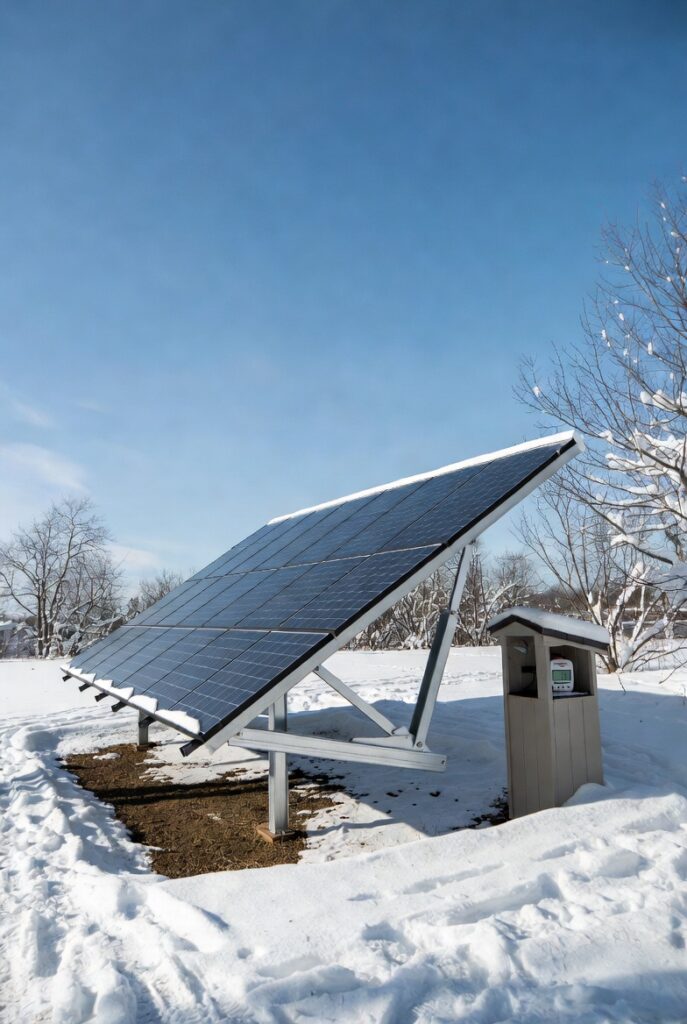
The ability to track the sun is the single biggest performance variable on any Ontario solar installation that is not at a fixed tilt. A homeowner on Watson Parkway North in Guelph, Wellington County installed a linear actuator single-axis tracking system on his 1,200W ground mount in the spring of 2024. The system cost approximately $500 to retrofit the frame and add the actuator, motor controller, and wiring.
On a clear January 2025 day, his data logger showed 3.1 kWh from the tracked array. He had logged the same array on an equivalent clear January day before the retrofit at 2.2 kWh, a difference of approximately 40%. January is Ontario’s most valuable tracking month because the sun’s arc is lowest and shortest in the sky.
The payback calculation on his $500 retrofit was sobering. His tracked array gains approximately 460 kWh per year over the fixed baseline at Ontario’s 3.5 annual average PSH on a 1,200W array. At Ontario’s electricity rate of approximately $0.13 per kWh, that gain is worth approximately $60 per year in energy value. The payback period on the $500 investment was approximately 8.3 years, longer than the stated service life of most linear actuator motors in Ontario outdoor conditions. The January 40% gain is real, but it does not make the tracker economical on a 1,200W array without grid electricity to offset.
He understood the trade-off before installing and made the decision with clear eyes. He wanted the January performance data and the daily visual confirmation that the array was optimised. The tracker delivered on both counts. However, when I walked him through the honest payback math three months later, he acknowledged that the same $500 spent on two additional BougeRV 400W panels would have added approximately 1,022 kWh per year at his Ontario PSH for a simpler installation with no moving parts.
That is 22% more annual harvest than the tracker for the same capital cost. Tracking costs are always compared against the alternative of additional fixed panels. For Ontario homeowners who want to track the sun, the question is always whether a motor is the right tool or whether more panels deliver better value. See our Ontario solar sizing guide before making this decision.
The physics of track the sun: cosine law and the 30% incidence angle penalty
The cosine law of incidence explains exactly how much output a panel loses when the sun is not perpendicular to its surface. Power received equals the panel’s rated output multiplied by the cosine of the angle between the incoming light and the panel’s surface normal. When the sun is perpendicular at 0 degrees incidence, the panel delivers 100% of available output. As the sun moves off perpendicular the losses compound quickly, at 45 degrees off perpendicular the panel delivers only 70.7% of available output, a loss of approximately 29%.
At 60 degrees off perpendicular the output falls to 50%. For Ontario homeowners, this is the core argument for tracking: a fixed panel only achieves 0 degrees incidence for a brief window around solar noon each day.
| Incidence angle | cos(angle) | % of output retained | Loss per 400W panel |
|---|---|---|---|
| 0° (perpendicular, ideal) | 1.000 | 100% | 0W |
| 15° | 0.966 | 96.6% | 14W lost |
| 30° | 0.866 | 86.6% | 54W lost |
| 45° | 0.707 | 70.7% | 117W lost |
| 60° | 0.500 | 50.0% | 200W lost |
| 75° | 0.259 | 25.9% | 297W lost |
Ontario January benefits most from tracking the sun because the solar arc is shortest and lowest in the sky. At Guelph’s 43.5 degrees north latitude, the sun reaches a maximum altitude of approximately 23 degrees above the horizon at noon in January. A fixed array at the winter optimal tilt of approximately 58 to 60 degrees captures the brief peak window near noon well, but the morning and afternoon sun at much lower angles means large incidence penalties that a tracker eliminates.
That is why the Guelph January gain of 40% exceeds the annual average gain of 30%. January is precisely the month where the decision to track the sun pays the most in Ontario. See our Ontario tilt angle guide for the seasonal optimal angle calculations by month.
When to track the sun with a motor: the Ontario single-axis payback calculation
The Watson Parkway payback calculation represents the honest Ontario case for small arrays. A 1,200W fixed array at 3.5 annual PSH produces approximately 1,533 kWh per year. Adding 30% single-axis tracking gain raises that to approximately 1,993 kWh per year. The annual gain of approximately 460 kWh is worth approximately $60 per year at Ontario’s $0.13 per kWh rate. At a $500 retrofit cost the payback is approximately 8.3 years, which sits at the outer edge of the linear actuator’s reliable service life in Ontario outdoor conditions. The same $500 invested in two additional 400W fixed panels adds approximately 1,022 kWh per year, 22% more annual harvest with no moving parts and no maintenance requirement.
The tracker math improves substantially as array size increases. At 4,000W with the same 30% tracking gain, the annual harvest increase is approximately 1,533 kWh per year, worth approximately $199 per year at today’s electricity rate. A $600 tracker retrofit on a 4,000W array pays back in approximately three years. For homeowners planning a 25-year system, the tracker break-even occurs comfortably within the operational window even accounting for one actuator replacement at approximately $300 in year 10 to 12.
The correct Ontario strategy for anyone deciding whether to track the sun is to use fixed panels for arrays under 2,400W, evaluate tracking above 4,000W, and maintain a manual lock-out protocol before any forecast ice event regardless of array size. A Victron SmartSolar MPPT charge controller extracts the maximum available power from both tracked and fixed arrays throughout the day.
Manual seasonal tilt: why twice-yearly adjustment beats a motor after the first ice storm
A rural property owner on Derry Road in Milton, Halton County decided against motorized tracking after reviewing the Guelph payback numbers. In September 2023 he set his four-panel 1,200W ground-mount array to 58 degrees for the winter position. In March 2024 he adjusted to 30 degrees for the summer position. The total adjustment time both ways was approximately 25 minutes, including locating the right wrench and going back inside for a second coffee. Over two full years his array has produced approximately 12 to 15% more annual yield than the same array would produce at a fixed 43-degree tilt. That improvement came from one tool, two afternoons, and zero dollars in operating cost.
The December 2023 Ontario ice storm confirmed his decision. The storm coated his panels and frame with approximately 25mm of ice, reducing output for three days until the ice melted. His manual adjustment system had no electrical failure modes. No actuator stalled, no motor burned out, and no frame bent. A tracked array with a 300N linear actuator under the ice load of a 1,200W frame stalls and burns its motor in under 60 seconds without current protection.
The Ontario ice storm failure mode is the strongest practical argument for manual tilt over motorized tracking in a Wellington or Halton County residential installation. Zero electrical components means zero ice storm vulnerability. See our ground mount installation guide for building a frame that accommodates seasonal tilt adjustment. Our best 400W panel guide covers the bifacial options that benefit most from tracking.
Single-axis vs dual-axis: which tracker type fits an Ontario array
Single-axis trackers rotate on a north-south horizontal axis to follow the sun from east to west across the sky. They produce 25 to 35% annual yield gain above fixed optimal tilt. Single-axis systems are simpler mechanically, cost approximately $400 to $600 for a residential ground-mount retrofit, require only one actuator point, and have lower failure risk than dual-axis alternatives. For any Ontario homeowner deciding to track the sun with a motor, single-axis east-west tracking is the correct starting point and is often the correct ending point too.
Dual-axis trackers follow both the east-west azimuth and the elevation angle, theoretically keeping the panel perfectly perpendicular to the sun at all times. In Ontario the dual-axis gain over single-axis is approximately 5 to 8% additional annual yield, far less than in desert climates because approximately 40% of Ontario’s annual irradiance is diffuse rather than direct beam, and diffuse light comes from all directions simultaneously rather than from a trackable point source.
A dual-axis system costs $1,200 to $2,000 installed for a residential ground mount. The 5 to 8% additional annual gain over single-axis rarely justifies doubling the mechanical complexity and maintenance exposure. A BougeRV 400W bifacial panel on a single-axis tracker captures rear-surface albedo from the ground while the front surface tracks the direct beam, producing the highest combined yield of any Ontario residential configuration on clear days.
NEC and CEC: code compliance for motorized tracking systems in Ontario
NEC 690 governs solar PV installations. Motorized tracking systems that include electrical actuators and motor control circuits connected to the solar array fall under NEC 690’s scope for wiring and overcurrent protection. NEC 690.13 requires a disconnecting means for the PV system, which applies to any electrical tracking controller connected to the array circuit. The actuator wiring, motor controller power supply, and control signals running between the tracker controller and the PV system must be installed with overcurrent protection appropriate to the conductor size and the motor current draw.
A stalled linear actuator can draw 5 to 10 times rated current, the overcurrent protection must be sized for that stall scenario, not just the running current. Contact the NFPA at nfpa.org for current NEC 690 and motor circuit requirements applicable to tracked residential PV systems.
CEC Section 50 governs solar PV installations in Ontario. A motorized tracking system added to an existing permitted installation constitutes a modification to the electrical system and requires an ESA permit amendment if it adds new electrical circuits or changes the system configuration. A manual tilt adjustment system that involves no new electrical wiring and only mechanical frame adjustment with no powered actuators does not require a permit amendment.
If a linear actuator is added to a previously permitted fixed-tilt ground mount, contact the Electrical Safety Authority Ontario at esasafe.com before energising the actuator circuit to confirm whether the modification requires a permit amendment or falls within the original permit scope. The permit question for trackers turns on whether the actuator circuit constitutes a new electrical installation, in most cases, it does.
Pro Tip: The manual tilt Ontario formula is simple enough to write on the inside of the equipment shed door: winter tilt = your latitude plus 15 degrees, summer tilt = your latitude minus 15 degrees. For Guelph and Milton at approximately 43.5 degrees north, that means 58.5 degrees in September (round to 58 to 60) and 28.5 degrees in March (round to 28 to 30). Set a calendar reminder for the weekend after the spring and fall equinox, March 20 and September 22 each year. The adjustment takes 15 to 25 minutes and delivers 12 to 15% more annual yield than leaving the array at a fixed 43-degree compromise angle year-round. The homeowner who tracks the sun with two manual adjustments per year spends less time on maintenance over 10 years than the homeowner who replaces one burned-out linear actuator motor.
Track the sun verdict: three Ontario installation profiles
- Ontario homeowner with a 1,200 to 2,400W ground-mount array choosing between tracker and additional panels: choose additional fixed panels. The Watson Parkway Guelph math is unambiguous at small array sizes. A $500 single-axis tracker retrofit on a 1,200W base array gains approximately 460 kWh per year, worth approximately $60 per year. The same $500 in two additional 400W fixed panels adds approximately 1,022 kWh per year, 22% more annual harvest with no moving parts, no ice storm vulnerability, and a 25-year performance warranty. The tracker requires at least one mechanical service within the 25-year horizon and has zero value in years where an ice storm stalls the actuator and burns the motor before the manual lock-out protocol is triggered. Additional fixed panels are the correct answer for any Ontario array under 2,400W.
- Ontario homeowner with an existing fixed ground mount who wants to track the sun without motors: implement the manual twice-yearly tilt adjustment. Set 58 to 60 degrees in September before the winter arc begins, set 28 to 30 degrees in March before the summer arc begins. The Milton Derry Road result confirms 12 to 15% annual yield improvement over a fixed 43-degree tilt with approximately 25 minutes per year of hands-on time. Zero electrical components, zero ice storm failure modes, and no permit requirements for the mechanical adjustment itself. Write the two angles on the inside of the shed door and set calendar reminders. The manual adjustment is the diesel engine of the track the sun strategy: simple, reliable, and still running at year 25.
- Ontario homeowner with a 4,000W or larger array on a high-irradiance property in Wellington or Halton County: evaluate single-axis tracking. At 4,000W the 30% single-axis gain adds approximately 1,533 kWh per year, worth approximately $199 per year at today’s Ontario electricity rate. A $600 tracker retrofit pays back in approximately three years at that scale. Factor in one actuator replacement at approximately $300 in year 10 to 12 and maintain a strict manual lock-out protocol before any forecast ice event. The larger the array, the more the fixed cost of the tracker is spread across a proportionally larger gain. At 4,000W and above, the decision to track the sun with a single-axis motor is economically justified in Ontario if the installer commits to the ice storm maintenance protocol.
Frequently Asked Questions
Q: How much more power does a solar tracker produce compared to a fixed array in Ontario?
A: A single-axis east-west tracker produces approximately 25 to 35% more annual yield than a fixed array at the optimal tilt for the site. A dual-axis tracker adds approximately 30 to 38% above fixed. The difference between single-axis and dual-axis is only 5 to 8% in Ontario because approximately 40% of Ontario’s annual irradiance is diffuse rather than direct beam, and diffuse light cannot be tracked to a point source. The Guelph Watson Parkway January result of 40% gain over fixed represents the highest-gain month for a single-axis tracker in Ontario, because January has the lowest and shortest solar arc where the cosine law penalties on a fixed array are largest.
Q: Is a manual seasonal tilt adjustment worth doing if I can’t afford a motorized tracker?
A: Yes, definitively. Two adjustments per year, 58 to 60 degrees in September and 28 to 30 degrees in March for Ontario at 43.5 degrees latitude, produce approximately 12 to 15% more annual yield than a fixed 43-degree compromise angle. The Milton Derry Road homeowner achieved that improvement over two full years with zero maintenance cost and approximately 25 minutes of total hands-on time per year. The same homeowner’s array survived the December 2023 ice storm without any mechanical damage. If you cannot afford a motorized tracker, the manual seasonal adjustment is the highest-return two-hour annual investment available for any Ontario ground-mount system.
Q: What happens to a motorized solar tracker during an Ontario ice storm?
A: A linear actuator under the ice load of a 1,200W panel frame during a significant Ontario ice storm stalls when the ice load exceeds the actuator’s force rating, typically 300 to 600N. A stalled actuator motor draws 5 to 10 times its rated running current and burns out in approximately 30 to 60 seconds without adequate overcurrent protection in the motor controller. The result is a burned motor, possible controller damage, and a panel array frozen at whatever angle the ice caught it, often not the optimal angle, until the repair is completed weeks later.
The correct prevention is a manual lock-out position at flat or low angle before any forecast ice event, combined with a current-limited motor controller with auto-reset. Failing to manage this is the most common and most expensive maintenance event in Ontario tracker installations.
This build is engineered within the 48V DC Safety Ceiling. Diagnostic logic is based on 20+ years of technical service experience. All structural and electrical installations must be verified by a Licensed Professional and comply with your Local AHJ.
This article contains affiliate links. If you purchase through these links, I earn a small commission at no extra cost to you.