
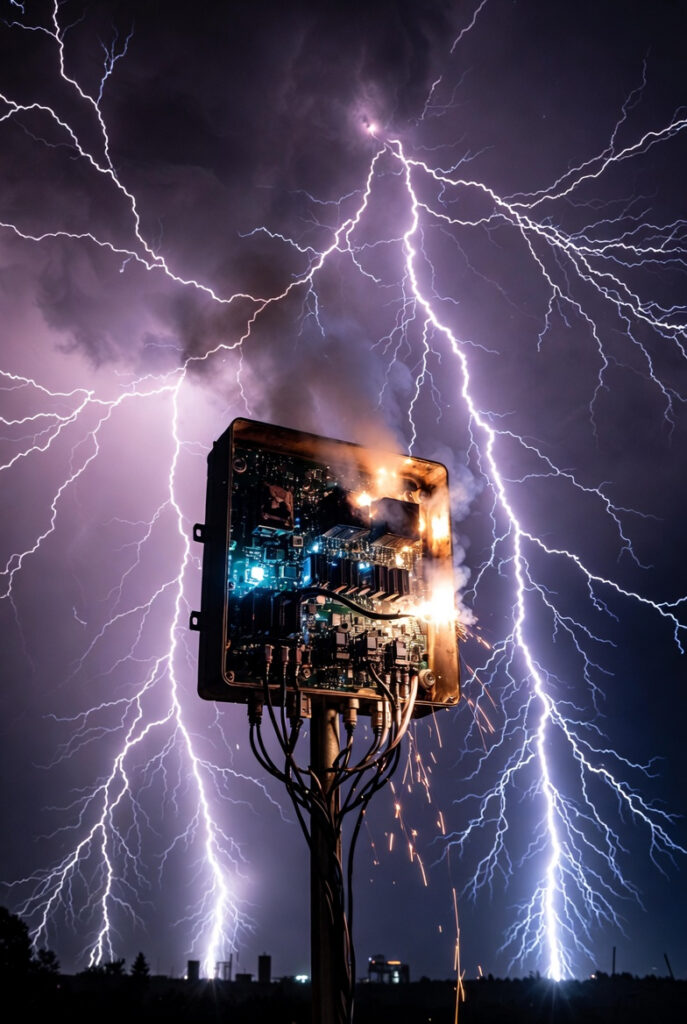
A lightning arrestor solar installation is the $120 component that stands between a summer Rockwood thunderstorm and a $280 fried charge controller and the lightning does not need to hit your array directly to destroy it. A strike 100 metres away in the back of the property induces a voltage spike in your solar homerun cables through electromagnetic induction Faraday’s law applied to a 50-metre conductor loop at the speed of light. That spike travels down the homerun cable into the MPPT input terminals and destroys the MOSFET protection circuit in microseconds. The arrestor sacrifices itself. The inverter lives. Before understanding the lightning arrestor solar standard understand how much solar power you actually need the system voltage and string configuration determine which SPD specification is correct.
Lightning Arrestor Solar: The Inductive Coupling Physics
What inductive coupling is: When lightning strikes the ground it releases an enormous burst of electrical energy a current pulse of 10,000-300,000 amps flowing from cloud to ground in approximately 1-2 milliseconds. This current pulse creates a rapidly changing magnetic field that radiates outward from the strike point. Any conductor within this changing magnetic field including your solar homerun cables, battery interconnect cables, and inverter AC output cables experiences an induced electromotive force described by Faraday’s law: V_induced = -N × dΦ/dt where dΦ/dt is the rate of change of magnetic flux through the conductor loop.
Why the induced voltage is dangerous without a direct hit: A 50-metre solar homerun cable running from a rooftop array to the equipment room forms a conductor loop with an area of approximately 50m × 2m = 100 square metres. At a strike distance of 100 metres the rate of change of magnetic flux through this loop during a lightning stroke can produce induced voltages of 1,000-10,000 volts far above the breakdown voltage of the MOSFETs in a solar charge controller (typically 60-100V for a 48V system). The MOSFET input protection circuit a $5 component inside a $280 charge controller vaporizes. The charge controller is a brick.
Why the cable is an antenna: Solar homerun cables are particularly vulnerable to inductive coupling because they run long distances typically 20-50 metres and because they are elevated on roof mounting structures that maximize the conductor loop area with respect to the ground. As covered in our Series Parallel Solar Wiring guide a series string configuration increases the string voltage and the higher the string voltage the less additional induced voltage is required to exceed the MOSFET breakdown threshold.
I arrived at a Rockwood property last August a client called the morning after a significant thunderstorm. The Victron SmartSolar MPPT was completely dark. No VRM data since 11:47pm the previous evening the exact time of the closest lightning strike. I examined the MPPT the PV input terminals showed characteristic burn marks at the input protection circuit location. The lightning had struck a large maple tree approximately 80 metres from the array not the array itself. The inductive pulse had traveled down the unprotected 45-metre homerun cable and destroyed the MPPT input MOSFETs. The Victron Cerbo GX survived it is connected to the MPPT output side, downstream of the destroyed input protection. The client’s face when I explained that a $120 lightning arrestor solar installation would have protected the $280 MPPT was the face of someone who had just learned an expensive lesson. A new MPPT and the lightning arrestor installation total cost $420. The lightning arrestor alone would have been $120. As covered in our Drip Loop Solar guide moisture damage and lightning induction are the two most common causes of charge controller failure in Ontario off-grid installations.
The MOV Technology – How the Sacrificial Lamb Works
What a Metal Oxide Varistor is: A Metal Oxide Varistor MOV is the active element inside a lightning arrestor. It is a semiconductor device made from zinc oxide granules pressed into a disc, the grain boundaries between the zinc oxide granules form a network of back-to-back diode junctions that are non-conductive below the MOV’s clamping voltage and highly conductive above it. The clamping voltage is set by the manufacturer based on the MOV’s zinc oxide composition and compression density.
How the MOV clamps a surge: During normal operation at system voltage 48-100V DC on the solar string the MOV presents very high resistance (megohms) and carries essentially zero current. When a lightning-induced voltage spike arrives at the MOV terminals the voltage rises above the clamping threshold – typically 150-300V depending on the arrestor model. At this threshold the MOV resistance drops from megohms to milliohms instantaneously. The surge current diverts through the MOV to the grounding electrode bypassing the connected electronics entirely. The diversion happens in nanoseconds faster than the surge can damage the connected equipment. When the surge passes the MOV resistance returns to megohms and normal operation resumes.
Why the MOV sacrifices itself: Each surge event causes some physical damage to the zinc oxide granule boundaries a small amount of grain boundary degradation from the energy dissipated during clamping. After many surge events or one very large surge the cumulative damage degrades the MOV’s clamping voltage and increases its standby current consumption. Eventually the MOV fails either by opening (no longer clamping) or by shorting (conducting continuously at system voltage). The arrestor sacrifices its MOV to protect the connected equipment. That is the design. That is correct operation.
The indicator window: Quality lightning arrestors including the Midnite Solar lightning arrestor have a visual indicator window that shows green when the MOV is intact and red when the MOV has failed and the arrestor requires replacement. Check the indicator window at every annual inspection as part of the protocol covered in our MC4 Connector Maintenance guide.
I installed a Midnite Solar lightning arrestor on a new Rockwood Fortress build last spring and explained the MOV technology to the client while mounting it. I held up the arrestor and described the zinc oxide disc inside the grain boundaries that are non-conductive at normal voltage and conductive at surge voltage. I explained that if lightning induces a 5,000-volt spike in the homerun cable the arrestor sees 5,000 volts, becomes conductive in nanoseconds, diverts 5,000 volts to the ground rod, and the Victron SmartSolar MPPT sees nothing unusual. The arrestor might show red in the indicator window after a large event which means it worked and needs replacing for $120 but the MPPT is intact. The client said: so it jumps on the grenade. Exactly. That is the lightning arrestor solar standard.
The Dual-Side SPD Requirement – DC and AC Protection
Why both sides need protection: The solar array produces DC current the lightning inductive surge enters the system from the DC side through the solar homerun cables. The inverter produces AC output a generator connection or utility tie-in introduces surge risk from the AC side through the AC input cables. A single SPD on the DC side protects the charge controller from inductive surges on the solar string. It does not protect the inverter AC input from surges entering through the generator cable or AC distribution panel. Both sides require protection.
DC-side lightning arrestor solar installation: The DC-side SPD installs on the positive and negative solar string conductors between the solar combiner box output and the MPPT charge controller input. The SPD connects from the positive conductor to ground and from the negative conductor to ground. When a surge arrives on either conductor the corresponding MOV clamps the voltage and diverts the surge to the grounding electrode. As covered in our Grounding Electrode guide the grounding electrode must be properly installed and of adequate conductance to absorb the surge current a poorly grounded SPD has nowhere to divert the surge energy.
AC-side SPD installation: The AC-side SPD installs at the inverter AC output or the main AC distribution panel between the inverter output and the load panel. It protects against surges entering through the AC distribution generator startup transients, utility connection surges, and any inductive coupling on the AC cable runs. The Midnite Solar MNPV6 includes both DC and AC SPD positions in a single enclosure the correct specification for a complete Fortress lightning protection installation.
The grounding electrode connection: The SPD ground terminal must connect directly to the grounding electrode conductor — not to the equipment ground bus. The surge current from a lightning-induced event is too large for the equipment grounding conductors routing it through the equipment ground bus instead of directly to the grounding electrode can produce dangerous voltage rises on the grounding conductors and damage other connected equipment. As covered in our Chassis Ground Solar guide the central grounding busbar is the convergence point where the SPD ground terminal, the equipment ground network, and the grounding electrode conductor all meet the direct path to earth.
What the Lightning Arrestor Does Not Protect Against
The direct strike limitation: A lightning arrestor solar installation does not protect against a direct lightning strike to the solar array itself. A direct strike delivers 10,000-300,000 amps at 1-100 million volts far beyond the energy absorption capacity of any residential MOV-based arrestor. A direct strike destroys the array, the cables, the mounting structure, and any connected equipment regardless of SPD installation. The arrestor sacrifices itself in this scenario but the sacrifice is insufficient to protect the connected equipment from the enormous direct strike energy.
What the arrestor does protect against: The lightning arrestor solar installation protects against induced surges from nearby strikes the far more common scenario. A nearby strike 50-500 metres away induces voltage spikes of 1,000-10,000 volts in the cable runs. These induced spikes are within the energy absorption capacity of a properly specified MOV-based arrestor. This is the failure mode that destroyed the Rockwood MPPT induced surge from a nearby strike, not a direct hit.
NEC 285 and CEC Section 64 – The Code Standard
NEC 285 – USA: National Electrical Code Article 285 governs surge protective devices. NEC 285.3 specifies the installation requirements for SPDs including the connection to the grounding electrode system and the requirement that the SPD be listed for the application voltage and current rating. For a 48V off-grid solar DC system the SPD must be listed for DC applications at or above the maximum system voltage including cold weather VOC as covered in our Series Parallel Solar Wiring guide.
CEC Section 64 – Canada: The Canadian Electrical Code Section 64 for photovoltaic systems recommends surge protection for solar arrays particularly for installations in areas of high lightning incidence. The CEC Section 64 recommendation becomes an effective requirement when insurance coverage for storm damage is considered as covered in our Surge Protection guide the absence of an SPD on a documented lightning damage claim provides the insurer with a clear path to partial or full claim denial.
Quick Reference – Lightning Arrestor Solar Installation Standards
| Location | SPD Type | Clamping Voltage | Connection | Inspection |
|---|---|---|---|---|
| DC side — solar string | DC-rated MOV SPD | 150-300V above string VOC | Positive and negative to grounding electrode | Annual — check indicator window |
| AC side — inverter output | AC-rated MOV SPD | 300-600V | Line and neutral to grounding electrode | Annual — check indicator window |
| Grounding electrode connection | Direct to grounding electrode conductor | N/A | Not through equipment ground bus | Annual — confirm connection integrity |
| Indicator window | Visual MOV status | Green = intact, Red = failed | N/A | Replace immediately if red |
Pro Tip: Replace the lightning arrestor immediately if the indicator window shows red do not wait for the next maintenance cycle. A red indicator means the MOV has sacrificed itself on a surge event the arrestor is no longer providing protection. Operating the system with a failed arrestor after a storm event is operating without any surge protection during the period when subsequent strikes are most likely Ontario summer thunderstorms typically produce multiple strike events in quick succession. Keep a spare arrestor in the equipment room labeled SPARE LIGHTNING ARRESTOR REPLACE IMMEDIATELY IF INDICATOR SHOWS RED. As covered in our Solar System Labeling guide the label and the spare together make the replacement a 5-minute task rather than a 3-day parts wait.
The Verdict
A lightning arrestor solar installation is the $120 sacrificial lamb that protects a $280-3,000 electronics investment from the most common electrical threat to off-grid systems the induced surge from a nearby strike.
Three steps to implement the lightning arrestor solar standard today:
- DC-side SPD – install between solar combiner output and MPPT input connected to grounding electrode directly
- AC-side SPD – install at inverter AC output or main panel connected to grounding electrode directly
- Annual inspection – check indicator window replace immediately if red keep a spare in the equipment room
The arrestor jumps on the grenade. Let it.
Disclosure: This article contains affiliate links. If you buy through them, GridFree Guide earns a small commission at no extra cost to you.
Questions? Drop them below.