
Proper heat shrink battery cable sealing is the $0.50 step that protects a $500 lug-and-cable assembly from the silent killer that dismantles cold welds from the inside creeping oxidation driven by moisture wicking up fine copper strands through capillary action. You spent $100 on the hydraulic crimper. You produced a cold weld that could pull a truck. And then you left the lug barrel entry point open to the air in your Rockwood barn equipment room. That gap is an invitation. Moisture enters. Copper oxidizes. Resistance rises. The cold weld holds forever but the cable feeding it corrodes from within. Before understanding the seal standard understand how much solar power you actually need the system current determines how much heat a corroded cable section generates.
Heat Shrink Battery Cable: The Capillary Wicking Problem
What capillary wicking is: Fine-stranded copper cable the flexible 4/0 AWG cable used for battery connections consists of hundreds of individual copper strands bundled together. The spaces between those strands are microscopic capillary channels. Water molecules are attracted to copper surfaces by adhesion forces that exceed the gravitational force on the water column in a channel this small. The result: liquid water and water vapor that condenses on the copper surface travels up the cable against gravity through the inter-strand spaces. The wicking distance depends on the strand count and strand diameter finer strands produce smaller capillary channels and longer wicking distances. In a 4/0 AWG fine-stranded cable the wicking distance can exceed 50-75mm from the point of moisture entry.
Why the lug barrel entry point is the problem: The lug barrel entry point the open end of the copper lug barrel where the cable enters is the first point of exposure for the copper strands. The cable jacket covers the strands up to the strip point. The lug barrel covers the strands from the strip point to the barrel end. The strands are covered everywhere except at that junction where jacket meets barrel. Without heat shrink battery cable sealing this junction is an open capillary entry point for every humidity cycling event in the equipment room every Ontario winter, every spring thaw, every summer storm.
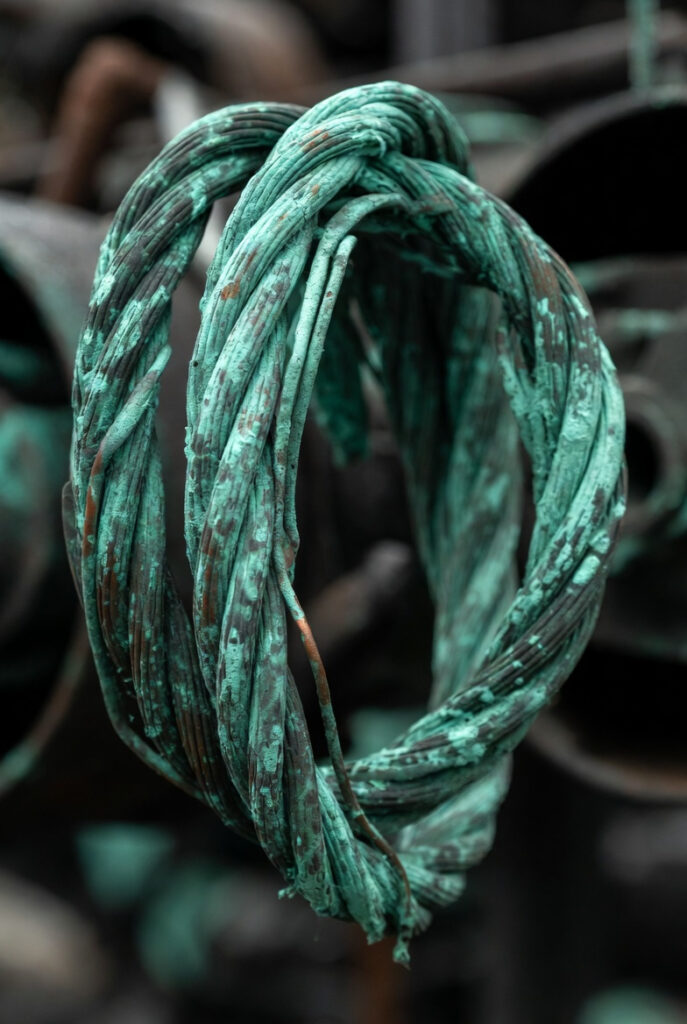
The oxidation progression: Copper oxidizes in the presence of oxygen and moisture forming copper oxide and copper hydroxide compounds that appear as green or black surface deposits. The initial oxidation occurs at the exposed strand surfaces at the lug entry point. As the moisture wicks up the strands the oxidation front follows progressing up the capillary channels into the covered section of the cable where it cannot be seen or detected without cutting the cable open. The resistance of the oxidized section increases progressively as the oxide layer thickens. It grows continuously. There is no stabilization. It only gets worse.
I cut open a 200A positive battery cable on a Rockwood barn solar installation last autumn three years old, unexplained voltage drop under heavy load. The cable looked perfect from the outside black jacket intact, lug torqued correctly, paint pen mark unbroken. I cut the cable 60mm back from the lug barrel and exposed the strands. Green oxidation extended 42mm up the strand bundle from the lug entry point. Forty-two millimetres of corroded copper inside a cable that looked factory fresh on the outside. Three Ontario winters of humidity cycling had wicked moisture up the strands and the oxidation had followed it every millimetre of the way. As covered in our Tinned Copper guide tinned copper resists this oxidation but the tin coating ends at the strip point, and without a heat shrink battery cable seal the entry point is unprotected regardless of whether the cable is tinned or bare copper.
The Dual-Wall Adhesive-Lined Construction – Why Standard Heat Shrink Fails
What single-wall heat shrink does and doesn’t do: Standard single-wall heat shrink tubing is a polyolefin sleeve that shrinks when heated typically to 50% of its original diameter at 120°C. It provides mechanical protection abrasion resistance and electrical insulation. It does not provide moisture sealing. Single-wall heat shrink shrinks around the lug barrel and cable jacket but does not bond to either surface. Moisture can enter the gap between the tubing inner wall and the cable surface through the same capillary channels that caused the original problem. Single-wall heat shrink looks like protection. It is not protection.
What dual-wall adhesive-lined heat shrink actually does: Dual-wall adhesive-lined heat shrink has two layers an outer polyolefin wall that provides the mechanical shrink and an inner adhesive wall typically a hot-melt thermoplastic adhesive that melts at approximately 80-90°C during the shrink process. As the outer wall shrinks it compresses the molten inner adhesive against the cable jacket and lug barrel surfaces. The adhesive flows into every surface irregularity including the inter-strand spaces at the lug entry point and bonds to both the polyolefin outer wall and the surfaces beneath it. When the assembly cools the adhesive solidifies creating a hermetic seal at both ends. Moisture cannot enter because there is no gap. The adhesive has filled every potential entry path.
The 3:1 shrink ratio requirement: Marine-grade adhesive-lined heat shrink for battery lug applications uses a 3:1 shrink ratio the tubing shrinks to one-third of its original diameter. This ratio is necessary to accommodate the diameter transition from the cable jacket to the lug barrel the lug barrel is typically 50-80% larger in diameter than the cable jacket. A 2:1 shrink ratio tubing may not shrink sufficiently to seal against both the barrel and the jacket across this transition zone. Always verify the shrink ratio on the packaging before purchasing. If it does not say 3:1 and adhesive-lined it is not the right product.
The Correct Application Procedure
Slide it on before you crimp – always: The heat shrink tubing must be slid onto the cable before crimping the lug. Once the lug is crimped the ring terminal end prevents the tubing from sliding over the lug barrel you cannot retrofit it without cutting the lug off and starting over. Slide the correctly sized dual-wall adhesive-lined heat shrink onto the cable and move it back at least 150mm from the strip point before picking up the WBHome hydraulic crimper. This is the step that catches builders off guard. Once. Never again.
Sizing the heat shrink: The tube must fit over the lug barrel before shrinking, shrink down to seal against the cable jacket, and cover the full lug barrel length plus 20-25mm of cable jacket at each end providing adhesive seal overlap at both ends of the transition zone.
The application procedure:
- Slide the correctly sized dual-wall adhesive-lined heat shrink onto the cable before crimping move it back 150mm from the strip point
- Complete the hex crimp as covered in our Battery Cable Crimping guide
- Slide the heat shrink forward over the lug barrel centered so it extends 20-25mm onto the cable jacket and 20-25mm onto the lug barrel
- Apply the heat gun starting at the center of the tube working outward toward both ends, this drives the adhesive toward the ends rather than trapping air in the center
- Watch for adhesive squeeze-out at both ends, a small amber bead of adhesive appearing at both ends confirms the hermetic seal is complete
- Allow to cool completely before handling, the adhesive is molten during application and must solidify before the connection is moved
The color coding standard: Red dual-wall adhesive-lined heat shrink for positive. Black for negative. Every time. The color coding tells anyone who opens the equipment room which cable is which without tracing it and as covered in our Solar System Labeling guide it signals to an ESA inspector or insurance adjuster that this system was built by someone who knew what they were doing.
I was sealing the freshly crimped 4/0 AWG positive cable on a client’s Fortress build last winter. Slid the red dual-wall heat shrink over the lug, centered it, applied the heat gun from the middle outward. The client was watching. As the tubing shrank I could see the adhesive beginning to move toward both ends a thin amber bead appearing at the cable jacket end first, then at the lug barrel end a few seconds later. The client said: what is that coming out? That is the adhesive sealing the connection. He watched both beads form and stabilize. He said: so nothing can get in there now? Nothing. Not in Rockwood. Not in January. Not ever. That is the heat shrink battery cable standard.
The Strain Relief Benefit – Why the Mechanical Protection Matters
What fatigue failure is: Every time a cable flexes during installation, maintenance access, or thermal expansion and contraction the flex stress concentrates at the transition between the rigid lug barrel and the flexible cable. This is the highest-stress point in the cable assembly. Over thousands of flex cycles the copper strands at this transition fatigue individual strands break the effective conductor cross-section decreases the resistance increases. In a correctly sealed heat shrink battery cable assembly the adhesive-lined boot bridges this transition distributing the flex stress over a longer section of cable rather than concentrating it at the lug entry point.
The strain relief radius: The minimum bend radius for 4/0 AWG cable is approximately 50-75mm. The heat shrink boot extending 20-25mm beyond the lug barrel onto the cable jacket prevents the cable from bending at a radius tighter than the boot length allows. The boot is both a moisture seal and a mechanical constraint. One component. Two jobs.
UL 486D and CEC Environmental Protection – The Code Standard
UL 486D – USA: UL Standard 486D governs insulating and jacketing materials for wire and cable. The standard addresses environmental protection requirements for conductor terminations including moisture resistance and mechanical protection. Dual-wall adhesive-lined heat shrink that meets UL 486D provides the environmental protection rating required for battery cable lug connections in locations subject to moisture including unconditioned equipment rooms, barn installations, and seasonal cabin environments like Rockwood and Guelph.
CEC Environmental Protection – Canada: The Canadian Electrical Code workmanlike manner requirement as applied to off-grid energy storage system installations in environments subject to humidity and temperature cycling requires that conductor terminations be protected from environmental degradation. A bare lug barrel entry point in a Rockwood barn equipment room that experiences -30°C winters and +35°C summers with humidity cycling between both extremes is exactly the environment where sealed terminations are required. The dual-wall adhesive-lined heat shrink battery cable seal satisfies this requirement. As covered in our Busbar Layout Solar guide the equipment room environment standard requires protection from all degradation mechanisms oxidation through unsealed lug entries is in the same category as heat through bundled cables.
Quick Reference Heat Shrink Battery Cable Selection Guide
| Application | Heat Shrink Type | Shrink Ratio | Color Standard | Adhesive Required? |
|---|---|---|---|---|
| Battery positive lug -any gauge | Dual-wall adhesive-lined | 3:1 minimum | Red | Yes — mandatory |
| Battery negative lug – any gauge | Dual-wall adhesive-lined | 3:1 minimum | Black | Yes — mandatory |
| Indoor signal wiring | Single-wall | 2:1 acceptable | Any | No — optional |
| DC bus connections – all | Dual-wall adhesive-lined | 3:1 minimum | Red/Black | Yes — mandatory |
| AC wiring terminations – indoor | Single-wall acceptable | 2:1 acceptable | Any | No — optional |
Pro Tip: Apply heat shrink battery cable sealing to every lug in the system during commissioning not as a retrofit after the system is running. Retrofitting heat shrink onto a crimped lug that is already installed requires cutting the lug off and recrimping because the ring terminal end prevents the tubing from sliding over the barrel. The cost of doing it correctly at commissioning is $0.50 of tubing per lug. The cost of the retrofit is one lug, one cable section, and 30 minutes of work per connection. Do it once. Do it correctly. As covered in our Battery Fortress guide the commissioning checklist includes heat shrink sealing on every battery cable lug it is not optional and it is not a retrofit item.
The Verdict
Heat shrink battery cable sealing is the $0.50 step that protects a $500 cable assembly from three years of capillary wicking and creeping oxidation.
Three steps for every lug – every time:
- Slide the correctly sized dual-wall adhesive-lined heat shrink onto the cable before crimping – red for positive, black for negative do not skip this step
- After crimping position it centered over the lug barrel with 20-25mm overlap onto the cable jacket at both ends
- Apply the heat gun from center outward, watch for the amber adhesive squeeze-out at both ends that bead is the hermetic seal confirming the moisture is locked out
If you can see the copper strands the moisture can see them too. Seal every lug. Every time.
Disclosure: This article contains affiliate links. If you buy through them, GridFree Guide earns a small commission at no extra cost to you.
Questions? Drop them below.