
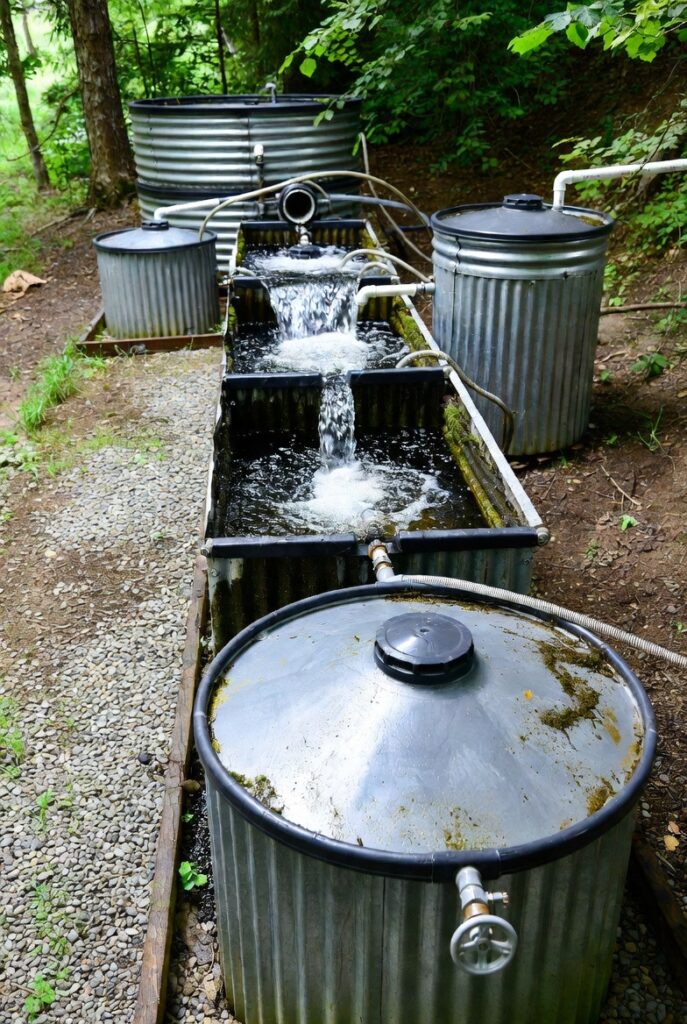
Off-grid greywater requires proper classification and treatment under Ontario regulations that most property owners do not know exist. I helped a property owner near Bancroft in Hastings County, Ontario respond to a health unit violation in spring 2025. He had run a 2-inch PVC pipe from his washing machine directly into a gravel-filled pit behind his cabin. The local health unit inspector found the discharge during a routine septic inspection. His off-grid greywater system was classified as an illegal Class 2 sewage system.
I examined his situation and explained the regulatory problem. In Ontario, any greywater leaching pit is legally a Class 2 sewage system under Ontario Building Code. Class 2 systems require permits, inspections, and specific construction standards. His PVC pipe into gravel violated every requirement. The inspector gave him 60 days to remediate or face fines starting at $500 per day. His off-grid greywater discharge had seemed harmless but created serious legal exposure.
I helped him install a compliant multi-stage biological filter system. We used a Biolan Greywater Filter rated for 600 litres daily. The filter sits in his heated crawlspace to prevent freezing. The discharge line runs 48 inches deep to a proper gravel leach bed with sub-surface distribution. His total cost was $1,400 for the filter and $800 for excavation and gravel. His off-grid greywater now meets Class 2 requirements with permit and inspection completed. For the water supply that feeds greywater production, The Off-Grid Water Standard covers the approach.
Why Off-Grid Greywater Is Classified as Class 2 Sewage in Ontario
Off-grid greywater classification as Class 2 sewage exists because untreated greywater contains contaminants that affect groundwater and soil. The Bancroft owner assumed greywater was harmless because it contained only soap and water. However, greywater contains phosphorus, nitrogen, bacteria, and suspended solids.
These contaminants accumulate in soil and can reach groundwater over time. His off-grid greywater discharge was contaminating his own well catchment area without his knowledge.
Class 2 classification ensures proper treatment and setback distances from water sources. The Ontario Building Code requires permits and inspections to prevent contamination of drinking water supplies.
The Class 2 Problem: When a PVC Pipe Becomes a Sewage Violation
The Class 2 problem catches property owners who assume greywater is unregulated. A simple pipe into a gravel pit seems like a reasonable solution for wastewater. However, Ontario Building Code classifies any subsurface discharge of wastewater as a sewage system.
The Bancroft owner’s 2-inch PVC pipe became a Class 2 sewage system the moment he buried it. His lack of permit made it an illegal system subject to enforcement action.
The health unit violation carried potential fines of $500 per day until remediation. Many property owners face similar surprises during routine septic inspections.
Multi-Stage Biological Filtration: How Microorganisms Process Waste
Multi-stage biological filtration uses living microorganisms to break down soaps and organic matter. The first stage settles heavy particles and solids. The second stage passes water through organic media colonized by bacteria. The bacteria consume fats, oils, and soap residue continuously.
The third stage polishes water before discharge to the leach bed. The Bancroft owner’s Biolan filter removes 95% of contaminants before water reaches soil.
The biological process converts harmful waste into simple compounds that soil can safely absorb. This method provides reliable long-term treatment without chemical inputs.
Kitchen Sink Water: The High-Load Classification
Kitchen sink water is classified as high-load greywater due to food particles, grease, and meat bacteria. Shower and laundry water contain primarily soap and body oils. Kitchen water adds significant biological load from food preparation activities.
Raw meat contact introduces potential pathogens absent from other greywater sources. The 2026 Ontario Building Code requires enhanced treatment for kitchen greywater.
The Bancroft owner installed a grease trap before his main filter to handle kitchen load. Never connect kitchen sinks to simple irrigation systems designed for shower water only.
The 24-Hour Rule: When Greywater Becomes Blackwater
The 24-hour rule exists because bacteria in standing greywater multiply rapidly. Bacterial count doubles approximately every 20 minutes in warm conditions. After 24 hours, greywater contains enough bacteria to be classified as blackwater.
Storage tanks holding greywater for later use become sewage tanks within a day. The Bancroft owner’s old gravel pit held water for several days before soaking in.
His discharge was technically sewage by the time it reached soil. Treat and disperse greywater within 24 hours of production to maintain proper classification.
Winter Thermal Protection: The 48-Inch Frost Line Requirement
I was troubleshooting a greywater backup with a property owner near Bobcaygeon in Kawartha Lakes, Ontario in January 2025. His washing machine had stopped draining mid-cycle. His greywater filter showed no blockage. His discharge line ran 18 inches deep across 40 feet to his leach bed. The line had frozen solid during a minus 25°C cold snap. His off-grid greywater system had become a winter liability.
I examined his installation and found the problem. His discharge line sat above the 48-inch frost line for the region. The line ran horizontally with no slope for the first 15 feet. Water pooled in the flat section and froze into a solid plug. His off-grid greywater backed up into his filter and nearly overflowed into his crawlspace. The ice plug took three days to thaw after we ran heat tape along the exposed section.
I helped him rebuild the discharge line properly. We excavated to 52 inches deep and installed new pipe with continuous 2% slope. We added a vertical drop at the filter outlet to prevent standing water in the line. The new line runs below frost line for the entire 40-foot run. His total cost was $1,200 for excavation and new pipe. His off-grid greywater now drains reliably at minus 30°C without heat tape or backup risk. For the heating system that keeps his crawlspace above freezing, The Off-Grid Heating Standard covers the approach.
Sub-Surface Discharge: Preventing Human Contact and Odors
Sub-surface discharge is required because surface greywater creates health hazards and nuisance odors. Even treated greywater contains bacteria and nutrients that should not contact skin. Surface discharge attracts insects and creates slippery conditions.
Ponding greywater produces odors as bacteria decompose organic matter in warm weather. The Bancroft owner’s leach bed sits 12 inches below grade with gravel distribution layer.
Water disperses through soil without ever reaching surface. Proper sub-surface design eliminates contact risk and odor complaints from neighbors.
Bio-Safe Detergents: Keeping Your Filter Microorganisms Alive
Bio-safe detergents are required because standard products kill the microorganisms that process greywater. Boron in traditional detergents is toxic to filter bacteria. Chlorine bleach sterilizes biological filters within days of exposure.
The Bancroft owner switched to Seventh Generation and similar boron-free chlorine-free products. His filter maintains healthy microbial colonies that process 95% of soap residue.
Using standard “Ultra” whitener detergents turns a biological filter into a simple settling tank. The filter still removes solids but no longer breaks down dissolved contaminants.
The Off-Grid Greywater Strategy: Biological Filtration and Compliance
The off-grid greywater strategy combines biological filtration with proper thermal protection and discharge design. The filter sits in a heated space or below frost line to prevent freezing. The discharge runs below 48 inches with continuous slope for reliable drainage.
A Victron SmartShunt tracks pump power consumption for distribution systems requiring pressure. The monitoring ensures efficient operation of any pumped components.
The Bancroft owner’s complete strategy handles 600 litres daily with MECP-compliant phosphorus and nitrogen levels. His off-grid greywater now meets all Class 2 requirements with documented permit and inspection.
Planning Your Off-Grid Greywater System: Components and Costs
Planning your off-grid greywater system starts with identifying your sources and daily volume. Count showers, laundry loads, and sink usage to estimate litres per day. The Bancroft owner produces approximately 400 litres daily from two occupants. His 600-litre filter provides 50% capacity buffer for peak usage days.
A Victron Cerbo GX tracks overall system power including water pumps and treatment components. Reference Ontario Building Code for current Class 2 requirements.
Your off-grid greywater investment protects groundwater and ensures legal compliance. The cost is minimal compared to health unit fines and remediation orders.
Minimum Viable vs Full Standard: Choosing Your Treatment Level
The off-grid greywater approach offers two treatment levels depending on your volume and source mix. The minimum viable level handles shower and laundry only. The full standard includes kitchen treatment and biological filtration.
| Treatment Level | Key Components | Cost | Daily Capacity |
|---|---|---|---|
| Minimum Viable | Settling tank + gravel discharge + bio-safe detergents | $400-$800 | 200-400 L |
| Full Standard | Biological filter + kitchen treatment + frost line burial | $2,000-$3,500 | 600-1,000 L |
Both off-grid greywater approaches require Class 2 permits in Ontario. The difference is treatment sophistication and volume capacity. Properties with kitchen connections or higher occupancy should consider the full standard.
Frequently Asked Questions
Q: Why is off-grid greywater classified as Class 2 sewage in Ontario?
A: Off-grid greywater is classified as Class 2 sewage because untreated greywater contains phosphorus, nitrogen, bacteria, and suspended solids that affect groundwater quality. Ontario Building Code classifies any subsurface wastewater discharge as a sewage system. The Bancroft owner’s simple PVC pipe into gravel became an illegal Class 2 system requiring remediation. Off-grid greywater requires permits, inspections, and specific treatment standards regardless of source or volume.
Q: How deep must off-grid greywater discharge lines be buried in Ontario?
A: Off-grid greywater discharge lines must be buried below the frost line, which is 48 inches in most of southern Ontario. The Bobcaygeon owner’s 18-inch deep line froze solid at minus 25°C and backed up into his crawlspace. His rebuilt line runs 52 inches deep with continuous 2% slope and vertical drop at the filter outlet. Off-grid greywater lines above frost line become winter liabilities that can damage filters and flood buildings.
Q: What detergents are safe for off-grid greywater biological filters?
A: Off-grid greywater biological filters require boron-free and chlorine-free detergents to keep filter microorganisms alive. Standard detergents containing boron kill filter bacteria within weeks. Chlorine bleach sterilizes biological filters within days. The Bancroft owner uses Seventh Generation and similar bio-safe products. Off-grid greywater filtration fails without detergent discipline because dead microorganisms cannot process soap and fat residue.
Pro Tip: Your off-grid greywater system is only as good as what you put into it. The Bancroft owner switched to boron-free detergents and his filter maintains healthy microbial colonies. His off-grid greywater now processes 95% of soap residue before reaching soil. Use bio-safe products for every load of laundry and every dish wash. Standard detergents turn your biological filter into an expensive settling tank.
Verdict
- The Class 2 Off-Grid Greywater Compliance Standard. The Bancroft owner ran a PVC pipe into a gravel pit and received a health unit violation with $500 daily fines because greywater leaching pits are Class 2 sewage systems in Ontario. His $2,200 investment in a Biolan biological filter and proper leach bed now handles 600 litres daily with MECP-compliant phosphorus and nitrogen levels. His off-grid greywater meets all permit and inspection requirements.
- The Frost Line Burial Standard. The Bobcaygeon owner’s 18-inch deep discharge line froze solid at minus 25°C, backing up into his crawlspace and nearly flooding his filter. His $1,200 excavation to 52 inches with continuous 2% slope and vertical drop at the outlet eliminated winter backup risk. His off-grid greywater now drains reliably at minus 30°C without heat tape.
- The Bio-Safe Detergent Standard. Biological filters depend on living microorganisms that standard boron and chlorine detergents kill within weeks. The Bancroft owner switched to Seventh Generation and similar products to maintain healthy microbial colonies. His filter processes 95% of soap residue before water reaches soil instead of functioning as a simple settling tank.
This build is engineered within the 48V DC Safety Ceiling. Diagnostic logic is based on 20+ years of technical service experience. All structural and electrical installations must be verified by a Licensed Professional and comply with your Local AHJ.
This article contains affiliate links. If you purchase through these links, I earn a small commission at no extra cost to you.
Questions? Drop them below.