
A 4/0 cable runs straight from the battery to the inverter. No switch. To swap a fuse the owner has to work on a live system touching terminals connected directly to a battery capable of 15,000A fault current. Every time he cleans a busbar connection he is working on a loaded gun. A dc disconnect switch off grid installation is not just for emergencies. It is for every maintenance task, every seasonal shutdown, every moment you need to zero the energy before touching anything. Before building your protection system understand how much solar power you actually need so you know what current your disconnect needs to handle.
A client called me at 11pm on a Thursday in January. His inverter was making a grinding noise and he could smell something burning. I told him to find the DC disconnect and throw it immediately. He said he did not have one. The only way to disconnect the inverter from the battery was to unbolt the main positive cable at the battery terminal live in a dark equipment room at -20°C. He burned his hand on a spark. We installed a Blue Sea Systems 3001 disconnect the following weekend. That 11pm call is why every system needs an accessible emergency brake within reach of the door.
DC Disconnect Switch Off Grid: Why Every System Needs One
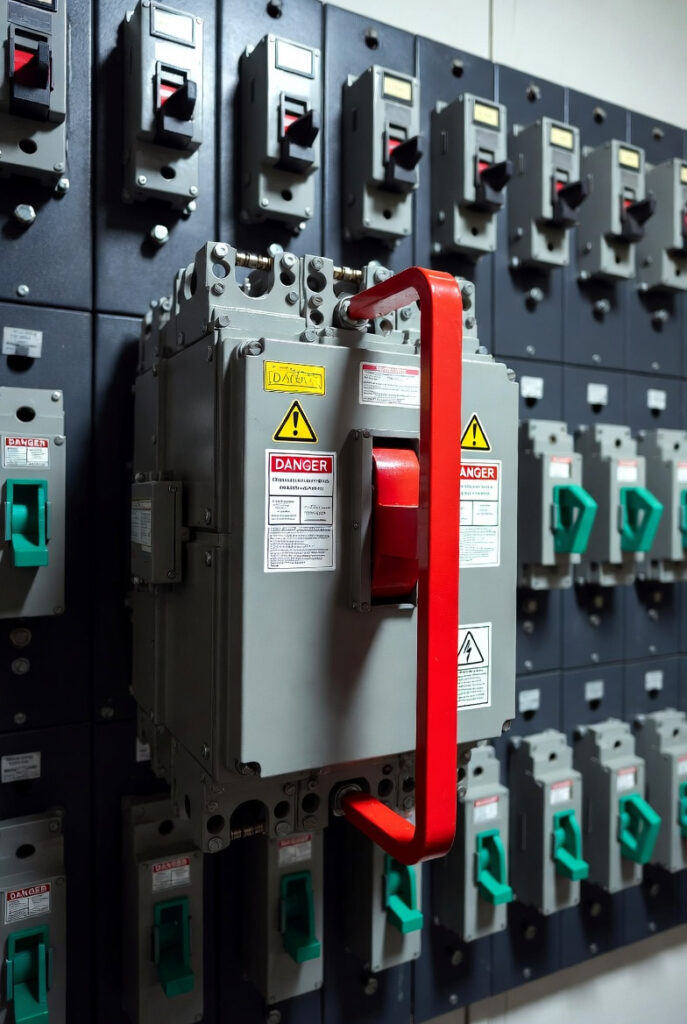
What a DC disconnect switch does: A DC disconnect switch is a rated switching device in the main positive cable between the battery bank and the inverter or between the battery and the entire DC distribution system. It provides a single point of intentional disconnection that can be operated quickly without tools. Throw the switch zero energy in the downstream system instantly.
The three situations that require it:
- Emergency: Inverter failure, burning smell, electrical smoke, flooding — any situation requiring immediate isolation of the battery from the system. Kill power in under two seconds without touching live terminals.
- Maintenance: Replacing a fuse in the Lynx Distributor, cleaning busbar connections, replacing the inverter, adding a new circuit — any task that requires de-energizing the DC system safely before touching anything.
- Seasonal shutdown: Leaving the cabin for the winter. One switch — battery isolated from all loads. No phantom draws. No risk from an unattended system.
Why no disconnect means working live: Without a dc disconnect switch off grid the only way to de-energize the system is to physically remove the main battery cable at the terminal a live operation on a battery capable of delivering fault currents measured in thousands of amps. Every removal creates a spark. Every spark is a risk. The disconnect switch makes this a zero-risk one-second operation.
Why Cheap Boat Switches Are a Death Trap
The amperage mismatch: A standard marine battery switch from a fishing supply store is typically rated for 100-150A continuous. A 3,000W inverter on a 12V system draws 250A continuous. Running 250A through a 150A rated switch creates a resistive heating element at the switch contacts. The plastic housing softens. The contacts arc at every switching cycle. The switch fails — either open circuit killing power unexpectedly or welded closed making it impossible to disconnect.
The inrush current problem: When a large inverter powers on its capacitor bank draws a massive inrush current — sometimes 1,000-2,000A for 10-50 milliseconds. A cheap switch rated for 150A continuous is not designed for this inrush. Each power-on cycle further damages the contacts. The switch that passes a continuity test today may fail completely under the next inrush event.
The DC arc problem: AC switches are not rated for DC service. DC arcs are significantly harder to extinguish than AC arcs because AC current passes through zero volts 120 times per second providing a natural arc extinction point. DC voltage is constant — the arc sustains. An AC-rated switch used in a DC application will arc and fail at a fraction of its rated current. Always verify DC voltage rating on any disconnect switch.
The Blue Sea Systems Standard
The 3001 HD Series the residential off-grid standard: The Blue Sea Systems 3001 HD Series disconnect is rated for 600A continuous and 2,000A inrush for 0.25 seconds handling any residential off-grid system up to 48V DC. M12 tin-plated copper studs accept 4/0 AWG lugs crimped correctly as covered in our Crimping guide directly. Ignition-protected housing. Surface or rear panel mounting. This is the dc disconnect switch off grid standard for Rockwood cabin builds.
Key specifications:
- Continuous rating: 600A
- Inrush rating: 2,000A for 0.25 seconds
- Voltage rating: 48V DC maximum
- Stud size: M12 accepts 4/0 AWG ring terminals
- Housing: reinforced polycarbonate — ignition protected
The lockout position: Pro-grade DC disconnect switches include a lockable OFF position a hole in the switch knob that accepts a padlock in the OFF position. Lock the switch off before leaving the cabin for the season. No phantom loads. No curious hands accidentally restoring power to an unattended system. No insurance claim from a fault in an unmonitored cabin.
The 3am Smoke Scenario
What happens without a disconnect: You wake up at 3am to a burning smell. The inverter is making a noise it has never made before. You stumble into the equipment room. The only way to kill power is to unbolt the main positive cable at the battery terminal live in the dark at -20°C while the system is actively faulting. This is how people get burned.
What happens with a dc disconnect switch off grid: You wake up at 3am to a burning smell. You reach the equipment room door. The disconnect switch is mounted within reach of the door at approximately 120-130cm height visible, labelled, accessible. You throw the switch. The system is dead in under two seconds. You step back. You call for help from outside the room. Nobody gets burned.
The mounting standard: Mount the dc disconnect switch off grid within reach of the equipment room door not buried behind the battery bank, not mounted at floor level, not hidden behind the inverter. The switch must be accessible to someone standing at the door who may need to operate it quickly without entering the room. 120-130cm height. Door-side wall. Label in large text: MAIN DC DISCONNECT.
Sizing the DC Disconnect for Your System
The sizing rule: The disconnect switch continuous rating must exceed your maximum system current with headroom. For a 12V 3,000W system drawing 250A the switch must be rated for at minimum 300A continuous and 600A is the correct specification because inrush current during inverter startup can reach 1,000-2,000A.
System sizing reference:
- 12V 2,000W (167A): minimum 200A switch – 350A+ recommended
- 12V 3,000W (250A): minimum 300A switch – 600A recommended
- 24V 3,000W (125A): minimum 150A switch – 350A recommended
- 48V 5,000W (104A): minimum 125A switch – 350A recommended verify 48V DC rating
The voltage rating check: Every switch must be rated for the DC voltage of your system. A switch rated for 32V DC is not safe on a 48V system. Verify the DC voltage rating not the AC voltage rating before purchasing. The Blue Sea Systems 3001 is rated for 48V DC correct for all common off-grid system voltages.
Pro Tip: Mount a second smaller disconnect switch on the solar array input between the MPPT charge controllers and the solar panels. This lets you de-energize the charging side of the system independently of the battery disconnect. During maintenance on the MPPT controller or combiner box you want solar input killed without disconnecting the battery. Two disconnects one on battery output, one on solar input gives complete system control from two accessible switches. Label both clearly. Test both monthly by operating through a full switch cycle to verify contacts are clean and operation is smooth.
The Verdict
The dc disconnect switch off grid is the last piece of the safety system. Class T fuse stops the catastrophic fault. Correctly sized cable prevents overheating. Crimped lugs maintain the connection. The disconnect switch gives you control when everything else has gone wrong.
$80-120 for a Blue Sea Systems 3001. Mounted at the door. Labelled clearly. Lockable in the OFF position.
That is the emergency brake. Install it before you need it.
Disclosure: This article contains affiliate links. If you buy through them, GridFree Guide earns a small commission at no extra cost to you.
Questions? Drop them below.