
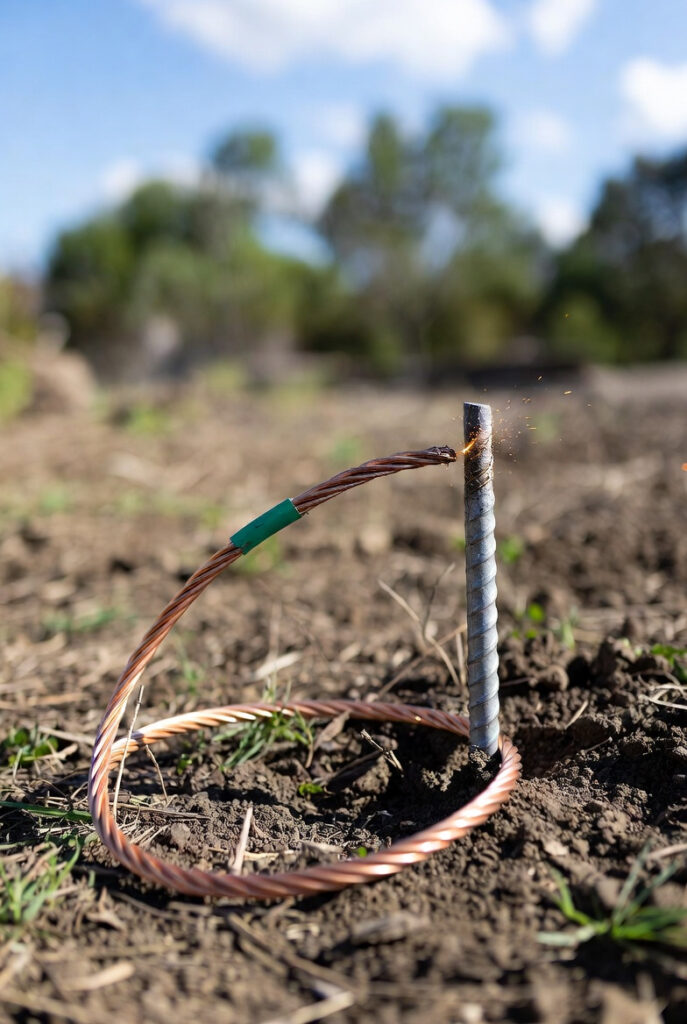
In the service bay if a chassis is not grounded you get stray voltage. It fries sensors and gives technicians a bite. In a 48V off-grid cabin a poor ground is not just a nuisance it is an open invitation for a lightning induction surge to travel through your solar array cables and turn your Victron MultiPlus-II into a very expensive paperweight. A grounding electrode system is the earth connection that gives every surge lightning or otherwise a place to go other than your inverter. Before building your grounding system understand how much solar power you actually need the system size determines the GEC sizing and electrode requirements.
Grounding Electrode System: Grounding vs Bonding – Getting the Terminology Right
Two different things that most people confuse: System grounding and equipment bonding are used interchangeably in casual conversation and incorrectly in most DIY guides. They serve different purposes and confusing them leads to installations that satisfy one requirement while leaving the other completely unaddressed.
System grounding – the earth connection: System grounding is the physical connection between the electrical system and the earth the actual dirt beneath the building. Its purpose is to provide a low-resistance path for external surge energy lightning induction, utility transients, static charge buildup to dissipate harmlessly into the earth rather than traveling through connected equipment. The grounding electrode is the rod driven into the earth. The Grounding Electrode Conductor (GEC) is the wire connecting the system to that rod. Without a driven rod and properly sized GEC there is no system ground regardless of other protective measures in place.
Equipment bonding – the chassis connection: Equipment bonding connects all metal enclosures, chassis, and structural components to a common equipotential reference typically the main ground busbar. Its purpose is to ensure that if a live conductor contacts a metal enclosure fault current has a low-resistance path back to the source causing the fuse or breaker to open rather than leaving the enclosure energized. A properly bonded system means touching an inverter enclosure during a wiring fault does not give you a shock it blows the fuse.
Why both are required: A system can be perfectly bonded all chassis connected but have no earth ground whatsoever. This is common in DIY installations where builders connect everything to a ground busbar but never drive a rod. The chassis are at the same potential relative to each other good but that potential floats relative to true earth dangerous during a lightning event. A grounding electrode system without proper bonding leaves enclosures potentially energized during a fault. Both are required. Neither substitutes for the other.
I visited a client who believed his system was fully grounded because his inverter chassis connected to his battery negative busbar and his solar rail to his enclosure. Bonded – yes. Grounded to earth – no. There was no rod, no GEC, no earth connection whatsoever. The entire system floated at an undefined potential relative to the earth outside. Every storm that summer induced transients into the system with nowhere to go except through the equipment. The client thought his inverter was defective. It was not it was ungrounded. As covered in our Lightning Protection guide the SPD is useless without a proper earth ground same physics, same consequence.
The Grounding Electrode – What Code Requires
NEC 250 – USA: National Electrical Code Article 250 governs grounding and bonding for electrical systems. For a photovoltaic system the NEC requires a grounding electrode system consisting of:
- A ground rod minimum 5/8-inch diameter, minimum 8 feet long driven to full length vertically into the earth
- If a single rod cannot achieve 25 ohms or less resistance to earth a second rod driven at least 6 feet from the first and bonded with the GEC
- A Grounding Electrode Conductor (GEC) minimum 6 AWG copper for systems up to 200A connecting the system ground point to the electrode
CEC Section 10 – Canada: The Canadian Electrical Code Section 10 requires for a photovoltaic system:
- A ground rod minimum 16mm diameter (approximately 5/8-inch), minimum 2.4 metres (approximately 8 feet) long, driven to full depth
- If rock prevents full depth two rods may be used in a driven configuration
- GEC minimum 6 AWG copper connecting the system neutral/ground point to the electrode
- The electrode must achieve 25 ohms or less resistance to earth tested with a ground resistance meter
The 25-ohm standard: Both NEC 250 and CEC Section 10 reference the 25-ohm resistance to earth standard. This is not arbitrary it is the threshold below which a ground connection provides meaningful surge dissipation. A ground resistance above 25 ohms means the earth path has too much resistance to effectively divert surge current the surge still prefers the path through your equipment.
The Rocky Soil Problem – Ontario Shield Country
Why Ontario soil resists grounding: The Canadian Shield underlies much of Ontario north and west of the GTA including Rockwood and Guelph areas. Shield rock close to the surface dramatically increases soil resistivity. A single 8-foot rod in shallow rocky Ontario soil may measure 50-100 ohms well above the 25-ohm standard.
The two-rod solution: Drive two 8-foot copper-clad steel rods at least 6 feet apart they must be separated by at least the length of the rods to avoid their resistance zones overlapping. Bond both rods with 6 AWG bare copper wire using direct-burial rated bronze acorn clamps. Connect the GEC from the main ground busbar to this bonded two-rod system. The parallel resistance of two separate earth electrodes in Ontario till soil typically achieves 20-35 ohms within the code standard.
The resistance test: A basic three-terminal earth resistance tester available for approximately $80-150 measures actual resistance to earth of the installed electrode. This is the only way to know if the grounding electrode system meets the 25-ohm standard. Driving the rod and assuming it passes is not a professional installation.
I got a call from a client near Guelph whose inverter had been acting glitchy every time a storm came through. Voltage fluctuations. Occasional resets. Cerbo GX logging showed transient events correlating perfectly with precipitation. I drove out and found his ground a 2-foot piece of rebar pushed into a flower pot filled with potting soil. Zero earth connection. We drove two 10-foot rods 6 feet apart in actual ground at the equipment room wall, bonded them with 6 AWG, ran a proper GEC to the ground busbar. Resistance measured: 21 ohms. The glitches vanished with the next storm. He has not called me about inverter behavior since.
The GEC and Hardware Standard
The Grounding Electrode Conductor: The GEC must be continuous from the main ground busbar to the grounding electrode no splices, no connectors in the run between the busbar and the rod. Minimum 6 AWG copper for systems up to 200A. The GEC does not need conduit if run along a building surface but must be protected from physical damage where it passes through an area subject to damage. Use a grounding bushing to protect the conductor where passing through a wall or floor.
The acorn clamp standard: Connection between the GEC and ground rod must be made with a UL/CSA listed acorn clamp rated for direct burial. Standard zinc-body acorn clamps corrode in soil contact over 5-10 years. Correct specification is a bronze or silicon bronze acorn clamp rated for direct burial. The connection is underground for 25 years the clamp must survive this environment.
The single point ground rule: All system ground connections — inverter chassis, solar array mounting rails, SPD ground terminal, disconnect switch chassis must converge at ONE main ground busbar before a single GEC run to the electrode. Multiple separate GEC runs from different equipment to the ground rod create ground loops — differences in potential between multiple paths that cause exactly the stray voltage and equipment interference the grounding electrode system is meant to prevent.
The Installation Checklist
The professional grounding electrode installation:
- Select rod location within 6 feet of equipment room exterior wall, in moist soil if possible, away from buried utilities
- Use SDS-plus rotary hammer with ground rod driver bit not sledgehammer which mushrooms rod top and compromises acorn clamp seat
- Drive first rod to full depth 8 feet minimum vertically
- Test resistance to earth if above 25 ohms drive second rod at least 6 feet from the first
- Bond rods with 6 AWG bare copper and direct-burial rated bronze acorn clamps one clamp per rod
- Run GEC 6 AWG copper from main ground busbar to bonded rod system continuous, no splices
- Connect GEC to main ground busbar with listed grounding lug torqued to specification per our Busbar Torque Spec guide
- Record measured resistance in system commissioning log as covered in our Off-Grid Solar Maintenance guide
Quick Reference – Grounding Electrode System Specifications
| Component | NEC 250 | CEC Section 10 | Professional Standard |
|---|---|---|---|
| Rod diameter | 5/8-inch minimum | 16mm minimum | 5/8-inch copper-clad steel |
| Rod length | 8 feet minimum | 2.4m minimum | 10 feet preferred |
| Rod spacing (2-rod) | 6 feet minimum | 6 feet minimum | 6 feet minimum |
| GEC size | 6 AWG copper | 6 AWG copper | 6 AWG bare copper |
| Clamp type | Listed acorn | Listed acorn | Bronze direct-burial acorn |
| Resistance target | 25 ohms or less | 25 ohms or less | Test and verify – don’t assume! |
Pro Tip: Water the soil around the ground rod during installation and the first season after. Moist soil has significantly lower resistivity than dry soil the same rod that measures 35 ohms in dry summer soil may measure 18 ohms after rain. If your resistance test is borderline 23-27 ohms test again after significant rainfall before driving a second rod. In Ontario the soil moisture in May and October is typically at its annual maximum a May commissioning resistance test is your best-case measurement. If the wet-soil reading passes 25 ohms a single rod is adequate. If dry soil regularly exceeds 25 ohms drive the second rod.
The Verdict
A grounding electrode system is the earth connection that gives every surge somewhere to go other than your equipment. Without it every lightning induction event, utility transient, and static charge buildup has only one path through connected electronics.
Drive the rod. Test the resistance. Bond the system to a single point. Run the GEC without splices.
The ground is the suspension system of your electrical installation it absorbs the bumps so the electronics do not have to.
Disclosure: This article contains affiliate links. If you buy through them, GridFree Guide earns a small commission at no extra cost to you.
Questions? Drop them below.
Pingback: Equipment Bonding Solar: The 48V Chassis Safety Standard
Pingback: Solar Surge Protection: SPD Selection and Installation Guide