
A popular YouTube host holds up a soldered battery terminal and calls it “beautiful totally pro.” It does look impressive. Shiny. Neat. But here is the catch it will fail when you need it most. A -30°C January in Rockwood. The solder becomes brittle. Under constant vibration from a running inverter stress fractures develop at the point where solder wicked up the cable strands. A battery cable crimp that takes 12 tons of hydraulic pressure to make does not care about cold or vibration. It is a solid mass of fused copper. It lasts 25 years. Before choosing your connection method understand how much solar power you actually need the current your cables carry determines the standard your connections must meet.
Battery Cable Crimp: The Science of the Cold Weld
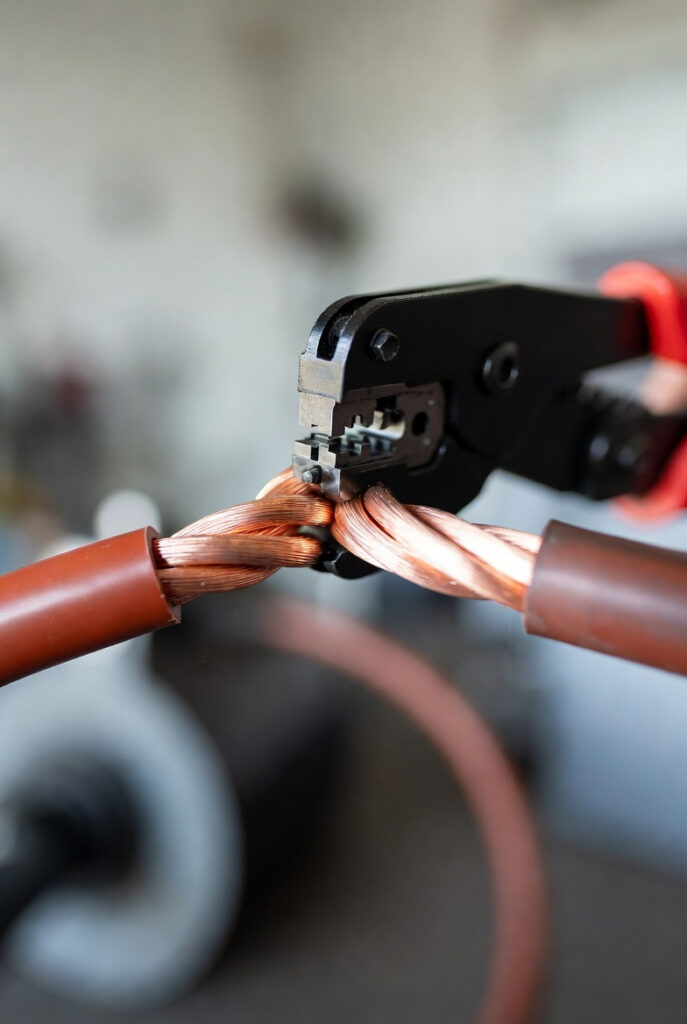
What a hex crimp actually does: A hydraulic hex crimp tool applies 8-12 tons of force through a precision machined die onto a copper lug and cable assembly. Under this pressure the copper strands of the cable and the copper barrel of the lug deform and interlock at the molecular level cold welding without heat. The result is a connection with no air gaps, no voids, and no interface between cable and lug. Just a single continuous mass of copper. This is the cold weld.
Why no air gaps matter: Copper oxidizes in air. Every void in a connection is a future oxidation site. Copper oxide has significantly higher electrical resistance than copper. A void-free battery cable crimp remains void-free at year 10 and year 25 the oxidation has nowhere to start. A connection with air gaps begins oxidizing immediately. By year 3 the resistance has increased. By year 5 the heat is measurable. By year 10 it is a failure.
The P = I²R reality: At the current levels carried by battery cables 200-500A in a typical 48V off-grid system even a small increase in contact resistance generates significant heat. At 300A through a connection with 0.001Ω of increased resistance: P = 300² × 0.001 = 90 watts of heat at that single connection. A proper battery cable crimp starts at effectively zero additional resistance. It stays there for 25 years.
I had a client whose system seemed sluggish his words. Nothing obvious. I put an IR thermometer on every connection and found one battery terminal running 0.3°C above ambient. Pulled the lug the strands inside were partially oxidized, the crimp had been done with a ratchet tool that left visible voids in the barrel. Replaced it with a hydraulic hex crimp. Temperature differential went to zero. He had been losing 90 watts of system capacity at a single lug and had no idea.
Why Solder Fails on Battery Cables
What solder actually is: Solder is a tin-lead or tin-silver alloy with a melting point of 180-230°C far below copper’s 1,085°C. When applied to a cable-lug joint the solder fills the voids between copper strands. This looks solid. It is not. Solder and copper are two different metals with different coefficients of thermal expansion they expand and contract at different rates during temperature cycling.
The solder wicking failure mode: When heat is applied to solder a copper cable the solder wicks up the cable strands by capillary action traveling 20-40mm up the cable beyond the lug barrel. This creates a rigid zone immediately above the lug where the cable strands are now impregnated with solder. A flexible cable is now rigid for 30mm. Under the constant low-frequency vibration of an operating inverter this rigid zone becomes a stress concentration point. The cable flexes. The rigid solder-impregnated section does not. The copper strands fracture at the boundary. The cable appears intact from the outside. The strands are broken inside.
The Ontario cold amplifier: At -30°C solder becomes measurably more brittle the tin-lead alloy loses ductility at low temperatures. A solder joint on a battery terminal that survived two Ontario winters may fail in the third when a particularly cold January coincides with a high-current discharge event that stresses the already-fatigued connection.
In the Lexus service bay I saw this exact failure on a set of aftermarket battery cables. Beautiful solder joints the installer had clearly taken his time. The owner reported intermittent cold starts. Visually the cables looked fine. Cut one open fractured strands at the solder wicking boundary. Classic stress fracture. The failure mode is identical in an off-grid battery bank running at 300A. The only difference is the consequence when it fails at 2am in a January cabin.
When solder is acceptable: The prohibition applies specifically to battery cables and high-current DC connections. For signal wiring 18 AWG and below, sensor connections, control circuit wiring, temperature sensor leads solder is fine and often preferred. These carry milliamps not hundreds of amps. The thermal cycling stress is minimal. State this clearly to anyone who asks the answer is not “never solder” it is “never solder battery cables.” As covered in our Crimping Battery Lugs guide this distinction matters.
The Code Standards – NEC, CEC, and ABYC
NEC 110.14 – USA: The National Electrical Code Section 110.14 requires electrical connections be made with connectors “identified for the use” in practice UL-listed crimp lugs with the correct wire gauge and temperature rating. A soldered battery terminal is not a listed connector under NEC 110.14. In a US jurisdiction requiring an electrical inspection a soldered battery cable fails. A hex-crimped lug with a UL listing satisfies NEC 110.14.
CEC 64-210 – Canada: The Canadian Electrical Code Rule 64-210 governs connections in photovoltaic systems and requires connections to maintain “integrity” under all operating conditions temperature cycling, vibration, mechanical stress. The hex battery cable crimp is the gold standard for CEC 64-210 compliance. An Ontario ESA inspection of a solar installation will look for listed crimp connections on battery cables. A soldered connection does not satisfy the integrity requirement under Ontario winter operating conditions.
ABYC E-11 – The Secret Weapon: The American Boat and Yacht Council Standard E-11 governs marine electrical systems an environment of continuous vibration, corrosion, and high-current DC that directly parallels off-grid solar in Ontario winter conditions. ABYC E-11 explicitly prohibits solder as the sole means of mechanical connection for battery cables. The ABYC arrived at this prohibition through decades of documented marine electrical failures the same failure modes that affect off-grid solar installations. This standard is almost unknown in the solar community. It is the most relevant external authority for anyone building a high-current DC system that will experience vibration and temperature cycling. As covered in our MC4 Connector guide the same vibration and corrosion principles that govern MC4 connections govern battery cable connections.
The Hydraulic Hex Crimper – The Tool That Makes the Standard
Why tool quality determines connection quality: A ratcheting hand crimp tool applies approximately 2-3 tons of mechanical force. The result is a partially compressed lug barrel with visible voids a better crimp than a plier crimp but not a cold weld. A hydraulic hex crimp tool applies 8-12 tons of force through a precision machined die that forms a perfect hexagonal cross-section compressing the copper strands into the cold-welded mass that defines a professional battery cable crimp.
The WBHome 12-ton hydraulic crimper: The WBHome 12-ton hydraulic lug crimper is the standard professional tool for off-grid battery cable crimping. It accepts die sets from 10 AWG through 600 kcmil covering every battery cable size from control wiring to the largest main cables. The hydraulic mechanism provides consistent force regardless of operator strength critical when crimping WindyNation 4/0 AWG battery cable where the mechanical advantage of a hand tool is completely inadequate. As covered in our Wire Gauge guide 4/0 AWG is the artery of a 3,000W system the connections on that artery must be cold-welded not hand-crimped.
The die selection rule: The correct hex die must match the lug barrel size not the wire gauge. A 4/0 AWG lug barrel is larger than a 2 AWG lug barrel even though both accept a specific wire size. Always verify the die number matches the lug manufacturer’s specification not just the wire gauge stamped on the lug.
The inspection: After crimping the lug barrel should show a clean hexagonal cross-section with no cracking at the corners. The cable should not rotate in the lug the crimp must be mechanically rigid. Perform a pull test grip the lug and cable separately and apply firm pulling force zero movement is the correct result.
The Shunt Connection – Where Crimping Matters for Monitoring
Why the shunt connection is critical: The Victron SmartShunt 500A measures battery current by measuring the voltage drop across a precision resistor. Any additional resistance in the shunt connections from a poorly crimped lug adds error to the current measurement. At 300A through a shunt connection with 0.001Ω of additional resistance: the voltage error is 0.3mV potentially adding 10-20A of measurement error to the shunt reading. A hex-crimped lug on both shunt terminals ensures the shunt reads accurately for its entire service life. And every connection protected by adhesive-lined heat shrink as covered in our Heat Shrink guide the crimp and the seal together are the 25-year standard.
Quick Reference – Battery Cable Crimp Standard
| Connection Type | Correct Method | Code Reference |
|---|---|---|
| Battery cables 4/0 AWG | Hydraulic hex crimp | NEC 110.14, CEC 64-210, ABYC E-11 |
| Battery cables 2 AWG | Hydraulic hex crimp | NEC 110.14, CEC 64-210, ABYC E-11 |
| Shunt connections | Hydraulic hex crimp | CEC 64-210 integrity standard |
| Signal wiring 18 AWG | Solder acceptable | Not a high-current connection |
| Sensor leads | Solder acceptable | Milliamp level – not battery cable |
| MC4 connectors | Ratcheting MC4 crimp tool | IEC 62852 – see MC4 guide |
Pro Tip: Mark every hydraulic hex crimp you make with a paint pen or permanent marker across the lug barrel and cable insulation immediately after crimping a straight line across both. If the crimp ever loosens which a proper cold weld never should the mark will show misalignment between lug and cable. At every annual inspection check that every mark is still straight and aligned. If a mark shows rotation the crimp has moved and the connection must be remade. This 5-second marking step creates a permanent visual inspection record for every critical battery cable connection in the system.
The Verdict
A battery cable crimp done with a hydraulic hex tool is a cold weld. NEC-compliant. CEC-compliant. ABYC E-11 compliant. It survives -30°C Rockwood winters and the vibration cycle of a running inverter for 25 years.
A soldered battery terminal looks beautiful in a YouTube thumbnail. It fails at the solder wicking boundary during the third Ontario winter at 300A in January when the cabin is cold and the system is being stressed hardest.
Crush the copper. Don’t melt it.
Disclosure: This article contains affiliate links. If you buy through them, GridFree Guide earns a small commission at no extra cost to you.
Questions? Drop them below.
Pingback: Tinned Copper Wire: The 25-Year Off-Grid Standard
Pingback: Off-Grid Commissioning Checklist: The 100-Point Standard