
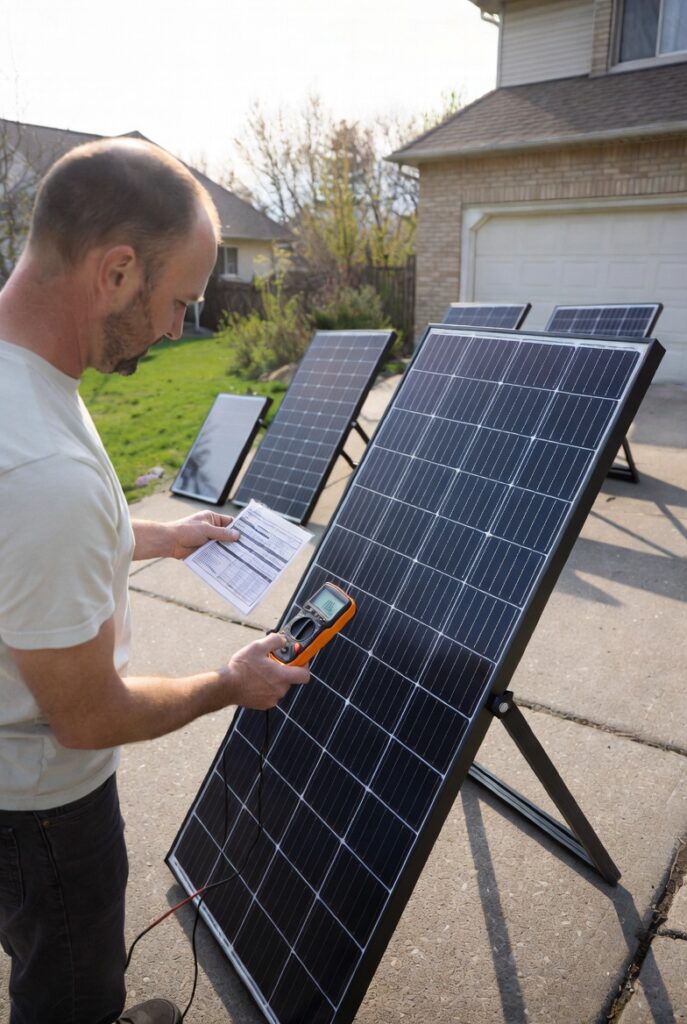
The time to test solar panel output is before the first bolt goes into the roof, not after. A homeowner on Kortright Road West in Guelph, Wellington County unboxed four 200W Renogy panels in the spring of 2025. He set them flat on the driveway in the afternoon sun before carrying any of them up the ladder. Three panels read 37.2V on open-circuit voltage, within 1% of the rated 37.44V Voc.
The fourth read 18.6V. He held the meter on it for two minutes, shifted the panel angle, and checked again: still 18.6V. That reading represents exactly half the expected voltage, which in a 200W panel means one of the three bypass diode zones has a dead or severely degraded cell string.
The repair would have been far worse discovered post-installation. A defective panel mounted in a four-panel series string produces a degraded string voltage that a charge controller may interpret as a failing battery rather than a bad panel. The other three healthy panels compensate by running hotter, reducing their own lifespan in the process. Diagnosing the fault from the roof requires removing the panel, carrying it down, testing it, and reinstalling the replacement, approximately three additional hours of elevated work for a fault that took four minutes to find on the driveway. The test solar panel bench procedure costs four minutes per panel on the ground. It costs three hours plus risk per panel after installation.
I use this procedure on every installation I evaluate. In July 2024 I walked a homeowner in Rockwood through the test on six 100W Renogy panels before their ground-mount installation. Five panels were clean at 22.1 to 22.4V Voc, within the tolerance band of the 22.3V specification. The sixth panel read 14.8V, two-thirds of the expected voltage, consistent with one of the two bypass zones being non-functional.
The homeowner contacted Renogy, provided the multimeter photo and the panel serial number from the back label, and received a warranty replacement within a week. The test solar panel procedure takes less time to learn than parallel parking and prevents warranty claims from becoming post-installation nightmares. See our Ontario solar sizing guide to confirm your full array specification before purchasing panels.
Why you must test solar panel output before mounting: the four-minute insurance policy
The compression test analogy applies directly. No engine goes back into a vehicle without a compression test, because finding a bad cylinder in the car is far more expensive than finding it on the bench. The same logic applies here. A pre-mount test solar panel check catches three critical failure modes before installation: dead cell zones that show as low Voc, broken cell strings that show as low Isc, and damaged junction boxes that produce inconsistent Voc readings between measurements. Each of these faults causes performance problems and, in the case of a damaged junction box, can create a fire risk if left energised in a wired array.
However, the multimeter test has honest limits. Early-stage micro-cracks are not detectable in the first weeks because the crack has not yet propagated far enough to isolate a cell string. Partial soiling affects Isc but not Voc, and long-term degradation that develops over years is invisible in a point-in-time test. A multimeter test solar panel check catches approximately 80% of serious defects. It does not replace a professional electroluminescence scan for critical large installations, but for the Ontario DIY installer putting four to twelve panels on a roof or ground mount, the four-minute driveway test catches the faults that matter most. See our solar system troubleshooting guide for diagnosing post-installation performance issues.
How to test solar panel Voc: the open-circuit voltage bench check
The Voc test is the safest test in the diagnostic sequence because no current flows during the measurement. To test solar panel open-circuit voltage, disconnect the panel from the charge controller, battery, and any load. Set the multimeter to DC Volts (DCV) and select a range above the panel’s rated Voc, the 200V range works for all standard residential panels. Connect the red lead to the positive MC4 terminal and the black lead to the negative MC4 terminal. Read the voltage in direct or indirect sunlight. Even on an overcast Ontario day a healthy panel produces 60 to 80% of rated Voc, so the Voc test can confirm function in any light conditions.
| Panel wattage | Typical rated Voc | Healthy Ontario reading | Suspect threshold | Fault threshold |
|---|---|---|---|---|
| 100W | ~22.3V | 20.5 to 22.5V | Below 18.9V | Below 16.7V |
| 200W N-Type | ~37.44V | 34.5 to 37.8V | Below 31.8V | Below 28.1V |
| 400W | ~37.1V | 34.2 to 37.4V | Below 31.5V | Below 27.8V |
The temperature gap matters for interpreting Ontario noon readings. At 50C cell temperature, 25C above the 25C STC reference, Voc drops approximately 7 to 8% below the specification. A 200W panel rated 37.44V may read approximately 34.5V at Ontario July noon, which falls within the healthy range in the table above. The fault threshold is 25% below rated Voc. The Guelph homeowner’s reading of 18.6V on a 37.44V-rated panel was 50% below specification, clearly a fault, not a temperature effect. Temperature cannot account for a 50% Voc deficit under any Ontario conditions.
How to test Isc: measuring short-circuit current safely
The Isc test measures the current the panel produces when its output terminals are directly connected through the meter, the maximum current the panel can deliver. The test is safe only because solar panels are current-limited sources: they cannot produce more than their rated Isc regardless of load. The critical setup error that blows multimeter fuses is inserting the red lead into the milliamp port instead of the 10A port.
The mA port is fused at 200 to 500 milliamps, a healthy 100W panel at 5A will blow it instantly. Always insert the red lead into the 10A port. Test each panel individually before any series wiring. Never perform the Isc test on panels already connected in series, the combined string voltage exceeds the 10A port’s safe operating range on most meters.
To test solar panel short-circuit current, ensure the panel is disconnected from all other panels and loads. Insert the red multimeter lead into the 10A port and the black lead into the common port. Connect red to positive MC4 and black to negative MC4. Read the current in direct sun, full solar noon conditions are required for a meaningful diagnostic reading. In Ontario at noon on a clear day, expect 75 to 90% of rated Isc.
In August 2024 a rural property owner on Derry Road West in Milton, Halton County found his battery bank not reaching full charge despite clear skies. He tested each panel in his four-panel parallel array individually. Three panels read 5.1A, 96% of the 5.29A rated Isc for the Renogy 100W, within the healthy range. The fourth read 2.8A, approximately 53% of rated, well below the 75% threshold.
He traced the fault to a loose MC4 crimp at the back of the positive connector on that panel. The crimp had engaged approximately 40% of the wire strands instead of the full conductor, creating a resistance that was halving the current output. He re-crimped with a proper MC4 crimping tool and the panel immediately read 5.0A. The battery bank reached 100% state of charge that same afternoon for the first time in six weeks. Total repair cost: $0 in parts, 20 minutes in labour. The series and parallel wiring guide covers the correct MC4 crimping sequence for both string configurations.
MC4 arc safety: the one rule that prevents a connector fire
MC4 connectors are not rated for disconnection while current is flowing. AC current self-extinguishes at each zero crossing, 120 times per second on a 60Hz circuit. DC current has no zero crossing. A sustained DC arc does not self-extinguish, and at 100V DC the arc temperature can exceed 6,000 degrees Celsius, which melts the MC4 housing and ignites surrounding materials. Before disconnecting any MC4 connector in a wired system, cover the panel or panels completely with an opaque tarp or sheet of cardboard.
With the panel covered, Voc drops to near zero within approximately five seconds. Disconnecting at 2V is safe. Disconnecting at 20V is not. This procedure adds 15 seconds to every MC4 disconnection and prevents the most common installation damage event.
Use opaque material, not translucent. A blue tarpaulin reduces irradiance to approximately 10 to 20% of full sun, which still produces 10 to 20V on a 100W panel, not safe for disconnection. Black poly sheeting or cardboard reduces irradiance to near zero. For a series string where multiple panels are connected, cover all panels in the string before disconnecting any single MC4 pair. The arc risk is proportional to the string voltage, one panel at 22V presents less risk than three panels at 66V, but the correct procedure is the same for both: cover first, wait five seconds, then disconnect.
This rule applies equally to the Voc test setup, the Isc test teardown, and any routine maintenance disconnection in the field.
NEC and CEC: code requirements for panel testing and installation in Ontario
NEC 690.17 requires that solar PV systems have a means to disconnect the array from all current-carrying conductors. This disconnect requirement means the test solar panel procedure should always begin with the system disconnect in the open position before any MC4 connections are made or broken. NEC 690.13 requires a PV system disconnect within sight of the array. Any DIY installation that does not include an accessible array disconnect does not comply with NEC 690.13, and a charge controller with a built-in disconnect does not satisfy this requirement if it is not within sight of the panels. Contact the NFPA at nfpa.org for current NEC 690 requirements applicable to residential off-grid installations in Ontario.
CEC Section 50 governs all solar PV installations in Ontario. Panel testing for commissioning purposes is not separately regulated under CEC Section 50, it is part of the general installation standard that every permitted system must meet before energisation. Any fault found during panel testing that results in a warranty claim does not affect the ESA permit status of the installation. The permit covers the system design and wiring, not individual component warranty outcomes.
If a panel replacement is required post-installation, the replacement must match the specification of the original permitted system, a different panel model with a different Voc or Isc changes the string voltage and current calculations and may require a permit amendment. Contact the Electrical Safety Authority Ontario at esasafe.com before replacing any panel in a permitted Ontario installation with a different model.
Pro Tip: The fastest documentation workflow for a warranty claim on a defective panel is to take three photos before calling the supplier: one of the multimeter display showing the low Voc reading with the red and black leads clearly visible on the MC4 connectors, one of the spec sheet showing the rated Voc, and one of the serial number label on the back of the panel. These three images together constitute unambiguous warranty claim documentation that no supplier can reasonably dispute. The Guelph homeowner had a replacement panel shipped within four days using exactly this three-photo sequence. Without the photos, a warranty claim for a “low-voltage panel” typically results in the supplier requesting you ship the panel back at your expense for testing, which adds two to three weeks and shipping costs to the resolution timeline. Three photos on a $0 driveway test save three weeks of back-and-forth on a claim worth $80 to $200.
The test solar panel verdict: what healthy readings look like in Ontario
- Ontario DIY installer unpacking new panels: test every panel Voc on the driveway before any installation work begins. Set all panels flat in direct sun and move down the row with the multimeter in DCV mode before picking up a single tool. Four minutes per panel on the ground is the insurance premium. The claim payout is avoiding three hours of elevated roof work to diagnose and replace a defective panel that was detectable in the driveway. The break-even is the first defective panel you find, one catch in a lifetime of DIY installations pays back every minute of every bench test you ever do. When you test solar panel Voc pre-install and find all panels clean, you also have a documented baseline Voc reading for every panel, which becomes useful if output drops years later and you need to determine whether a panel has degraded.
- Ontario homeowner whose installed array is underperforming: start with Voc test on each panel in the string, then move to Isc on each panel individually. The Milton Derry Road case confirms the diagnostic sequence. Voc was normal on all four panels, the cells were intact. The fault was at the connection, which only showed in the Isc test under load. If Voc is normal and system output is still low, the fault is in a connection, a crimp, or a charge controller setting, not the panels themselves. If Voc is low on one panel, that panel has a cell fault and is dragging the string voltage. The test solar panel sequence, Voc first, Isc second, narrows the fault to either the panel or the wiring in two tests that take approximately 10 minutes combined. See our 200W panel guide if the fault leads to a panel replacement decision.
- Ontario installer who finds a panel at 50% or less of rated Voc: photograph and claim immediately, before installation. A 50% Voc reading on a new panel is an unambiguous manufacturing defect. It cannot be explained by temperature, sun angle, or irradiance, no Ontario outdoor condition produces a 50% Voc deficit in a healthy panel. Take three photos: meter display with leads on MC4 connectors, spec sheet showing rated Voc, and panel serial number label on the back. Contact the supplier with those three photos and the purchase invoice. Do not install the panel while the claim is open, installing a defective panel and then claiming warranty on it post-installation creates complications that delay resolution. The driveway is the correct place to make this discovery and this documentation.
Frequently Asked Questions
Q: What does it mean when I test solar panel Voc and get a reading that is 10% below the spec sheet?
A: A 10% deficit below rated Voc at Ontario July noon is within the normal temperature effect range. At 50C cell temperature, a realistic Ontario summer figure, Voc drops approximately 7 to 8% below the STC specification due to the temperature coefficient of approximately -0.32%/C. A reading 10% below rated in full July afternoon sun is borderline but not immediately conclusive. Confirm with an Isc test: if Isc is also 10 to 15% below rated, the panel may have minor cell degradation.
If Isc is within the 75 to 90% healthy range, the Voc deficit is most likely thermal. Test again in the morning before 9 AM when cell temperatures are closer to 25C for a cleaner comparison against the STC specification.
Q: Is it safe to test solar panel short-circuit current (Isc) with a standard multimeter?
A: Yes, with two conditions. First, the red lead must go into the 10A port, not the milliamp (mA) port. The mA port is fused at 200 to 500mA and a 5A panel Isc reading will blow it instantly. Second, never perform the Isc test on panels wired in series. The combined series string voltage exceeds the safe operating voltage of the 10A port on most multimeters. Test each panel individually before wiring. A single 100W panel at 5.29A rated Isc is well within the 10A port range. Always cover the panel with an opaque tarp before disconnecting the MC4 connectors after the test, the 15-second cover procedure prevents the DC arc hazard that damages connectors.
Q: How do I know if a low Isc reading means a bad panel or just Ontario cloud conditions?
A: Test at solar noon on a clear Ontario day for a reliable diagnostic reading. In overcast conditions, irradiance drops to 15 to 30% of the clear-sky value, which naturally reduces Isc by the same proportion, an overcast reading of 1.5A on a 5.29A panel is not a fault, it is physics. On a clear Ontario noon in July, expect 75 to 90% of rated Isc from a healthy panel.
Below 60% of rated Isc in full noon sun is the fault threshold. If you cannot get a clear noon window, take a morning reading on a clear day before 10 AM and compare all panels in the array to each other, a panel reading 40% of what the others are producing in identical conditions is faulty regardless of the absolute irradiance level.
This build is engineered within the 48V DC Safety Ceiling. Diagnostic logic is based on 20+ years of technical service experience. All structural and electrical installations must be verified by a Licensed Professional and comply with your Local AHJ.
This article contains affiliate links. If you purchase through these links, I earn a small commission at no extra cost to you.
Pingback: Solar Panel Degradation: The 25-Year Performance Curve