
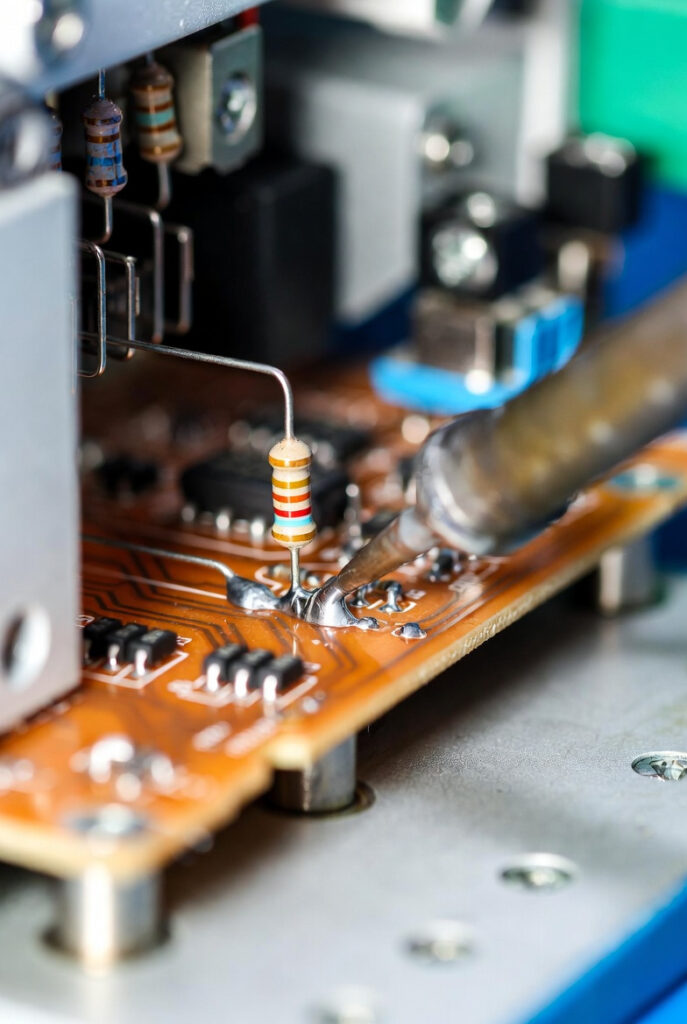
“POP.” Loud enough to make you flinch. Lights flicker. A faint smell of ozone. Your hand is shaking over the disconnect switch and you are not sure whether to flip it back. That sound is 500+ amps of inrush current hitting your inverter’s capacitor bank in a microsecond. A pre-charge resistor is the $2 component that turns that gunshot into silence and protects the $3,000 inverter you just installed. Before building your protection system understand how much solar power you actually need so you know what size inverter you are protecting.
Pre-Charge Resistor: What That “POP” Is Actually Doing to Your Inverter
What inrush current is: An inverter like the Victron MultiPlus-II contains a bank of large electrolytic capacitors on its DC input these capacitors stabilize the DC bus voltage and protect the inverter’s internal electronics from voltage spikes during load switching. When the inverter is powered down these capacitors are completely discharged zero volts. When you close the main disconnect switch and connect a fully charged 48V battery bank to a discharged capacitor bank the voltage differential is the full battery voltage 52-58V for a LiFePO4 48V bank.
The capacitor inrush math: The inrush current when connecting a voltage source to a discharged capacitor is limited only by the resistance of the circuit the wire, the connections, the switch contacts, and the internal resistance of the battery. In a well-built 48V system with 4/0 AWG cable and low-resistance connections this total resistance may be 0.05-0.1 ohms. Ohm’s Law: I = V/R = 52V / 0.05Ω = 1,040 amps in the first microsecond. This current flows through the switch contacts, the cable, and the battery terminals all in the time it takes the capacitors to charge to battery voltage.
What 1,000 amps does to a switch: A DC disconnect switch even a quality unit like the Blue Sea Systems HD 600A Disconnect is rated for continuous current and for switching current at its rated voltage. It is not rated for 1,000A inrush events. The switch contacts experience micro-welding the contact surfaces momentarily reach temperatures that partially fuse the copper. One POP may leave invisible damage. Ten POPs and the contacts are permanently roughened increased contact resistance increased heat eventual failure. Twenty POPs and the contacts may weld shut.
A client in Guelph had been connecting his system without a pre-charge resistor for eight months. He called because his 400A disconnect was getting warm during normal operation. I inspected the contacts the surface was pitted and roughened from repeated inrush events. The contact resistance had increased enough to generate measurable heat at 200A continuous. A $400 switch damaged by a $2 resistor never used. Replaced the switch. Installed a pre-charge circuit. Never happened again.
Why the capacitors suffer too: Electrolytic capacitors the type used in inverter DC bus applications have a maximum surge current rating. Repeated inrush events above this rating degrade the capacitor dielectric the insulating layer inside the capacitor that determines its voltage rating and capacitance. Degraded capacitors have higher ESR (Equivalent Series Resistance) they generate more heat during normal operation they fail sooner. The POP you hear every morning is not normal operation accepted by design. It is cumulative damage to the most expensive single component in your off-grid system.
The Manual Pre-Charge Resistor Trick
What a pre-charge resistor does: A pre-charge resistor placed in series with the DC circuit before the main disconnect closes limits the inrush current to a safe level. Ohm’s Law: I = V/R. With a 100-ohm resistor in series: I = 52V / 100Ω = 0.52 amps a gentle trickle that fills the capacitors slowly over 5-10 seconds rather than a 1,040A spike in a microsecond. The capacitors charge to battery voltage through the resistor. When voltage on both sides of the disconnect is equalized you close the main switch with zero voltage differential and zero inrush current.
The manual method – step by step:
- Keep the main DC disconnect switch OPEN system disconnected
- Hold a 25W 100-ohm resistor across the disconnect switch terminals bridging the open gap
- Wait 5-10 seconds the capacitors are charging through the resistor
- Verify the resistor is warm but not hot current is flowing capacitors are charging
- Close the main disconnect switch no spark, no pop, no inrush
- Remove the resistor the main switch is now carrying the load
The resistor specification: 25W power rating minimum the resistor dissipates power during pre-charge: P = V²/R = 52²/100 = 27 watts for 5-10 seconds. A 25W resistor handles this comfortably. Use a wirewound resistor not carbon film wirewound handles the brief power surge without failure. Cost: $2-5 from any electronics supplier. This is the honest answer for an occasional-use system or a first commissioning.
The Permanent Pre-Charge Circuit – The Professional Install
Why a permanent circuit is better for full-time systems: A system switched on and off daily or a system where multiple people have access to the main disconnect needs a permanent pre-charge circuit. Relying on a handheld resistor requires the correct resistor to be present, requires remembering the procedure, and requires someone to hold it correctly every time. A permanent circuit makes the correct procedure the only procedure.
The permanent circuit components:
- 25W 100-ohm wirewound resistor
- Momentary pushbutton switch (normally open) rated for DC voltage
- Small fuse 1A protecting the pre-charge circuit
- Short length of wire connecting the circuit in parallel with the main disconnect
The permanent circuit wiring: The pre-charge resistor and momentary pushbutton are wired in series this series combination is wired in parallel with the main DC disconnect switch. The fuse is in series with the pre-charge circuit on the positive side. To energize the system: press and hold the momentary button for 5 seconds (pre-charge resistor fills the capacitors) → close the main disconnect (zero inrush) → release the button. The pre-charge path is fused at 1A the resistor limits current to 0.52A the fuse protects the pre-charge wiring from any fault in the pre-charge circuit itself.
I was finishing a Rockwood Fortress build last autumn. The client had heard about the connection POP from a neighbour and was nervous about switching the system on for the first time. I installed the permanent pre-charge circuit, walked him through the procedure, and handed him the controls. He pressed the momentary button. Waited five seconds. Closed the Blue Sea Systems HD 600A Disconnect. Silence. He looked at me and said “that’s it?” Yes. That is it. The sound of engineering working correctly is silence.
The winter consideration: In Ontario winter conditions electrolytic capacitors have higher ESR at low temperatures they charge more slowly and handle inrush less gracefully than at room temperature. A system that produces a manageable POP in August may produce a significantly larger inrush event in January when the inverter has been sitting at 5°C. As covered in our Battery Heating Pad guide cold components are more vulnerable winter is the worst time to skip pre-charge procedure.
Pre-Charge and the Disconnect Switch – Protecting Your Investment
The disconnect switch as the inrush victim: The DC disconnect switch covered in our DC Disconnect guide is the component that experiences the inrush event directly. A Blue Sea Systems HD 600A Disconnect is the correct switch for a 48V LiFePO4 system. It is not rated for repeated 1,000A inrush events. Use the pre-charge resistor every time. Every single time.
The MultiPlus-II capacitor bank: The Victron MultiPlus-II 5000VA contains a significant DC bus capacitor bank typically 10,000-50,000 microfarads for a unit of this size. This capacitance generates the massive inrush current when the inverter is cold-connected to a battery. Victron’s own commissioning documentation recommends pre-charge procedures for 48V systems. This is not an edge case concern. It is a documented requirement. As covered in our MultiPlus-II vs Quattro guide protecting the inverter investment starts before the first switch is ever closed.
The MultiPlus-II at 12V: The Victron MultiPlus-II 3000VA at 12V produces the same inrush phenomenon lower voltage but higher current at 12V means capacitor inrush is still significant. Pre-charge is recommended for all inverter sizes at all system voltages. And as covered in our Battery Fortress guide the pre-charge circuit belongs inside or adjacent to the battery enclosure one procedure, one location, every time.
Quick Reference — Pre-Charge Resistor Specifications
| Item | Specification | Notes |
|---|---|---|
| Resistor value | 100 ohms | Limits inrush to 0.52A at 52V |
| Resistor power rating | 25W minimum | Dissipates 27W during 5-10 second pre-charge |
| Resistor type | Wirewound – not carbon film | Handles brief power surge without failure |
| Pre-charge time | 5-10 seconds | Capacitors reach battery voltage |
| Momentary button | Normally open – DC rated | For permanent circuit install |
| Pre-charge fuse | 1A | Protects pre-charge wiring from fault |
| Cost (manual method) | $2-5 | From any electronics supplier |
Pro Tip: If you are commissioning a new system for the first time and do not have a pre-charge resistor available a safe field alternative is to connect the inverter to the battery through a light bulb a 12V or 48V bulb of appropriate wattage connected in series with the positive cable during initial connection. The bulb acts as a current-limiting resistor. When the bulb dims to full brightness the capacitors are charged and the main connection can be made safely. Remove the bulb after the main switch is closed. Not as elegant as a proper pre-charge resistor but significantly better than a cold connection and the POP that follows.
The Verdict
The pre-charge resistor is a $2-5 component that protects a $3,000 inverter and a $400 disconnect switch from cumulative inrush damage that builds invisibly with every unprotected connection.
The POP is not a feature. It is not normal. It is not something to get used to.
Hold the resistor. Wait five seconds. Close the switch. Silence.
That is the correct sound of your system turning on.
Disclosure: This article contains affiliate links. If you buy through them, GridFree Guide earns a small commission at no extra cost to you.
Questions? Drop them below.