
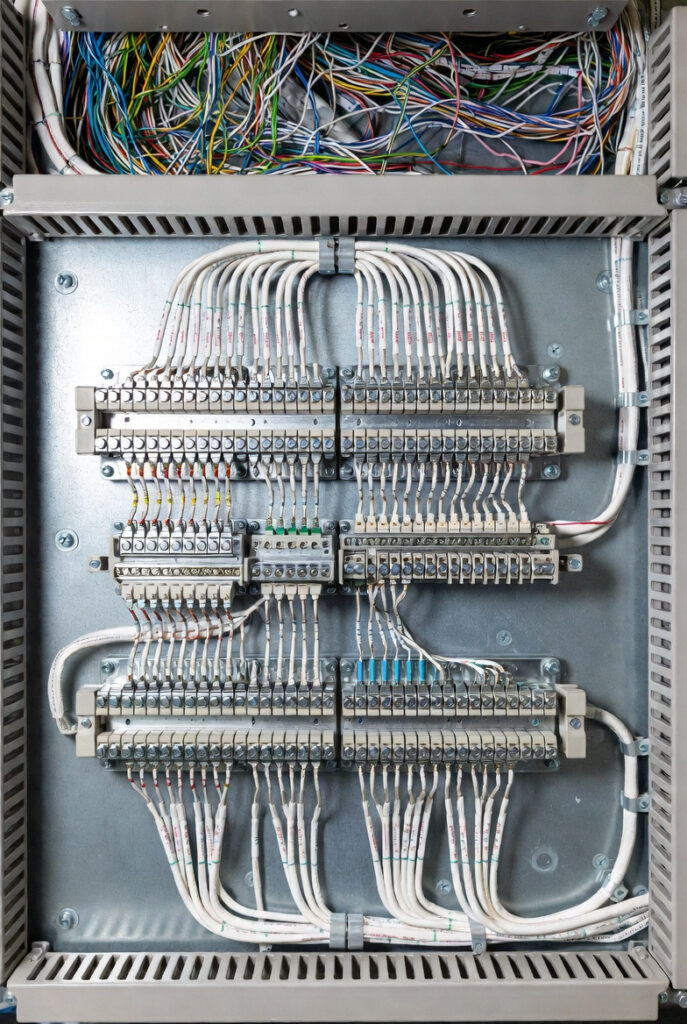
Twelve ring terminals stacked on one battery positive bolt. The bolt is barely long enough. The bottom terminal is crushed flat. The top terminal rocks when you touch it. Every milliohm of resistance in that stack generates heat at 200A. In an Ontario winter with a space heater pulling full load that heat can melt a battery terminal before the fuse blows. A busbar off grid solar installation gives every device its own dedicated stud no stack, no crush, no loose top terminal. Before building your distribution system understand how much solar power you actually need so you know what current your busbars need to handle.
I spent 90 minutes tracing a voltage drop fault in a Rockwood cabin last fall. Six devices wired point-to-point each with its own ring terminal stacked on the battery post. The fault was a single loose terminal buried third from the bottom. With a proper busbar off grid solar system I would have found it in five minutes by checking one stud at a time.
Busbar Off Grid Solar: Why Stacked Terminals Fail
The Christmas Tree voltage drop: Each additional ring terminal in a stack adds contact resistance at the joint. The bottom terminal contacts the battery post directly. The second terminal contacts the first. The third contacts the second. By the sixth terminal at the top of the stack the current has passed through five additional interfaces each adding 1-5 milliohms of resistance.
At 200A typical for a 3,000W inverter on 12V even 5 milliohms of cumulative resistance produces 1V of voltage drop across the stack. Your inverter reads 12.2V. Your battery is actually at 12.6V. The inverter thinks the battery is low and triggers low voltage cutoff. The battery is fine. The stack is the problem. As covered in our DC Fuse Sizing guide voltage drop at connection points is one of the most common causes of unexplained system shutdowns.
The crush and vibration problem: The bottom terminal in a six-terminal stack is compressed under the weight of five terminals above it. The bolt elongates under repeated torquing. The top terminal has almost no compression held by the bolt head alone. Vibration from a nearby gravel road, from the HVAC system, from the generator loosens the top terminal first. A loose high-resistance connection generates heat. Heat melts insulation. Melted insulation causes a fire.
The troubleshooting nightmare: Finding a fault in a stacked terminal system requires removing terminals one at a time under load to find the high-resistance joint. Every removal is a spark risk. Every reinstallation changes the stack geometry. With a busbar off grid solar system each device has its own dedicated stud voltage measurement across each stud immediately identifies any high-resistance connection without disassembly.
What a Busbar Actually Is
The simple version: A busbar is a solid block of copper or tin-plated copper with multiple threaded studs one stud per connected device. All studs are at the same potential directly connected to the main bus bar conductor. Every device gets its own stud. No stacking. No compression. No shared resistance.
Positive and negative busbars: A complete busbar off grid solar installation uses two busbars one positive and one negative. Every device positive cable connects to its own stud on the positive busbar. Every device negative cable connects to its own stud on the negative busbar. The positive busbar connects to the battery positive through the main fuse. The negative busbar connects to the battery negative through the SmartShunt covered in our SmartShunt vs BMV-712 guide.
The shunt as specialized negative busbar: The SmartShunt is effectively a precision negative busbar with current measurement built in. Every negative return connects to the load side of the shunt. The shunt connects to the battery negative. This ensures every amp flowing through the system passes through the shunt for accurate coulomb counting and every negative return has its own dedicated connection point.
Tin-Plated Copper – The Marine Grade Standard
Why bare copper fails in Ontario: Bare copper oxidizes in the presence of oxygen and moisture. The copper oxide layer green patina has significantly higher resistance than bare copper. In a Rockwood cabin equipment room that cycles between -10°C in winter and 30°C in summer condensation forms on cold surfaces during temperature transitions. Three seasons of condensation cycles on bare copper busbars produces measurable oxide buildup at every connection point.
Why tin-plating matters: Tin-plating creates a protective barrier between the copper and the atmosphere. Tin oxide which forms in preference to copper oxide has much lower resistance than copper oxide and is significantly more corrosion resistant. Tin-plated busbars in Ontario conditions outlast bare copper busbars by a factor of 5-10 in terms of maintaining low-resistance connections.
The marine grade specification: Tin-plated copper is the marine industry standard environments that combine salt air, humidity, and vibration at levels that destroy bare copper in a single season. If tin-plating survives marine environments it is more than adequate for an Ontario cabin equipment room. Any busbar off grid solar installation in Ontario, Minnesota, or Montana should specify tin-plated copper not bare copper, not aluminum.
The Vibration Reality – Nyloc Nuts and Lock Washers
What vibration does to terminal connections: A standard hex nut on a busbar stud will loosen over time under vibration — road vibration for van builds, HVAC vibration for cabin builds, generator vibration for any system with backup power. A loose busbar connection is better than a loose terminal in a stack it involves one connection point but still requires prevention.
The nyloc nut standard: Nylon-insert locking nuts nylocs have a nylon ring embedded in the top of the nut that grips the stud threads under vibration. Once torqued to specification a nyloc nut will not loosen from vibration alone. For busbar off grid solar installations near any source of vibration van, cabin near gravel road, generator-powered system nyloc nuts on every busbar stud is the professional standard.
The lock washer addition: Star lock washers under the terminal lug provide additional grip at the contact surface. Combined with a nyloc nut lock washer under the lug, nyloc over it the connection is mechanically secure against all normal vibration conditions. This is the wiring standard used in commercial vehicle electrical systems.
The Scalability Advantage
Adding a device with stacked terminals: You want to add a second MPPT charge controller. Your battery positive post already has five terminals stacked on it. You need to remove all five terminals, add the new one somewhere in the stack, and reinstall hoping you get the torque right, hoping the bottom terminal is not now crushed beyond its rating, hoping the top terminal has enough thread engagement. Thirty minutes of work and new spark risk on every removal.
Adding a device with a busbar: You want to add a second MPPT charge controller. Your busbar has an open stud. You bolt the new cable to the open stud. Torque to specification. Done. Five minutes. No other connections disturbed.
The premium solution: For the most professional busbar off grid solar installation the Victron Lynx Distributor takes this concept further enclosed housing, fused outputs, LED fuse monitoring, modular expansion. The Lynx system is the busbar concept fully realized as a professional product.
The Quick Reference – Busbar vs Point-to-Point
| Feature | Stacked Terminals | Busbar System |
|---|---|---|
| Resistance per connection | Multiple interfaces | Single interface per device |
| Voltage drop | Cumulative across stack | Minimal per stud |
| Fault finding | 30-90 minutes | 5 minutes |
| Vibration resistance | Poor top terminal loosens | Good – one connection per stud |
| Scalability | Rewire required | Bolt on to open stud |
| Corrosion resistance | Poor shared contact surfaces | Good – tin-plated individual contacts |
| Ontario winter rating | Problematic | Professional standard |
Pro Tip: Torque every busbar stud connection to specification do not hand-tighten. Most busbar studs for off-grid systems are M6 or M8. M6 torque specification: 4-6 Nm. M8 torque specification: 8-12 Nm. A torque wrench costs $25. Under-torqued connections are as dangerous as loose stacked terminals the ring terminal can pivot on the stud under vibration creating an intermittent high-resistance fault. Over-torqued connections crack ring terminal barrels and strip stud threads. Use a torque wrench. Do it once. Do it right.
The Verdict
A busbar off grid solar installation is not a luxury upgrade. It is the baseline for any system where reliability matters. Every device on its own stud. Every connection at the same bus potential. Every fault findable in five minutes instead of ninety.
Stop stacking terminals. Buy a busbar. Use nyloc nuts. Use tin-plated copper. Label every stud before you close the equipment room.
That is how a Master Tech builds it.
Disclosure: This article contains affiliate links. If you buy through them, GridFree Guide earns a small commission at no extra cost to you.
Questions? Drop them below.