
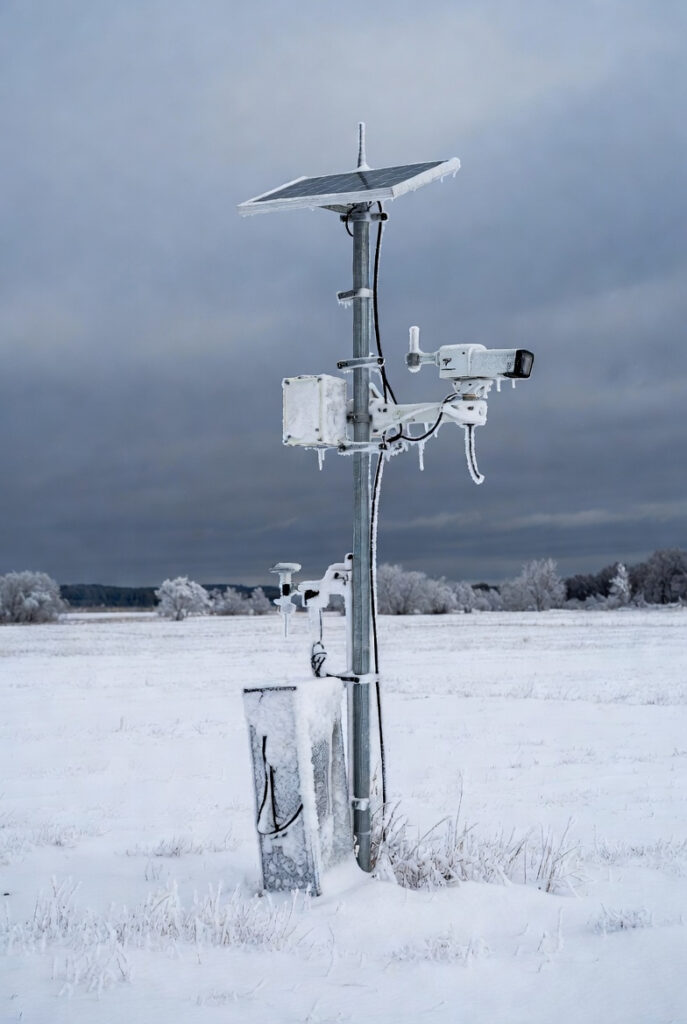
Solar weather station data integrity fails quietly in an Ontario ice storm. I got a call in January from a grain farmer near Palmerston in Perth County who had been relying on his remote weather station to trigger his grain bin aeration system. The station was a consumer-grade Davis Vantage Pro 2 on a 3-metre mast in the middle of his largest field, solar powered by a 10W panel and a small sealed lead-acid battery.
The station had been reporting 0.0 m/s wind speed continuously for four days during a January cold snap that brought minus 28°C overnight lows. He assumed the wind had genuinely stopped and left his aeration system off. I drove out to inspect the station on the fifth day. The anemometer cups were encased in a 12mm shell of clear ice from freezing rain two days earlier. The cups were physically locked. The station was reporting zero wind speed not because the air was still but because the instrument could not move.
His grain bins had gone without aeration for 96 hours during a period of high humidity and temperature differential that had begun developing condensation on the grain surface. He lost approximately $2,800 in grain spoilage from a condensation event that aeration would have prevented. The fix was a 12V resistive heating element wrapped around the anemometer and a 40W dedicated solar panel to power it. Total cost: $310. He has not had a frozen reading since, including the winter of 2023 when three consecutive ice storms hit Perth County in February. For the battery bank winterization standard that ensures the 50Ah LFP station battery accepts a charge at minus 20°C without lithium plating, Article 190 covers the deep freeze protocol. For the full system sizing hub that covers the load calculation foundation, the hub covers the numbers.
Why a Solar Weather Station Sends Wrong Data in an Ontario Ice Storm
When ice locks the cups on an anemometer, the station reports 0.0 m/s wind speed regardless of actual conditions. The farmer trusts the zero and makes decisions based on false data. The Palmerston story is not unusual it is the standard failure mode for unheated cup anemometers in Ontario January.
The heating budget calculation explains why the 10W panel fails. An unheated solar weather station draws about 48Wh per day for data acquisition and telemetry. A heated station with a 12V anemometer heater at 12W running 16 hours plus a rain gauge heater at 7W running 16 hours draws 304Wh per night alone. Total energy consumption for the heated station is 352Wh per day, about 7.3 times more than the unheated version.
The 10W panel fails on day 2 of a minus 20°C stretch. A 40W panel with a 50Ah LFP battery keeps the heaters running for 14 days of Ontario winter without resupply. The Victron SmartShunt installed on the station battery tracks the daily Wh consumed by the heater circuit so the operator knows whether the solar budget is keeping pace with the heating demand during a cold snap. For the solar remote monitoring standard that sends a low-SoC alert to the farmer’s phone before the station battery hits the 20% cutoff that silences the telemetry mid-storm, Article 187 covers the VRM alert configuration.
| Station Configuration | Daily Energy Draw | Panel Required for Ontario Winter |
|---|---|---|
| Unheated station | 48Wh | 10W |
| Heated anemometer only | 352Wh | 60 to 80W |
| Full heated setup | 448Wh | 120 to 160W |
The Heated Sensor Budget: Solar Thermal Math for Winter Stations
To size the panel correctly, take the unheated station’s panel wattage and multiply by 6 to 8 for a fully heated Ontario winter setup. A 10W unheated station needs 60 to 80W of panels when sensor heating is added. A 20W unheated station requires 120 to 160W.
For the battery bank, size for 5 days of heated operation with no solar input. At 350Wh per day the 5-day reserve is 1,750Wh, approximately 146Ah at 12V. Round up to 150Ah LFP. The Victron Smart Battery Sense wireless sensor monitors the LFP bank temperature during a minus 40°C flash freeze, providing data to the MPPT controller that suspends charging if cell temperature drops below 0°C and resumes when the cells warm above freezing.
Without this sensor the charge controller pushes current into frozen cells, causing lithium plating that permanently destroys 20 to 30% of bank capacity. The heater thermostat setpoint activates below 2°C and deactivates above 5°C. This is the same protocol from Article 190 applied at weather station scale. It ensures the sensors stay clear without wasting energy on mild nights.
The Aspirated Radiation Shield: Fixing the Afternoon Temperature Lie
Solar weather station temperature accuracy fails in a different way in July than it does in January. I installed an aspirated radiation shield upgrade at a crop research plot near Arthur in Wellington County in June after the station’s research team noticed that their midday temperature readings were consistently running 3.8°C higher than a reference station 800 metres away.
The station was using a standard passive radiation shield over a platinum resistance thermometer. On clear summer afternoons the passive shield absorbed enough solar radiation that the internal air temperature was significantly higher than the ambient air around it. The PRT read the shield interior, not the atmosphere. The systematic warm bias appeared every afternoon between 11 AM and 4 PM on sunny days and disappeared on overcast days.
The research team had not caught this because it correlated with good weather and their reference comparison was only done manually on occasional site visits. I replaced the passive shield with a solar-powered aspirated shield running a 5V DC fan at 1.2W continuous. The following week the midday temperature bias dropped to 0.3°C and was no longer correlated with solar radiation. The systematic error that had affected 14 months of growing-degree-day calculations required a correction pass on the archived data.
At 1.2W continuous the fan draws 28.8Wh per day. Over a full year this adds 10.5kWh to the station’s annual energy budget. On a 40W solar panel producing approximately 50kWh per year in Ontario the fan represents 21% of the annual production budget. For any research installation where growing-degree-day accuracy determines field management decisions, that trade-off is worth it every time. For the farm solar agrivoltaic standard where GDD accuracy directly determines harvest timing on a commercial scale, Article 184 covers the full farm power architecture.
The Ultrasonic Wind Sensor: No Moving Parts in a Perth County Ice Storm
A standard 3-cup anemometer has three mechanical components that fail in Ontario winter: the bearing, the magnetic reed switch or optical encoder, and the cup assembly itself. In a 3-year Perth County field deployment a typical cup anemometer requires bearing replacement once, reed switch replacement once, and produces 3 to 8 data gaps totalling 40 to 120 hours of missing wind data.
An ultrasonic wind sensor has no bearings, no rotating parts, and no components subject to ice loading. It measures wind speed by timing acoustic pulses between transducers. The additional power draw is 0.7 to 0.9W continuous, which adds 17 to 22Wh per day.
Over 5 years the ultrasonic sensor saves approximately $400 in maintenance parts and labour and eliminates every mechanical failure data gap. For a farmer using wind data for spray application decisions or a researcher calculating atmospheric deposition rates, 120 hours of missing data during ice storms is not an acceptable trade-off for saving 20Wh per day.
The Snow Mast and LTE-M Telemetry: Keeping the Station Visible All Winter
A standard 3-metre weather station mast in an Ontario field accumulates snowdrift depth of 0.5 to 1.5 metres by February in an average winter. The solar panel at 0.8 metres above ground is buried, leaving the anemometer functioning but the panel under snow and the heaters without power.
The correct mounting: all solar panels on a dedicated snow mast at a minimum of 1.8 metres above ground, separate from the sensor mast. The sensor mast carries only the anemometer, rain gauge, and radiation shield. The solar and battery enclosure sit on a separate steel tube mast at 1.8 to 2.5 metres.
LTE-M and NB-IoT cellular telemetry use the existing cellular network on spectrum optimised for low-bandwidth device communication. LTE-M achieves penetration through dense forest canopy that standard 4G LTE cannot reach, drawing 0.1 to 0.5W average versus 1 to 3W for a standard cellular modem. For a weather station in a sheltered agricultural valley where cellular signal is marginal, LTE-M reaches the tower when 4G drops. The monthly data cost for a weather station transmitting 15-minute observations runs approximately $3 to $8 on a standard IoT SIM plan. For the solar repeater station 10:1 sizing rule that applies to any 24/7 continuous load in Ontario winter conditions, Article 193 covers the calculation.
The Solar Weather Station System: Minimum Viable vs Full Data Standard
The decision follows whether the station is monitoring a farm field or a research-grade installation with data integrity requirements.
The minimum viable solar weather station for a farm field in southern Ontario where the primary need is frozen-sensor prevention includes a 40W panel on a snow mast at 1.8 metres, a 50Ah LFP battery with Victron Smart Battery Sense temperature monitoring, 12V anemometer and rain gauge heaters with 2°C/5°C thermostat, and a passive radiation shield. Capital cost runs $600 to $900 in upgrades over a standard consumer station. It keeps the sensors transmitting accurate data through a normal Ontario winter.
The full data standard for a research plot or agricultural monitoring network requiring laboratory-grade data accuracy year-round includes a 120W panel array on snow mast, 100Ah LFP bank with Victron SmartShunt and Smart Battery Sense, ultrasonic wind sensor, solar-powered aspirated radiation shield, LTE-M cellular telemetry module, and all components in a NEMA 4X enclosure. Capital cost runs $2,800 to $4,500. It provides unattended autonomous operation through a minus 40°C flash freeze with continuous accurate temperature, wind, and precipitation data and automatic low-battery telemetry alerts to the operator’s phone.
NEC and CEC: What the Codes Say About Solar Weather Stations
NEC 690 governs the PV source circuits of any solar weather station installation regardless of array size. A 40W or 120W station array is subject to the same NEC 690 overcurrent protection and disconnecting means requirements as a residential installation. NEC 810 covers amateur radio and external wiring and applies by analogy to the antenna and telemetry wiring external to the weather station enclosure. The LTE-M telemetry module and its external antenna wiring are subject to NEC 810.15 for antenna installation requirements. The heating element circuits are DC load circuits fed from the battery bank through the MPPT controller load port and are subject to NEC 690 overcurrent protection at the battery connection.
In Ontario, a solar weather station on agricultural land does not require an ESA permit for the solar installation provided the system is a self-contained portable or permanently mounted system with no connection to the building’s fixed wiring and no AC inverter output. A fully DC system powered by a solar panel and LFP battery charging 12V DC sensor heaters through a charge controller load port is outside the scope of ESA permit requirements as a low-voltage DC installation. If an AC inverter is added to power AC-connected data acquisition equipment the installation becomes subject to CEC Section 64 for the PV source circuits and ESA permit requirements apply. Contact the local ESA district office for requirements for agricultural weather station solar installations in Wellington County and Perth County.
Pro Tip: Before you size the solar panel for a heated weather station, run the station on bench power for one full week in November with the heaters connected and log the total Wh consumed each day. The coldest night of that test week is your design load, not the average. I have seen heated station energy budgets run 4 times higher on a minus 22°C night than on a minus 5°C night because the heater thermostat cycles almost continuously at extreme cold. Size for the worst night, not the average night.
The Verdict
A solar weather station built to the data standard sends accurate numbers whether the temperature is minus 28°C and the anemometer cups are glazed in ice, or 34°C and the passive shield is cooking the temperature sensor in the afternoon sun.
- Add the anemometer heater before the first ice storm. The Palmerston farmer lost $2,800 in grain spoilage because a frozen cup reported zero wind for 4 days and he trusted the zero. A $310 heater and panel would have told him the truth. The heating budget is the first thing to size, not the last.
- Upgrade the passive shield to aspirated before any growing-degree-day data matters. The Arthur research plot had a 3.8°C warm bias for 14 months before anyone caught it. The systematic error was invisible because it only appeared on sunny days when conditions looked fine. A 1.2W fan eliminates it entirely.
- Mount the solar panel on a snow mast at 1.8 metres minimum. A panel buried in a February drift does not charge the heaters. The heaters that do not run let the sensors freeze. The sensors that freeze send zeros. The zeros look like real data. The whole chain fails because of 90 centimetres of snow clearance.
In the shop, we do not trust the diagnostic scan if the scan tool is not connected properly. On the farm, we do not trust the weather data if the sensors are frozen or the shield is cooking them.
Questions? Drop them below.
This post contains affiliate links. If you purchase through our links, we may earn a small commission at no extra cost to you.